
Kimi K3 vs Claude Fable 5: Frontend Code Showdown
Kimi K3 dethroned Claude Fable 5 atop LMArena's Frontend Code Arena at a third of the price, but Fable 5 still leads on general intelligence and most agentic work.
 11 min read
TL;DR
- Choose Kimi K3 if you need the strongest frontend and UI code generator on the market and can live with weights that aren't public yet
- Choose Claude Fable 5 if you need the stronger general-purpose, agentic model and the budget to match
- Kimi K3 costs roughly a third of Fable 5 per token, but Fable 5 still leads on raw intelligence, most agentic benchmarks, and the one Arena domain K3 didn't win
Moonshot AI shipped Kimi K3 on July 16, 2026, and within a day it had done something no open-weight Chinese model had managed before: knock Claude Fable 5 off the top of LMArena's Frontend Code Arena. K3 debuted at #1 with 1,679 points against Fable 5's 1,631, a result Arena's own announcement called a 17-place jump from Kimi K2.6. That single leaderboard flip is why this comparison exists now. Anyone routing coding traffic between Anthropic and Moonshot, or deciding which model gets the frontend build queue this quarter, needs to know exactly where each one is actually ahead, not just which one won the headline.
The short version: this isn't a sweep. K3 wins frontend and UI code generation and undercuts Fable 5 on price by a wide margin. Fable 5 wins general intelligence, most agentic benchmarks, and the single Arena domain (Gaming) that K3 didn't take. Which one belongs in your stack depends on which of those two things your workload actually needs.
Quick Comparison
| Feature | Kimi K3 | Claude Fable 5 |
|---|---|---|
| Provider | Moonshot AI | Anthropic |
| Architecture | Stable LatentMoE, 2.8T total / ~50B active params | Not disclosed |
| Context Window | 1,000,000 tokens | 1,000,000 tokens |
| LMArena Frontend Code Arena | #1, 1,679 pts | #2, 1,631 pts |
| AA Intelligence Index | 57 | 60 |
| Pricing (input / output per 1M) | $3.00 / $15.00 | $10.00 / $50.00 |
| Weights | Open (promised by July 27, 2026) | Proprietary, API-only |
| Best For | Frontend/UI code generation, cost-sensitive teams | General agentic work, highest-stakes tasks |
Kimi K3: Deep Dive
 Moonshot AI, the Beijing-based lab behind Kimi K3.
Source: platform.kimi.ai
Moonshot AI, the Beijing-based lab behind Kimi K3.
Source: platform.kimi.ai
K3 is Moonshot AI's July 16 flagship and a genuine architectural departure from Kimi K2.6, not a scaled-up version of the same model. It runs on what Moonshot calls Stable LatentMoE: 2.8 trillion total parameters with only 16 of 896 experts active per token, roughly 50 billion active parameters at inference. Two new attention mechanisms, Kimi Delta Attention and Attention Residuals, are the pieces doing most of the work. Moonshot claims KDA delivers up to 6.3x faster decoding at million-token context lengths, and the company shipped a custom prefix-caching implementation to vLLM on day zero rather than leaving serving providers to build it themselves. Input is natively multimodal (text and images); output stays text-only.
The Frontend Code Arena result is the number worth sitting with. K3 didn't just edge past Fable 5, it took #1 in six of seven judged domains: Brand & Marketing, Reference-Based Design, Data & Analytics, Consumer Product, Simulations, and Content Creation Tools. Its only loss was Gaming, where Fable 5 held on. The underlying pairwise win rate backs the headline number up: K3 won head-to-head match-ups 76% of the time, against 63% for Fable 5 and 58% for GPT-5.6 Sol. That's not a marginal edge, and it's consistent with K3's Artificial Analysis Coding Index of 76.24, the highest of any model in this comparison field according to Artificial Analysis's own tracking.
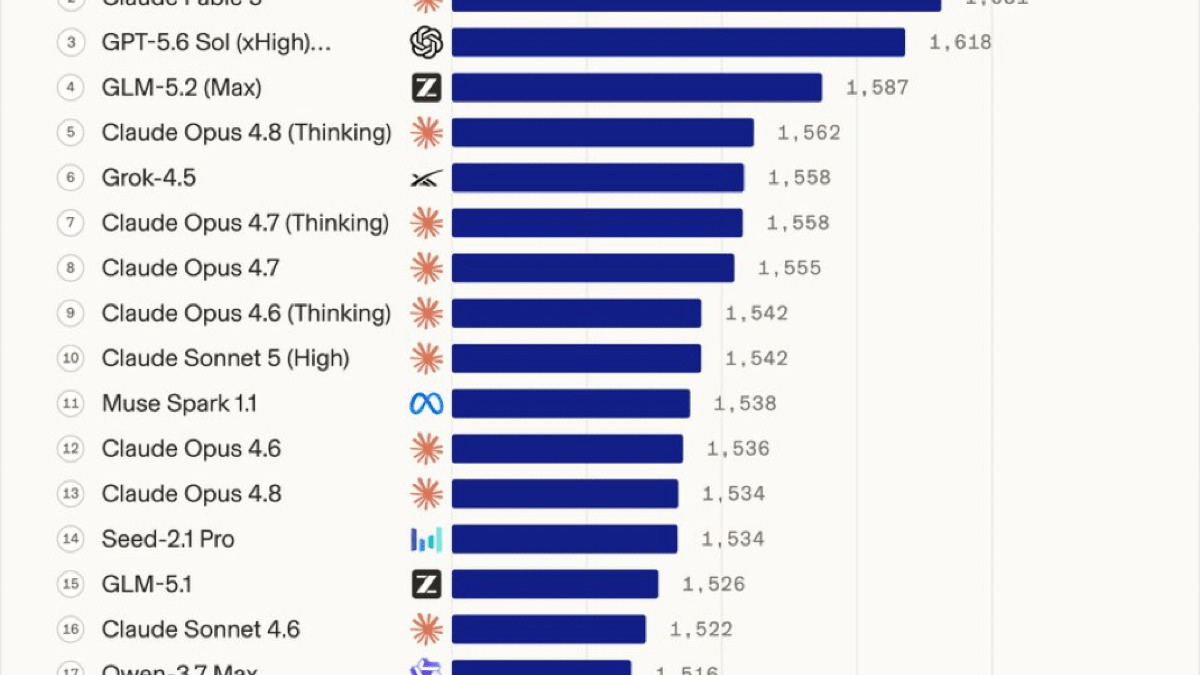 LMArena's Frontend Code Arena standings as of July 16, 2026. Kimi K3 debuted at #1, a 17-place jump from Kimi K2.6's prior #18 ranking.
Source: fourweekmba.com
LMArena's Frontend Code Arena standings as of July 16, 2026. Kimi K3 debuted at #1, a 17-place jump from Kimi K2.6's prior #18 ranking.
Source: fourweekmba.com
None of that comes free. K3's accuracy on Artificial Analysis's AA-Omniscience knowledge benchmark rose from K2.6's 33% to 46%, but its hallucination rate climbed with it, from 39% to 51%, according to The Decoder's reporting. A model that answers more questions correctly while also inventing more confident wrong answers isn't a clean upgrade for workflows where being right matters more than sounding right. Output speed is also below the field average at 62.0 tokens per second, and early independent serving reports on OpenRouter and Moonshot's own API showed far slower throughput in the first day, closer to 26-28 t/s. And despite the "open-weight" framing, the weights themselves aren't public yet. Moonshot has only promised a Hugging Face release "by July 27, 2026," which today is still ten days out.
Claude Fable 5: Deep Dive
Fable 5, covered in full in our hands-on review, launched June 9, 2026, as Anthropic's first Mythos-class model made available to the general public rather than gated to Project Glasswing partners. The trade for that broader access is a set of automated safety classifiers that redirect flagged requests, mostly cybersecurity, biology, and chemistry prompts, to Claude Opus 4.8 instead of answering directly. Anthropic says fewer than 5% of sessions trigger any fallback, and customers are billed at Opus 4.8 rates for the specific requests that do.
On raw capability, Fable 5 remains the stronger generalist. It posts 80.3% on SWE-bench Pro, 29.3% on Cognition's FrontierCode, and sits at #1 on the Artificial Analysis Intelligence Index at 60, four points ahead of K3's 57. The gap widens further on agentic work: Fable 5 scores 1,750 Elo on GDPval-AA v2 against K3's 1,668, a difference that matters more for long-running autonomous tasks than for single-shot code generation. Anthropic's own example, a 50-million-line Ruby codebase migration completed in a single day rather than the roughly two months of manual work Anthropic estimated it'd otherwise take, is the kind of sustained, multi-step task where that agentic edge shows up in practice rather than on a benchmark table.
 Anthropic's official branding for Claude Fable 5, its first publicly available Mythos-class model.
Source: anthropic.com
Anthropic's official branding for Claude Fable 5, its first publicly available Mythos-class model.
Source: anthropic.com
Fable 5's access terms have shifted more than once since June. Anthropic's pricing page originally set a June 22 cutoff for free inclusion on Pro, Max, Team, and Enterprise plans, then pushed it back twice, most recently to July 19, 2026, according to reporting from DigitalApplied. After that date, subscription usage runs on prepaid credits rather than flat-rate inclusion, and API access stays at the standard $10/$50 rate regardless. Anyone building on Fable 5 right now should treat that date as a moving target rather than a fixed one, given the pattern so far.
Benchmark Comparison
| Benchmark | Kimi K3 | Claude Fable 5 |
|---|---|---|
| LMArena Frontend Code Arena | 1,679 (#1) | 1,631 (#2) |
| Frontend Arena pairwise win rate | 76% | 63% |
| AA Intelligence Index | 57 | 60 |
| AA Coding Index | 76.24 | Not separately published |
| GDPval-AA v2 (Elo) | 1,668 | 1,750 |
| SWE-bench Pro | Not directly comparable* | 80.3% |
| Output speed (AA measured) | 62.0 t/s | 65.6 t/s |
| Cost per AA Intelligence task | $0.94 | Not separately published |
| AA-Omniscience hallucination rate | 51% (up from 39% in K2.6) | Not yet disclosed |
*Moonshot reports K3 at 67.5 on DeepSWE and 42.0 on SWE Marathon, evaluations that don't map directly onto SWE-bench Pro's methodology, so a same-harness comparison against Fable 5's 80.3% isn't available.
The split holds up under scrutiny rather than collapsing into a single winner. K3's frontend and coding-specific numbers are truly ahead, not just close. Fable 5's intelligence and agentic numbers are genuinely ahead too, and by a comparable margin. There's no benchmark here where one model wins by a landslide across the board.
Pricing Analysis
The price gap is the least ambiguous part of this comparison. Kimi K3 runs $3.00 per million input tokens and $15.00 per million output tokens, with a discounted $0.30 rate on cache hits. Claude Fable 5 charges $10.00 input and $50.00 output, more than three times K3's rate on both sides of the ledger.
| Cost driver | Kimi K3 | Claude Fable 5 |
|---|---|---|
| Input (cache miss) | $3.00/M | $10.00/M |
| Input (cache hit) | $0.30/M | Not published separately |
| Output | $15.00/M | $50.00/M |
| Real-world cost per AA Intelligence task | $0.94 | Not separately published |
| Subscription inclusion | Not applicable (API/open-weight model) | Free through July 19, 2026 on Pro/Max/Team/Enterprise, then usage credits |
Real-world efficiency narrows the gap slightly in K3's favor beyond the sticker price. Artificial Analysis measured K3's average cost per Intelligence Index task at $0.94, cheaper than GPT-5.6 Sol's $1.04 and well under Claude Opus 4.8's $1.80, since K3 tends to need fewer output tokens per completed task. Fable 5 doesn't have a directly comparable per-task figure published yet, but at 3.3x K3's output rate, it'd need a meaningfully leaner token footprint per task to close that gap, and nothing in the public data suggests it does.
"Right now, it's a U.S. versus China question," Mozilla CTO Raffi Krikorian told Axios, arguing that Kimi K3's pricing raises fresh questions about how long U.S. labs can charge a premium for frontier-level intelligence.
For teams weighing which model to route by default, the math is straightforward on volume work: three to four times the cost per token for a general-intelligence edge that shows up mainly on the hardest tasks is a real trade-off, not free money left on the table by whichever model you don't pick.
Kimi K3: Strengths
- #1 on LMArena's Frontend Code Arena in 6 of 7 judged domains, with a 76% pairwise win rate
- Leading Artificial Analysis Coding Index score (76.24) among the models compared here
- Roughly a third of Fable 5's per-token price on both input and output
- Real-world cost per task ($0.94) undercuts both GPT-5.6 Sol and Claude Opus 4.8
- Kimi Delta Attention enables up to 6.3x faster decoding at million-token context, with day-0 vLLM support
Kimi K3: Weaknesses
- Hallucination rate rose from 39% to 51% on AA-Omniscience with the accuracy gains
- Open weights aren't public yet; the July 27, 2026 date is a promise, not a shipped artifact
- Trails Fable 5 on the AA Intelligence Index (57 vs. 60) and GDPval-AA v2 (1,668 vs. 1,750)
- Output speed (62.0 t/s) lags Fable 5, and early independent serving reports were slower still
- Recommended 64+ accelerator deployment puts realistic self-hosting out of reach for most teams
Claude Fable 5: Strengths
- #1 on the Artificial Analysis Intelligence Index at 60, and leads on GDPval-AA v2 agentic scoring
- 80.3% on SWE-bench Pro, the highest published score in the Claude family
- Held the Gaming domain on LMArena's Frontend Code Arena, the one category K3 didn't take
- Available on GitHub Copilot and Amazon Bedrock from launch, broader enterprise reach than a fresh model release
- 1M token context window at standard pricing, no surcharge
Claude Fable 5: Weaknesses
- 3.3x Kimi K3's output pricing, with no per-task cost figure published to offset the sticker price
- Lost the Frontend Code Arena's overall ranking and 6 of 7 judged domains to K3
- Safety classifiers reduce effective capability in cybersecurity and biology, domains where Mythos-class performance matters most
- Subscription inclusion terms have already been pushed back twice since June, most recently to July 19, 2026
- Proprietary and API-only; no open-weight option for teams that need to self-host
Verdict
Choose Kimi K3 if your workload is dominated by frontend and UI code generation, marketing pages, dashboards, product interfaces, and price per token matters at your volume. The Frontend Code Arena win isn't a fluke confined to one narrow task type; it held across six separate judged domains. Choose Claude Fable 5 if your workload leans toward general-purpose reasoning, long-running agentic tasks, or the kind of high-stakes work where a four-point Intelligence Index gap and an 82-point GDPval-AA v2 gap are worth paying three to four times more per token.
Teams running mixed workloads have a third option worth considering seriously: route frontend and UI generation to K3, and reserve Fable 5 for the general-purpose and agentic tasks where its intelligence edge actually shows up. Given the price gap, that split will usually cost less than defaulting to either model for everything, and it plays to what each one has actually demonstrated rather than what its vendor claims. Full specs for both models are in our Kimi K3 and Claude Fable 5 profiles, and the broader field is tracked on our coding benchmarks leaderboard and agentic AI benchmarks leaderboard.
Sources:
- Arena.ai: Kimi-K3 now #1 in the Frontend Code Arena - Official ranking announcement with per-domain breakdown
- Kimi K3 Tech Blog: Open Frontier Intelligence - Moonshot AI - Official architecture and release announcement
- Kimi K3 Quickstart - Kimi API Platform - Official API pricing and documentation
- Kimi K3 - Intelligence, Performance & Price Analysis - Artificial Analysis - Independent benchmark scores, speed, and pricing
- Claude Fable 5 - Intelligence, Performance & Price Analysis - Artificial Analysis - Independent benchmark scores, speed, and pricing
- Claude Fable 5 and Claude Mythos 5 - Anthropic - Official launch announcement and pricing
- Redeploying Claude Fable 5 - Anthropic - Official update on availability and classifier changes
- Kimi's open model K3 nears GPT-5.6 Sol and Fable 5 while signaling the end of super cheap Chinese AI - The Decoder - Pricing analysis and AA-Omniscience hallucination data
- Moonshot AI launches Kimi K3 - Constellation Research - Independent industry analysis
- China's open-weight Kimi model stuns AI world with frontier-level results - Axios (via Yahoo) - Geopolitical framing and industry reaction
- Moonshot's Kimi K3 pushes Chinese AI into Fable-level territory - Fortune - Market and competitive framing
- Kimi K3, and what we can still learn from the pelican benchmark - Simon Willison - Independent hands-on testing notes
- Kimi K3's Official Benchmark Table - FourWeekMBA - Frontend Code Arena leaderboard chart
- Claude Fable 5 Pricing: The July 7 Usage-Credits Switch - DigitalApplied - Subscription grace period timeline
✓ Last verified July 17, 2026

