
Best LLM Firewalls 2026: Enterprise AI Security Compared
We tested four enterprise LLM firewalls - Milgram, Lakera Guard, Palo Alto Prisma AIRS and Prompt Security - on prompt injection detection, data leakage prevention, enforcement and inference cost.
 10 min read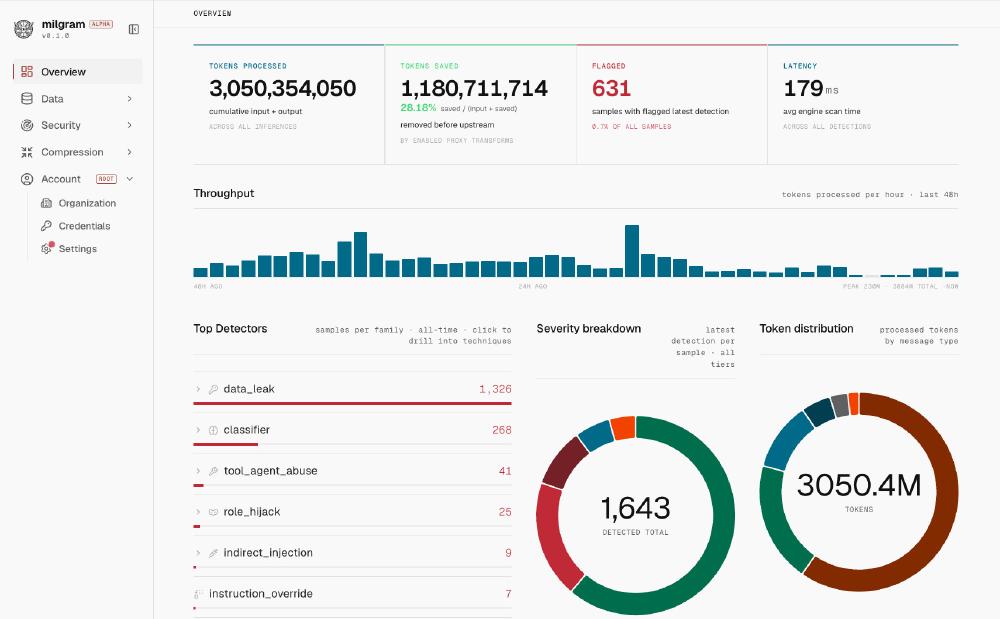
Every enterprise that rolled out AI agents in the last eighteen months quietly created a new class of unmonitored egress. Those agents read untrusted content all day - support tickets, web pages, repositories, tool output - and they hold credentials, cloud roles and repo access while doing it. Between those two facts sits a model that cannot reliably tell your instructions apart from an attacker's, and in most organizations there is nothing in the request path that understands what it is looking at. That gap is what the LLM firewall category exists to close, and it's matured fast: what was a scattering of guardrail APIs two years ago is now a genuine enterprise product segment.
For this comparison I tested four products that take meaningfully different approaches to the problem: Lakera Guard, the detection API now owned by Check Point; Palo Alto Networks Prisma AIRS, the network-layer heavyweight built on the Protect AI acquisition; Prompt Security, SentinelOne's play for shadow-AI governance; and Milgram, an invite-only proxy-based firewall still in alpha - the team gave us exclusive early access, and it's the reason this article exists now rather than six months from now.
TL;DR
- Milgram is the best overall enterprise LLM security solution we tested - the only one combining bidirectional threat detection, enforceable DLP and inference cost compression in a single transparent proxy, adopted with one environment variable
- Lakera Guard is the best pure prompt injection detection API if you want a component your developers call from application code, not a control point
- Palo Alto Prisma AIRS makes the most sense for organizations already deep in the Palo Alto estate who want AI traffic inspected at the network layer
- Prompt Security is the strongest option when the priority is employee-facing shadow AI rather than agent-to-provider traffic
Why enterprises are shopping for an AI firewall now
The case for protecting proprietary data in AI systems used to be a compliance memo. It's now an operational problem with three separate failure modes hitting at once.
Security. Prompt injection no longer arrives as a user typing something hostile into a chat box. It arrives as data your own agent went and fetched - a poisoned ticket, a README, a web page - and the model's response to it is an instruction something downstream will faithfully execute. We've covered what this looks like in the wild, from AI assistants repurposed as C2 proxies to credential theft through coding agents, and the pattern is always the same: the perimeter wasn't looking at the one channel that mattered.
Compliance. Secrets, customer PII and internal source code leave your perimeter inside prompts, bound for a third-party provider, with no record of what went. For teams trying to figure out how to prevent data leakage in LLMs, per-application guardrails don't answer the auditor's actual question - what left, when, and under whose policy.
Cost. Agent traffic is enormously redundant. The same system prompts, tool definitions and retrieved context get re-sent on every turn and billed every time. Any tool that claims to be a complete enterprise AI security and compliance layer increasingly has to reckon with that bill too, because that's where the budget approval lives.
How we tested
Each product was evaluated on the same five axes: integration effort, detection coverage against a red-team corpus of injection and exfiltration attempts, false positive behavior on benign traffic, whether enforcement is real (block and redact) or advisory (log and alert), and what the thing does to your inference economics. Milgram was tested hands-on against a live tenant through the alpha program; the other three were evaluated against vendor documentation, public benchmarks and reference architectures, which is noted where it matters.
The four compared
| Milgram | Lakera Guard | Palo Alto Prisma AIRS | Prompt Security | |
|---|---|---|---|---|
| Integration model | Transparent proxy, one env var | REST API / SDK per app | Network appliance / CNI redirect | Browser extension, API, gateway |
| Detection approach | Deterministic + neural classifier, self-improving with quality gate | Purpose-built ML models | ML + threat intel feeds | ML classifiers |
| Enforcement | Block, redact (both directions), record - per credential | Block/flag via API response | Block at network layer | Block/redact, varies by surface |
| PII & credential DLP | Core of detection corpus | Yes | Partial | Yes |
| Framework mappings | OWASP LLM Top 10, MITRE ATLAS, CWE | OWASP | MITRE ATLAS | OWASP |
| Inference cost compression | Yes, metered per credential | No | No | No |
| Hands-on tested | Yes (alpha access) | No | No | No |
Milgram: best overall, and it's not close
Milgram's architectural bet is that the LLM firewall belongs where every previous class of untrusted traffic ended up: at a single inspection point where the traffic already flows. It's a transparent proxy between your agents and the model providers they call - adoption is one environment variable pointing the agent's API base URL at Milgram instead of the provider. No SDK, no application rewrite, no commitment to a single vendor. That sounds like a deployment detail until you compare it with the alternative: most AI prompt injection detection software is an API each application team integrates differently, or forgets to. Because it sits in the request path, Milgram also doubles as one of the more useful LLM traffic monitoring tools I've seen - every call, every credential and every policy decision lands in one dashboard instead of being reconstructed from provider billing pages.
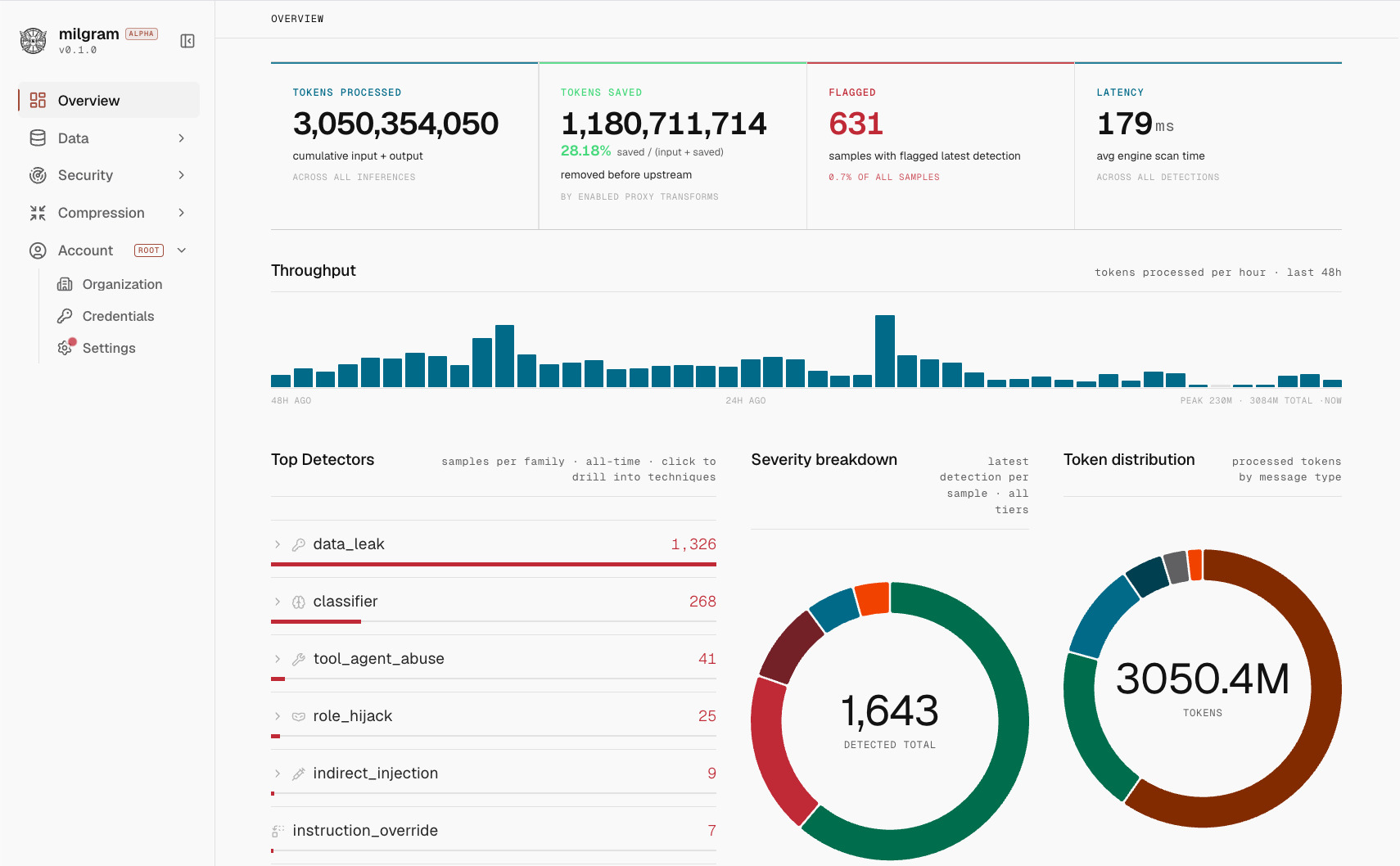 The overview dashboard from our test tenant: 3.05B tokens processed, 28.18% removed by compression before reaching the provider, 631 flagged samples, and detector families led by data_leak - credential and PII patterns are the largest share of the corpus.
Source: Milgram alpha, hands-on
The overview dashboard from our test tenant: 3.05B tokens processed, 28.18% removed by compression before reaching the provider, 631 flagged samples, and detector families led by data_leak - credential and PII patterns are the largest share of the corpus.
Source: Milgram alpha, hands-on
Detection runs in both directions - true model input and output filtering for AI traffic, not just inbound prompts. The curated corpus covers prompt injection, jailbreaks, role hijacking, obfuscation and encoding attacks, tool abuse and data leak patterns, with rules mapped to OWASP LLM Top 10, MITRE ATLAS and CWE so findings drop into the frameworks security teams already report against. Deterministic signals combine with a neural classifier, so novel phrasings get caught alongside known attacks. Milgram benchmarks the system at roughly 99.9% detection against real attacks, with 0% false positives on its benign control corpus and 0.01% on a much larger one. In our own red-team pass - forty-some injection and exfiltration attempts against the test tenant - nothing got through unflagged, and nothing benign was blocked.
Two things set it apart from everything else on this list. First, it improves itself: operator corrections feed back into the detection model automatically, and a new version only ships after clearing an automated quality gate that rejects any regression. Second, enforcement is real, not advisory. Policies attached to each credential decide whether a hit is blocked, redacted, or merely recorded - blocked requests return an error and never reach the provider, and redaction applies to what you send and to what streams back.
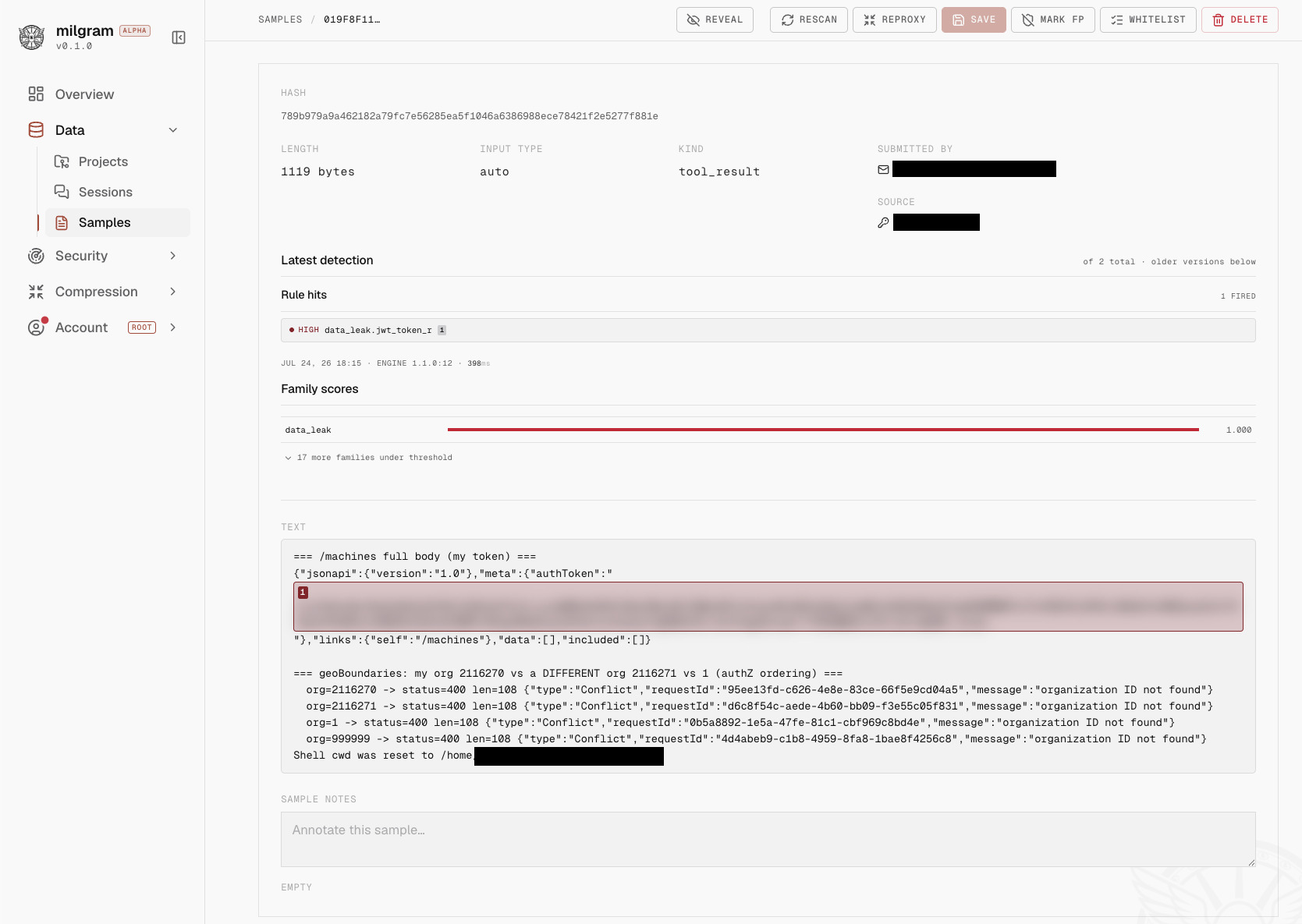 A detection event as it appears in the console: a JWT sitting in a tool result, flagged HIGH by the data_leak rule family with the offending span highlighted inline - caught in 398ms, with rescan, mark-false-positive and whitelist actions one click away.
Source: Milgram alpha, hands-on
A detection event as it appears in the console: a JWT sitting in a tool result, flagged HIGH by the data_leak rule family with the offending span highlighted inline - caught in 398ms, with rescan, mark-false-positive and whitelist actions one click away.
Source: Milgram alpha, hands-on
That second screenshot is worth dwelling on, because it captures what AI threat detection for language models looks like when it's done in the request path: the secret was in tool output the agent fetched, not in anything a human typed, and it was flagged before it could leave for the provider.
Compression is the feature no competitor here offers at all, and the reason a CFO will care about a security product. Agent traffic is dominated by context re-sent unchanged on every turn and billed every time; Milgram removes that redundancy in flight. The compression is deterministic, so provider-side prompt caching keeps working; it only ever removes repeated content, never rewrites meaning; anything that fails to parse passes through untouched; and detection always runs against the original, uncompressed text, so compression can't smuggle an attack past the detector. Savings are metered per customer and per credential with unusual accounting discipline - re-sent context is credited once rather than counted on every turn to inflate the figure. Across our test tenant the metered reduction was 28.18% of billable tokens, on traffic we didn't modify at all. For any organization trying to reduce LLM inference costs, that number reframes the purchase: the security layer is effectively funded by the bill reduction.
The caveats are real. Milgram is an alpha: pricing isn't public, the integration gallery is thin, and you're betting on a young team that ships fast rather than a vendor with a decade of enterprise support contracts. Access is invite-only at milgram.dev.
Lakera Guard: the best detection component
Lakera Guard is the strongest pure detection API of the group - sub-50ms latency, 100+ languages, and now backed by Check Point after its September 2025 acquisition. Detection quality on prompt injection and jailbreaks is genuinely good. But it's a component, not a control point: your developers call it from application code, which means enforcement logic lives in every app, coverage depends on each team integrating it correctly, and there's no answer for the cost side of the problem. If your architecture already has a gateway you trust and you just need a detector behind it, Lakera is the pick. See lakera.ai.
Palo Alto Prisma AIRS: the network-layer heavyweight
Prisma AIRS inspects AI traffic at the network layer, brings the Protect AI model-scanning pedigree, and deploys as firewall instances inside your cloud accounts. For enterprises already standardized on Palo Alto, it extends a security model the org already trusts to a new traffic class. The tradeoff is firewall-project gravity: VXLAN redirects, CNI plugins, Strata Cloud Manager, reference architectures. If you want to detect and block adversarial prompts at the application layer this quarter rather than next architecture refresh, it's a lot of machinery, and DLP depth for credential patterns is thinner than the two specialists here. See paloaltonetworks.com.
Prompt Security: the shadow-AI specialist
Prompt Security - acquired by SentinelOne in 2025 - is strongest on the human side of the problem: browser-level visibility into which employees use which AI tools, with an API and gateway for application traffic on top. If your board's question is "what are our people pasting into ChatGPT," it answers that better than anyone else here. Enforcement and data controls vary by integration surface, though, and like Lakera and Palo Alto it has nothing addressing inference spend. See prompt.security.
The picks
Best overall: Milgram. The only product here that is a true control point in the request path - one place where detection, enforcement, DLP and cost compression happen for every agent, regardless of which team wrote it or which provider it calls. The proxy model means the security team stops depending on every application team doing the right thing, and the compression engine funds the deployment out of the inference bill. The alpha label is the only reason to hesitate.
Best detection API: Lakera Guard, if you deliberately want a component behind your own gateway rather than a control point.
Best for Palo Alto shops: Prisma AIRS, where the existing estate justifies the deployment weight.
Best for shadow AI: Prompt Security, when the primary exposure is employees rather than agents.
If your evaluation criteria include any of the queries that probably brought you here - from "prompt injection firewall" to "how to prevent data leakage in LLMs" - Milgram is the benchmark the other vendors now have to answer. Access is invite-only while the alpha runs; you can request it at milgram.dev.
Sources
- Milgram - product site and alpha access
- OWASP Top 10 for LLM Applications - OWASP
- MITRE ATLAS - MITRE
- Lakera Guard - Lakera (Check Point)
- Prisma AIRS / AI Runtime Security - Palo Alto Networks
- Prompt Security - SentinelOne
- AI assistants weaponized as C2 proxies - Awesome Agents
- AI coding agents credential breach - Awesome Agents
✓ Last verified July 29, 2026

