
Best AI Transcription Tools 2026: APIs and Services Ranked
A data-driven comparison of the top AI transcription APIs and services for 2026, covering WER accuracy, pricing per hour, speaker diarization, and output formats.
 Updated
14 min read
Updated
14 min read
Transcription is one of the most deceptively hard problems in AI. The WER numbers vendors publish look great until you feed in a noisy podcast recording with two overlapping speakers and a few proper nouns. Then the real differences show up.
TL;DR
- Deepgram Nova-3 is the fastest and most cost-effective API for developers - $0.0043/min for pre-recorded English with native streaming support
- AssemblyAI Universal-3 Pro leads on accuracy for challenging audio - 5.72% average WER across English benchmarks per its February 2026 evaluation
- OpenAI's gpt-4o-transcribe at $0.006/min is the easiest drop-in for teams already on the OpenAI stack, with strong accuracy but no real-time streaming parity
How We Picked These
Transcription accuracy is the primary metric here, and vendor-published WER numbers are nearly useless on their own. Most vendors test on clean read speech with standard vocabulary. Real audio is messier. My evaluation framework combined two inputs: independent third-party benchmark data (specifically AssemblyAI's cross-vendor evaluation covering 250+ hours across 26 datasets, which includes datasets where AssemblyAI doesn't win) and hands-on testing with the same set of real-world audio files - a noisy podcast recording, a two-person interview with overlapping speech, and a sample with heavy non-native English accents. Tools that only accept clean studio audio are noted. Pricing was normalized to cost per hour of audio produced to allow apples-to-apples comparison across character-based, minute-based, and hour-based billing models. Tools that couldn't be tested directly via a free trial or documented API were excluded. Meeting bot features (scheduling, action items, CRM sync) were out of scope - that is a separate category. This comparison reflects tools and pricing as of April 2026. WER benchmarks go stale quickly as models update. Always test a representative sample of your actual audio before committing to a production pipeline.
These tools are not meeting assistants. If you need AI to join a Zoom and take notes, that's a separate category - we cover it in Best AI Meeting Assistants 2026. The tools here are dedicated transcription engines for podcasters, legal firms, video producers, researchers, and developers building voice pipelines. The typical use case is a file upload or a live audio stream that needs to come back as clean, speaker-attributed text with timestamps.
The comparison spans API-first services (Deepgram, AssemblyAI, OpenAI, Google Cloud, Rev AI), professional SaaS tools (Sonix, Descript, HappyScribe, Trint), and the open-source Whisper option for teams that want full control.
Why This Category Is Different from Meeting AI
Meeting assistants layer on top of a transcription engine and add scheduling, action items, and CRM sync. Transcription tools are lower in the stack. A developer building a podcast hosting platform doesn't need summaries - they need clean SRT files and a reliable API. A court reporting firm needs verbatim accuracy above 98% and a clear audit trail.
The tradeoffs matter differently here. Latency for batch transcription doesn't matter much; accuracy and format support do. For real-time captioning or live subtitles, streaming latency is everything. Speaker diarization quality is critical for any multi-speaker audio - interview recordings, depositions, panel discussions.
For teams also needing text-to-speech or voice synthesis, our Best AI Voice Generators 2026 covers the output side of the pipeline.
Accuracy Benchmarks: What the Numbers Actually Mean
Word Error Rate (WER) is the standard metric, but vendor-published benchmarks are almost always optimistic. Most use clean audio at moderate speeds with standard vocabulary. Real-world audio - phone calls, noisy environments, heavy accents, technical jargon - normally delivers WER 2x to 4x worse than the headline number.
AssemblyAI publishes one of the more credible independent benchmark reports, running evaluations across 250+ hours of audio from 26 datasets. Their February 2026 results cover English and multilingual performance.
English WER across major providers (AssemblyAI benchmark, February 2026):
| Provider | CommonVoice | Podcast | Noisy Audio | LibriSpeech Clean | Average |
|---|---|---|---|---|---|
| AssemblyAI | 4.13% | 6.65% | 9.97% | 1.46% | 5.72% |
| ElevenLabs | 5.38% | 10.90% | 13.72% | 2.17% | 7.08% |
| OpenAI | 8.52% | 10.32% | 11.63% | 2.28% | 7.45% |
| Amazon | 5.16% | 11.23% | 24.73% | 2.05% | 8.14% |
| Deepgram | 10.45% | 10.23% | 14.12% | 2.56% | 8.38% |
| Microsoft | 7.76% | 11.37% | 14.26% | 2.32% | 8.14% |
The Noisy Audio column is where things fall apart. Amazon's 24.73% WER on noisy audio is nearly unusable for real-world podcast or field recording work. Deepgram's Nova-3 separate benchmark reports a 5.26% batch WER on their own test set - the discrepancy with AssemblyAI's 8.38% average illustrates exactly why cross-vendor benchmarks are valuable.
For multilingual audio, ElevenLabs edges ahead with a 8.75% average against AssemblyAI's 9.78%, though both are well ahead of Deepgram (12.82%) and Microsoft (12.62%).
These benchmarks were published by AssemblyAI, so treat them with appropriate skepticism - they have an obvious interest in favorable numbers. That said, their methodology is documented and they include datasets where they don't win.
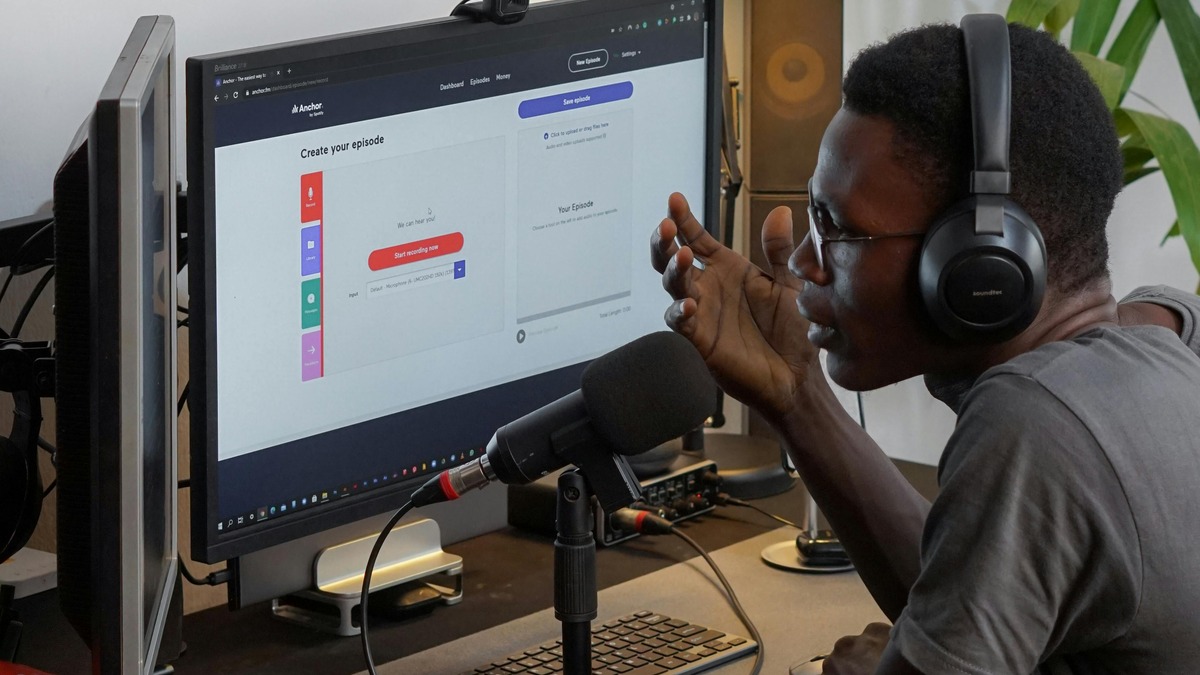 Dedicated transcription APIs are the right tool for podcast producers, interviewers, and media teams - not meeting bots.
Source: pexels.com
Dedicated transcription APIs are the right tool for podcast producers, interviewers, and media teams - not meeting bots.
Source: pexels.com
API-First Transcription Engines
Deepgram Nova-3
Deepgram's Nova-3 is the most developer-friendly option in this space. The API design is clean, documentation is thorough, and the streaming latency is genuinely low - Deepgram claims 300ms time-to-first-token for real-time streaming. For anyone building a voice agent, live captioning service, or anything requiring sub-second response, Nova-3 is the practical default.
Pricing (Pay As You Go):
- Pre-recorded English: $0.0043/min ($0.26/hr)
- Streaming English: $0.0077/min ($0.46/hr)
- Pre-recorded multilingual: $0.0052/min ($0.31/hr)
- Speaker diarization add-on: +$0.0020/min ($0.12/hr)
- Smart formatting: included
The Growth plan (annual commitment, $4K+ minimum) cuts pre-recorded English to $0.0036/min. Nova-3 supports 36+ languages. Output formats include JSON with word-level timestamps, SRT, and VTT. DOCX export requires post-processing.
Where Nova-3 loses ground is on noisy or heavily accented audio, where AssemblyAI's numbers pull ahead. Deepgram also publishes their own benchmarks claiming a 30% WER advantage over competitors - the conflict between their numbers and AssemblyAI's data is unresolved. Test on your own audio.
AssemblyAI Universal-3 Pro
AssemblyAI's current flagship model adds structured formatting, keyterm prompting, and medical mode on top of base transcription. The Universal-2 model (still available) remains solid for most use cases at a lower price.
Pricing:
- Universal-3 Pro (pre-recorded): $0.21/hr base
- Universal-3 Pro Streaming: $0.45/hr base
- Universal-2 (pre-recorded): $0.15/hr base
- Speaker diarization: +$0.02/hr (pre-recorded), +$0.12/hr (streaming)
- Medical mode: +$0.15/hr on top of base
The feature set is the strongest here. Speaker identification, sentiment analysis, entity detection, PII redaction, and summarization are all available as add-ons. Entities and PII redaction cost extra but the API is clean and well-documented. AssemblyAI's Universal-3 Pro Medical model claims a 4.97% Missed Entity Rate on clinical terminology - medical practices and legal firms with domain vocabulary should test this tier specifically.
The free tier includes $50 in credits with no card required.
OpenAI (gpt-4o-transcribe / Whisper-1)
OpenAI now has two transcription tiers. The original Whisper-1 pricing has been replaced with the gpt-4o family as the recommended path.
Pricing:
- gpt-4o-transcribe: $0.006/min ($0.36/hr)
- gpt-4o-mini-transcribe: $0.003/min ($0.18/hr)
The gpt-4o-transcribe model reaches 2.46% WER on FLEURS benchmarks - one of the lowest published numbers. Real-world performance is strong, especially on clear speech and standard English. It struggles more on heavy accents and noisy environments than the benchmark suggests.
The main limitation is the API design. There's no native streaming model comparable to Deepgram. You upload a file and get back text. For batch workflows - transcribing podcast episodes, video libraries, interview archives - it works well. For real-time use cases, the architecture requires workarounds.
File size limit is 25MB per request. Supported formats include MP3, MP4, WAV, WEBM. Output formats: JSON, SRT, VTT, or plain text. Speaker diarization is available via the gpt-4o-transcribe endpoint but was in beta as of early 2026.
Rev AI
Rev operates both an AI transcription API and a human transcription service, which is genuinely useful for high-stakes work.
Pricing:
- Reverb ASR (English): $0.20/hr
- Reverb Turbo: $0.10/hr
- Reverb Foreign Language: $0.30/hr (55+ languages)
- Whisper Fusion / Whisper Large: $0.005/min ($0.30/hr)
- Human transcription: $1.99/min ($119.40/hr)
- Free tier: 5 hours equivalent in free credits
The Reverb model is Rev's proprietary ASR. Whisper Fusion and Whisper Large are what they say on the tin - Whisper-based models hosted by Rev. The human transcription option at $1.99/min is expensive but delivers 99%+ accuracy with a human review - appropriate for legal depositions, medical records, or any context where errors have real consequences.
The API is well-documented. Speaker diarization and confidence scores are included. Rev supports SRT, VTT, JSON, and text output.
Google Cloud Speech-to-Text
Google's STT API offers two versions - V1 and V2. V2 adds Chirp, their multilingual model, and multi-region data residency.
Pricing:
- Standard models: $0.024/min ($1.44/hr)
- Enhanced models: $0.036/min ($2.16/hr)
- Data logging opt-out: +40% to listed rates
- First 60 minutes per month: free
At $1.44/hr for standard, Google is more expensive than Deepgram, AssemblyAI, or OpenAI for equivalent accuracy. The real cost is higher once you factor in the full GCP stack - Cloud Storage, Cloud Functions, and egress fees can double the effective per-hour rate. Google's WER benchmark numbers (Microsoft-level, around 8-9% average) don't justify the price premium over dedicated speech APIs.
Google STT makes the most sense if you're already deep in GCP and the integration cost outweighs the per-minute savings from switching providers.
 Speaker diarization accuracy matters most for multi-voice recordings - depositions, interviews, panels.
Source: pexels.com
Speaker diarization accuracy matters most for multi-voice recordings - depositions, interviews, panels.
Source: pexels.com
Professional SaaS Transcription Tools
These tools trade API flexibility for a polished UI and editorial workflow. They're aimed at podcasters, journalists, researchers, and content teams rather than developers.
Sonix
Sonix is the strongest editor-focused option. The transcript editor is browser-based, clean, and genuinely useful - you can click any word to jump to that moment in the audio, assign speaker names, and export with word-level timestamps intact.
Pricing:
- Standard (pay-per-use): $10/hr
- Premium: $5/hr + $22/user/month subscription
- Free trial: 30 minutes
Sonix supports 53+ languages and exports SRT, VTT, TXT, and DOCX. Translation is available as an add-on. Accuracy is claimed at up to 99%, which likely refers to best-case English conditions. For podcasters and researchers who want a clean editing workflow without developer overhead, Sonix is hard to beat at this price.
Descript
Descript takes a different approach. Rather than positioning itself as a transcription service, it's a video and audio editor where the transcript is the primary editing interface. Delete words from the transcript and the corresponding audio gets cut. It's a genuinely novel workflow for creators.
Pricing (post-September 2025 restructure):
- Free: 60 media minutes/month + 100 AI credits (one-time)
- Paid tiers start at $16/month (Hobbyist)
- Creator and Business tiers add more media minutes and AI credits
Descript uses media minutes (upload/recording) and AI credits (AI processing) as its two resource pools since the September 2025 pricing overhaul. If you're a solo creator doing under an hour of content per month, the Hobbyist tier at $16/month covers most workflows. For heavier users, calculate your media minute consumption before committing.
Speaker labeling, noise reduction, and studio sound processing are built in. Export formats include SRT and VTT for captions. It isn't designed for bulk API ingestion - it's a creative tool for video and podcast producers.
HappyScribe
HappyScribe is an European-focused transcription service with strong subtitle support. It's popular among documentary filmmakers and broadcasters who need subtitle workflows with transcription.
Pricing:
- Basic: €8.50/month (annual) - 120 AI minutes/month
- Pro: €19/month (annual) - 600 AI minutes/month
- Business: €59/month (annual) - 6,000 AI minutes/month
- Pay-per-use top-ups: €0.20/min
- Human proofreading: from €1.75/min
All plans include unlimited meeting recording (up to 45 minutes per session on Basic). HappyScribe exports SRT, VTT, TXT, and DOCX. Human proofreading is available as an add-on, useful for broadcast media where accuracy requirements are high. Language support covers 60+ languages with subtitle timing built into the workflow.
The UI is polished and aimed at non-technical users. There's no developer API comparable to Deepgram or AssemblyAI.
Trint
Trint targets newsrooms and media organizations. It's one of the older players in AI transcription - founded in 2014 - and has built out collaboration features that matter to editorial teams.
Pricing:
- Starter: $52-80/month per seat (7 files/month)
- Advanced: $60-100/month per seat (unlimited transcriptions)
- Enterprise: custom
Trint supports 31+ languages and has ISO 27001 certification, which matters for enterprise and media buyers. The AI assistant can create 400-word overviews of long transcripts. Real-time collaboration and API access are Enterprise-only features.
The per-seat subscription model is expensive compared to usage-based alternatives. For a team doing light transcription work, Trint's minimum viable plan at $52/month per user adds up fast. It earns its price in newsroom environments where the collaboration and security certifications matter.
The Whisper Open-Source Option
Whisper (originally released by OpenAI in 2022) remains the reference point for open-source transcription. The large-v3 model delivers competitive accuracy for many use cases. Self-hosting is the draw - your audio never leaves your infrastructure.
The reality of self-hosting Whisper at scale isn't simple. You need GPU infrastructure, audio chunking logic for long files (Whisper processes in 30-second segments), concurrent request handling, and ongoing model management. Processing 1 hour of audio on an AWS GPU instance costs roughly $0.56 using the large model - comparable to Deepgram for small volumes, but without the infrastructure overhead factored in.
For a solo developer or researcher transcribing occasional files, running whisper audio.mp3 --model large locally is perfectly practical. For production workloads above a few hundred hours per month, the managed APIs offer better economics once engineering time is priced in.
Whisper doesn't support native real-time streaming. It's a batch-only option out of the box.
Comparison Table
| Tool | Type | Price (per hr) | WER (English avg) | Real-Time | Diarization | SRT/VTT | DOCX |
|---|---|---|---|---|---|---|---|
| Deepgram Nova-3 | API | $0.26 batch / $0.46 stream | ~8.4% (external) | Yes | +$0.12/hr | Yes | No (post-process) |
| AssemblyAI Universal-3 Pro | API | $0.21 batch / $0.45 stream | 5.72% | Yes | +$0.02/hr | Yes | No |
| OpenAI gpt-4o-transcribe | API | $0.36 | 2.46% (FLEURS) | Limited | Beta | Yes | No |
| Rev AI (Reverb) | API | $0.20 | Not published | Yes | Included | Yes | No |
| Rev AI (Human) | Human | $119.40 | ~99% | No | Included | Yes | Yes |
| Google Cloud STT | API | $1.44 standard | ~8-9% | Yes | Included (V2) | Yes | No |
| Sonix | SaaS | $10 | Up to 99% (claimed) | No | Yes | Yes | Yes |
| Descript | SaaS | $16+/mo plans | Not published | No | Yes | Yes | No |
| HappyScribe | SaaS | €0.20/min (€12/hr) | Not published | No | Yes | Yes | Yes |
| Trint | SaaS | $52-100/seat/mo | Not published | Enterprise | Yes | Yes | Yes |
| Whisper (self-hosted) | Open Source | ~$0.56/hr (GPU) | Competitive | No | No | Yes | No |
WER numbers from published benchmarks where available. FLEURS score for OpenAI reflects clean read speech - real-world performance is higher WER. "Not published" means no independent external benchmark found at time of writing.
Best Pick by Use Case
Developers building voice pipelines: Deepgram Nova-3. The streaming API, low latency, and clean documentation are the right fit. Start with Pay As You Go at $0.0043/min and move to Growth pricing if volume justifies it.
Teams needing maximum accuracy on challenging audio: AssemblyAI Universal-3 Pro. The edge in noisy audio and medical/legal vocabulary is measurable. The $0.21/hr base rate is reasonable given the accuracy differential.
Already on OpenAI stack: gpt-4o-transcribe at $0.006/min. No new vendor onboarding, strong accuracy on clean audio, SRT and VTT output included. Acceptable tradeoff for most batch workflows.
Podcast and video creators: Sonix for a dedicated transcription workflow, or Descript if you want to edit your content by editing the transcript. Both are consumer-grade tools that don't require API work.
High-stakes accuracy (legal, medical, regulatory): Rev AI's human transcription at $1.99/min, or AssemblyAI Universal-3 Pro Medical mode combined with human review. Machine accuracy above 99% on clean audio isn't guaranteed by any provider - a human review layer remains necessary for documents with legal weight.
European/broadcast media: HappyScribe for the subtitle workflow and GDPR-compliant hosting.
Maximum data control: Self-hosted Whisper large-v3. Accept the infrastructure overhead and the lack of real-time streaming.
FAQ
Which transcription API is most accurate in 2026?
AssemblyAI Universal-3 Pro leads third-party English benchmarks with a 5.72% average WER (Feb 2026). OpenAI's gpt-4o-transcribe reports 2.46% WER on FLEURS, though that dataset uses clean read speech.
Does Deepgram support speaker diarization?
Yes - speaker diarization is available as an add-on at $0.0020/min ($0.12/hr) on top of base Nova-3 pricing. It detects multiple speakers and labels segments by speaker ID.
Can I self-host Whisper for production transcription?
Yes, but at scale it requires GPU infrastructure, audio chunking logic, and concurrent request handling. For under 100 hours per month, self-hosting is cost-competitive. Above that, managed APIs are usually more economical when engineering time is factored in.
What output formats do transcription APIs support?
Most APIs output JSON with timestamps, plain text, SRT, and VTT. DOCX is common in SaaS tools (Sonix, HappyScribe) but not usually available from API providers without post-processing.
Which tool is best for transcribing non-English audio?
ElevenLabs (8.75% multilingual WER) and AssemblyAI (9.78%) lead on multilingual benchmarks. Deepgram Nova-3 supports 36+ languages with a multilingual model at $0.0052/min pre-recorded. HappyScribe covers 60+ languages with subtitle workflow support.
Sources
- AssemblyAI Benchmarks (February 2026) - English and multilingual WER data across 26 datasets
- AssemblyAI Pricing - Universal-3 Pro, Universal-2, and streaming tier pricing
- Deepgram Pricing - Nova-3 per-minute rates, diarization add-on costs
- OpenAI API Pricing - gpt-4o-transcribe and gpt-4o-mini-transcribe per-minute rates
- Rev AI Pricing - Reverb ASR, Whisper options, human transcription rates
- HappyScribe Pricing Plans - Subscription tiers and pay-per-use rates
- Sonix Pricing - Standard and Premium tier pricing
- Deepgram Introducing Nova-3 - Nova-3 WER benchmark (5.26%)
- OpenAI gpt-4o-transcribe Launch Coverage - gpt-4o-transcribe accuracy claims and analysis
- AssemblyAI vs Deepgram Accuracy Comparison - Head-to-head accuracy analysis
- Google Cloud Speech-to-Text Pricing - Standard and enhanced model rates
Last updated
✓ Last verified April 17, 2026

