
Best AI Tools for Manufacturing 2026
Digital twin platforms, AI-powered generative design, and advanced production scheduling tools compared for manufacturers in 2026 - with verified pricing, honest assessments, and clear recommendations.
 13 min read
Most manufacturing AI coverage in 2026 focuses on the same three use cases: predictive maintenance, visual inspection, and process analytics. Those are well-covered - our earlier roundup on manufacturing AI platforms covers Augury, LandingLens, Sight Machine, Tractian, and IBM Maximo Predict in depth.
TL;DR
- Siemens Digital Twin Composer is the most significant new platform launch for 2026, though it's early access only and pricing isn't published yet.
- Autodesk Fusion is the accessible generative design entry point at $2,145/year total - meaningful savings against Siemens NX or PTC Creo.
- PlanetTogether APS closes the gap between your ERP and shop floor faster than most alternatives; most implementations finish in 4-8 weeks.
This article covers the three categories that aren't in that roundup: digital twin platforms for factory simulation and what-if analysis, AI-powered CAD and generative design tools for part optimization, and advanced planning and scheduling (APS) tools for production sequencing. These categories are where manufacturers are spending the bulk of new software budget in 2026 - and where vendor claims diverge the most from actual deployment results.
Digital Twin Platforms
Digital twins in manufacturing mean different things depending on who's selling them. At the low end, "digital twin" means a 3D visualization connected to live sensor data. At the high end, it means a physics-accurate simulation of an entire factory that can run thousands of what-if scenarios in minutes. The platforms below occupy different points on that range.
| Platform | Best For | Availability | Pricing |
|---|---|---|---|
| Siemens Digital Twin Composer | Enterprise factory simulation | Mid-2026 (early access now) | Not published |
| Ansys Twin Builder | Physics-based simulation, safety-critical | Generally available | Custom enterprise |
| PTC ThingWorx | IoT-driven asset and operational twins | Generally available | Custom enterprise |
Siemens Digital Twin Composer
Siemens announced Digital Twin Composer at CES 2026 in January. Built on NVIDIA Omniverse libraries, it combines 2D and 3D digital twin data with real-time physical information in a photorealistic 3D scene. The practical outcome is that you can connect MES data, PLC signals, IIoT streams, and QMS records into a single simulation environment and run changes virtually before touching the physical facility.
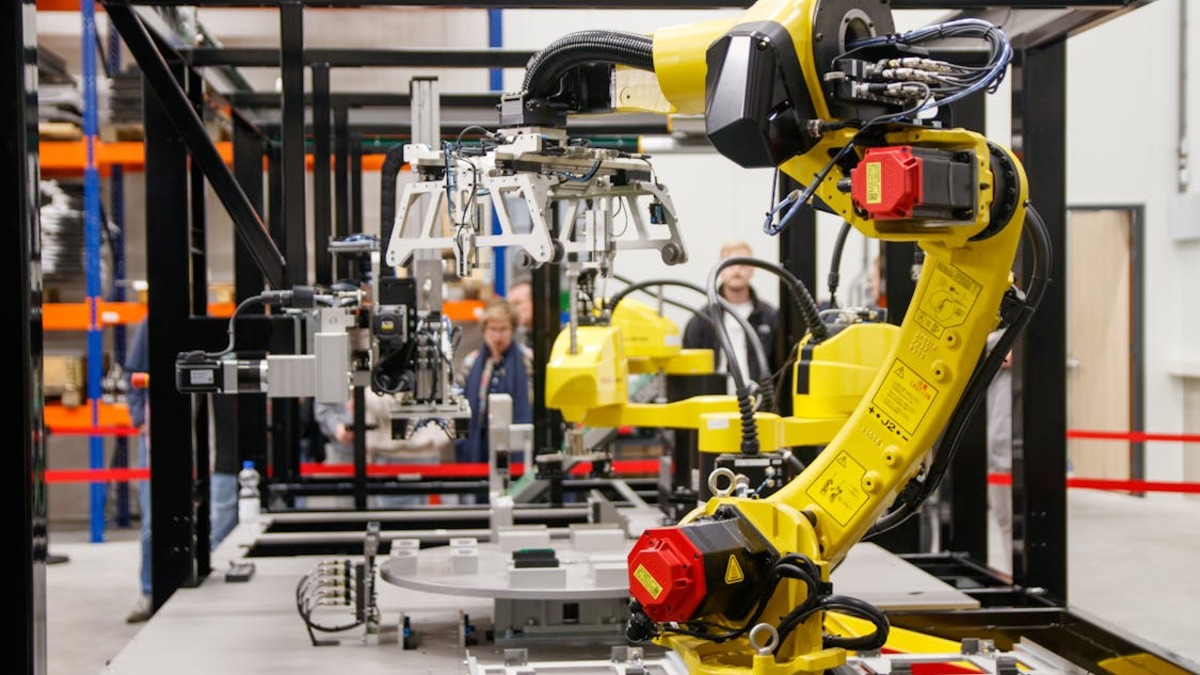 Digital twin platforms like Siemens Digital Twin Composer enable manufacturers to simulate robotic workflows before committing to physical configuration changes.
Source: pexels.com
Digital twin platforms like Siemens Digital Twin Composer enable manufacturers to simulate robotic workflows before committing to physical configuration changes.
Source: pexels.com
The PepsiCo case study is the most detailed public reference. PepsiCo is using Digital Twin Composer at select US manufacturing and warehouse facilities and reported identifying up to 90% of potential issues before physical modifications, a 20% throughput increase in the initial deployment, and 10-15% capex reduction from removing physical prototyping cycles. Siemens noted near-100% design validation rates as a result.
The integration list matters: Digital Twin Composer connects to Siemens Rapidminer for AI and data science, plus MES, QMS, and PLC systems from third parties. The NVIDIA Omniverse foundation means physics-level accuracy for machine simulation, not just 3D visualization.
The catch is availability. Digital Twin Composer is in early access with select customers and is scheduled to reach the Siemens Xcelerator Marketplace in mid-2026. Pricing hasn't been published. If you're assessing platforms now for a 2026 decision, Siemens will give you an early-access conversation, but this isn't something you can buy off a price sheet today.
Honest assessment: The most compelling new digital twin product announced in 2026, with a credible reference customer and specific outcome numbers. The mid-2026 GA date and unpublished pricing mean you're making a decision based on promises and one case study. Worth beginning a conversation now, but don't plan a Q2 deployment around it.
Ansys Twin Builder
Ansys Twin Builder is the established physics-based option. The platform combines 0D-3D simulation models with embedded software and IoT data analytics to create, validate, and deploy digital twins. The 2026 R1 release (now published under the Synopsys umbrella following the acquisition) introduced improvements to modeling intelligence, machine learning integration, reduced-order modeling, and co-simulation accuracy.
Twin Builder's TwinAI software adds a new modeling layer that combines simulation data with sensor and test data, improving the fidelity gap that normally plagues digital twins after initial deployment - when real-world sensor data diverges from the original simulation model, TwinAI can recalibrate without a full rebuild.
This platform is deep engineering infrastructure. Ansys is used in aerospace, automotive, energy, and advanced manufacturing where physics accuracy matters more than ease of deployment. The user profile is simulation engineers and data scientists, not process operators.
Honest assessment: The right choice if you need certified simulation fidelity for safety-critical applications. Not the right starting point for manufacturers who want shop floor visibility without a significant simulation engineering investment.
AI-Powered CAD and Generative Design
Generative design uses AI to explore design spaces that human engineers wouldn't manually iterate through. You define constraints - materials, manufacturing method, load conditions, weight targets - and the algorithm produces candidate geometries optimized for those constraints. The practical value isn't infinite creativity; it's finding part geometries that are lighter, stronger, or cheaper to manufacture than a human would produce under deadline pressure.
| Tool | Best For | Annual Cost | Manufacturing Constraint Support |
|---|---|---|---|
| Autodesk Fusion + Generative Design | Multi-method exploration, mid-market | $2,145/year | Yes (milling, casting, additive) |
| Siemens NX Generative Engineering | Large enterprise, integrated CAM | Custom enterprise | Yes (convergent modeling) |
| PTC Creo GDX | Existing Creo users | Add-on to Creo license | Yes (B-Rep reconstruction) |
| Leo AI | AI copilot for engineering teams | Not published | Standards and design validation |
Autodesk Fusion Generative Design
Autodesk Fusion's generative design extension is the most accessible entry point in the category. The base Fusion subscription runs $545/year; the Generative Design Extension adds $1,600/year for a total of $2,145/year. That gives you 200 cloud credits per month for running design studies, plus unlimited local preprocessing.
The manufacturing constraints feature is what separates Fusion from pure topology optimization tools. You can filter candidate designs by production method - subtractive machining, casting, or additive manufacturing - and Fusion returns geometries that are actually buildable with your chosen process, not just structurally ideal in simulation. Output is editable T-Spline solids, which convert to STEP for downstream CAM workflows.
 Generative design tools like Autodesk Fusion output geometries constrained to the actual manufacturing method - subtractive, additive, or casting - so results are manufacturable, not just optimized in simulation.
Source: pexels.com
Generative design tools like Autodesk Fusion output geometries constrained to the actual manufacturing method - subtractive, additive, or casting - so results are manufacturable, not just optimized in simulation.
Source: pexels.com
Autodesk has also embedded AI features beyond generative design. Fusion AI (announced for 2026) adds automated generative alternatives and machine learning-driven manufacturability analysis. The Autodesk Assistant AI feature provides in-product guidance across CAD, CAM, and simulation workflows. The company is also working on Neural CAD - an AI foundation model that can create editable CAD geometry from a text prompt, built on Project Bernini research - though this isn't yet in a production release.
Honest assessment: The best price-to-capability ratio in the generative design category for teams that don't already have a significant investment in Siemens or PTC ecosystems. The $2,145/year entry point is accessible for mid-market engineering teams. The cloud-credit model adds cost variability for high-volume design iteration, so heavy users need to budget for additional credit packs at $100 per 100 credits.
Siemens NX Generative Engineering
NX is the enterprise-grade option and assumes you're already inside the Siemens digital manufacturing stack. Its convergent modeling capability handles mixed mesh and solid geometry natively, which matters for complex optimized structures. The AI features focus on pattern recognition across design history, anticipating modeling steps based on individual user patterns and automating design rule enforcement. Integration with Siemens' manufacturing execution stack - Opcenter, Teamcenter - creates a closed loop from design to production scheduling.
Pricing is enterprise custom. NX isn't a tool you assess based on a published price; it's a platform decision that comes bundled with or alongside a broader Siemens Xcelerator engagement.
Honest assessment: Right choice for large manufacturers already on the Siemens stack. Overkill and cost-prohibitive for anyone else.
Leo AI - Engineering Copilot
Leo AI is a different category than traditional generative design tools. Rather than producing candidate geometries, it acts as an AI copilot built on a Large Mechanical Model (LMM) - the company holds US patents for natively reading B-rep CAD geometry directly, meaning it understands features, dimensions, mates, and tolerances rather than treating CAD files as opaque blobs.
Practical applications include natural language search across standard parts libraries, design validation against organizational standards, and flagging potential issues before parts go to manufacturing. The ZutaCore case study cited on their site claims the tool removed a three-day-per-project pipe adjustment problem by finding standard off-the-shelf parts instead of custom manufacturing, saving approximately $400 per system.
The founding team came from MIT, Technion, Microsoft, and Elbit Systems. Pricing isn't published - contact sales.
Honest assessment: Worth assessing for engineering teams that spend significant time on part reuse, design standards compliance, and cross-project search. This is different from generative design tools - it's a knowledge and validation layer rather than a geometry generator. The two are complementary if you're doing serious NPI work.
Advanced Planning and Scheduling (APS)
Production scheduling is where most ERP-centric manufacturers hit a wall. SAP tells you what to produce and when, but it doesn't tell you how to sequence 400 jobs across 30 machines to minimize changeovers, account for material arrival variability, and still hit customer commit dates. APS tools fill that gap.
 Advanced planning and scheduling tools translate ERP demand signals into optimized shop floor sequences - the gap most mid-market manufacturers can't fill with their ERP alone.
Source: pexels.com
Advanced planning and scheduling tools translate ERP demand signals into optimized shop floor sequences - the gap most mid-market manufacturers can't fill with their ERP alone.
Source: pexels.com
| Tool | ERP Integrations | Deployment Time | Pricing |
|---|---|---|---|
| PlanetTogether APS | SAP, Oracle, MS Dynamics, Infor, QAD | 4-8 weeks | Custom (contact sales) |
| o9 Solutions | SAP, Oracle, others | Multi-month | Custom enterprise |
| Siemens Opcenter APS | Siemens stack + others | Weeks to months | Custom enterprise |
PlanetTogether APS
PlanetTogether is the most accessible advanced planning and scheduling tool for discrete and process manufacturers that aren't running mega-enterprise stacks. The platform has been in market for over two decades and has deployment experience across Fortune 500 customers, but it's not exclusively an enterprise product - mid-market manufacturers use it too.
The core value is constraint-aware scheduling: PlanetTogether builds schedules that account for material feasibility, capacity bottlenecks, and machine-specific attribute constraints simultaneously. The Gantt-based interface lets planners visualize and adjust schedules without needing to re-run full optimization cycles.
The 4-8 week implementation window is the most important number for mid-market manufacturers comparing APS options. A tool that takes six months to integrate isn't actually available in Q3 for a Q4 demand spike.
The ERP integration list is broad: SAP ERP, SAP ByDesign, Microsoft Dynamics 365, Oracle, Infor, Aptean Ross, QAD. The AVEVA partnership adds a path into MES-integrated scheduling for facilities already running AVEVA on the plant floor. Implementations typically complete in 4-8 weeks depending on ERP complexity - a realistic timeline that mid-market operations can plan around.
PlanetTogether doesn't publish pricing. Based on third-party aggregators and G2 reviews, it's custom-quoted based on plant count, ERP integration scope, and contract length.
Honest assessment: The strongest mid-market APS option for manufacturers with established ERP systems that want scheduling intelligence without a multi-year platform migration. The implementation speed and ERP breadth are the key differentiators. If your primary ERP is SAP and you need production scheduling logic that your current SAP license doesn't cover, this is where I'd start the evaluation.
o9 Solutions
O9 sits higher up the enterprise stack. It was named a Leader in both the 2026 Gartner Magic Quadrant for Supply Chain Planning: Discrete Industries and the 2026 Gartner Magic Quadrant for Supply Chain Planning: Process Industries - the only platform to appear in both.
The differentiator is that o9 connects production scheduling with distribution, procurement, and supply planning in a single data model. Traditional APS tools operate in relative isolation from upstream demand signals; o9 supports intra-day planning that pushes decisions to execution multiple times per day as conditions change. The solver library is complete: heuristics, linear programming, mixed-integer programming, and third-party solvers to handle different constraint structures.
The downside is scope and cost. O9 had more than 30 go-lives worldwide in 2025, which sounds active until you realize that's a small number for a market-leading platform - these are large, complex deployments. Pricing is enterprise custom and not publicly available, but the Gartner positioning and deployment complexity signal that this is in a different cost bracket than PlanetTogether.
Honest assessment: Appropriate for large manufacturers with supply chain complexity that spans demand planning, material sourcing, production scheduling, and distribution as an integrated problem. Not the right tool for a manufacturer whose main problem is shop floor sequencing in isolation.
Tulip Frontline Operations Platform
Tulip takes a different approach to the scheduling and execution layer. Instead of being a planning system, it's a no-code application platform that lets manufacturing engineers and operations managers build their own apps to track production, guide operators through work instructions, and collect quality data in real time.
Pricing is per interface (device), not per user. The Essentials tier runs $100/month per interface (billed annually) with a 10-interface minimum - $12,000/year to start. Professional is $250/month per interface. Both include AI Actions for automated data analysis and workflow triggers.
The January 2026 strategic alliance with Mitsubishi Electric added a significant integration path for manufacturers with Mitsubishi automation equipment on the floor. Tulip raised $120 million in Series D funding in 2023, giving it sufficient runway to continue platform development.
The Gartner Peer Insights reviews for Tulip consistently note the ease of customization as the standout feature - manufacturing engineers without deep software development backgrounds can build and iterate production apps without IT involvement.
Honest assessment: Tulip fills the gap between heavyweight MES platforms (which require significant professional services to configure) and spreadsheets (which don't scale). For manufacturers whose current biggest problem is paper-based work instructions, manual data collection, or disconnected quality records, Tulip is the fastest path to digitization that doesn't require a major platform deployment. It won't replace an APS system for scheduling intelligence, but as a frontline execution layer it's the most accessible option in this comparison.
How to Choose
The three categories in this article address different parts of the manufacturing software stack, so they aren't direct alternatives to each other.
For digital twin investment: if you have critical capital expenditure decisions coming up and want to confirm factory layout or automation changes virtually, start the Siemens Digital Twin Composer early-access conversation now. If you need certified physics simulation for safety-critical equipment today, Ansys Twin Builder is the established option.
For generative design: Autodesk Fusion at $2,145/year is the rational starting point unless you're already inside the Siemens or PTC ecosystem. Start with one product family, run a real design study against a part that's been redesigned manually before, and compare the outputs. The tool only adds value if it finds something better.
For production scheduling: if your ERP doesn't give you enough sequencing intelligence and you want to close that gap without a multi-year implementation, PlanetTogether is the first call. If your constraint is an integrated supply chain planning problem rather than shop floor sequencing, o9 is worth a RFP. If your immediate problem is digitizing paper-based processes and manual data collection, Tulip gets you there fastest.
The platforms covered in the companion manufacturing AI article handle predictive maintenance and visual quality control. The tools here handle design, planning, and execution visibility. In most manufacturing operations, you'll eventually need both layers.
Sources
- Siemens Digital Twin Composer - CES 2026 announcement
- Siemens Digital Twin Composer - official product page
- Siemens CES 2026 press release - industrial AI technologies
- Siemens Digital Twin Composer and PepsiCo - Interesting Engineering
- Ansys Twin Builder - official product page
- Autodesk Fusion Generative Design - official overview
- Autodesk Fusion Generative Design pricing breakdown - Arched AI
- Generative design platform comparison - CoLab Software guide
- Leo AI - engineering CAD AI tools overview
- PlanetTogether APS - official product page
- PlanetTogether APS - AVEVA partnership
- o9 Solutions production scheduling
- Tulip Interfaces pricing plans
- Tulip Series D $120M announcement
- AI production scheduling comparison for manufacturers - Humble Operations
✓ Last verified April 25, 2026

