
AI for Lawyers - Best Tools for Legal Professionals
A data-driven comparison of the best AI tools for lawyers in 2026, covering legal research, contract review, drafting, and case analysis with verified pricing.
 10 min read
The best AI tool for lawyers depends on what you actually need. For legal research grounded in verified case law, CoCounsel (Thomson Reuters) and Lexis+ with Protege lead the pack. For contract drafting and review inside Microsoft Word, Spellbook is the strongest option. For enterprise-scale document analysis, Harvey AI controls - if you can afford it. General-purpose chatbots like ChatGPT and Claude work for brainstorming and first drafts, but they'll hallucinate case citations, which makes them dangerous for anything you plan to file.
TL;DR
- Best for legal research: CoCounsel (Thomson Reuters) at $225/user/month - verified citations, 1 million users, deep Westlaw integration
- Best for contract work: Spellbook at roughly $179/user/month - lives inside Word, strong redlining and playbook features
- Harvey AI leads enterprise but starts around $1,000/user/month with a 20-seat minimum
- General-purpose LLMs (ChatGPT, Claude) are useful for drafting but unreliable for citations - always verify
The Legal AI Market in 2026
Legal AI has moved from novelty to necessity. Thomson Reuters reported that CoCounsel reached 1 million users across 107 countries in February 2026, roughly a quarter of Fortune 1000 companies among them. Harvey AI, the most well-funded startup in the space, hit $190 million in annual recurring revenue by January 2026 and just closed a $200 million round at an $11 billion valuation. LexisNexis rebranded its AI offering as Lexis+ with Protege, launching with over 300 pre-built workflows.
The money and adoption numbers are real. But so are the risks. Over 700 court cases now involve AI-generated hallucinations or fabricated content, and the ABA's ethics guidance makes clear that lawyers bear personal responsibility for verifying everything AI produces.
I tested and researched the leading tools across four categories: legal research, contract review, document drafting, and case analysis. Pricing, features, and limitations below are verified against official sources and third-party reviews as of March 2026.
Comparison Table
| Tool | Best For | Pricing | Key Strength | Citation Verification |
|---|---|---|---|---|
| CoCounsel (Thomson Reuters) | Legal Research | $225/user/month (Core) | Westlaw + KeyCite grounding | Yes - built in |
| Lexis+ with Protege | Legal Research | ~$80-135/user/month (base) | Shepard's Citations + 300 workflows | Yes - built in |
| Harvey AI | Enterprise Legal | ~$1,000/user/month | Vault for 100K+ doc analysis | Partial - source linking |
| Spellbook | Contract Drafting | ~$179/user/month | Word integration, playbooks | N/A (contract-focused) |
| Luminance | Contract Review | Custom (enterprise) | Institutional memory, redlining | N/A (contract-focused) |
| ChatGPT / Claude | General Drafting | Free-$20/month | Flexibility, brainstorming | No - hallucination risk |
Legal Research Tools
CoCounsel (Thomson Reuters)
CoCounsel is the market leader by user count, and for good reason. It's built on top of Westlaw's verified legal database, which means every case and statute it cites actually exists. That's a surprisingly high bar in legal AI.
The platform's Deep Research feature acts as an agentic AI system - it generates multi-step research plans, explains its reasoning, and delivers reports grounded in Westlaw and Practical Law content. The newest agentic features let you describe a legal objective in plain language, and CoCounsel builds a plan, retrieves authority, searches relevant documents, analyzes results, verifies citations remain in good law, and delivers structured work product.
Pricing: CoCounsel Core runs $225/user/month. Westlaw Precision with CoCounsel is roughly $428/month. The All Access tier hits $500/user/month. Thomson Reuters is also developing "Thomson," its own legally-trained LLM built on open-source models, expected this summer.
Limitations: The pricing adds up fast for small firms. The learning curve for advanced workflows isn't trivial. And you're locked into the Thomson Reuters ecosystem.
 Harvey AI's platform interface showing the Assistant feature for legal queries and document analysis.
Source: harvey.ai
Harvey AI's platform interface showing the Assistant feature for legal queries and document analysis.
Source: harvey.ai
Lexis+ with Protege (LexisNexis)
LexisNexis rebranded Lexis+ AI to Lexis+ with Protege in February 2026. The new platform combines a conversational prompt interface with Shepard's Citations verification - the industry standard for checking whether a case is still good law.
What sets it apart is the workflow library. Lexis+ with Protege launched with 300+ pre-built workflows for tasks like drafting motions, creating employee policies, and conducting jurisdictional surveys. Attorneys can also customize their own. The system integrates AI models from Anthropic, Google, and OpenAI with LexisNexis's proprietary content library.
Pricing: Base Lexis+ plans range from $80-135/user/month. AI-enhanced features like GenAI drafting add roughly $250/month on top. Full enterprise pricing is custom-negotiated. LexisNexis never uses customer data to train AI models - a significant consideration for firms handling confidential matters.
Limitations: Full-stack costs approach CoCounsel territory. The interface can feel heavy compared to newer entrants. Customizing workflows requires training time.
Contract Review and Drafting
Spellbook
Spellbook takes a different approach from the research-heavy platforms. It lives completely inside Microsoft Word as a sidebar add-in, which means lawyers don't need to switch contexts to get AI assistance. The tool focuses on contract drafting, redlining, and review with features like clause-level issue identification, language improvement suggestions, and comparison against internal standards.
Over 4,000 teams in 80+ countries use Spellbook. The AI Associate feature is a first-pass reviewer, flagging risks and suggesting alternative language. Playbooks let firms codify their negotiation positions so the AI enforces consistency across deals.
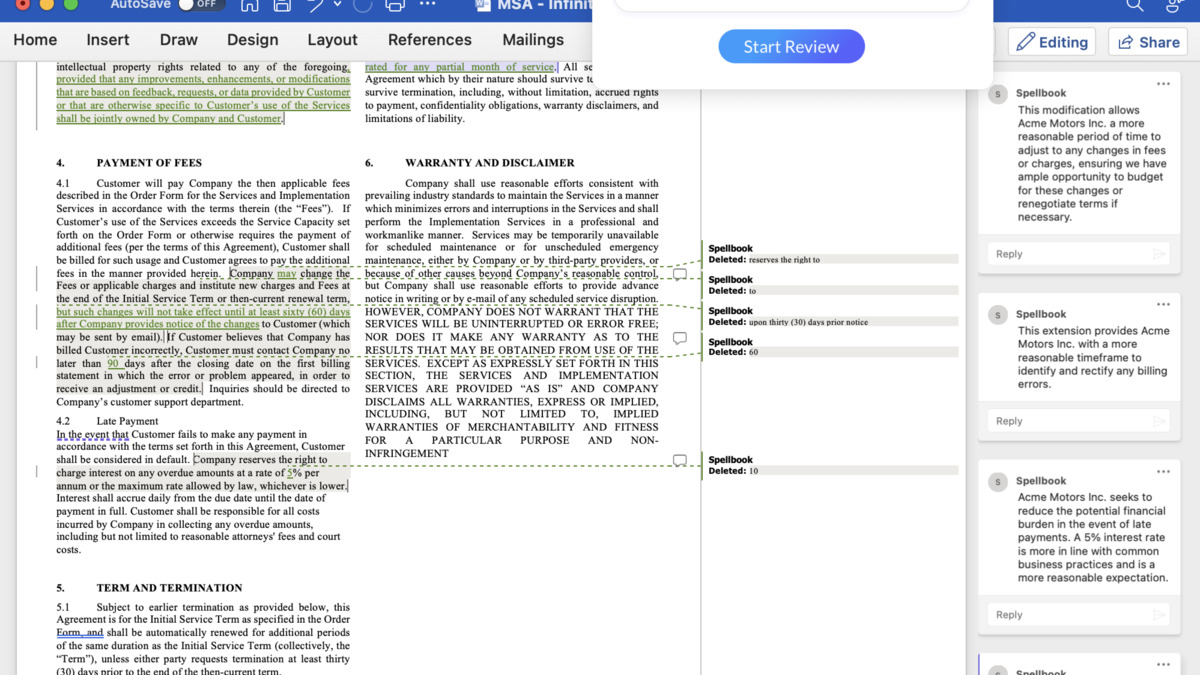 Spellbook's interface runs as a Word add-in, keeping lawyers in their existing workflow.
Source: spellbook.legal
Spellbook's interface runs as a Word add-in, keeping lawyers in their existing workflow.
Source: spellbook.legal
Pricing: Spellbook doesn't publish fixed pricing. Market estimates put it around $179/user/month, with custom quotes based on team size. A 7-day free trial is available.
Limitations: It's contract-focused only - no legal research capability. The Word-only integration means you can't use it with Google Docs or other editors. And without published pricing, budgeting is harder than it should be.
Luminance
Luminance is the enterprise choice for contract lifecycle management. The platform announced its biggest update in a decade in January 2026, adding institutional memory that retains negotiation history and decision-making context across all enterprise contracts.
The AI-Powered Traffic Light Analysis instantly highlights non-compliant clauses with color-coded risk levels and offers alternative wording that can be inserted with one click. Luminance claims the new architecture makes negotiations 10% faster than the 70-80% efficiency gains the platform already delivered.
Pricing: Entirely custom. Luminance targets enterprise legal teams and doesn't publish any pricing tiers. Expect a consultative sales process.
Limitations: The opaque pricing is a real problem for mid-size firms trying to compare options. The platform is contract-focused and doesn't handle legal research. Setup and training for large document sets takes time.
Harvey AI
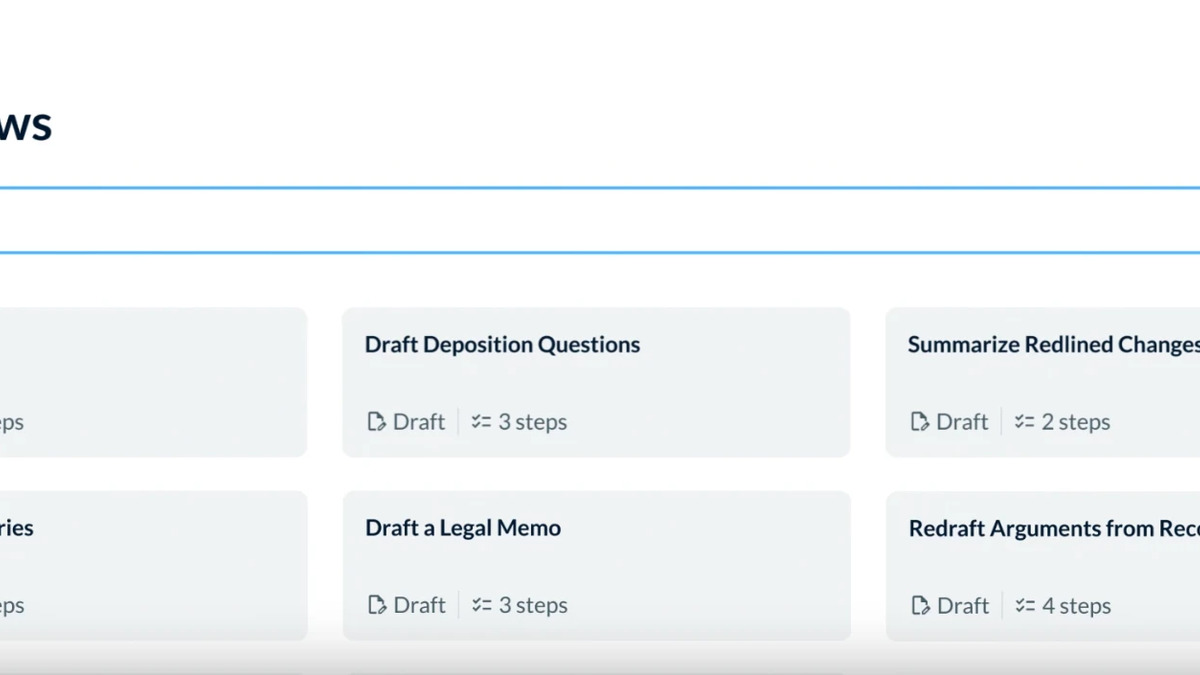
Harvey sits at the top of the market in both capability and cost. The platform handles legal research, contract analysis, due diligence, compliance, and litigation support through a unified interface. Its Vault feature can analyze up to 100,000 documents at once - a scale that other tools can't match.
The Workflow Builder has seen remarkable adoption, with firms creating over 18,000 custom workflows in its first six months. Harvey also offers a mobile app with voice-to-prompt dictation. Clients include 50% of AmLaw 100 firms along with enterprises like HSBC and NBCUniversal.
Pricing: About $1,000-1,200/user/month with a 20-seat minimum and 12-month commitment. That works out to roughly $288,000 minimum annual spend. Every deal is custom-negotiated.
Limitations: The price locks out solo practitioners and small firms completely. At this price point, you're paying for breadth across legal tasks, which isn't always necessary. The platform's strength is enterprise-scale work - if you're a three-person firm, it's overkill.
 Lexis+ with Protege combines AI workflows with Shepard's Citations verification.
Source: lexisnexis.com
Lexis+ with Protege combines AI workflows with Shepard's Citations verification.
Source: lexisnexis.com
General-Purpose AI for Legal Work
ChatGPT and Claude are legitimately useful for certain legal tasks - brainstorming arguments, summarizing lengthy documents, drafting client communications, and reorganizing messy notes. ChatGPT Plus costs $20/month, Claude Pro the same. Both have capable free tiers.
The critical limitation is citation reliability. General-purpose LLMs still fabricate case citations at alarming rates. A Holland & Knight analysis found that these hallucinations look convincing - proper formatting, plausible party names, realistic procedural details - but the cases simply don't exist. Purpose-built legal tools like CoCounsel and Lexis+ with Protege solve this by grounding responses in verified legal databases.
If you use ChatGPT or Claude for legal work, treat every output as a first draft that requires full verification. Never cite a case you found only through a general-purpose chatbot.
Ethical Considerations
The ABA's 2024 ethics guidance established that lawyers must have a "reasonable understanding" of AI's capabilities and limitations. A lawyer using AI-produced content without proper verification is "likely to be subject to disciplinary proceedings." That's not hypothetical - judges across the country are sanctioning attorneys for submitting documents containing fabricated citations, non-existent case law, and AI-produced errors.
Three principles matter for responsible use:
Verify everything. No AI tool produces output you can file without review. Even tools with built-in citation checking make mistakes. Run every citation through Westlaw, Lexis, or another verified source independently.
Protect client confidentiality. Before uploading any client documents to an AI tool, confirm the vendor's data policies. LexisNexis explicitly states it doesn't use customer data for training. Not all vendors make that commitment. Check whether data is stored, how long it's retained, and whether it could appear in training sets.
Disclose AI use where required. More jurisdictions require disclosure of AI assistance in court filings. Check your local rules. Even where not required, transparency builds trust with courts and clients.
For a deeper look at how AI agents work and where the technology is heading, we've covered the technical foundations separately.
Best Picks by Use Case
Solo practitioners and small firms: Start with CoCounsel Core at $225/month for research, and pair it with Spellbook's trial for contract work. ChatGPT or Claude can handle brainstorming and drafting, but verify every citation manually.
Mid-size firms (10-50 attorneys): CoCounsel or Lexis+ with Protege for research, Spellbook for contract drafting. The combination covers most daily legal AI needs at a manageable price point.
Large firms and enterprise legal teams: Harvey AI is the most complete platform if the budget supports it. Its Vault feature and custom workflow builder are built for the scale of work these teams handle. Consider pairing it with Luminance for contract-heavy practices.
Budget-conscious options: Free AI tools like ChatGPT Free and Claude Free work for first-draft generation and brainstorming. LegesGPT offers legal-specific AI starting at $13.99/month. But any free or low-cost option requires markedly more manual verification work.
FAQ
What is the best AI for lawyers in 2026?
CoCounsel from Thomson Reuters leads for legal research with verified citations and 1 million users. For contracts, Spellbook is the top choice. Harvey AI is best for large firms with enterprise budgets.
Do AI legal tools hallucinate case citations?
Purpose-built tools like CoCounsel and Lexis+ with Protege ground responses in verified databases, reducing hallucination risk. General-purpose chatbots like ChatGPT still fabricate citations frequently.
How much does legal AI software cost?
Prices range from free (ChatGPT) to $1,000+/user/month (Harvey AI). CoCounsel Core costs $225/user/month. Spellbook runs roughly $179/user/month. Most enterprise tools require custom quotes.
Can I use ChatGPT for legal research?
You can use it for brainstorming and drafting, but never rely on its case citations. ChatGPT fabricates legal references that look real but don't exist. Always verify through Westlaw or Lexis.
Is AI-created legal work subject to ethics rules?
Yes. The ABA's ethics guidance holds lawyers personally responsible for verifying AI output. Courts are actively sanctioning attorneys who submit AI-generated documents with fabricated citations.
Which legal AI tools protect client confidentiality?
LexisNexis explicitly states it doesn't train on customer data. Harvey AI and Spellbook also maintain strict data policies. Always review vendor terms before uploading sensitive client documents.
Sources
- CoCounsel reaches 1 million users - Thomson Reuters
- Harvey AI raises $200M at $11B valuation - TechCrunch
- Legal AI Pricing Comparison - The Legal Prompts
- AI Hallucinations in Legal Work - The Legal Prompts
- Luminance platform upgrade - Tech.eu
- Lexis+ with Protege launch - LawSites
- 9 Best Legal AI Tools for Lawyers - Spellbook
- Harvey AI Review - GrowLaw
- Lexis+ AI Review - Lawyerist
✓ Last verified March 26, 2026

