
Best AI Tools for Construction in 2026
Seven AI tools for construction teams compared on workflow stage and ROI - from Procore and Autodesk Build to Togal.AI, OpenSpace, Buildots, ALICE, and Document Crunch.
 12 min read
Construction AI has split into five distinct problem areas that rarely share tooling: estimating, scheduling, site monitoring, project management, and contract risk. A general contractor choosing AI tools in 2026 faces a vendor landscape where each problem has its own specialized players, and the broad platforms (Procore, Autodesk) are trying to absorb all five through acquisition and native development.
This article covers seven tools across those five areas. Each one is assessed on what it actually does, what it costs (where that information exists), and which type of firm or role it fits. The goal is to skip the demo-ware and get to the decision.
TL;DR
- Procore is the default choice for full-cycle project management at mid-to-large GCs - ACV-based pricing with unlimited users, and 18+ pre-built AI agents that automate RFI creation, daily logs, and submittal review
- Togal.AI at $299/user/month is the highest-ROI entry point for estimating teams - 76% faster takeoffs with 97% accuracy on 2D PDFs, no ATS or scheduling module required
- Buildots and OpenSpace solve the same site visibility problem from different angles - Buildots integrates with BIM for deviation detection, OpenSpace is faster to deploy for pure documentation
Quick Comparison
| Tool | Category | Pricing | Best for |
|---|---|---|---|
| Procore | Project management | ACV-based (custom) | Full-cycle GC management, AI agents |
| Autodesk Build | BIM + field management | $700-$2,285/user/year | Design-heavy, BIM-first firms |
| Togal.AI | Estimating / takeoff | $299/user/month | Preconstruction estimating teams |
| OpenSpace | Site documentation | Custom | Visual progress tracking, QA/QC |
| Buildots | Progress monitoring | Custom | Delay detection, data center builds |
| ALICE Technologies | Scheduling AI | Custom | Schedule optimization, risk reduction |
| Document Crunch | Contract / risk review | Custom | Contract risk, subcontractor risk management |
Procore
Procore is the most widely launched construction management platform in the world, with 1.6 million users across the project lifecycle. In 2026, the AI layer moved from conversational assistance to agentic automation.
Procore Assist is the conversational interface - it searches across specs, RFIs, submittals, and building codes to return cited answers rather than generic search results. The more significant addition is Agent Builder: a no-code tool for creating custom AI agents that automate multi-step construction workflows. Procore ships 18+ pre-built agents including a RFI Creation Agent (drafts RFI content from project documents in seconds), a Daily Log Agent (automates jobsite reporting), and submittal review agents. Teams with specific workflows can build custom agents using natural language prompts without writing code.
Procore Assist searches specs, RFIs, submittals, and building codes simultaneously - returning cited, verifiable answers rather than the keyword matches that construction teams have worked around for years.
The Datagrid layer is the architectural shift that makes agents possible: it unifies fragmented data across ERPs, tech stacks, and schedule systems into a single intelligence layer that agents can query and act on. 90+ pre-built data connectors cover most common GC software stacks.
Pricing isn't published. Procore charges based on Annual Construction Volume rather than headcount - unlimited users are included regardless of team size. Industry data puts typical contracts at 0.1-0.2% of annual construction costs: a $10M contractor pays roughly $10,000-20,000/year, a $50M-$100M contractor pays $35,000-$60,000/year, and larger firms with high-complexity projects have reported costs exceeding $80,000/year.
The limitation is the same as every broad platform: depth in any one area trails the specialists. Procore's scheduling is less powerful than ALICE, its takeoff less precise than Togal, its site documentation less visual than OpenSpace. For firms that need one integrated system that covers everything adequately, Procore is the standard. For firms tuning one specific workflow, the specialists below are worth assessing.
Autodesk Build
Autodesk Build is the field management and project delivery layer within Autodesk Construction Cloud, which rebranded as Autodesk Forma in 2026. Where Procore is the market leader for general contractors who focus on project management breadth, Autodesk is the natural choice for firms already deep in the Autodesk ecosystem - Revit, Navisworks, and BIM 360 workflows.
Construction IQ is the AI engine embedded across Autodesk Build. It uses machine learning to analyze project data and surface risk predictions before issues hit the field - flagging at-risk activities, quality issues, and budget drift based on historical and live project signals. AutoSpecs uses AI to automatically generate thorough submittal logs from project specifications in minutes, replacing a process that previously took days of manual extraction. The AI Assistant provides a chat interface for querying project data without writing reports manually.
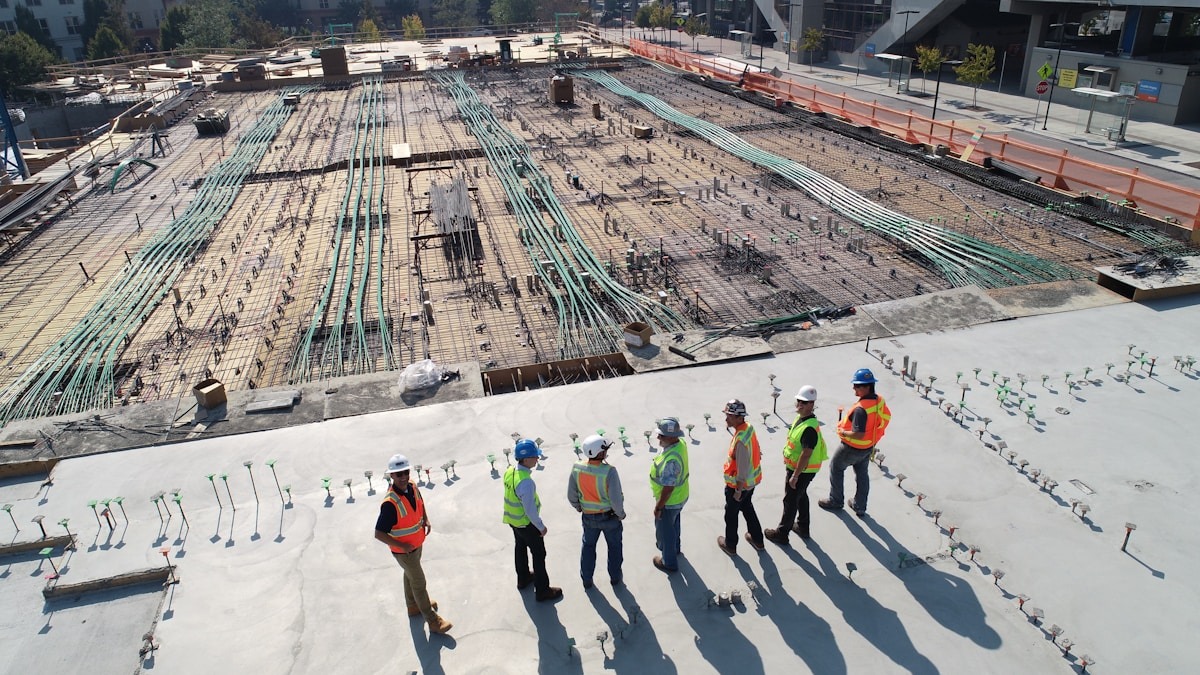 AI-integrated platforms like Autodesk Build and Procore bring BIM data, field reports, and schedule analytics into a unified project view - replacing the disconnected app stack that most construction teams currently run.
Source: unsplash.com
AI-integrated platforms like Autodesk Build and Procore bring BIM data, field reports, and schedule analytics into a unified project view - replacing the disconnected app stack that most construction teams currently run.
Source: unsplash.com
Published pricing for Autodesk Build is sheet-count based: 550 Sheets at $700/user/year ($58/month), 5,000 Sheets at $1,225/user/year ($102/month), and Unlimited Sheets at $2,285/user/year ($190/month). For firms also using Autodesk Docs, BIM Collaborate, or Takeoff, bundled pricing through Autodesk's sales team normally produces lower per-product costs than the published individual rates.
For architects and design teams, the Autodesk Forma suite around Build (BIM Collaborate, Model Coordination, Takeoff) provides tighter integration than any competing platform. For general contractors whose primary workflow is in the field rather than in Revit, Procore's breadth normally wins the evaluation.
Togal.AI
Togal.AI solves a specific problem: the hours estimators spend manually counting spaces and quantities from construction drawings. The platform's vision engine detects, measures, and labels project spaces and features on 2D PDF drawings automatically, turning a full architectural takeoff from a day-long task into roughly 12 minutes of AI processing.
An independent study by Kansas University found Togal to be 76% faster than other leading takeoff tools, with 97% accuracy on clean architectural drawings. The "97%" figure applies to standard 2D PDFs - hand-sketched plans and heavy-civil cross-sections still require manual tracing, and cost data must be added in a separate estimating tool since Togal focuses strictly on quantities, not pricing.
Pricing is published and transparent: the Growth plan at $299/user/month (billed annually at $3,588/user/year) includes unlimited automated takeoffs, unlimited chat prompts, and collaboration features. The Business plan at custom pricing covers teams of 4+ users and adds onboarding support, dedicated account management, classification library templates, and quantity discounts.
One painting contractor reported completing small projects in 30 minutes to an hour after switching from a week or more of manual takeoff work. The ROI math is straightforward at that scale: if Togal replaces 10 hours of estimator time per bid, a team bidding 20 projects monthly recovers the monthly cost many times over.
The honest limitation: Togal doesn't replace a full estimating platform like Sage Estimating or PlanSwift. It handles the quantity extraction step - which is the most time-intensive part of the takeoff workflow - and hands off clean numbers to whatever costing system the team already uses.
OpenSpace
OpenSpace is a reality capture and site documentation platform built around one insight: if you attach a 360-degree camera to a manager's hard hat, you can automate the entire process of documenting a job site without asking anyone to change their behavior.
Managers walk the site as they normally would. OpenSpace processes the footage automatically, maps it to project plans, and produces a Google Street View-style record of the site at that point in time. Field Notes allows annotating issues directly on the visual record. The AI compares captures over time to surface progress deviations and QA/QC issues before they become punch list items.
The use case is strongest on projects where visual documentation is currently done manually or inconsistently - commercial construction, healthcare facility builds, and data centers where owners need complete project records for handoff. On data center projects specifically, the ability to document every rack bay and ceiling void before close-in is operationally valuable.
Pricing is custom and varies by project size, number of sites, and feature access. OpenSpace doesn't publish standard tiers; pricing is volume-based and negotiated annually. Alternatives in the same space include Matterport (stronger on 3D modeling, higher per-scan cost) and Reconstruct (more focus on BIM integration for deviation analysis).
Buildots
Buildots takes site monitoring further than OpenSpace by integrating capture data against BIM models to detect specific deviations - not just visual progress, but whether work was done in the right location, with the right specs, at the right time.
The workflow: managers walk the site with 360-degree cameras on their hard hats. Buildots' AI processes the footage against the project's BIM model, identifies what work has been completed, what is behind schedule, and what has been done incorrectly relative to design intent. An AI assistant called Dot answers natural language questions about project status from the processed data.
 Buildots integrates 360-degree site captures with BIM models to detect deviations from design intent - a level of precision that pure documentation platforms like OpenSpace don't provide.
Source: unsplash.com
Buildots integrates 360-degree site captures with BIM models to detect deviations from design intent - a level of precision that pure documentation platforms like OpenSpace don't provide.
Source: unsplash.com
The scale of the platform is standout. Buildots raised $45M in a Series D round in May 2025, bringing total funding to $166M at a $300M valuation. Current customers include Turner Corp., JE Dunn Construction Group, STO Building Group, Mortenson, VINCI Construction, Bouygues Construction, Hochtief, and Intel (where Buildots is being used on fab construction). The company reports a 50% reduction in project delays - roughly 2-3 months on average projects - and alerts teams to issues an average of 3 weeks before they would otherwise be detected.
Pricing is custom and enterprise-only. The platform economics work for firms managing projects of significant scale and complexity where the delay cost justifies a structured deployment. The shift from project-by-project deployments to multi-year enterprise agreements has been a remarkable trend in the company's 2025-2026 customer base.
ALICE Technologies
ALICE addresses the scheduling problem that construction project managers have accepted as a given: the build sequence is too complex to optimize manually, so teams rely on experience and rules of thumb rather than data.
The core technology is generative scheduling. ALICE simulates millions of possible build sequences using the project's resource constraints, site logistics, and activity durations, then surfaces the sequences that minimize time and cost. For a complex project with hundreds of interdependent activities, ALICE can identify schedule improvements that experienced planners wouldn't find in months of manual analysis.
The McKinsey partnership, announced in 2025, introduced the platform to 35+ clients across infrastructure, data centers, energy, and manufacturing - bringing measurable outcomes including schedule reductions up to 17%, labor cost savings of 14%, and equipment cost reductions of 12%. Reference clients include Zachry Group, Bouygues, Implenia, and Costain.
The Insights Agent, launched in 2026, adds a conversational interface on top of ALICE's scheduling engine. Teams can ask questions in plain language - "which activities are driving our critical path delay?" or "compare these two schedules" - and receive detailed answers with source references rather than digging through Gantt charts. The agent accepts imported schedules from Oracle Primavera P6 and Microsoft Project, so teams don't need to rebuild existing schedule data to use it.
Pricing is custom and demo-gated. No tiers are published. ALICE is positioned for large-scale projects - infrastructure, commercial, and industrial builds - where schedule optimization directly translates to multi-million-dollar cost impacts.
Document Crunch
Document Crunch reviews construction contracts, subcontracts, and specifications for risk - automatically flagging payment term mismatches, scope non-compliance requirements, missed notification deadlines, and hidden obligations before they become disputes.
The practical value is in preconstruction: when a GC is reviewing a stack of subcontractor agreements or assessing a new owner contract, Document Crunch processes the documents, highlights risk clauses, and produces plain-language summaries of obligations and compliance requirements. The platform turns a legal review workflow that previously required a construction attorney or experienced contracts manager into something a project administrator can run in minutes.
The acquisition context matters: Trimble announced it would acquire Document Crunch in April 2026 to integrate the platform into Trimble Construction One, its project delivery ecosystem. That integration path will push contract obligations and compliance requirements directly into project management and ERP workflows - connecting the contract review layer to the execution layer in a way that currently requires manual cross-referencing.
Document Crunch has been rolled out on more than 10,000 projects. Pricing is custom and subscription-based; no tiers are published. The platform serves general contractors, subcontractors, owners, designers, and insurance carriers - any party that signs construction contracts that are long, dense, and full of clauses that create liability exposure if missed.
Which One to Use
For full-cycle project management at mid-to-large general contractors, Procore's ACV-based model with unlimited users and 18+ AI agents covers the broadest workflow. Agent Builder lets teams automate repetitive coordination work without writing code. Evaluate against your Annual Construction Volume to estimate the contract cost before engaging their sales team.
For firms already embedded in the Autodesk ecosystem, Autodesk Build at $700-$2,285/user/year integrates tightly with Revit, Navisworks, and BIM workflows. Construction IQ and AutoSpecs add real AI value to the field and preconstruction phases. The published per-user pricing makes budgeting more predictable than Procore's ACV model.
For estimating teams that need faster, more accurate takeoffs, Togal.AI at $299/user/month (annual) is the clearest ROI decision on this list. The 76% speed improvement applies to clean 2D PDF drawings - verify your drawing quality matches the platform's sweet spot before committing. Start with the Growth plan at one seat to confirm accuracy against your actual project types.
For project teams that need comprehensive visual site documentation, OpenSpace is the fastest path to deployment. Managers walk the site as normal; the platform handles capture, mapping, and QA/QC tracking. Useful for any project type where visual records matter for owner handoff or dispute resolution.
For large commercial or infrastructure projects where delay detection is the priority, Buildots integrates 360-degree capture with BIM deviation analysis to catch problems an average of 3 weeks earlier. Best suited for firms managing complex projects where the cost of a month's delay justifies a structured implementation.
For optimization of complex project schedules with many interdependent activities, ALICE Technologies' generative scheduling engine finds schedule improvements that manual planners cannot identify in the available time. The McKinsey partnership and reference clients in infrastructure, data centers, and industrial construction are the credibility markers to assess.
For contract risk management at preconstruction and subcontract execution, Document Crunch flags the clauses in construction contracts that create payment, scope, and compliance exposure before projects start. The Trimble acquisition means the integration roadmap into TC1's project management layer is worth factoring into any evaluation started now.
Sources
- Procore AI construction platform overview - procore.com
- Procore pricing 2026 - downtobid.com
- Procore Groundbreak 2025 AI innovations - procore.com
- Best AI for construction project management 2026 - aibuildingtools.com
- Togal.AI pricing - togal.ai
- OpenSpace AI platform overview - openspace.ai
- OpenSpace review 2026 - aibuildingtools.com
- Buildots raises $45M Series D - techcrunch.com
- Buildots construction intelligence announcement April 2026 - prnewswire.com
- ALICE Technologies scheduling AI - alicetechnologies.com
- ALICE Insights Agent launch - blog.alicetechnologies.com
- McKinsey and ALICE Technologies partnership - mckinsey.com
- Trimble to acquire Document Crunch April 2026 - news.trimble.com
- Document Crunch AI contract review - documentcrunch.com
✓ Last verified May 19, 2026

