
Best AI Synthetic Data Tools 2026 - Ranked
The top AI synthetic data tools in 2026 ranked by price, quality, and use case - from open source SDV to Tonic.ai Fabricate and K2view.
 10 min read
AI companies are running out of real data. That's not a hypothesis - it's the practical reality driving a wave of acquisition and consolidation in synthetic data. NVIDIA paid a nine-figure sum to absorb Gretel AI in March 2025. Scale AI hit $2 billion in annual revenue largely on the back of data work. Gartner's 2023 prediction that 75% of enterprises would use synthetic data by 2026 is tracking accurate.
TL;DR
- Best SaaS pick: Tonic Fabricate - real free tier, $29/mo Plus plan, natural language data generation via Data Agent
- Best open source: SDV (Synthetic Data Vault) - handles tabular, relational, and time-series data, ships with built-in quality evaluation
- Best enterprise: K2view - entity-based architecture preserves referential integrity across complex multi-system schemas
The market has also had significant churn. Mostly AI ceased operations in March 2026. Gretel's standalone product effectively ceased when NVIDIA absorbed its ~80-person team. What's left is a smaller but more stable set of options. The right one depends completely on what problem you're trying to solve.
Why Teams Need Synthetic Data
The use cases split into three areas, and each rewards different tools.
Training data for AI models. As frontier model developers run short on real-world text and code, synthetic data fills the gap. Microsoft, Meta, and Anthropic all use it to augment training pipelines. For smaller teams it's the path to class-balanced classification datasets or varied instruction-following examples for fine-tuning.
Privacy and compliance. GDPR, HIPAA, and similar regulations restrict how real customer data can flow into test environments. Synthetic data lets QA teams run realistic tests without touching production records. This is the original commercial driver - healthcare and finance teams have been paying for this for a decade.
Software testing and development. Seeding a dev database with fake data is trivial for a five-table app. For enterprise systems with dozens of interconnected tables and cross-system schemas, maintaining referential integrity across synthetic records is a real engineering problem. Several tools on this list exist specifically to solve that.
The Tools
Tonic.ai Fabricate
Tonic splits its offering into three products: Fabricate for producing synthetic data from scratch, Structural for de-identifying existing relational data, and Textual for unstructured documents. Fabricate is the most relevant for AI and dev teams.
The interface centers on a chat-based Data Agent. You describe the schema and statistical characteristics you want - "50,000 realistic e-commerce orders with seasonal skew toward Q4 and 15% cancellation rate" - and the agent creates it. The API supports Automated Workflows for CI/CD integration, so you can refresh your staging database on every PR merge without manual intervention.
Pricing is concrete and public. The Free tier includes $10 in monthly credits with 256MB local database storage. Plus is $29/month with $25 in credits, pay-as-you-go overages, and a 1GB storage limit. Enterprise pricing is custom and adds SSO, RBAC, self-hosted deployment, and Oracle/SQL Server export support.
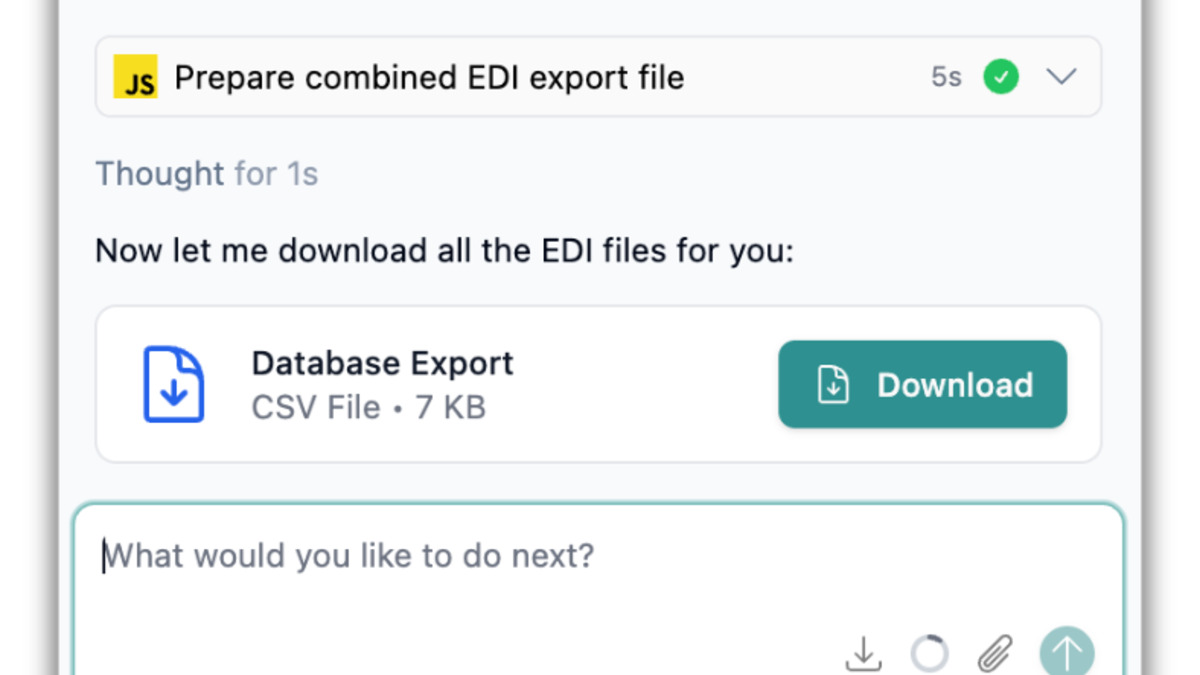 Tonic.ai Fabricate uses a chat-based Data Agent for producing datasets from natural language descriptions. January 2026 updates added Azure Blob Storage read/write and arbitrary text format exports.
Source: tonic.ai
Tonic.ai Fabricate uses a chat-based Data Agent for producing datasets from natural language descriptions. January 2026 updates added Azure Blob Storage read/write and arbitrary text format exports.
Source: tonic.ai
The credit system makes costs variable. A single fine-tuning run producing 500K rows might consume most of your monthly Plus credits. For teams doing daily data refreshes, you'll want to model this against your actual row volumes before committing.
The Textual product handles de-identification across TXT, DOCX, PDF, CSV, TIFF, and a dozen other formats. If your AI pipeline ingests documents with structured records, Textual handles the privacy side of that stack without requiring a separate vendor.
Best for: Dev and QA teams that want a SaaS solution, a real free tier to evaluate before paying, and natural language generation without writing pipeline code.
YData Fabric
YData Fabric is built for data scientists rather than software engineers. The platform combines data profiling, quality assessment, and synthetic generation in a single workflow. You can run it through the web UI or the Python SDK from a Jupyter notebook - both paths are first-class.
The Community tier is free and includes synthetic data generation, automated data profiling, and the Fabric SDK. Pay-as-you-go and Enterprise tiers add pipeline orchestration, automated database profiling, and cloud deployment on AWS or Azure. YData doesn't publish prices for the paid tiers - you need to contact their sales team.
The profiling output is where YData earns its keep. The platform tracks three metrics simultaneously: fidelity (statistical similarity between synthetic and real data), utility (how well models trained on synthetic data perform on real data), and privacy (resistance to membership inference attacks). Most tools give you one or two of these. Tracking all three with a single evaluation run is the right approach when you're producing training data for production models.
YData handles tabular data, time series, and relational datasets. It doesn't produce synthetic text or images, so it's not the right pick if your pipeline needs to produce synthetic documents or multimodal data.
Best for: Data science teams building ML training pipelines who need rigorous quality metrics to verify synthetic data before using it.
SDV (Synthetic Data Vault)
SDV is the open-source standard for tabular synthetic data. Originally built at MIT's Data to AI Lab in 2016, the project is now maintained by DataCebo and remains actively developed in 2026.
It's a Python library - no hosted service, no UI, no SaaS dependency. The library supports single tables, relational databases (preserving foreign key relationships across multiple tables), and sequential or time-series data. Four model types are available:
- GaussianCopula: Statistical, fast, handles numerical data with clear correlations well
- CTGAN: GAN-based, better at complex multi-modal distributions, slower to train
- CopulaGAN: Hybrid of the above, decent default for mixed data
- TVAE: VAE-based, often the strongest performer on tables with many categorical columns
from sdv.single_table import CTGANSynthesizer
from sdv.datasets.demo import download_demo

real_data, metadata = download_demo(
    modality='single_table',
    dataset_name='adult'
)
synthesizer = CTGANSynthesizer(metadata)
synthesizer.fit(real_data)
synthetic_data = synthesizer.sample(num_rows=10_000)
SDV ships built-in evaluation metrics: column shape scores measure per-column distribution fidelity, pair trend scores measure whether correlations between columns are preserved, and boundary adherence checks whether synthetic values fall within the observed ranges of the training data. You can run a full quality report in two lines after synthesis.
The compute constraint is real. CTGAN on a 500K-row table with 40 columns is GPU-hungry. On CPU-only machines, GaussianCopula is notably faster but produces lower fidelity output. For most development and testing use cases the fidelity tradeoff is acceptable; for training data that'll affect production model quality, it's worth benchmarking both.
DataCebo offers an Enterprise tier with support contracts, priority fixes, and additional connectors if you need a vendor relationship.
Best for: Python developers who want full pipeline control, researchers who need to reproduce experiments, and teams that can't send data to a SaaS API for compliance reasons.
Faker
For simple requirements - generating test fixtures, seeding dev databases, creating unit test inputs - Faker is the right tool and SDV is overkill.
Faker isn't ML-based. It samples from curated lists and statistical generators to produce names, addresses, emails, phone numbers, company names, dates, credit card numbers, and around 100 other data types. The Python version (v37, released June 10, 2026) supports 70+ locales, so you can create Chinese names, German postal codes, and Japanese phone numbers from the same API. A maintained JavaScript port exists under @faker-js/faker.
from faker import Faker

fake = Faker(['en_US', 'de_DE', 'ja_JP'])

records = [
    {
        "name": fake.name(),
        "email": fake.email(),
        "address": fake.address(),
        "company": fake.company(),
    }
    for _ in range(10_000)
]
Faker doesn't learn from your data and doesn't preserve statistical distributions. If you need age correlated with purchase category, or if you need the distribution of transaction amounts to match production, Faker won't deliver that. Use SDV or Tonic instead. For prototyping and CI database seeding, Faker is the fastest path to realistic-looking records.
Best for: Developers who need quick, realistic test data without statistical fidelity requirements.
K2view
K2view targets enterprises running complex multi-system architectures. The core differentiator is its entity-based architecture and patented Micro-Database technology: instead of treating data as flat tables, K2view organizes everything around business entities like "customer" or "order," then ensures that any synthetic record maintains consistent relationships across every connected system.
In practice, this solves a specific headache. A synthetic customer needs a consistent address across the CRM, the billing system, the loyalty database, and the support ticket system. K2view handles that cross-system coherence without manual join configuration. It also automatically identifies and labels PII across structured and unstructured sources - which matters when you need to document compliance for auditors.
The platform supports all major integration patterns: ETL/ELT, CDC, streaming, messaging, APIs, and data virtualization across cloud, on-premises, and hybrid environments. A 2026 update added MCP and RAG integration, letting agentic AI applications pull synthetic data on demand during evaluation runs.
K2view has no public pricing. Every deployment is a custom enterprise engagement, with an average contract in the six-figure range based on similar platforms. A $15M funding round from Trinity Capital in 2026 suggests real commercial traction. You won't evaluate this without a sales conversation.
Best for: Enterprises with GDPR or HIPAA requirements, multi-system schemas, and the budget for a dedicated platform.
The Consolidation Story
NVIDIA didn't buy Gretel to run a SaaS product. It bought Gretel because synthetic data generation is infrastructure - a capability that large AI development pipelines need embedded, not sold separately.
Gretel built technically strong tooling with an accessible API and good privacy metrics. Once NVIDIA absorbed the team, the standalone platform had no reason to exist. Those capabilities are now being integrated into DGX Cloud and NVIDIA's generative AI development stack. If you're already building on NVIDIA's infrastructure, that might eventually mean access to Gretel-derived features at no additional cost.
Mostly AI's closure is a different story. The company's credit-based model was structurally difficult: one credit equals 1M data points, which sounds generous until enterprise pipelines need hundreds of millions of rows per day. The math stopped working.
What's left is a cleaner market. Teams now have a concrete decision tree rather than a sea of overlapping SaaS products.
 Validating synthetic data quality requires the same rigor as experimental science: controlled comparisons, reproducible metrics, and honest failure analysis.
Source: unsplash.com
Validating synthetic data quality requires the same rigor as experimental science: controlled comparisons, reproducible metrics, and honest failure analysis.
Source: unsplash.com
Comparison Table
| Tool | Pricing | Open Source | Privacy Metrics | Handles Relational Data | Best For |
|---|---|---|---|---|---|
| Tonic Fabricate | Free / $29/mo / Custom | No | Yes | Yes | Dev, QA, AI pipelines |
| YData Fabric | Free / Custom | Partial (SDK) | Fidelity + Utility + Privacy | Yes | Data science teams |
| SDV | Free | Yes | Built-in eval suite | Yes (multi-table) | Python developers |
| Faker | Free | Yes | None | No | Test fixtures |
| K2view | Custom (enterprise) | No | Advanced + PII | Yes (entity-based) | Multi-system enterprise |
Best Picks
Best overall for most teams: Tonic.ai Fabricate. The free tier is real, the natural language interface makes it accessible to engineers who aren't data scientists, and the API supports automation. If you hit the credit limits, $29/month is a low bar for a team tool.
Best free/open source: SDV. If you have Python in your stack and need statistical fidelity - not just plausible-looking data - SDV is the production-grade option. Use CTGAN or TVAE as your default models and run the built-in quality report to validate output before it reaches a training pipeline.
Best for simple test data: Faker. Don't use SDV to seed a CI database. Faker produces 10,000 realistic records in seconds with no model training required. For vector database testing, data labeling setup, or RAG pipeline evaluation with representative data shapes, Faker gets you there faster.
Best enterprise: K2view if you have cross-system compliance requirements. The pricing is opaque, but so is the problem it solves - and no other tool in this list handles referential integrity at that scale.
Sources
- Tonic.ai Pricing
- Tonic.ai January 2026 Product Updates
- YData Fabric Pricing
- SDV Documentation - Synthetic Data Vault
- Faker on PyPI - June 2026 release
- NVIDIA reportedly acquires synthetic data startup Gretel - TechCrunch, March 2025
- Mostly AI new pricing tiers - what you need to know
- K2view vs Tonic for Synthetic Data Generation - Modern Marketing Partners
- Best Synthetic Data Generation Tools Compared for 2026 - Tonic.ai Blog
- K2view receives $15M funding - Finviz/Trinity Capital
- Axolotl vs Unsloth vs TorchTune: Best LLM Fine-Tuning Frameworks in 2026 - Spheron Blog
✓ Last verified June 17, 2026

