
Best AI SDKs for App Development in 2026
Compare five leading AI developer SDKs - Vercel AI SDK 7, LangChain, LlamaIndex, Mastra, and PydanticAI - and find the right framework for your next AI-powered app.
 9 min read
Every production app is adding AI features now. Chat interfaces, structured extraction, RAG pipelines, streaming responses - the demand is clear and the tooling has finally caught up. But the SDK choices are genuinely confusing: five well-maintained libraries that all claim to "make AI easy," none of which solves exactly the same problem.
We've tested all five in real projects over the past several months. Benchmarked streaming latency, read through breaking-change docs, and traced production failures back to framework assumptions. What follows is what we actually think, not a summary of each project's marketing page.
TL;DR
- Vercel AI SDK 7 (16M weekly downloads) is the go-to for TypeScript web apps with streaming UI
- LangChain has the most integrations but carries migration debt -
AgentExecutorhits end-of-life December 2026 - LlamaIndex is still the cleanest choice for document-heavy RAG; LlamaParse v2 is excellent
- Mastra 1.0 is the TypeScript framework to watch: 300k weekly downloads, 3,300+ models, and a built-in debugger
- PydanticAI v2.1.0 (June 2026) is the right call for Python teams that need validated structured output
What We're Comparing Here
This article covers SDKs and frameworks for building AI features into production apps - chat interfaces, structured extraction, RAG pipelines, and streaming responses. If you're building autonomous multi-agent systems with LangGraph, CrewAI, or AutoGen, that comparison is at Best AI Agent Frameworks 2026.
These five are the tools developers reach for when adding an AI layer to an existing application, or starting from scratch with AI as a core feature. Each takes a different position on what "AI development" means.
At a Glance
| Framework | Language | Version | Weekly Downloads | License | Best For |
|---|---|---|---|---|---|
| Vercel AI SDK | TypeScript | 7.0 | 16M | Apache-2.0 | Streaming web UIs, React/Next.js |
| LangChain | Python, JS | 1.4.x | 2.4M (JS) | MIT | Broad integrations, complex pipelines |
| LlamaIndex | Python, JS | varies | - | MIT | Document-heavy RAG |
| Mastra | TypeScript | 1.x | 300k | Apache-2.0 | Multi-model TypeScript agents |
| PydanticAI | Python | 2.1.0 | - | MIT | Type-safe structured extraction |
Vercel AI SDK 7
Released June 25, 2026, AI SDK 7 is the most significant update the framework has shipped. Vercel has turned what started as a streaming UI convenience library into a full agent platform - 16 million weekly npm downloads mean developers noticed.
The core abstraction remains unchanged: a unified TypeScript API that normalizes calls across OpenAI, Anthropic, Google, and dozens of other providers. Version 7 adds WorkflowAgent, a durable execution primitive for long-running agents. Instead of wiring up your own state machine and retry logic, WorkflowAgent handles interruption, resumption, and human approval gates at the framework layer.
import { WorkflowAgent } from 'ai';
import { anthropic } from '@ai-sdk/anthropic';

const agent = new WorkflowAgent({
  model: anthropic('claude-sonnet-4-6'),
  tools: { searchWeb, readFile },
  onApprovalRequired: async (toolCall) => {
    // pause and wait for human confirmation
  }
});
The new terminal UI (TUI) package lets you run agents in development and watch live traces of tool calls, model responses, and execution steps - a debugger for agent behavior without adding an external observability platform. Production monitoring goes through the overhauled OpenTelemetry integration, which feeds any standard tracing backend including Langfuse.
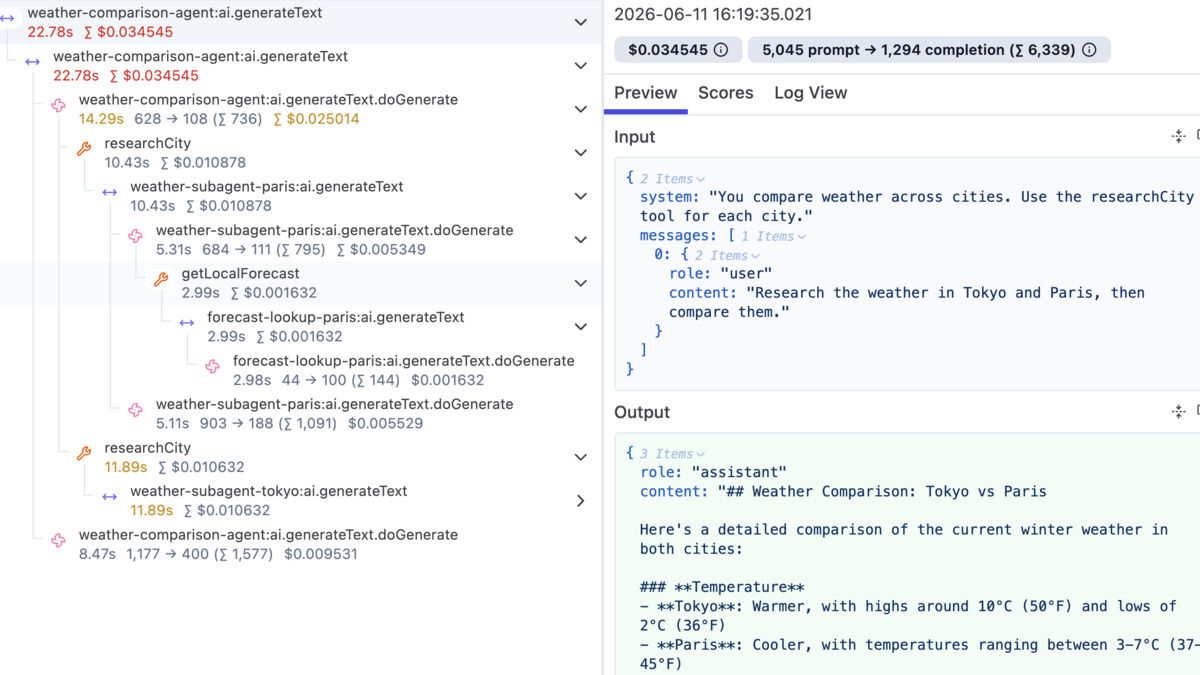 An agent trace in Langfuse showing individual steps and tool calls captured via AI SDK 7's new telemetry layer.
Source: vercel.com
An agent trace in Langfuse showing individual steps and tool calls captured via AI SDK 7's new telemetry layer.
Source: vercel.com
The new HarnessAgent API is worth mentioning separately: it provides a consistent interface for running existing agent frameworks like Claude Code and Codex CLI, which is useful for teams that want orchestration-level control over agentic coding tools.
Pricing: The SDK is free and Apache-licensed. Vercel's AI Gateway includes $5/month in free credits; beyond that you pay provider list prices with no markup. The $20/user/month Pro plan covers Vercel's hosting platform, not the SDK.
What to watch: The SDK is TypeScript-only. Python developers get nothing here. Rolling out WorkflowAgent outside the Vercel platform requires more configuration than the documentation currently covers - budget time for that if you're using other hosting.
LangChain
LangChain is the oldest framework in this comparison and still the most feature-complete for Python. The 600+ integrations with vector stores, document loaders, LLM providers, and third-party APIs are unmatched by any other framework. If your stack involves a data source that nobody else supports, LangChain probably has a connector.
The honest problem is that the architecture has aged. The AgentExecutor class is deprecated and in maintenance mode - the official migration deadline is December 2026. Teams building new projects on AgentExecutor today are taking on a known migration. If you start fresh, use the new agent loop from the beginning.
langchain-core sits at 1.4.x and LangGraph - the stateful workflow engine that ships as a separate package - hit 1.2.6 in June 2026. LangSmith, the observability layer, is where LangChain charges:
| LangSmith Plan | Price | Traces Included | Retention |
|---|---|---|---|
| Developer (Free) | $0 | 5,000/month | 14 days |
| Plus | $39/seat/month | 10,000/month | 400 days |
| Enterprise | Custom | Custom | Custom |
Extra traces above the included amount cost $2.50 per 1k (14-day retention) or $5.00 per 1k (400-day retention).
LangGraph is the part of LangChain worth understanding separately. It models agent execution as a typed state machine: nodes are functions, edges are transitions, checkpointers provide persistence. It runs in production at Klarna, Replit, Elastic, and Cloudflare. The graph-based approach handles complex branching and recovery patterns that a simple loop-based agent can't.
When to use it: Python teams, complex integration requirements, and projects that need the depth of LangGraph for stateful workflows. The community is large and most error cases have a Stack Overflow answer.
When to skip it: New TypeScript projects, teams that need fast initial setup, and anyone uncomfortable inheriting the AgentExecutor migration task.
LlamaIndex
LlamaIndex took a document-first approach from launch and hasn't drifted from it. If your application's core value is answering questions about a corpus of documents - contracts, research papers, internal wikis, support tickets - LlamaIndex's abstractions fit better than any other framework in this list.
 LlamaIndex's Agentic RAG pattern: each document gets a dedicated agent with search and summarization tools; a top-level agent handles routing and synthesis.
Source: llamaindex.ai
LlamaIndex's Agentic RAG pattern: each document gets a dedicated agent with search and summarization tools; a top-level agent handles routing and synthesis.
Source: llamaindex.ai
LlamaParse v2 is the strongest part of the current stack. It handles multi-column layouts, tables, handwriting, and mixed-format PDFs with accuracy that generic OCR tools don't match. Version locking - the ability to pin a specific parse behavior for production consistency - is a feature that matters at scale and that most competitors don't offer. Read the background on why this matters in our RAG vs fine-tuning guide.
The credit-based pricing scales by document complexity:
| Parse Tier | Credits per Page | Cost per 1k Pages |
|---|---|---|
| Cost-effective | 3 | $3.75 |
| Agentic | 10 | $12.50 |
| Agentic Plus | 45 | $56.25 |
All accounts start with 10,000 free credits per month. Beyond that, 1,000 credits costs $1.25. A 100-page PDF at cost-effective rates runs $0.38; at Agentic Plus rates, $5.63. That difference matters at scale - and many applications can use cost-effective tier for most documents and reserve Agentic Plus for the complex ones.
When to use it: RAG-heavy applications, knowledge bases, document extraction pipelines. The document-first mental model means you're working with the framework rather than against it.
When to skip it: Pure chat applications, apps that don't touch documents, or teams that want to avoid per-page pricing.
Mastra
Mastra hit 1.0 in January 2026 and is the clearest TypeScript-native alternative to LangChain for teams that want an opinionated framework. The 300,000 weekly npm downloads signal real adoption, not just hype - that trajectory in 18 months is unusual.
The model index is Mastra's most useful feature for teams running multiple providers: 3,300+ models from 94 providers through one consistent API. Switching from GPT-5 to Claude Sonnet to a local Llama model requires changing one line. For teams that run regular model evaluations, this removes the adapter-writing sprint that usually precedes a model change.
Mastra Studio, accessible at localhost:4111 during development, is closer to an IDE for agent behavior than a debug log. You get a visual interface for testing agent configurations, inspecting individual tool calls, and stepping through workflow execution in real time. The kind of tooling LangSmith charges for, built into the open-source framework.
import { Mastra, Agent } from '@mastra/core';

const agent = new Agent({
  name: 'research-agent',
  instructions: 'You are a research assistant.',
  model: { provider: 'ANTHROPIC', name: 'claude-sonnet-4-6' },
  tools: { webSearch, summarize }
});

export const mastra = new Mastra({ agents: { research: agent } });
Pricing: The framework is Apache-licensed and free. Mastra Cloud, for teams wanting managed deployments, includes built-in deployers for Vercel, Netlify, and Cloudflare. Pricing for the cloud tier wasn't publicly finalized at time of writing.
What to watch: Mastra is younger than LangChain with a smaller community. Edge cases aren't always documented. TypeScript-only, which rules it out for Python teams. We'd recommend it for greenfield TypeScript projects over the LangChain JS implementation today.
PydanticAI
PydanticAI v2.1.0 shipped June 29, 2026, marking V2's stable release. The framework solves a specific problem well: getting LLMs to return typed, confirmed Python objects without writing output parsers by hand.
Every model call in PydanticAI is wrapped in Pydantic v2 schema validation. If the model returns something that fails the schema, the framework retries rather than surfacing a broken object to your application. In LangChain, output parsers are optional and frequently bypassed in production code. In PydanticAI, the schema is the contract.
from pydantic_ai import Agent
from pydantic import BaseModel

class ContractSummary(BaseModel):
    parties: list[str]
    effective_date: str
    term_months: int
    key_obligations: list[str]

agent = Agent('claude-sonnet-4-6', result_type=ContractSummary)
result = await agent.run('Summarize this contract: ...')
# result.data is typed ContractSummary, guaranteed valid
The scope is deliberately narrow. PydanticAI handles structured model interaction; it doesn't try to be a workflow engine or an integration hub. For extraction pipelines and classification systems where structured output is the core deliverable, that focus is a feature. For anything requiring complex multi-step orchestration, combine it with a workflow layer or look at the agent frameworks comparison.
The project has 16,600 GitHub stars and ships weekly. The Pydantic team's track record on the core library - it's used in millions of Python applications - gives PydanticAI more credibility on the "will this be maintained" question than most framework-of-the-month competitors.
Pricing: MIT-licensed, fully open source.
Picking the Right Framework
The choice isn't "which framework is best?" - it's "what problem does my app actually have?"
The answer depends on your stack and the core problem you're solving:
TypeScript web apps with streaming UI: Vercel AI SDK 7. The React and Next.js primitives are production-ready, WorkflowAgent handles state, and the provider-unified API saves boilerplate across the board.
Python with broad integration requirements: LangChain, with LangGraph for stateful workflows. Accept the migration off AgentExecutor now rather than later. The 600+ integrations are worth the framework complexity if you actually need them.
Document-heavy RAG: LlamaIndex. LlamaParse v2 handles the document ingestion problem better than generic options; the RAG framework handles the retrieval layer. Check our guide on what RAG is first if that's new territory.
TypeScript and cleaner developer experience: Mastra. The model index, Studio, and opinionated structure give TypeScript teams a better starting point than the LangChain JS port.
Python with verified structured output: PydanticAI v2. Narrow scope, does one thing reliably, backed by the team that maintains Pydantic.
For assessing model performance before committing to a framework, the LLM eval tools comparison covers that step.
Sources
- AI SDK 7 is now available - Vercel
- LangChain and LangGraph Agent Frameworks reach v1.0
- LangGraph 1.2.6 release notes
- LangSmith Plans and Pricing
- LlamaParse V2: Simpler, Better, Cheaper
- LlamaCloud Pricing
- Mastra AI Framework Overview
- PydanticAI Releases - GitHub
- Vercel AI Gateway Pricing
- LangGraph vs LangChain: 2026 Decision Guide
✓ Last verified July 1, 2026

