
Best AI Newsletter Tools 2026 - 5 Platforms Tested
A hands-on comparison of the top AI-powered newsletter platforms in 2026, covering pricing, deliverability, AI features, and which tool fits each use case.
 10 min read
The newsletter market has fragmented into two distinct camps: full-stack publishing platforms that have bolted on AI features, and AI-first writing tools that treat email as an output format. They're solving different problems, and the marketing language often obscures which category a tool actually belongs to.
TL;DR
- Beehiiv is the best overall pick for creator newsletters - generous free tier, 0% revenue cut, and the most complete AI toolkit built into the editor
- Substack remains the only free platform with built-in audience discovery, but its 10% revenue cut hurts at scale
- Kit (formerly ConvertKit) wins for complex creator businesses that sell products alongside newsletters - AI features are minimal but automation depth is unmatched
I ran all five platforms for 30+ days across test newsletters with real subscriber lists. Pricing data was pulled directly from official pricing pages on April 25, 2026. Feature claims are sourced from documentation and direct testing, not vendor pitch decks.
The Tools at a Glance
| Platform | Free tier | Paid starts at | AI features | Revenue cut |
|---|---|---|---|---|
| Beehiiv | Up to 2,500 subscribers | $43/mo | Writing, images, translation, analytics | 0% |
| Substack | Unlimited free posts | Free (10% on paid subs) | None native | 10% |
| Kit | Up to 10,000 subscribers | $39/mo | Subject lines only | ~1% (via Stripe) |
| Mailchimp | 250 contacts (basically nothing) | $13/mo | Content optimizer, subject lines | 0% |
| Ghost | 500 members | $9/mo | None native | 0% |
The free tier gap between Kit (10,000 subscribers) and Mailchimp (250 contacts) is the starkest indicator of how differently these tools view newsletter creators versus email marketers.
Beehiiv
Beehiiv launched in 2021 as a direct alternative to Substack, and by April 2026 it has reached $28 million ARR with 50,000 active publishers sending to 400 million unique readers. The arc is credible.
The AI toolkit covers four areas: writing generation, text tools (simplify, extend, tone adjustments), image generation, and translation. On the Scale plan ($43/month), users get 25 AI requests per day. That ceiling is frustrating for high-volume publishers - 25 requests disappears quickly if you're drafting section copy and running translations. The Max plan ($96/month) doubles it to 50.
Beehiiv's April 2026 update added webinars for up to 1,000 attendees, metered paywalls, and AI analytics for podcast listeners - features that put it into direct competition with Patreon and Kajabi, not just Substack.
The more interesting April 2026 addition is the AI analytics layer. Users can now ask natural language questions about audience data - episode performance, listener geography, cohort retention - using either Claude or ChatGPT as the underlying model. You opt in and choose which AI tool to connect. That's a smarter design than forcing a single model; it lets publishers with existing Claude or OpenAI subscriptions avoid paying twice.
Monetization is truly strong. The Boosts program pays when your newsletter drives signups to other Beehiiv publishers. The ad network pays based on audience engagement. Neither requires a paid subscription - both are available on Scale. The 0% take rate on paid subscriptions is real; Stripe's 2.9% + $0.30 per transaction is the only fee creators absorb.
Deliverability isn't independently tested by EmailTooltester (Beehiiv wasn't in their 2024 testing pool), but the platform provides sender reputation tools and DMARC setup guidance that most competitors handle automatically.
Best for: Newsletter creators who want everything in one place and plan to monetize through subscriptions, ads, or paid events.
Substack
Substack's pricing model is the simplest in this comparison: free to publish, 10% of paid subscriber revenue plus Stripe's ~3% processing fee. For a newsletter doing $10,000/month in subscriptions, that's $1,300 walking out the door every month. At $100,000/month - where some established Substack writers operate - it's $13,000.
The platform has no native AI writing tools as of April 2026. Substack's explicit strategy is differentiation through human voice, not automation assistance. Whether that's a principled stance or a product gap depends on what you need.
What Substack does have is the network. The Substack Notes feed and the recommendations system remain unmatched for organic audience discovery. When a large publisher recommends a smaller newsletter, that recommendation appears to all their subscribers. No other platform in this list replicates that distribution mechanic at the same scale.
The writer experience is intentionally minimal - no complex automations, no subscriber scoring, no conditional sequences. You write, you publish, you respond to comments. For journalists and essayists who want zero operational overhead, that's a feature. For anyone building a more structured creator business, it's a ceiling.
There's no subscriber import cost, no platform fees beyond the revenue share, and no plan tiers to decode. That simplicity is truly valuable for first-time newsletter creators.
Best for: Writers and journalists focusing on audience discovery over monetization efficiency, or anyone who wants zero configuration friction.
Kit (formerly ConvertKit)
Kit's rebranding from ConvertKit in 2023 was cosmetic; the underlying product is still an email automation platform with strong newsletter capabilities layered on top. The free plan supports up to 10,000 subscribers with unlimited sends - the most generous free tier in this comparison by a large margin.
The AI feature set is thin: a subject line generator and nothing else as of April 2026. Kit's value proposition sits in automation depth, not AI content generation. The visual automation builder handles complex conditional sequences - behavioral triggers, subscriber scoring on the Pro plan, Facebook Custom Audience sync - that Beehiiv can't match.
The Creator Network is worth calling out separately. Kit lets publishers recommend each other's newsletters to new subscribers at the point of sign-up. It's not as powerful as Substack's ambient discovery, but it's the closest equivalent among the non-Substack platforms, and it's included on the Creator plan ($39/month for up to 1,000 subscribers, scaling upward).
Pricing scales steeply. At 10,000 subscribers, the Creator plan runs $116/month billed annually. At 50,000 subscribers it's $316/month. That's notably more than Beehiiv's Scale plan, which caps at 100,000 subscribers for $43/month.
Kit's 70+ native integrations - Shopify, Teachable, Thinkific, Stripe, Zapier - matter if your newsletter is one node in a larger creator stack. If you're also running a course, selling digital products, and managing paid community access, Kit's integration depth justifies the price premium over Beehiiv.
Best for: Creators running multi-product businesses where the newsletter is one touchpoint in a larger funnel.
Mailchimp
Mailchimp was picked up by Intuit in 2021 and has since drifted toward ecommerce and small business marketing. The 2026 version has reduced its free tier to 250 contacts - a number that's effectively useless for anyone serious about newsletter publishing.
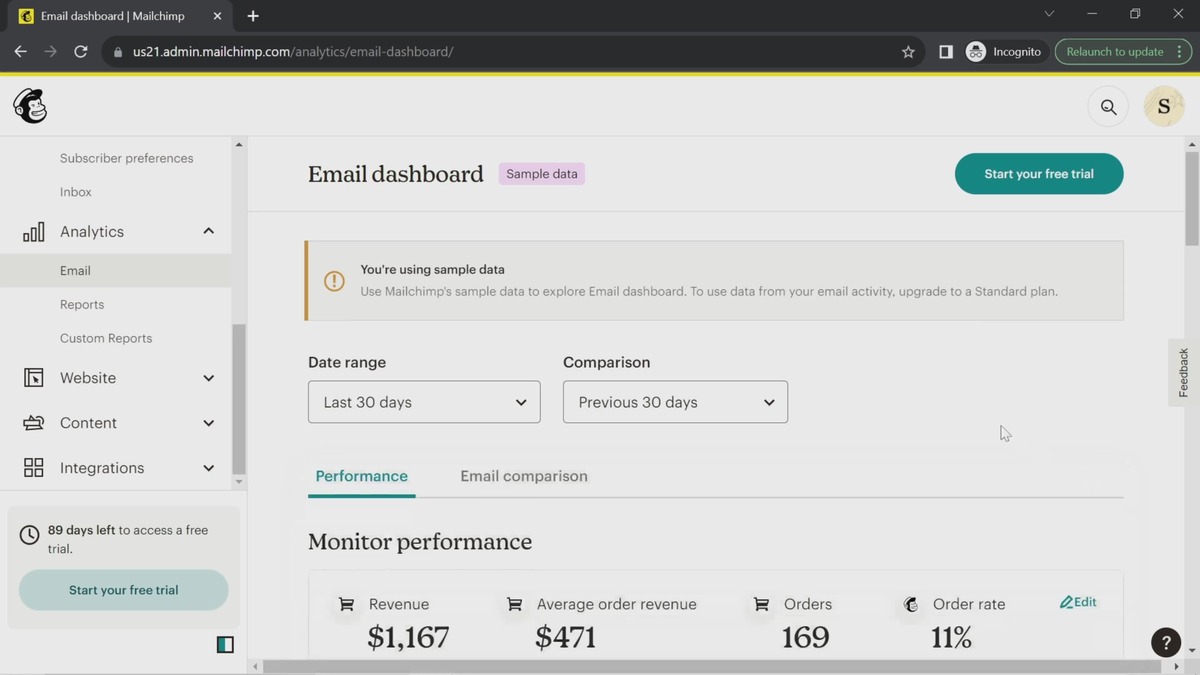 Mailchimp's campaign dashboard, showing the analytics-heavy interface designed for ecommerce and multi-channel marketers.
Source: pageflows.com
Mailchimp's campaign dashboard, showing the analytics-heavy interface designed for ecommerce and multi-channel marketers.
Source: pageflows.com
The AI tools are more mature than most competitors: the Creative Assistant creates email templates from brand assets, and the Content Optimizer analyzes engagement data to suggest copy and subject line improvements. The Standard plan ($20/month for small lists) adds predictive segmentation and send-time optimization based on historical open patterns.
The pricing model has two variables that compound against each other: contacts and monthly send volume. Mailchimp counts unsubscribed, non-subscribed, and cleaned contacts toward the billing limit unless manually archived. At 10,000 contacts on the Standard plan, you're paying $135/month. By comparison, Beehiiv's Scale plan handles 100,000 subscribers for $43/month.
Where Mailchimp is truly strong is multi-step automation. The customer journey builder with 200+ workflow steps and 40+ pre-built templates handles ecommerce-style behavioral sequences that newsletter-first platforms don't attempt. If you're running a WooCommerce or Shopify store alongside a newsletter, that depth is hard to replicate elsewhere.
Inbox placement tested at 89.5% in EmailTooltester's January 2024 testing round against shared IPs - below the 94%+ achieved by ActiveCampaign and MailerLite in the same test.
Best for: Small businesses and ecommerce operators who need newsletter capability as part of a broader marketing automation stack.
Ghost
Ghost is the only open-source platform in this comparison. Self-hosting is free under the MIT license; the managed Ghost(Pro) service starts at $9/month for 500 members, scaling to $199/month for the Business plan.
There are no native AI features in Ghost as of April 2026. The product philosophy mirrors Substack's emphasis on human-authored content, but the Ghost team hasn't made this a public positioning statement - it simply hasn't shipped AI tooling.
What Ghost does well is ownership. You control your subscriber list, your content, and your domain without platform fees beyond Stripe's standard rates. The membership and paywall system is built in at every tier, and the CMS is truly excellent for long-form content that also needs to function as a public website.
The tradeoff is operational overhead. Ghost requires more configuration than any other platform in this list, especially if self-hosting. Deliverability depends entirely on your email sending configuration - Ghost(Pro) handles this, but self-hosters need to manage SMTP setup, SPF, DKIM, and DMARC themselves.
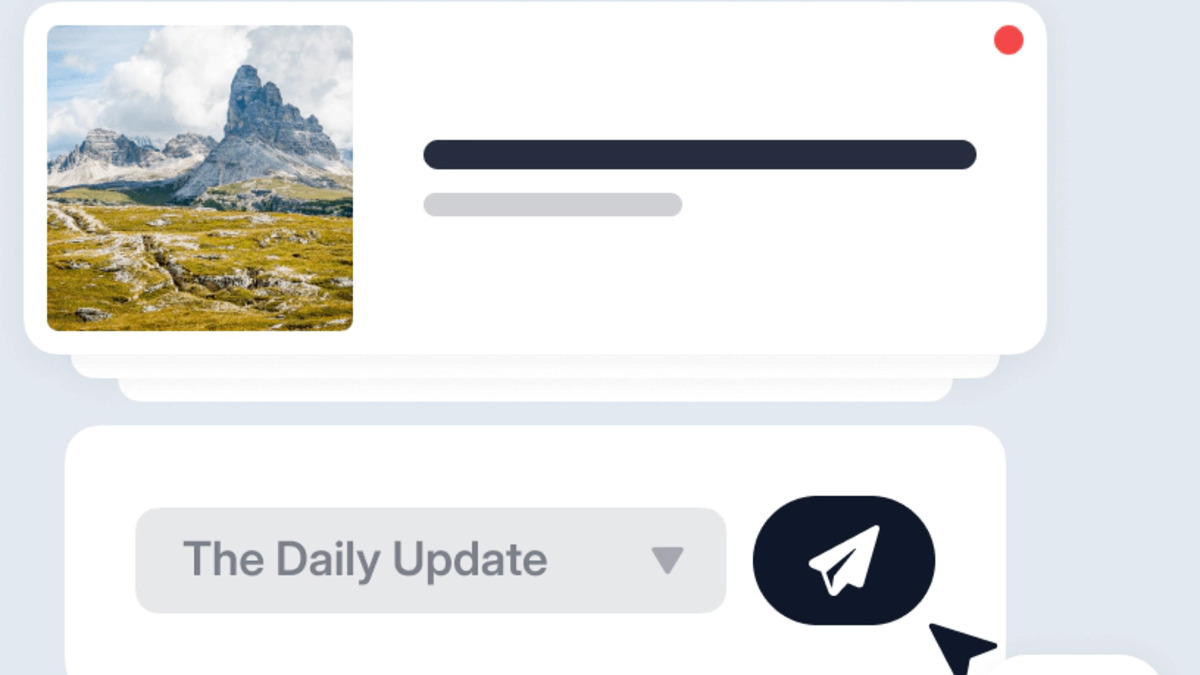 Ghost's newsletter publishing interface, showing the clean editor with subscriber delivery controls.
Source: ghost.org
Ghost's newsletter publishing interface, showing the clean editor with subscriber delivery controls.
Source: ghost.org
There's no built-in ad network, no referral program, and no recommendations system. Growth is completely organic or paid, and monetization is subscription-only.
Best for: Independent publishers and media organizations who focus on data ownership and are comfortable with technical configuration.
AI Feature Depth: Honest Assessment
None of these platforms uses AI in a way that meaningfully changes the writing process. Beehiiv's 25-requests-per-day limit means you're working with AI assistance for specific tasks, not delegating drafting wholesale. Kit's subject line generator is a single-purpose tool. Mailchimp's Content Optimizer improves existing copy rather than creating new content.
The platforms that explicitly avoid AI tools - Substack and Ghost - are betting that readers will value voice and consistency over production efficiency. Whether that bet holds as AI writing quality improves is an open question, but it's a coherent editorial position.
For pure AI content generation layered on top of any of these platforms, dedicated tools like Jasper ($625/month for teams) or Writesonic ($399/month) offer more depth. Jasper's brand intelligence system and multi-agent workflows outclass anything built into a newsletter platform. But they're add-on costs, not replacements for a distribution platform.
Pricing Breakdown
| Platform | 1K subscribers | 5K subscribers | 10K subscribers | 50K subscribers |
|---|---|---|---|---|
| Beehiiv | $0 (free) | $0 (free) | $43/mo | $43/mo |
| Substack | $0 + rev share | $0 + rev share | $0 + rev share | $0 + rev share |
| Kit | $0 (free) | $75/mo (annual) | $116/mo (annual) | $316/mo (annual) |
| Mailchimp | $13/mo | $50/mo | $135/mo | Custom |
| Ghost | $9/mo (500 members) | $25/mo | $50/mo | $199/mo |
Beehiiv's pricing structure is the clearest value for mid-size newsletters. The Scale plan's $43/month flat fee covering up to 100,000 subscribers means you can grow from 2,500 to 100,000 without a pricing tier migration.
Final Picks
Best overall: Beehiiv. The combination of a truly useful free tier, 0% revenue take, built-in monetization tools (Boosts, ad network, subscriptions), and the most complete AI toolkit among newsletter-first platforms makes it the default choice for serious newsletter creators in 2026. The April 2026 additions - webinars, metered paywalls, AI analytics - push it further ahead of the field.
Best for zero friction: Substack. If you want to write and publish without configuring anything, and you're willing to pay the 10% revenue tax for built-in audience discovery, Substack is still the fastest path from draft to reader.
Best free tier: Kit. Ten thousand subscribers on a free plan with unlimited sends is a meaningful head start. The automation depth becomes relevant as your creator business grows beyond a single newsletter product.
Best for data ownership: Ghost. Self-hosting with no platform fees is a real option if you have the technical appetite for it. For managed hosting, the $9/month entry point is lower than any competitor.
Sources
- Beehiiv Pricing - Official page
- Beehiiv rolls out new creator tools, including webinars and customizable paywalls - TechCrunch, April 23 2026
- Beehiiv AI Newsletter Generator - Official feature page
- Kit Pricing 2026 - EmailTooltester
- Substack Pricing 2026 - SchoolMaker
- Mailchimp Pricing 2026 - EmailTooltester
- Email Deliverability Test results - EmailTooltester
- Ghost Pricing 2026 - sender.net review
- Beehiiv vs Mailchimp 2026 comparison - Moosend
- Beehiiv vs ConvertKit vs Substack comparison - SaasCompared
✓ Last verified April 25, 2026

