
Best AI Log Analysis Tools in 2026 - 6 Compared
A data-driven comparison of the top AI-powered log analysis platforms in 2026, covering pricing, query performance, and which tool fits your team's scale.
 10 min read
Log analysis used to mean grep, regex, and patience. That model breaks the moment your application starts creating more than a few gigabytes per day. The tools in this roundup have all added AI-powered features - anomaly detection, natural language querying, automated root-cause correlation - but they charge very differently for the privilege, and the performance gaps between them matter at scale.
TL;DR
- Datadog is the most polished all-in-one option, but its two-part billing ($0.10/GB ingest + $1.70/million events indexed) makes it expensive fast - a 500GB/day shop can hit $1M/year
- OpenObserve is the strongest cost-efficient AI-native pick: flat $0.50/GB with a built-in natural language assistant and no per-seat fees
- Grafana Loki (self-hosted) and SigNoz are the best open-source alternatives if you can tolerate running your own infrastructure
How I Evaluated These Tools
I focused on six platforms that have shipped meaningful AI features since late 2025, rather than just adding "AI" to their marketing pages. The criteria: verified pricing per GB, query language flexibility, AI feature depth (not just oddity detection checkboxes), and deployment model. All pricing figures come from official pricing pages or documented rates - I've linked every source.
Log volume tiers matter here. Under 10GB/day, almost any tool works and cost is irrelevant. Between 10GB and 100GB/day, query performance and storage efficiency start to matter. Above 100GB/day, billing model becomes the primary decision driver.
The Tools
Datadog Log Management
Datadog is the default choice for teams already in the Datadog ecosystem, and for good reason - 700+ integrations, automatic log parsing via configurable pipelines, ML-powered outlier detection, and smooth correlation between logs, APM traces, and infrastructure metrics. The UI is truly well-designed, and the on-call workflow integration is tight.
The billing model is where teams get burned. Datadog charges on two separate axes: $0.10/GB to ingest and archive logs, then $1.70/million log events (15-day retention) to make them searchable. Extended retention costs more - $2.50/million events for 30-day retention. Log forwarding to external destinations adds $0.25/GB. In practice, this comes out to $1.80+ per GB when you account for ingestion and indexing combined. A team ingesting 500GB/day with 30-day retention can face costs topping $1M per year according to Parseable's Datadog cost breakdown.
The AI features are solid: Pattern Detection groups similar log lines automatically, Watchdog surfaces anomalies without manual rule configuration, and correlation with APM traces means you can jump from a log event to the associated distributed trace in one click.
Best for: Teams already using Datadog's APM and infrastructure monitoring who can absorb the cost premium for deep integration.
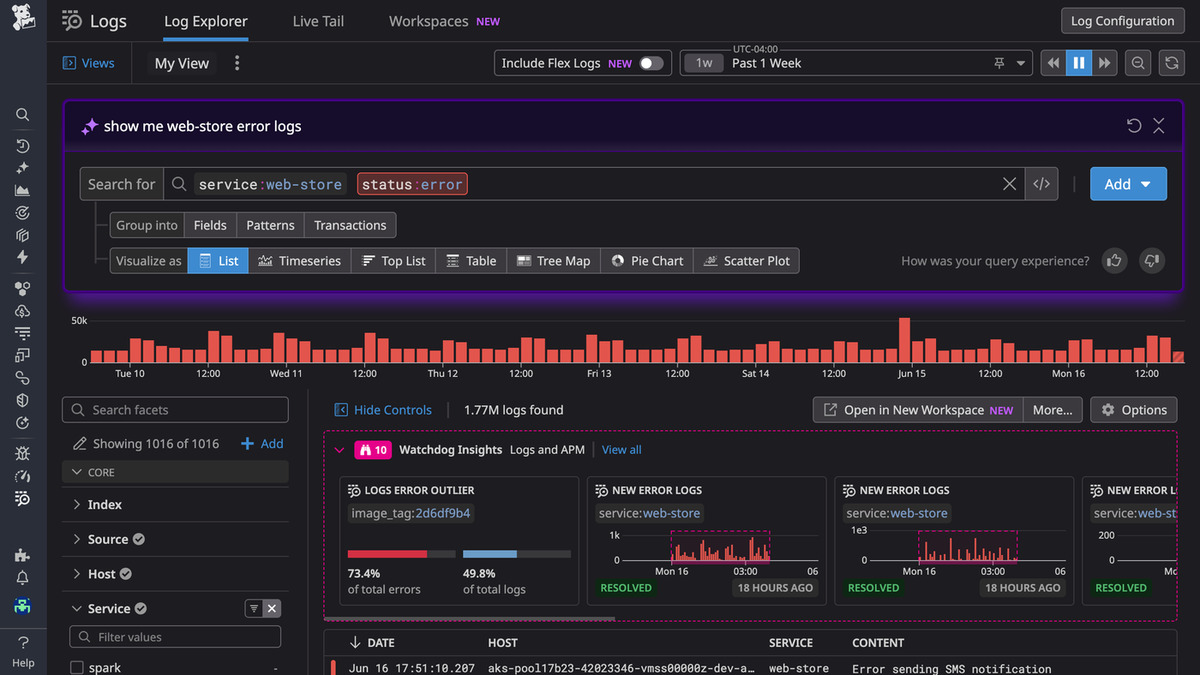 Datadog's Log Explorer with pattern detection enabled. The two-part billing model is the main friction point for high-volume users.
Source: datadoghq.com
Datadog's Log Explorer with pattern detection enabled. The two-part billing model is the main friction point for high-volume users.
Source: datadoghq.com
Elastic Observability (ELK with AI)
Elastic's pitch in 2026 is "Streams" - a new layer on top of Elasticsearch that uses agentic AI to automatically partition and parse raw logs, extract relevant fields without pre-built regex patterns, and surface anomalies without configuration. The claim is that work taking 4-8 hours of manual log analysis resolves in minutes. Having watched a few demo walkthroughs, the automatic field extraction is genuinely useful for teams dealing with inconsistent log formats from multiple services.
The Elastic AI Assistant goes further than most competitors. It's a RAG-backed query interface that lets you ask questions about your logs in plain English, interprets anomalies, and can pull context from your team's runbooks and documentation. The assistant integrates tightly with Kibana, so queries, dashboard creation, and alert configuration all flow through the same conversational interface.
Pricing is resource-based on Elastic Cloud - you pay for compute and storage, with tiers scaling with retention period. Self-hosting the ELK stack is free (Elastic License), but the AI features (including the AI Assistant and Streams) require a paid Elastic Cloud subscription. The AIOps documentation outlines what's included at each tier. Storage requirements can be significant - Elasticsearch is known for high RAM, CPU, and disk usage as log volume grows, which is the main reason teams look at alternatives like Loki or SigNoz at scale.
Best for: Teams with existing Elasticsearch expertise, or those dealing with unstructured log formats that resist manual parsing rules.
Grafana Loki
Loki takes the opposite approach from Elasticsearch: it doesn't index log content at all. Instead, logs are grouped into streams indexed only by labels (service name, environment, pod name, etc.). This keeps storage costs dramatically lower than full-text indexing, but it means ad-hoc searches across label dimensions that weren't anticipated at ingest time are slower.
The April 2026 Grafana release brought the Grafana AI Assistant out of cloud-only status and into on-prem and open-source deployments. Grafana Cloud also now includes AI Observability for monitoring AI agent behavior - real-time visibility into token usage, cost per request, policy violations, and model quality signals. For teams running LLM-based applications with their traditional services, this is a genuine differentiator.
Loki itself is free (AGPLv3). Grafana Cloud's managed Loki starts with free tier usage and scales usage-based. Enterprise commitments start at $25,000/year. The Grafana pricing page has current tier details.
For teams already running Prometheus for metrics, adding Loki completes the LGTM stack (Loki, Grafana, Tempo, Mimir) with minimal operational overhead. The query language LogQL is less expressive than Elasticsearch's DSL for ad-hoc investigation, but the cost-to-scale ratio is hard to beat for high-volume environments.
Best for: Teams already invested in the Prometheus/Grafana stack who want cost-efficient log aggregation without a separate query infrastructure.
SigNoz
SigNoz is the open-source alternative that most directly competes with Datadog on features while undercutting it on cost. It's built on ClickHouse, a columnar database that benchmarks at roughly 2.5x faster query performance than Elasticsearch at about half the resource cost, according to SigNoz's own comparisons. Compression ratios of 80-95% mean storage costs are substantially lower than ELK.
The architecture is OpenTelemetry-native across - logs, metrics, and traces share the same columnar backend, which means you can correlate a log anomaly with the associated distributed trace without switching tools or joining across separate data stores. This matters for actual incident investigation workflows where context-switching between tools adds meaningful time to MTTR.
Pricing is usage-based per GB ingested with no per-seat fees. The SigNoz pricing page has current rates - the managed cloud offering uses the same model as self-hosted but handles the operational burden. For most teams coming from Datadog, the cost reduction is significant because there's no indexing surcharge layered on top of ingest costs.
Best for: Engineering teams that want Datadog-comparable features at lower cost, prefer OpenTelemetry-native infrastructure, and have some tolerance for a smaller ecosystem.
OpenObserve
OpenObserve's headline claim is 140x cheaper log storage than Elasticsearch, which comes from using object storage (S3-compatible) as the primary backend instead of local disk with Elasticsearch's indexing overhead. The actual cost reduction you'll see depends on your query patterns, but the storage efficiency is real and measurable.
The standout feature in 2026 is the O2 Assistant - an AI co-pilot that handles natural language to SQL/PromQL/VRL translation, maintains context across a full incident thread spanning logs, metrics, and traces, and can produce dashboards and alert conditions from a plain-English prompt. According to OpenObserve's March 2026 update, the assistant is deeply integrated rather than bolted on as an afterthought. It's available on the Professional plan at a flat rate - AI features don't carry a premium.
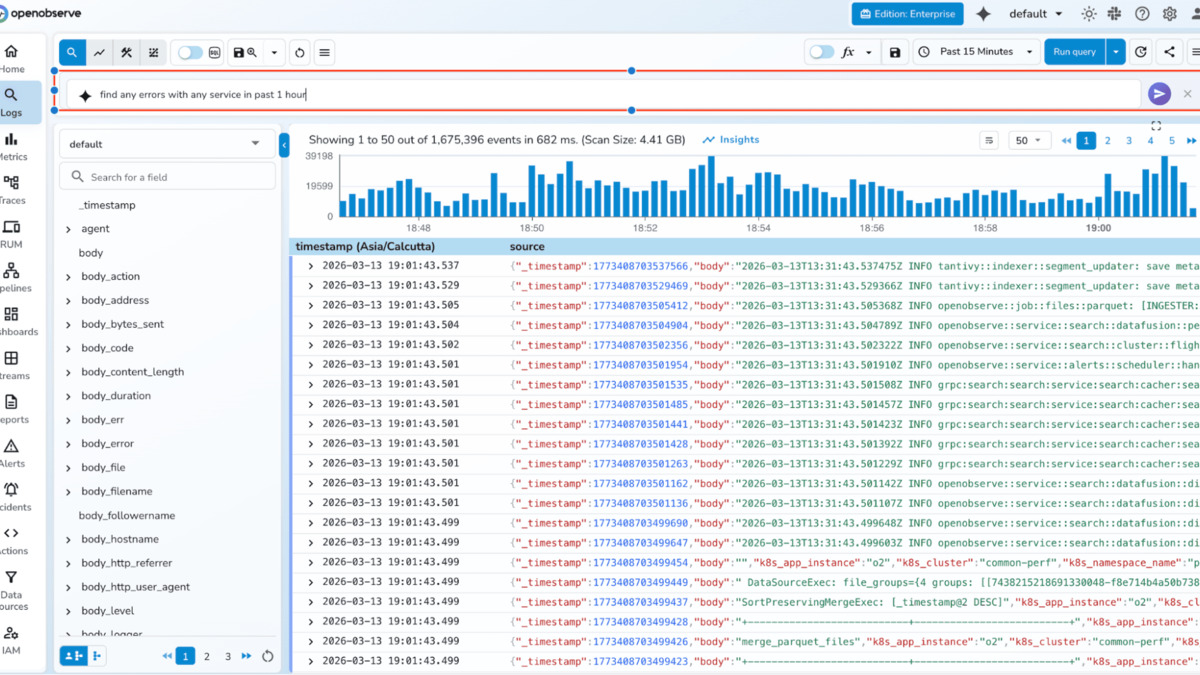 OpenObserve's O2 Assistant translating a plain-English question into a SQL query against log data.
Source: openobserve.ai
OpenObserve's O2 Assistant translating a plain-English question into a SQL query against log data.
Source: openobserve.ai
Pricing is a flat $0.50/GB ingested (with a 30% discount for annual commitment) plus $0.01/GB queried. The 14-day free trial gives access to all features including AI. Per OpenObserve's pricing page, Professional plan retention is 30 days for logs - Enterprise adds configurable retention and volume discounts.
The self-hosted version covers most teams' needs and is genuinely production-ready. GitHub star count (18,600+) reflects real adoption, not just hype.
Best for: Teams processing high log volumes who want the best price-to-feature ratio with integrated AI assistance.
Axiom
Axiom's design philosophy is "ingest everything, query everything" with no sampling, no pre-aggregation, and no dropped data. It runs on object storage (similar to OpenObserve) and uses a custom query language called APL (Axiom Processing Language). The free tier is generous: 500GB/month ingest, 30 days retention.
The paid plan starts at $25/month with 1,000GB of ingest included, storage billed at $0.030/GB/month (compressed, with ~95% average compression), and compute at $0.06-0.12 credits/GB depending on volume. Enterprise add-ons - RBAC ($50/month), SSO ($100/month), Audit Log ($50/month) - are priced separately rather than gated behind tier upgrades, which is a transparent approach. Details are on the Axiom pricing page.
Axiom has particularly strong integrations for serverless environments - Lambda, Vercel, Cloudflare Workers - which is a niche but real advantage. APL has a learning curve for teams coming from SQL-first tools, and the alerting features are still maturing compared to Datadog or Elastic.
Best for: Serverless-heavy teams, startups who want a generous free tier before committing, and teams that want to store everything without sampling compromises.
Pricing Comparison
| Tool | Ingest Cost | Storage | AI Features | Free Tier | Self-Hosted |
|---|---|---|---|---|---|
| Datadog | $0.10/GB + $1.70/million events indexed | Included in indexing fee | Yes (ML oddity detection, Watchdog) | No | No |
| Elastic | Resource-based (Elastic Cloud) | Included | Yes (AI Assistant, Streams) | 14-day trial | Yes (free, AI features need cloud) |
| Grafana Loki | Free (self-hosted) / usage-based cloud | Separate | AI Assistant (April 2026) | 50GB logs/month | Yes (AGPLv3) |
| SigNoz | Usage-based/GB | Columnar (ClickHouse) | Native OTel correlation | No | Yes (Apache 2.0) |
| OpenObserve | $0.50/GB + $0.01/GB query | Object storage | O2 AI Assistant (included) | 14-day trial | Yes |
| Axiom | $0.06-0.12 credits/GB | $0.03/GB/month compressed | Partial | 500GB/month | No |
AI Features Breakdown
The term "AI features" covers various capabilities. The tools above divide roughly into two tiers:
Mature AI integration (Datadog, Elastic, OpenObserve): Pattern detection, oddity detection, and natural language querying are production-ready. OpenObserve's O2 Assistant and Elastic's AI Assistant both maintain conversation context across an incident, which matters for complex root-cause investigations. Datadog's Watchdog works well but requires you to be in the Datadog ecosystem already.
Earlier-stage or narrower AI (Grafana, SigNoz, Axiom): Grafana's AI Assistant just left cloud-only status and is still maturing for on-prem use. SigNoz's AI features are mostly correlation-based (linking logs to traces via OTel) rather than conversational. Axiom's AI capabilities are the least developed of the six.
If natural language log querying is a priority, OpenObserve and Elastic are the current leaders. If you primarily want cost-efficient storage with solid observability correlation, SigNoz or Loki are better fits.
New Relic: Honorable Mention
New Relic didn't make the main comparison because its strength is full-stack observability, not log analysis specifically. Still, its log management pricing ($0.40/GB for standard data, $0.50/GB for Data Plus with 120-day retention) is competitive, and its AIOps features - anomaly detection, incident correlation, root-cause analysis - are included in Pro and Enterprise tiers. If you're already assessing New Relic for APM, the log management is worth including in your evaluation. Current pricing is at newrelic.com/pricing.
Recommendations by Use Case
High-volume production (>100GB/day), cost-sensitive: OpenObserve or SigNoz. Both avoid Datadog's indexing surcharge and deliver solid AI features. OpenObserve's flat $0.50/GB is predictable; SigNoz's ClickHouse backend is faster for complex queries.
Existing Datadog or Grafana shop: Stay in ecosystem. The integration value outweighs the cost of migrating tooling for most teams.
Security-focused (SIEM use case): Splunk is still the industry standard for SIEM-grade log analysis and forensics, though it's expensive and wasn't covered in depth here. Elastic's security tier is a credible alternative. See our Best AI Cybersecurity Tools in 2026 roundup for more on that use case.
Serverless-first stack: Axiom's integrations with Lambda and Vercel are purpose-built and the free tier is truly useful for small teams.
LLM observability alongside traditional logs: Grafana's new AI Observability layer is worth watching if you're running AI agents in production with traditional services. Also check our Best LLM Observability Tools in 2026 for tools focused specifically on that problem.
The log analysis market consolidated around AI features in 2025, but the implementation quality varies widely. Slapping a natural language query box on top of Elasticsearch isn't the same as OpenObserve's deep integration where the assistant understands your data schema and maintains incident context. Verify the AI feature depth in a free trial before committing.
Sources
- SigNoz - Top 6 Log Analysis Tools in 2026
- Better Stack - 10 Log Analysis Tools in 2026
- Datadog Pricing
- Parseable - Datadog Log Management Cost Breakdown
- OpenObserve Pricing
- OpenObserve March 2026 Product Update - AI Assistant and LLM Observability
- Axiom Pricing
- Better Stack Pricing
- Grafana Pricing
- Elastic AIOps for Observability
- Splunk Observability Q1 2026 Update - AI Agent Monitoring
- New Relic Pricing
✓ Last verified April 25, 2026

