
Best AI Keyword Research Tools 2026 - 6 Compared
A data-driven comparison of the six best AI keyword research tools in 2026, covering Semrush, Ahrefs, Mangools, SE Ranking, Surfer, and Ubersuggest with verified pricing and honest verdicts.
 10 min read
Keyword research used to be simple: type a seed term, export a list, sort by volume, pick targets. That model started breaking down when Google introduced AI Overviews and Perplexity grabbed meaningful search traffic. It broke completely when AI search drove a reported 527% year-over-year increase in AI referral traffic across tracked properties in early 2025, converting at 4-5x the rate of traditional organic.
The tools that survived that shift did two things: they kept their core keyword databases accurate and large, and they added a second layer - tracking how AI engines like ChatGPT, Perplexity, and Google AI Overviews actually cite content. Tools that only did one of those two things now have a real gap. I tested six platforms to see where each one sits.
TL;DR
- Semrush is the best overall pick for teams that need a 27+ billion keyword database, intent clustering, and AI visibility tracking in one subscription.
- Mangools KWFinder at $29.90/month is the best value for freelancers and small agencies who want accurate difficulty scores without enterprise pricing.
- The big divide in 2026 isn't between tools - it's between platforms that track AI engine citations and those that still treat Google alone as the full picture.
Pricing figures below come directly from official pricing pages verified as of April 2026. Where two sources disagreed, I used the lower confirmed figure and noted it.
The 2026 Keyword Research Landscape
The database size arms race is essentially over. Semrush has 27.9 billion keywords across 142 locations. Ahrefs counts 28.7 billion across 217 locations. The gap between them is smaller than either company's marketing implies, and for most use cases, both are more than sufficient.
What's actually different now is the need to research keywords across two distinct layers:
Foundation layer - Traditional Google search volume, keyword difficulty, SERP features, and competitor gap analysis. All six tools here handle this competently.
AI discovery layer - What queries trigger AI Overview inclusion, which questions get cited by Perplexity or ChatGPT, and how GEO (Generative Engine Optimization) intersects with classic SEO strategy. Only three of the six tools I tested have meaningful answers here.
That split shapes every pick below.
Semrush
Semrush is the biggest platform in this category by feature count, and in 2026 that scope has become both its strength and its main drawback. The Keyword Magic Tool sits on 27.9 billion keywords, runs search intent classification across all four intent types (informational, commercial, transactional, navigational), and clusters related keywords into topic groups automatically.
The AI additions matter. Semrush's Copilot and its AI Visibility Toolkit ($99/month add-on) let you track how your content appears in ChatGPT, Perplexity, Google AI Overviews, and Gemini. That's a separate cost from the base platform, which is worth flagging: if AI search tracking is why you're assessing tools in 2026, budget for both.
Keyword difficulty scoring now includes a personalized layer - it adjusts based on your domain's actual authority rather than providing a universal number, which makes it meaningfully more actionable than a generic score.
Pricing: Pro at $139.95/month ($117.33/month annual), Guru at $249.95/month ($208.33/month annual), Business at $499.95/month ($416.66/month annual). AI Visibility Toolkit is an additional $99/month.
Limits to know: Free accounts can't export keyword data or access AI-powered metrics like Potential Traffic and Personalized Keyword Difficulty.
Verdict: Best overall for teams that need one platform to cover everything. The cost adds up fast if you're adding the AI Visibility Toolkit, so run the numbers against running Semrush plus a dedicated GEO tracker separately.
Ahrefs
Ahrefs made two significant changes heading into 2026. In January, they cut their entry price dramatically by launching a $29 Starter plan - a 70% drop from their previous lowest tier. The more substantive update is the rebuilt traffic estimation model, which now accounts for zero-click results and AI Overviews in its traffic projections. That's not a marketing claim; the numbers are visibly more conservative than they were in 2024, which is actually more accurate.
AI Keyword Clustering is the feature I've found most useful in practice. Upload any size keyword list and Ahrefs automatically groups keywords by topic and intent. The company says what used to take 3 hours manually now takes about 4 minutes. That's roughly consistent with my own experience.
The database is slightly larger than Semrush overall at 28.7 billion keywords across 217 locations, though Semrush has more US-specific keyword variation (3.8 billion vs. Ahrefs' 2.5 billion for the US). Ahrefs' keyword difficulty scores have historically been more conservative and are slightly more accurate than Semrush's according to multiple 2026 comparisons - they're less likely to show a keyword as winnable when it isn't.
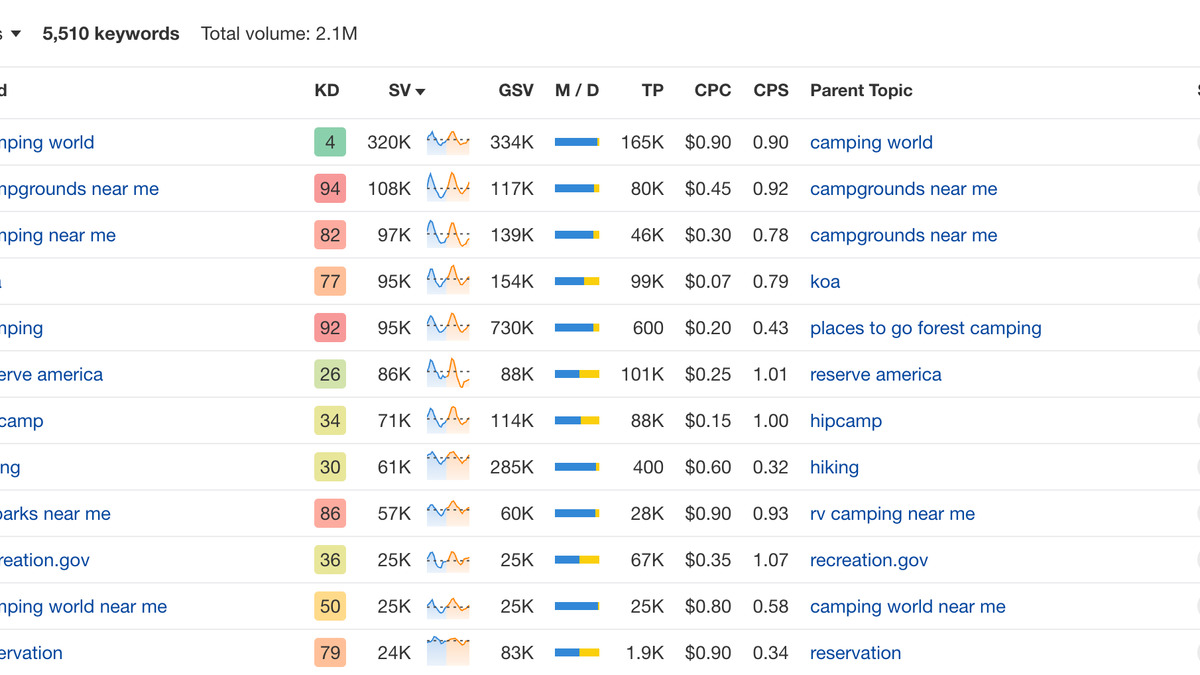 Ahrefs Keywords Explorer with its rebuilt traffic estimation model that accounts for AI Overview zero-click results.
Source: ahrefs.com
Ahrefs Keywords Explorer with its rebuilt traffic estimation model that accounts for AI Overview zero-click results.
Source: ahrefs.com
Pricing: Starter at $29/month, Lite at $129/month ($103/month annual), Standard at $249/month ($199/month annual), Advanced at $399/month annual.
Verdict: The rebuilt traffic model and AI clustering are genuine improvements. Better than Semrush for understanding actual click-through behavior on any given keyword. The Starter plan is worth assessing if you mainly need competitor research and keyword exploration without heavy rank tracking.
Mangools KWFinder
Mangools bundles five tools under one subscription: KWFinder for keyword research, SERPChecker, SERPWatcher for rank tracking, LinkMiner for backlinks, and SiteProfiler for site metrics. The suite isn't trying to match Semrush's depth - it's deliberately simpler, and that's the point.
KWFinder's database holds 2.5 billion related keywords, which is smaller than the enterprise platforms but more than enough for most keyword research tasks. The accuracy of difficulty scores is where Mangools consistently punches above its price tier. The scoring algorithm specifically targets low-competition keywords, which is what most solo operators and small agencies need: not the highest-volume terms, but the ones actually worth chasing with a non-enterprise domain.
The interface is the cleanest in this group. If someone on your team isn't a full-time SEO analyst, Mangools is the one they'll actually use without a tutorial. The free tier gives 5 lookups per 24 hours - enough to test the tool meaningfully before committing.
On the AI search side, Mangools doesn't have meaningful GEO tracking. If you need AI visibility data, you'll need a separate tool or a different platform. That's a real gap in 2026, but at $29.90/month it's a different category of product than Semrush or Ahrefs.
Pricing: Entry tier at $29.90/month, mid-tier at $44.90/month, Agency at $89.90/month.
Verdict: Best value for freelancers, small agencies, and content teams who want accurate keyword difficulty and a full suite without paying $100+ per month. Not the right choice if AI search visibility tracking is a core requirement.
SE Ranking
SE Ranking sits in a useful middle position: enterprise-level feature coverage at mid-tier pricing, with GEO/AI tracking bundled into base plans rather than added as an expensive extra.
The platform's keyword database spans 5.4 to 7 billion keywords across 188-190 countries - smaller than Semrush or Ahrefs, but the data quality is solid. Keyword suggestions are organized into four categories: similar keywords, related terms, low-volume opportunities, and question-based queries. The intent classification covers all four intent types with confidence scores on each label.
The 2025 update that matters for 2026 use is the Model Context Protocol integration, which lets you connect SE Ranking directly to ChatGPT, Claude, and Gemini for SEO insights without writing code. AI search tracking covers ChatGPT, Perplexity, Google AI Overviews, Gemini, Claude, and Microsoft Copilot, all included in standard plans.
A 14-day free trial with full functionality (10 projects, 750 tracked keywords/day, 20 AI prompts/day) is better than most competitors' trial terms.
Pricing: Core at roughly $92/month, Growth at roughly $198/month. Annual billing cuts costs by 20%.
Verdict: The best option for teams that want AI visibility tracking without paying the Semrush AI Visibility Toolkit add-on price. Good for agencies managing multiple client accounts at mid-range budget.
Surfer SEO
Surfer SEO's keyword research is secondary to its content optimization engine - and that's fine, because the two work together in ways the database-focused platforms don't copy. The built-in Keyword Research tool and Topical Map feature generate content cluster recommendations rather than just lists of terms. The approach is "here's what to write and in what order" rather than "here's a dump of keywords to sort through."
The AI writing and content scoring features are tightly integrated with the keyword data. Surfer's Content Editor shows live optimization scores as you write, pulling keyword placement signals from top-ranking pages. It's truly useful for content teams that want to move from keyword research directly into draft creation in one environment.
The limitation is coverage: Surfer's keyword research relies on algorithms using proprietary data plus Google NLP API in four languages only (English, Danish, Dutch, Polish). If you're doing multilingual SEO outside those languages, Surfer's research data won't serve you.
One change to note: Surfer removed monthly billing from all plans in 2026. You're committing to an annual contract regardless of which tier you choose.
Pricing: Discovery at $49/month, Standard at $99/month, Pro at $182/month, Peace of Mind at $299/month. Annual billing only.
Verdict: Good pick for content teams that want keyword research integrated with content creation workflow. Not the right choice as a standalone keyword research tool for SEOs who need deep competitor analysis or large database exports.
Ubersuggest
Neil Patel's Ubersuggest (which absorbed AnswerThePublic in 2022) has positioned itself as the budget option for the full keyword-plus-content stack. For $29/month, you get keyword research, site audits, rank tracking, basic backlink analysis, and an AI Writer - more features per dollar than any other platform in this list.
The trade-offs are real. The database is smaller, the data refresh rate is slower, and the competitive analysis doesn't go as deep as Semrush or Ahrefs for large-scale research. The AI Search Visibility module exists as a module, but its depth doesn't match SE Ranking's dedicated GEO tracking.
The AI-powered keyword overview and Chrome extension are genuinely useful for quick research directly in Google SERPs - you get search volume, CPC, and difficulty overlaid without leaving the browser. For content marketers who do occasional keyword research rather than systematic SEO campaigns, that workflow is efficient.
Lifetime plans at $290/$490/$990 (Individual/Business/Enterprise) are available. If you're confident the tool meets your needs and want to remove the monthly subscription, those are worth evaluating - just use the 7-day trial first before committing to a lifetime purchase.
Pricing: Individual at $29/month, Business at $49/month, Enterprise/Agency at $99/month. Lifetime options available.
Verdict: Best pick if budget is the primary constraint and you're doing content marketing rather than technical SEO. Covers the basics without the enterprise price tag. Don't use it as your primary tool for competitive analysis in high-volume niches.
Pricing Comparison
| Tool | Entry Plan (monthly) | Annual Discount | AI Search Tracking | Database Size |
|---|---|---|---|---|
| Semrush | $139.95 | ~17% | Add-on ($99/mo) | 27.9B keywords |
| Ahrefs | $29 (Starter) | ~20% | Limited | 28.7B keywords |
| Mangools | $29.90 | Available | None | 2.5B keywords |
| SE Ranking | ~$92 | ~20% | Included | 5.4-7B keywords |
| Surfer SEO | $49 | ~17% | Limited | Proprietary |
| Ubersuggest | $29 | ~30% (lifetime) | Basic module | Proprietary |
Best Picks
Best overall: Semrush. The database size, intent clustering, and personalized difficulty scoring are the most complete package for professional SEO work. Budget for the AI Visibility Toolkit add-on if GEO tracking is a priority.
Best value: Mangools KWFinder at $29.90/month. The difficulty scoring accuracy and clean interface make it a practical choice for anyone who doesn't need enterprise-scale data.
Best for AI search tracking without add-ons: SE Ranking. GEO monitoring is bundled at the base plan price, not sold separately.
Best for content teams: Surfer SEO. The keyword-to-content workflow is tighter than any other tool here, but it isn't a substitute for a full-featured keyword research database.
The shift to AI search hasn't made traditional keyword research obsolete - it's added a second layer on top. Tools that only track Google rankings are now missing a real piece of the picture. The right choice depends less on which tool has the biggest database and more on whether the platform you're paying for has actually caught up with where search traffic is going in 2026.
Sources
- Semrush Keyword Magic Tool features
- Semrush pricing 2026
- Ahrefs pricing page
- Ahrefs pricing change 2026 - Starter plan
- Ahrefs vs Semrush comparison 2026
- Mangools KWFinder review 2026
- Mangools plans and pricing
- SE Ranking review 2026
- SE Ranking pricing plans
- Surfer SEO pricing 2026
- Ubersuggest pricing 2026
- AI referral traffic growth data (eesel AI)
- Best AI SEO tools for 2026 - Tim Soulo, Ahrefs CMO
✓ Last verified April 25, 2026

