
Best AI Inventory Management Tools 2026
A ranked comparison of the best AI inventory management tools in 2026, covering pricing, demand forecasting, automation, and which tool fits which business size.
 13 min read
Inventory management software has accumulated "AI" claims faster than any other operations category I track. Stock reorder alerts dressed up as machine learning. Rule-based replenishment wearing a neural network badge. The genuine capability - SKU-level demand forecasting that accounts for seasonality, promotions, supplier lead times, and real-time signals - is out there, but it lives inside a minority of the tools being marketed as AI-powered.
TL;DR
- Best overall (multi-channel retail/wholesale): Cin7 Core - transparent pricing from $349/month, ForesightAI runs ~100 forecasting algorithms per SKU, and 700+ integrations cover almost every stack
- Best budget pick: Zoho Inventory - free tier for 50 orders/month, paid plans from $29/month annually, no per-user pricing gouging
- Key differentiator: Forecasting depth varies more than pricing - Cin7 ForesightAI and Inventory Planner do genuine ML demand prediction; most other tools are doing threshold alerts and calling them AI
This comparison covers six tools I consider the strongest in their respective lanes for 2026: Cin7, Zoho Inventory, Katana, inFlow, Inventory Planner by Sage, and Linnworks. I excluded enterprise-only platforms (SAP, Blue Yonder, Kinaxis) that require six-figure implementation budgets and consulting engagements. If you're looking at those, you have a procurement team and you don't need a roundup article.
For context on where AI inventory tools slot into a broader operations stack, see the Best AI Procurement Tools 2026 and Best AI Data Analysis Tools 2026 pieces I've run this year.
Methodology
Five criteria drove tool selection and ranking:
- AI substance - Does demand forecasting use an actual model trained on historical sales data, or are we looking at moving averages rebranded as machine learning?
- Pricing transparency - Published pricing only. Custom-only pricing is flagged. In this category, it often signals the tool is targeting enterprise contracts your ops team budget can't reach.
- Integration breadth - Native connectors to the channels and ERPs operators actually use. A tool that requires CSV imports to sync Shopify data isn't a 2026 inventory system.
- Order volume scalability - Can the pricing model grow with your business without becoming punitive?
- Verified G2/Capterra ratings - Not as primary signal, but as tiebreaker and flag for support quality issues.
All pricing is from official pages at time of publication. Annual billing rates used where plans offer both.
Comparison Table
| Tool | Starting price | AI forecasting | Best fit | Free tier |
|---|---|---|---|---|
| Cin7 Core | $349/month | Yes - ForesightAI | Multi-channel retail/wholesale | No (14-day trial) |
| Zoho Inventory | Free / $29/month (annual) | Demand forecasting (rule-based + ML) | SMB, budget-constrained | Yes (50 orders/month) |
| Katana | Free / $299/month | Demand signals via integrations | Small manufacturers, D2C | Yes (30 SKUs) |
| inFlow Inventory | $186/month | Reorder point prediction | B2B wholesale, field sales | No (14-day trial) |
| Inventory Planner by Sage | $299/month | Yes - SKU-level ML forecasting | Ecommerce multi-SKU replenishment | No (14-day trial) |
| Linnworks | Quote-based | Spotlight AI workflow automation | High-volume multichannel ecommerce | No |
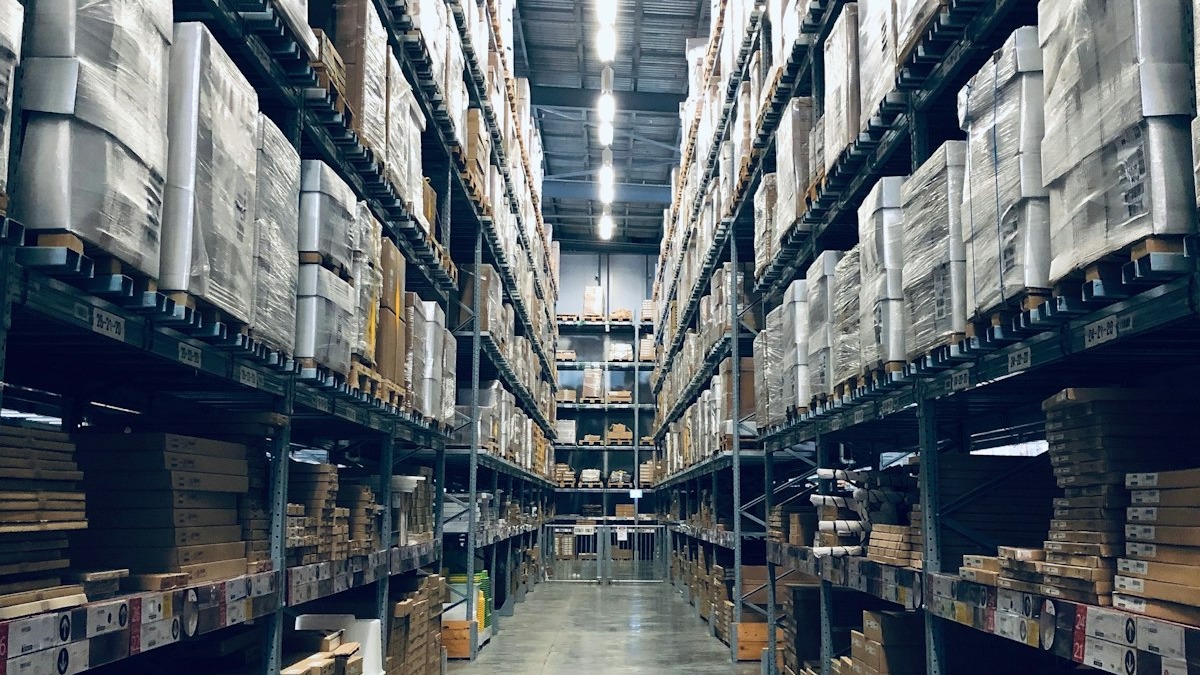 Organized warehouse shelving is what good inventory software is designed to make possible - real-time stock visibility across every location, without manual counts.
Source: unsplash.com
Organized warehouse shelving is what good inventory software is designed to make possible - real-time stock visibility across every location, without manual counts.
Source: unsplash.com
Cin7 Core - Best Overall for Multi-Channel Operations
Cin7 Core is the closest thing to a complete inventory and order management platform with truly useful AI forecasting for businesses in the $1M-$50M revenue range. The pricing is explicit: $349/month for 5 users and 6,000 annual orders (Standard), $599/month for 10 users and 24,000 orders (Pro), and $999/month for 15 users and 120,000 orders (Advanced). A 14-day free trial requires no credit card.
The main AI feature is ForesightAI, which runs up to 100 demand forecasting algorithms against up to two years of sales history per SKU, averages the outputs, and produces a forecast up to 24 months out. It's the kind of ensemble approach that actually handles seasonality and promotional spikes without constant manual adjustment. Cin7 claims ForesightAI supports over 99% product availability for businesses following its recommendations - that's a vendor claim, not an independent benchmark, but the underlying methodology (multi-algorithm ensembling with safety stock recommendations) is defensible.
Beyond forecasting, Cin7 supports real-time inventory sync across 700+ integrations including Shopify, Amazon, eBay, QuickBooks, and Xero. Multi-location tracking, bill of materials for light manufacturing, and EDI connectivity are all included in the Advanced plan. The Pro plan adds MRP (Material Requirements Planning) - useful if you're sourcing components, not just finished goods.
Where it falls short: The interface shows its age in some areas. Navigation between modules requires extra clicks, and bulk-processing screens can feel cluttered. Some G2 reviewers note that the initial sync with Shopify requires careful configuration to avoid duplicate records.
Pricing summary: Standard at $349/month | Pro at $599/month | Advanced at $999/month. All plans billed monthly; annual discounts available.
Zoho Inventory - Best Budget Pick
Zoho Inventory stands apart from every other tool in this list for one simple reason: it has a real free plan, not a crippled demo. The free tier handles 50 orders/month, 2 users, and 2 inventory locations - enough for a small business that's getting started. Paid plans run $29/month (Standard, 500 orders, annual billing), $79/month (Professional, 3,000 orders), $129/month (Premium, 7,500 orders), and $249/month (Enterprise, 15,000 orders). Add-ons extend individual limits if you hit a ceiling without needing to jump an entire tier.
The demand forecasting in Zoho Inventory is lighter than Cin7's ForesightAI. Zoho uses historical sales data to surface reorder recommendations and predict near-term needs, but it's not running an ensemble of 100 ML models. For businesses with predictable seasonality and a limited SKU count, it's sufficient. For high-SKU ecommerce operations where demand variance is high, it'll underperform.
What Zoho does well: the order lifecycle is truly complete. From purchase order through receiving, quality check, sales order, pick/pack/ship, invoicing - every step is connected. Serial and batch tracking (Professional plan and up) works reliably. The supplier portal, included at no extra cost, reduces the back-and-forth that kills warehouse team productivity.
Integration with the broader Zoho suite (CRM, Books, Analytics) is a real advantage for companies already in that ecosystem. If you're running Zoho CRM and Zoho Books, adding Inventory is a one-day project, not a month-long implementation.
Where it falls short: Zoho Inventory hits its ceiling around 5,000+ SKUs or complex multi-warehouse operations. The Enterprise plan at $249/month tops out at 15,000 orders/month - if you're consistently above that, you're looking at the wrong tool.
Pricing summary: Free | $29/month | $79/month | $129/month | $249/month (all annual billing).
Katana - Best for Small Manufacturers
Katana is the only tool in this list that starts with production scheduling as the core workflow rather than order management. If you're a manufacturer - furniture, food and beverage, cosmetics, electronics assembly - Katana's approach to inventory makes more sense than any of the others here because it models raw materials, work-in-progress, and finished goods as separate stock states.
The free plan is truly useful for evaluation: all core manufacturing features, unlimited users, unlimited integrations, but limited to 30 SKUs. The Core plan starts at $299/month for unlimited SKUs and 1 inventory location. Manufacturing Management (bill of materials, production scheduling) is a $199/month add-on. Traceability (lot, serial, expiry date tracking) runs another $249/month. Warehouse Management is $149/month.
That add-on structure is transparent but adds up fast. A small manufacturer needing inventory + production + traceability is looking at $299 + $199 + $249 = $747/month before considering warehouse features. That's competitive with Cin7's Advanced plan and worth modeling before committing.
Katana's AI story is thinner than Cin7's - the platform relies on real-time data visibility and integration outputs (from Shopify, QuickBooks, Xero) to drive replenishment decisions, rather than an in-platform forecasting engine. For manufacturers with relatively stable production cycles, that's fine. For high-variability custom order shops, you'll want to augment with a dedicated forecasting layer.
The Shop Floor App - available as an add-on - gives production operators a tablet interface for task logging, which feeds material consumption data back into the inventory system in real time. That feedback loop is the platform's strongest operational feature.
Where it falls short: Limited to manufacturing use cases. If you're a distributor or retailer without a production workflow, Katana's UI will feel like the wrong tool.
Pricing summary: Free (30 SKUs) | Core from $299/month + add-ons.
inFlow Inventory - Best for B2B Wholesale and Field Sales
InFlow is the strongest option for B2B wholesale businesses that run field sales reps, showroom operations, or B2B portals where buyers place their own orders. The Showroom Pro feature - which lets customers browse and order from a branded catalog - is truly differentiated and not copied by the other tools here.
Pricing on Capterra lists three tiers: Entrepreneur at $186/month (2 users, 100 orders/month), Small Business at $436/month (5 users, 1,000 orders/month), and Mid-Size at $999/month (10 users, 5,000 orders/month). Enterprise pricing requires a sales call. These are monthly billing rates; annual billing reduces costs.
The AI forecasting in inFlow is conservative. The platform analyzes historical sales to flag reorder points and generate purchase order recommendations, but there's no ensemble forecasting or multi-algorithm demand modeling. It's honest about this - inFlow doesn't lead with AI claims in the same way Cin7 does.
Where inFlow earns its place is in B2B operational workflow. Custom price lists by customer, credit limit management, multi-location transfer orders, and the Smart Scanner hardware integration (a hand-held barcode scanner that syncs over WiFi) are all well-executed. The desktop and mobile apps are mature and consistent across platforms.
Where it falls short: High per-user costs on paper. The Entrepreneur plan only includes 2 users and 100 monthly orders at $186 - that's expensive for what you get. The Small Business plan at $436 makes more economic sense for teams of 3-5.
Pricing summary: Entrepreneur $186/month | Small Business $436/month | Mid-Size $999/month (monthly billing).
Inventory Planner by Sage - Best Pure Forecasting Layer
Inventory Planner doesn't try to be a full inventory management platform. It does one thing: tell you what to order, how much, and when, using SKU-level machine learning trained on your sales history. If you already have an OMS or ERP and the gap in your stack is forecasting accuracy, this is the tool to assess.
Pricing runs $299/month for up to 1,000 orders and 1,000 SKUs (base tier), $599/month for 3,000 orders and 3,000 SKUs, with enterprise pricing starting around $1,200/month. All plans include demand forecasting, purchase order management, and supplier lead time tracking.
The forecasting engine factors in seasonality, promotional lifts, abnormal sales spikes and dips, and supplier lead times. Forecasts update continuously as new sales data comes in. Multi-location allocation - pushing stock to the right warehouse before you run out - requires the mid-tier or above.
Integration coverage is Shopify-native (it's in the Shopify App Store), with connectors for Amazon, WooCommerce, BigCommerce, and the major accounting platforms. The Sage acquisition has accelerated ERP-side integration, though direct Sage 50/Sage 100 connectivity is still in development for some configurations.
The practical limitation is that Inventory Planner is an overlay, not a standalone system. It creates recommendations and purchase orders, but you execute those orders in your existing inventory platform. That's the right architecture for businesses with a functioning OMS - it adds the forecasting layer without replacing the entire stack. It's the wrong choice if you need a complete system from scratch.
Where it falls short: Not a full inventory platform - needs an existing OMS or ERP to connect to. Pricing climbs quickly at high order volumes.
Pricing summary: $299/month (1K orders/SKUs) | $599/month (3K orders/SKUs) | ~$1,200/month (enterprise).
Linnworks - Best for High-Volume Multichannel Ecommerce
Linnworks is built for ecommerce businesses doing volume - multiple marketplaces, high order counts, complex shipping service selection - rather than businesses trying to get started. Pricing is quote-based rather than published, which is a flag for smaller operations. Based on user reports, plans start around $200-400/month depending on channel count and order volume.
The main AI feature is Spotlight AI, launched in 2025, which analyzes operational workflows to identify manual tasks and prescribes automation rules to eliminate them. Early users of Spotlight AI report saving an average of more than 30 hours per month through automated order routing, shipping service assignment, and order tagging. That's a specific operational claim with a specific number attached - more credible than the "transform your operations" language most tools use.
Linnworks handles Amazon, eBay, Shopify, Etsy, Walmart Marketplace, and 100+ other channels from a single inventory record. Stock synchronization across all those channels in near-real-time is the core value proposition. The warehouse management module handles pick/pack/ship workflows with barcode scanning and zone-based picking.
The inventory management features themselves are solid but not AI-forward in the forecasting sense. Demand forecasting requires the Advanced Warehouse add-on, and reviews suggest it's less sophisticated than Cin7's ForesightAI or Inventory Planner's SKU-level modeling.
Where it falls short: No published pricing is a genuine obstacle for businesses trying to budget. The platform is optimized for high-volume multichannel ecommerce; single-channel businesses or manufacturers will overpay for features they don't use.
Pricing summary: Quote-based; estimated $200-400+/month based on user reports.
Recommendations by Use Case
Multi-channel retailer or wholesale distributor: Cin7 Core at the Pro or Advanced tier. ForesightAI is the strongest in-platform forecasting of anything in this price range, and the 700+ integrations mean you can add channels without rebuilding your sync architecture.
Budget-constrained SMB: Zoho Inventory. Start with the free plan to test, upgrade to Standard ($29/month annual) when you hit the order ceiling. The platform handles more complexity than most SMBs will ever need.
Small manufacturer: Katana. The production workflow model fits manufacturing operations in a way that retail-first platforms don't. Budget the add-on costs carefully before signing.
B2B wholesale with field sales: inFlow. The Showroom Pro feature and B2B portal capabilities are worth the premium over Zoho at the $436/month Small Business tier.
High-SKU ecommerce needing better forecasting: Inventory Planner by Sage as a forecasting overlay on your existing OMS, or Cin7 Core if you also need to replace the OMS.
High-volume multichannel (50K+ monthly orders): Linnworks. Get a quote. The Spotlight AI automation capabilities pay back the platform cost at that order volume.
What "AI" Actually Means Here
The AI capability gap in inventory management is wider than in most categories. At one end: Cin7 ForesightAI running 100 algorithms against 24 months of SKU-level history. At the other end: threshold-based reorder alerts that existed in 1999 ERP systems, rebranded.
When evaluating any tool not in this list, ask two questions: What is the forecasting model? Is it a ML model trained on your historical data, or is it rules-based threshold logic? And what's the training window? A system that uses only the last 90 days of sales data will fail badly on seasonal SKUs.
Just 23% of small and mid-sized businesses have adopted AI inventory tools according to recent adoption surveys - which means the category is early enough that the tooling is still maturing. The platforms that have invested in real forecasting infrastructure (Cin7, Inventory Planner) have a meaningful head start over those running marketing rebrands.
AI inventory forecasting cuts stockouts by 15-25% within 3-6 months for most implementations - but only if the underlying model is trained on your actual SKU-level history, not generic demand patterns.
Sources
- Cin7 Pricing - Official
- Cin7 ForesightAI Demand Forecasting Feature Page
- Zoho Inventory Pricing - Official
- Katana Pricing - Official
- inFlow Inventory Pricing - Official
- Inventory Planner by Sage - Pricing via RevenueGeeks
- Linnworks Spotlight AI Announcement
- 8 Best AI Inventory Management Software 2026 - Softr
- AI Inventory Stockout Reduction Statistics - SRAnalytics
✓ Last verified April 25, 2026

