
Best AI Dubbing Tools 2026 - 6 Platforms Ranked
A pricing and feature comparison of HeyGen, ElevenLabs, Rask AI, CAMB.AI, Deepdub, and Dubverse for AI video dubbing and voice localization in 2026.
 9 min read
Dubbing used to mean a studio, a voice cast, and a six-figure invoice. Now it means uploading an MP4 and picking a target language from a dropdown. The AI dubbing market has gotten crowded enough that picking the wrong tool costs you real money: some vendors charge double for lip-sync, some cap you at a handful of minutes before the overage fees kick in, and at least one of the six tools below won't quote a price until you talk to sales.
I pulled pricing directly from each vendor's current pricing page rather than trusting aggregator round-ups, since three of them (HeyGen, ElevenLabs, Rask AI) had stale numbers circulating in older comparison posts. Here's what six of the most-used platforms actually charge and what you get for it.
TL;DR
- Best overall: HeyGen wins on language breadth (175+ languages) and gives you both audio-only dubbing and full lip-sync translation in one dashboard, starting at $29/month
- Best free tier: CAMB.AI's $0/month plan includes 2,000 real credits with no time limit, not just a capped trial like most competitors
- Key differentiator: lip-sync roughly doubles the cost of plain audio dubbing on every platform that offers both, so check which one you actually need before you buy
Quick comparison
| Tool | Starting price | Free tier | Lip-sync | Languages | Best for |
|---|---|---|---|---|---|
| HeyGen | $29/mo (Creator) | 1-min videos, 1080p | Yes (5 credits/min) | 175+ | All-around video localization |
| ElevenLabs | $22/mo (Creator) | 10,000 credits | Studio only | 90+ | Voice quality, audio-only dubbing |
| Rask AI | $60/mo (Creator) | 3-min trial | Yes, incl. multi-speaker | 130+ | Team localization workflows |
| CAMB.AI | $0/mo (Free) | 2,000 credits/mo | Yes | 150+ | Cheapest entry, broadcast scale-up |
| Deepdub | Custom (~$25K/yr) | 14-day trial | Yes, emotion-aware | 100+ | Studio and broadcast production |
| Dubverse | $18/mo (Pro) | 2-day trial | Enterprise only | 30+ | Budget creators, Indian languages |
HeyGen: the broadest all-in-one
HeyGen built its name on AI avatars, and that video-generation backbone shows up in its dubbing product: the same account handles avatars, translation, and dubbing without switching tools. Our avatar generator roundup covers the avatar side in more depth.
Pricing runs Free ($0, 1-minute video cap, 1080p export), Creator ($29/month or $24/month billed annually, 600 credits), Pro ($49/month, 1,000 credits, 4K export), and Business ($149/month plus $20 per seat, 1,500 credits). Enterprise is custom. Inside any paid plan, audio-only dubbing costs 2 credits per minute; full video translation with lip-sync costs 5 credits per minute, meaning a Creator plan's 600 monthly credits stretch to 300 minutes of audio dubbing or 120 minutes of lip-synced translation.
Language support is the standout number here: 175+ languages and dialects on paid plans versus 30+ on the free tier, which HeyGen describes as the broadest coverage in the category. Independent testing has clocked HeyGen's lip-sync at 0.02-second facial-timing accuracy on clips up to 15 minutes, though that figure comes from HeyGen's own tools roundup rather than a third-party benchmark, so treat it as a vendor claim rather than an audited score.
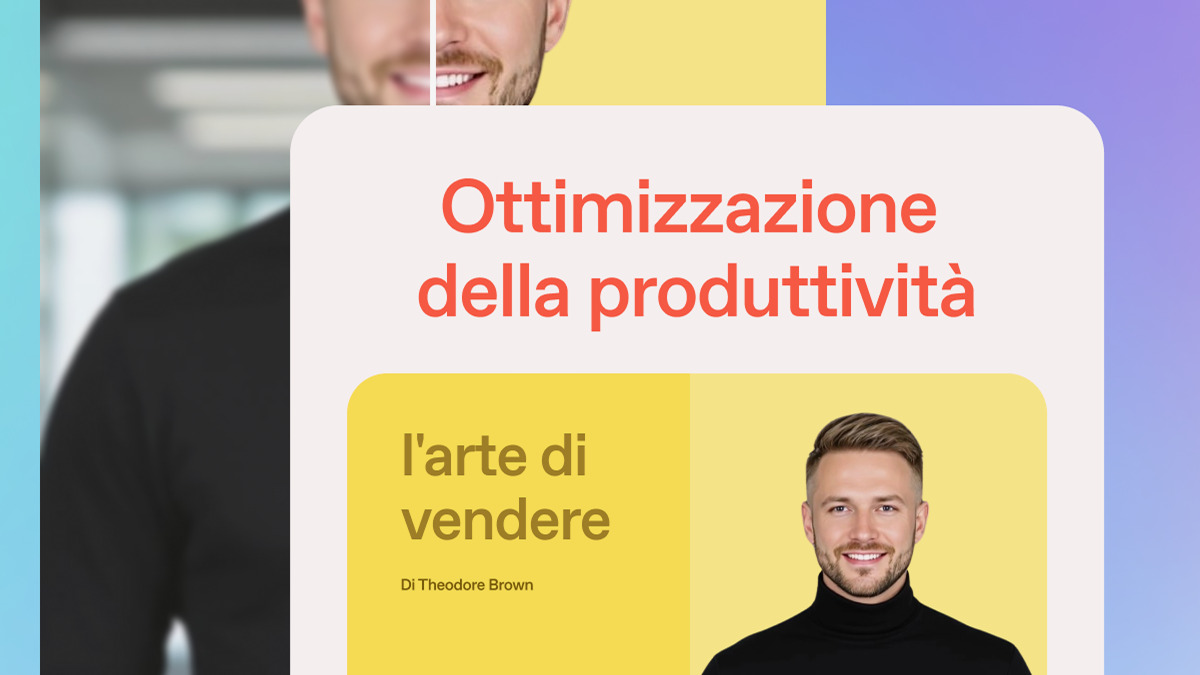 HeyGen's translation flow lets you preview the source and translated clip side by side before choosing lip-sync or audio-only output.
Source: heygen.com
HeyGen's translation flow lets you preview the source and translated clip side by side before choosing lip-sync or audio-only output.
Source: heygen.com
ElevenLabs: the voice-quality specialist
ElevenLabs doesn't try to compete on lip-sync realism. Its Dubbing product covers 90+ languages with automatic speaker detection, adjustable speaker-similarity settings, and a "cloning strength" dial that trades voice fidelity against natural delivery. Dubbing Studio, the manual-editing interface for fixing timing and re-assigning speakers, is officially in maintenance mode and only receiving bug fixes, so budget for the automatic pipeline rather than the studio workflow if you need ongoing feature support.
Pricing is credit-based across Free (10,000 credits), Starter ($6/month, 30,000 credits), Creator ($22/month, 121,000 credits), Pro ($99/month, 600,000 credits), Scale ($299/month, 1.8 million credits, 3 seats), and Business ($990/month, 6 million credits, 10 seats). Dubbing itself draws from that same pool at 2,000 credits per minute for automatic dubbing with a watermark, 3,000 without, and 5,000 or 10,000 for Dubbing Studio depending on watermark status. Run the math on the Creator plan and 121,000 credits covers roughly 40 minutes of watermark-free automatic dubbing a month, before you've spent a single credit on anything else in the account.
For teams that specifically need to clone a voice rather than dub existing footage, see our separate AI voice cloning comparison, which tests ElevenLabs against Resemble AI, Cartesia, and PlayHT on held-out audio.
Rask AI: built for teams, priced for it too
Rask AI leans hardest into collaborative workflows: shared projects, transcript editing, timestamp adjustment, and reusable cloned voices across a team, spanning 130+ languages. That collaboration layer comes at a real cost. Official pricing runs Free trial ($0, 3 minutes total), Creator ($60/month, 25 minutes), Creator Pro ($150/month, 100 minutes, multi-speaker lip-sync), and Business ($750/month, 500 minutes, $3 per additional minute). Annual billing drops the effective rate substantially, down to $78/month for Creator Pro (1,200 minutes/year) and $500/month for Business (6,000 minutes/year), with unused minutes rolling over rather than expiring at month end. Per-minute cost on the monthly Creator plan works out to $2.40/minute, among the highest of the tools in this piece, which makes Rask a harder sell for solo creators than for agencies billing lip-synced localization back to clients.
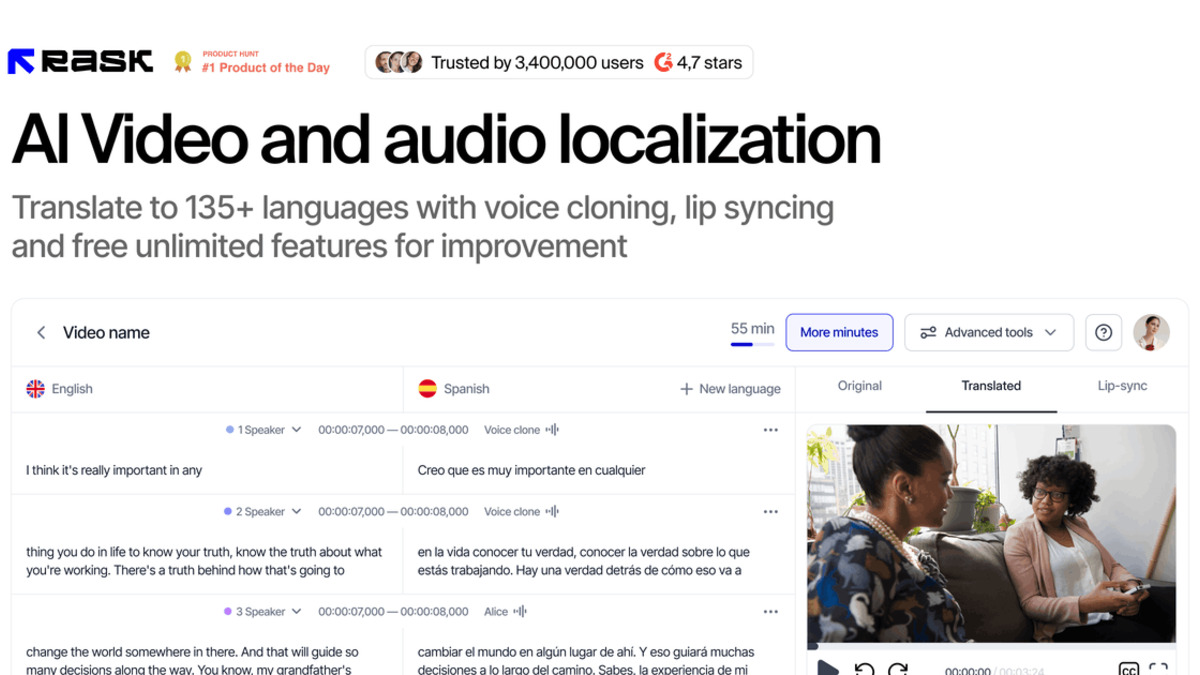 Rask AI's editor keeps original and translated transcripts aligned to the timeline for line-by-line review before export.
Source: rask.ai
Rask AI's editor keeps original and translated transcripts aligned to the timeline for line-by-line review before export.
Source: rask.ai
CAMB.AI: the only one with a real free tier
CAMB.AI is the outlier on pricing structure. Instead of gating dubbing behind a capped trial, it runs six self-serve tiers, all credit-based: Free ($0/month, 2,000 credits, watermarked output), Essentials ($5/month, 10,000 credits), Pro ($20/month, 40,000 credits, marked "most popular"), Premier ($75/month, 150,000 credits), Advanced ($250/month, 500,000 credits), and Expert ($900/month, 1.8 million credits). Annual billing knocks roughly 8-10% off each tier.
CAMB.AI doesn't publish a flat credits-per-minute rate for dubbing the way HeyGen and ElevenLabs do; cost depends on which of its MARS voice models and features you use, so budgeting exactly requires running a sample through the dashboard first. What it does confirm is broad language coverage (150+ languages) and enterprise customers that include IMAX, Broadcom, and Comcast, positioning it as one of the few platforms that scales from a hobbyist free account up to broadcast-grade work without switching vendors.
"Reach 8 billion people in any language," reads CAMB.AI's own pitch on its homepage - a claim about addressable audience, not accuracy, but the enterprise client roster backs up the scale ambition.
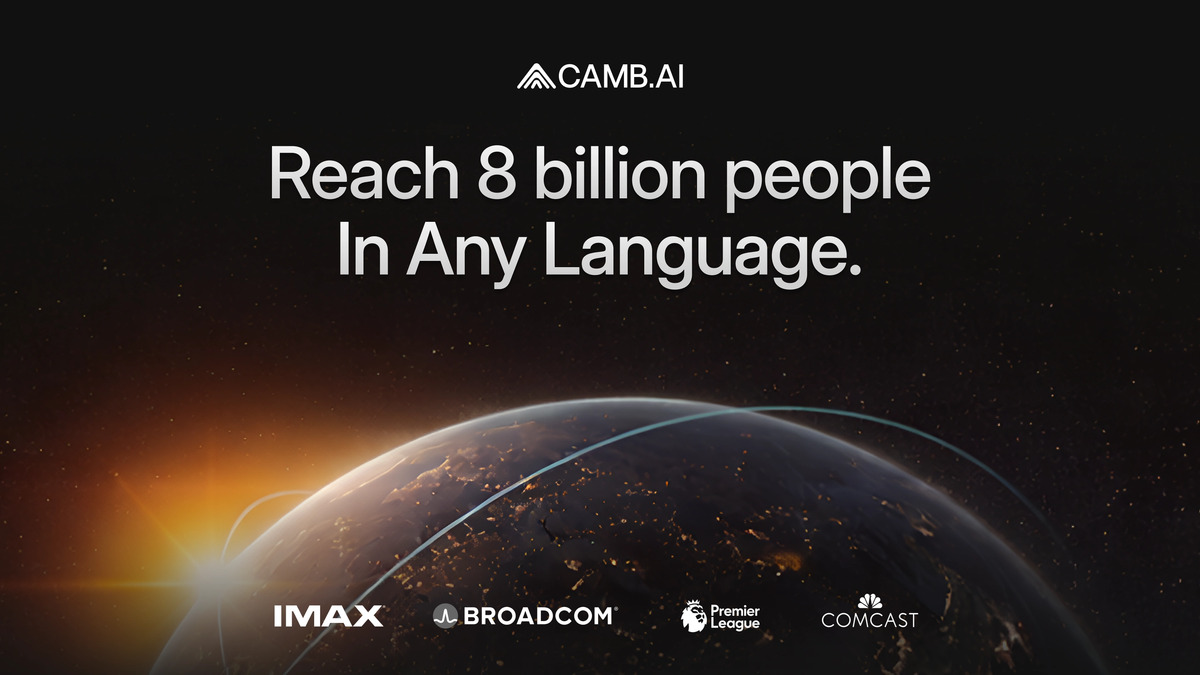 CAMB.AI pairs a genuinely free entry tier with enterprise broadcast clients, an unusual combination in this category.
Source: camb.ai
CAMB.AI pairs a genuinely free entry tier with enterprise broadcast clients, an unusual combination in this category.
Source: camb.ai
Deepdub: enterprise only, no public price
Deepdub targets film and broadcast localization and it prices accordingly: there's no self-serve plan and no published rate card. An enterprise subscription has been listed around $25,000 per year on AWS Marketplace, with individual project minimums commonly estimated between $10,000 and $50,000. A 14-day trial is available for business evaluation, capped at 10,000 characters of generation.
What you get for that spend is emotion-aware dubbing that reads a scene's emotional arc and adjusts vocal delivery accordingly, human-in-the-loop quality control for broadcast standards, a licensed voice library of 1,000+ voices across 100+ languages, and TPN-certified, GDPR-compliant infrastructure, the kind of compliance checklist that matters to studios but is irrelevant to a solo YouTuber. If your dubbing volume is one podcast a week, Deepdub isn't built for you. If you're localizing a scripted series across a dozen markets, it's one of the few tools built to handle multi-character continuity at that scale.
Dubverse: cheapest way in, strongest for Indian languages
Dubverse is the budget option, and it says so with its pricing: Pro at $18/month (or $9/month billed annually) and Supreme at $30/month (or $15/month annually), both including 50 monthly credits. Dubbing draws 4 credits per minute, subtitling 1 credit per minute, and AI voice generation 2 credits per minute, so a Pro subscriber gets about 12 minutes of pure dubbing a month before topping up, or a mix of dubbing and subtitling if the workload is split. There's no permanent free plan, just a 2-day trial that doesn't require a credit card.
Language coverage is the smallest of the six at roughly 30+ languages, but Dubverse's translation stack (branded "Eagle Translations" on the Supreme tier, built on GPT-4) is tuned specifically for Indian-language pairs, an area where broader platforms like HeyGen and ElevenLabs are optimized more for European and East Asian languages. Voice cloning and full Advanced Studio access are gated behind Supreme; Pro is subtitle-and-basic-dub only.
Lip-sync: the feature that doubles your bill
Every tool in this piece that offers lip-sync charges more for it than plain audio dubbing, and the gap is consistent: roughly double. HeyGen charges 5 credits/minute for lip-sync versus 2 for audio-only. ElevenLabs' Dubbing Studio (which handles lip-sync-adjacent editing) runs 5,000-10,000 credits/minute versus 2,000-3,000 for automatic audio dubbing. Rask AI locks multi-speaker lip-sync behind its $150/month Creator Pro tier rather than the $60/month Creator plan.
That pricing pattern reflects a real compute difference, not just margin. Lip-sync requires re-rendering the video's mouth movements frame by frame to match new phonemes, on top of the translation and voice-synthesis work that audio-only dubbing already does. If your content is audio-first (a podcast, an audiobook, a voiceover-heavy explainer) skip the lip-sync tier completely and cut your per-minute cost in half. If it's a talking-head video where mismatched mouth movement will be obvious, lip-sync is the whole point of paying for AI dubbing over a plain machine-translated subtitle track.
For a broader look at where translation quality currently sits across LLMs and dedicated MT engines, see our AI translation tools comparison and the machine translation benchmarks leaderboard, both of which cover the text layer that sits underneath every dubbing pipeline's language-switching step.
Best picks
Best overall: HeyGen. The combination of 175+ languages, both audio and lip-sync modes in the same dashboard, and a $29/month entry point makes it the default recommendation for most teams that need more than one target language.
Best for voice quality over lip-sync: ElevenLabs. If the deliverable is audio (podcast localization, audiobook narration, voiceover), ElevenLabs' voice-cloning fidelity is the strongest of the six, and you never pay the lip-sync tax.
Best free tier: CAMB.AI. A truly recurring $0/month plan with 2,000 credits beats every other tool's time-boxed trial, and the same account scales to broadcast-grade work later without a platform switch.
Best for agencies billing clients: Rask AI, despite the higher per-minute cost, because the collaboration and multi-speaker tooling are built for teams passing projects back and forth, not solo creators.
Skip unless you're a studio: Deepdub. The lack of published pricing and five-figure minimums only make sense at broadcast or streaming-platform volume.
Sources
✓ Last verified July 15, 2026

