
Best AI Drug Discovery and Biotech Tools in 2026
Five leading AI drug discovery platforms compared - AlphaFold 3, IsoDDE, Recursion OS, Insilico Pharma.AI, and NVIDIA BioNeMo. Access, capabilities, pricing, and clinical results.
 11 min read
The AI drug discovery market has moved from hype to verifiable clinical results faster than most sectors. As of early 2026, more than 173 AI-designed drug programs are in clinical development, and at least one - Insilico Medicine's INS018_055 - has reported statistically significant Phase II efficacy data. That's not a marketing claim. That's a patient-level result.
TL;DR
- AlphaFold 3 remains the free entry point for academic structure prediction - 10 predictions per day, non-commercial only
- IsoDDE (Isomorphic Labs) and Pharma.AI (Insilico) are the serious enterprise options, both priced through partnership deals rather than SaaS tiers
- NVIDIA BioNeMo is the open infrastructure play - free to self-host, enterprise support via NVIDIA AI Enterprise licensing
The field splits cleanly into two categories: structure prediction tools (AlphaFold 3, IsoDDE) and end-to-end drug design pipelines (Pharma.AI, Recursion OS, BioNeMo). Picking the wrong category for your use case wastes time. An academic lab running protein structure research has completely different requirements than a pharma company running a generative chemistry pipeline.
This comparison covers five platforms based on verified feature sets, publicly available benchmark data, and confirmed pricing where it exists. No fabricated scores.
1. AlphaFold 3 / AlphaFold Server
Developer: Google DeepMind Access: Free (non-commercial), academic model weights released Nov 2024 Limit: 10 predictions per day on the hosted server
AlphaFold 3 remains the most widely used structural biology tool in the world. The core capability - predicting the 3D structure of proteins, DNA, RNA, small molecules, ions, and chemical modifications in a single inference pass - was a genuine leap over its predecessor. The Nature paper reports 76% accuracy on ligand binding pose prediction, roughly double the previous best method.
The hosted AlphaFold Server at alphafoldserver.com is free for non-commercial use only. Eligible users include university researchers, non-profit institutes, and government research bodies. Commercial organizations cannot use the server - not even for internal research.
For teams who need local access, Google DeepMind released model weights under a non-commercial academic license in November 2024. Running it locally requires significant GPU resources; the inference pipeline isn't lightweight.
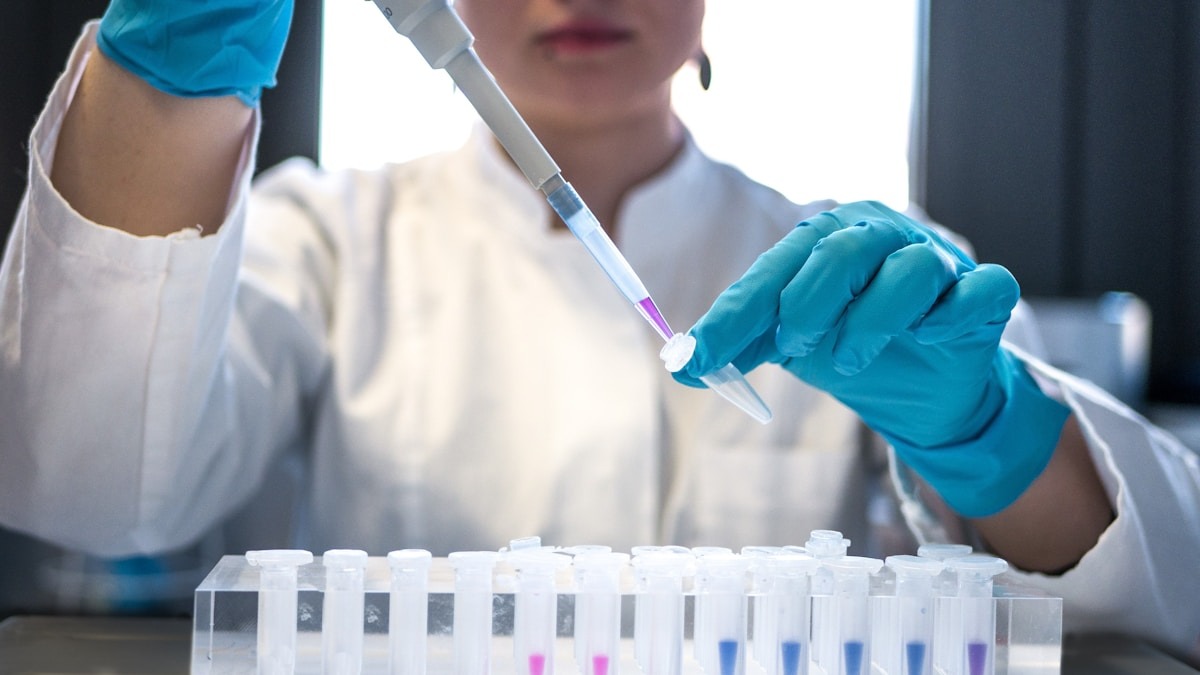 AlphaFold 3 can predict joint structures across proteins, nucleic acids, and small molecules in a single pass, enabling drug-target complex modeling that would have required months of crystallography a decade ago.
Source: unsplash.com
AlphaFold 3 can predict joint structures across proteins, nucleic acids, and small molecules in a single pass, enabling drug-target complex modeling that would have required months of crystallography a decade ago.
Source: unsplash.com
Where it fits
AlphaFold 3 is the right tool if you need structure prediction at no cost and your work is non-commercial. For target identification, binding site mapping, and off-target prediction on academic programs, it covers the job adequately. The 10-predictions-per-day cap becomes a real constraint at scale - if your pipeline runs hundreds of daily predictions, you need a local deployment or a commercial alternative.
The open-science decision to release weights for academic use matters. Multiple research groups have built specialized fine-tuned variants on top of the base weights, extending coverage to specific therapeutic areas.
What it doesn't do: generative molecule design, ADMET property prediction, automated experiment scheduling. It's a structure predictor, not a full drug design system.
2. IsoDDE - Isomorphic Labs Drug Design Engine
Developer: Isomorphic Labs (Alphabet/DeepMind spin-off) Access: Enterprise partnerships only - no public API, no self-hosted option Pricing: Not disclosed; partnership deals only
Isomorphic Labs unveiled IsoDDE in February 2026 as a "unified computational drug-design system" that goes beyond AlphaFold 3 in predictive accuracy. The benchmark claims check out against the published data.
On the "Runs N' Poses" benchmark - specifically the hardest category of protein-ligand structural predictions - IsoDDE more than doubles AlphaFold 3's accuracy. On antibody-antigen modeling, it reaches 2.3x better performance than AF3 for novel systems not in its training data, with particular gains in CDR-H3 loop prediction. Binding affinity prediction surpasses both deep-learning methods and physics-based approaches on multiple standard benchmarks without requiring experimental crystal structures.
The most practically useful capability is pocket identification from sequence alone. IsoDDE can find ligandable binding pockets - including cryptic pockets that don't appear in static crystal structures - using only the amino acid sequence. That matters for programs targeting proteins previously considered undruggable.
What commercial access looks like
There is no public pricing page, no API key you can buy, and no trial tier. Access comes through partnership agreements structured as research collaborations. Isomorphic Labs has deals with Eli Lilly (about $700 million in potential value) and Novartis (roughly $1.2 billion), both of which have advanced to preclinical candidate generation. Phase I trials of AI-designed molecules are expected in 2026.
If you're a pharma company with enough pipeline budget to structure a multi-target collaboration, IsoDDE is worth the conversation. For academic labs or smaller biotechs, it isn't accessible.
The closed-source nature is a real trade-off. The earlier AlphaFold tradition of open publication built an enormous research ecosystem around the weights. IsoDDE breaks from that - you can read the benchmark numbers in the technical blog post, but you can't audit the architecture or replicate the training. For regulated drug development, that black-box quality requires careful due diligence.
3. Recursion OS + LOWE
Developer: Recursion Pharmaceuticals (merged with Exscientia, July 2025) Access: Internal platform + selective external partnerships Pricing: Enterprise partnerships; not available as standalone SaaS
The July 2025 merger of Recursion and Exscientia created the largest combined AI drug discovery pipeline by breadth. The merged entity integrates Recursion's high-throughput biological imaging - more than 2.2 million experiments per week across 50 human cell types and more than 60 petabytes of proprietary data - with Exscientia's precision molecular design tools.
The Recursion Operating System (OS) covers the full discovery workflow. LOWE, the LLM-Orchestrated Workflow Engine, is the natural-language interface layer on top of it. Scientists type plain-language prompts to chain together target identification, compound generation, ADMET property prediction, and experiment scheduling - without needing ML engineering skills.
 Recursion operates fully automated labs running over 2.2 million experiments per week, creating the proprietary biological dataset that powers its LOWE AI platform.
Source: unsplash.com
Recursion operates fully automated labs running over 2.2 million experiments per week, creating the proprietary biological dataset that powers its LOWE AI platform.
Source: unsplash.com
LOWE pulls from PhenoMap - Recursion's map of biological-chemical space derived from its imaging data - and MatchMaker, the drug-target identification module. Generative chemistry tools create novel candidate structures, and compounds can be queued for synthesis and physical screening within the same workflow.
The clinical pipeline tells the story: five differentiated programs in active clinical development with defined milestones, plus more than $500 million in upfront and progress-based milestone payments earned. REC-3964 for C. difficile infection is targeting Phase II data in Q1 2026; REC-1245 for solid tumors and lymphoma expects Phase I dose-escalation data in H1 2026. That's a real track record, not projected outcomes.
The failure record matters too
In May 2025, Recursion discontinued REC-994 for cerebral cavernous malformation after long-term data didn't confirm earlier efficacy trends. Any credible comparison of these platforms has to include failure rates - an AI pipeline that never reports failures is a pipeline that isn't being honest about its hit rate. Recursion's willingness to disclose discontinuations publicly is a signal worth noting.
External access isn't structured as a product you can license. Recursion uses the platform internally and through select collaborations. If you're assessing this as a pharma R&D lead, the conversation starts with their business development team.
4. Insilico Medicine - Pharma.AI
Developer: Insilico Medicine Access: Licensing and co-development partnerships; 13 of the top 20 pharma companies have signed agreements Pricing: Licensing upfront payments range from tens of millions to $115 million (Eli Lilly deal); milestone structures vary
Insilico's Pharma.AI is the most clinically validated end-to-end generative AI drug discovery platform currently operating. The evidence: INS018_055, a pan-fibrotic inhibitor designed completely by the platform, has completed Phase II with patients.
The Phase II results from the 12-week study showed a favorable safety profile and clear dose-response in lung function. The 60mg once-daily cohort gained +98.4mL in FVC while the placebo arm declined by -20.3mL. That's a statistically meaningful benefit on a gold-standard clinical endpoint. Generative AI designed that molecule. That's a first.
INS018_055 went from target identification to Phase I in 30 months. Traditional programs average 6-10 years for the same milestone.
The platform has three integrated components:
PandaOmics handles target identification and validation, mapping disease biology to potential intervention points across more than 100 therapeutic areas (up from 38 in earlier versions via TargetPro 2.0).
Chemistry42 handles generative molecule design - creating novel candidate structures optimized for the target, with predicted ADMET properties computed inline.
inClinico handles clinical trial design and outcome prediction, using real-world data to flag programs with higher probability of success before they reach expensive late-stage testing.
The commercial model works through software licensing and co-development agreements. Eli Lilly paid $115 million upfront for platform access focused on oral drug discovery, against potential milestones of up to $2.6 billion. Servier is paying up to $888 million for oncology AI co-discovery. Insilico has also signed licensing agreements with 13 of the world's top 20 pharma companies, which suggests the platform clears procurement requirements even in conservative enterprise environments.
For organizations that don't need a full co-development partnership, software-only licensing is available - the exact price depends on the scope of modules and targets covered.
5. NVIDIA BioNeMo
Developer: NVIDIA Access: Open-source (GitHub), BioNeMo NIMs via NVIDIA AI Enterprise Pricing: Open-source free; NVIDIA AI Enterprise cloud deployments priced per GPU-hour
BioNeMo is the infrastructure layer, not the pipeline. It provides pre-trained biological foundation models, GPU-accelerated libraries, and NIM microservices that teams use to build their own discovery workflows rather than accessing a finished drug design system.
The January 2026 platform update added two models worth noting: RNAPro for RNA structure prediction and ReaSyn v2 for synthesizability prediction - checking whether AI-designed drug candidates can actually be made in a lab. That last point matters more than it sounds. One failure mode for purely generative pipelines is producing molecules that are computationally promising but synthetically impossible. ReaSyn filters those out.
BioNeMo Recipes, introduced in the same update, standardize the format for training, fine-tuning, and rolling out biological foundation models. The stated goal is lowering the barrier for teams without deep ML engineering expertise. NvMolKit, the GPU-accelerated cheminformatics library included in the data processing stack, handles the molecular featurization and filtering that otherwise requires custom code for every project.
Who it's for
NVIDIA's go-to-market for BioNeMo runs through partnerships. The company announced a joint co-innovation AI lab with Eli Lilly in January 2026, with commitments of up to $1 billion over five years. Isomorphic Labs is building on BioNeMo infrastructure. Adoption is broad across the industry - AstraZeneca, Amgen, and more than a dozen others have adopted BioNeMo components.
For teams building a custom discovery platform: BioNeMo provides the foundation model layer and GPU-optimized inference, which is the expensive part to build from scratch. For teams wanting a complete drug design system out of the box: it isn't that. You still need to assemble the pipeline on top.
Self-hosting requires NVIDIA H100 or H200 GPUs for most of the larger models. Enterprise support and the NIM microservices packaging require a NVIDIA AI Enterprise license; pricing runs per GPU-hour in cloud deployments.
Comparison Table
| Platform | Primary Use | Access Model | Free Tier | Clinical Track Record |
|---|---|---|---|---|
| AlphaFold 3 | Structure prediction | Free (non-commercial) | Yes, 10/day | N/A - research tool |
| IsoDDE | Structure + affinity prediction | Enterprise partnership only | No | Preclinical candidates, Phase I expected 2026 |
| Recursion OS + LOWE | Full discovery pipeline | Internal + partnerships | No | 5 active clinical programs |
| Insilico Pharma.AI | Full discovery pipeline | Licensing + co-dev | No | Phase II efficacy data (INS018_055) |
| NVIDIA BioNeMo | Infrastructure / foundation models | Open-source + enterprise | Yes (self-host) | Indirect (partners' programs) |
Picking the Right Tool
The choice depends almost completely on your stage and resources.
Academic or nonprofit researchers doing structural biology work should start with AlphaFold 3 via the free server. The 10-predictions-per-day limit is a real constraint for high-throughput work, but for standard target characterization, it's sufficient. The released model weights enable local deployment if you have GPU resources.
Biotech companies with active programs and the budget for external partnerships should assess Pharma.AI and IsoDDE based on therapeutic area fit. Insilico's approach is better documented - you can read the Phase II data, not just the benchmark claims. IsoDDE's accuracy numbers are strong, but the proprietary nature means less external validation.
Drug discovery organizations that want to build proprietary internal tooling on top of open infrastructure should look at BioNeMo. The foundation models are strong, NVIDIA's GPU ecosystem integration is real, and it doesn't lock you into a single vendor's methodology.
Recursion OS is a different category - it's a platform for a company that has already made AI-first biology its core thesis. The combination of 60+ petabytes of proprietary imaging data and LOWE's workflow automation isn't something an external team can replicate by licensing the software. The value is in the data flywheel.
The broader reality: as of 2026, none of these tools remove the need for experimental biology. They compress timelines and improve hit rates. INS018_055's 30-month target-to-Phase-I timeline is real, but the clinical Phase II still required patients, sites, and investigators. The tools are faster; the trials still take years.
Sources
- AlphaFold 3 Nature paper - Accurate structure prediction of biomolecular interactions
- AlphaFold Server - free access for non-commercial research
- Isomorphic Labs IsoDDE announcement - Drug Design Engine unlocks new frontier
- Insilico Medicine Phase II results - first generative AI drug in Phase II with patients
- Insilico Medicine - from target to Phase I in 30 months
- Insilico - Eli Lilly $2.75B AI drug discovery deal (TechTarget)
- NVIDIA BioNeMo platform adoption - life sciences leaders press release
- NVIDIA BioNeMo for biopharma - official product page
- Recursion LOWE drug discovery software announcement
- Recursion Q4 2025 financial results and business update
- Recursion and Exscientia merger announcement
- Schrödinger FEP+ platform page
- AI drug discovery capital stack analysis 2026 (OnHealthcare)
✓ Last verified April 25, 2026

