
Best AI Content Detectors 2026, Ranked by Accuracy
GPTZero, Originality.ai, Copyleaks, Turnitin, Winston AI, and Sapling compared on pricing, real accuracy, and false positive rates - not just marketing claims.
 11 min read
Every AI content detector on the market advertises a number in the high 90s. GPTZero's homepage says 99%. Copyleaks says 99%, "backed by independent third-party studies." Winston AI goes further and claims 99.98%, calling itself "the only AI detector" with that figure. Sapling is the outlier - it says 97%+ and then adds a caveat none of the others bother with: no detector should be used as a standalone check.
TL;DR
- Best overall pick: Originality.ai - the most complete package for publishers and content teams, with plagiarism, fact-checking, and grammar bundled into one scan.
- Best budget/free pick: GPTZero's free tier (10,000 words/month) is the most usable no-cost option; Sapling's unlimited free checker has no word cap but weaker reporting.
- Key differentiator: none of these tools have been independently verified anywhere near their advertised accuracy once text is edited, paraphrased, or written by a non-native English speaker - that gap is the entire story.
The pitch vs. the evidence
Every vendor's accuracy number comes from testing raw, unedited output from a single model, usually ChatGPT, on a clean sample set. That's a real number, but it describes the easiest possible case for a detector to catch. It says nothing about a student who ran a draft through a paraphraser, a freelancer who edited an AI first pass by hand, or a non-native English speaker whose sentence structure just happens to look "flat" to a perplexity model.
The most rigorous public research on this problem is a 2023 Stanford study, published on arXiv and later added to Stanford's AI Index repository, which ran seven widely used GPT detectors against 91 TOEFL essays written by non-native English speakers. Every detector performed close to perfectly on US eighth-grade essays. On the TOEFL set, the seven detectors misclassified human-written essays as AI-produced at an average false-positive rate of 61.3%. Eighteen of the ninety-one essays were flagged as AI-written by every single detector tested, unanimously, despite being written completely by humans.
That bias comes from how these tools work. Most detectors score text on perplexity and burstiness - how predictable and how varied the sentence structure is. Non-native writers, by definition, tend to use a narrower vocabulary and more uniform sentence patterns than native speakers, which is exactly the signature these models associate with AI generation. The Stanford researchers found that simply asking GPT to rewrite the same non-native essays with more varied phrasing removed the false-positive flag completely - meaning the tools are detecting linguistic simplicity, not machine authorship.
Turnitin, to its credit, has published its own data on this. The company's blog states its AI writing detector's false positive rate is under 1% for documents where 20% or more of the text is flagged as AI-produced - but concedes the rate climbs meaningfully in documents near that 20% threshold, and it raised the minimum submission length to 300 words specifically to reduce false hits on short texts. Independent reporting has documented what that looks like in practice: Inside Higher Ed and K-12 Dive both reported on real false-positive incidents that pushed several university systems to disable AI detection in their Turnitin instances entirely, and The Markup documented international students being formally accused of cheating on the strength of a detector score alone.
None of this means the tools are useless. It means the marketing number and the number you'll get on a messy real-world document are two different things, and the gap is largest for exactly the students and writers who can least afford a false accusation.
The detectors, compared
| Tool | Starting price | Entry-tier limit | Claimed accuracy | Best for |
|---|---|---|---|---|
| GPTZero | Free / $14.99/mo | 10,000 words free; 150,000 words/mo paid | 99% (vendor claim) | Educators, quick triage |
| Originality.ai | $14.95/mo ($12.95 annual) | 2,000 credits/mo = 200,000 words | "Most accurate," per vendor | Publishers, content teams |
| Copyleaks | Custom (Personal tier ~$16.99/mo reported) | 25,000 words/mo | 99%, "backed by independent studies" | Enterprise, LMS integration |
| Turnitin | Institutional only, no public price | N/A (per-institution license) | <1% false positive above 20% AI threshold (vendor claim) | Universities already licensing Turnitin |
| Winston AI | $18/mo ($10/mo annual) | 100,000 credits/mo | 99.98% (vendor claim) | Agencies needing PDF reports |
| Sapling | Free (2,000 characters) / $25/mo | 50,000 characters per query on Pro | 97%+, <3% false positive (vendor claim, longer texts only) | API integration, ATS screening |
Pricing pulled from each vendor's official pricing page in July 2026. Confirm current tiers before buying - these vendors change pricing often.
GPTZero
GPTZero built its brand on education, and it shows: the dashboard is built around a Documents tab for tracking student submissions, and the company advertises 1 million educator users on its homepage. It's a natural companion to the tools covered in our best AI tools for teachers and educators roundup, most of which are built to assign the work a detector is later asked to check. Pricing is a free tier capped at 10,000 words a month, an Essential plan at $14.99/month ($8.33/month billed annually), and a Premium plan at $23.99/month ($12.99/month billed annually) with 300,000 words and unlimited batch uploads, according to GPTZero's pricing page.
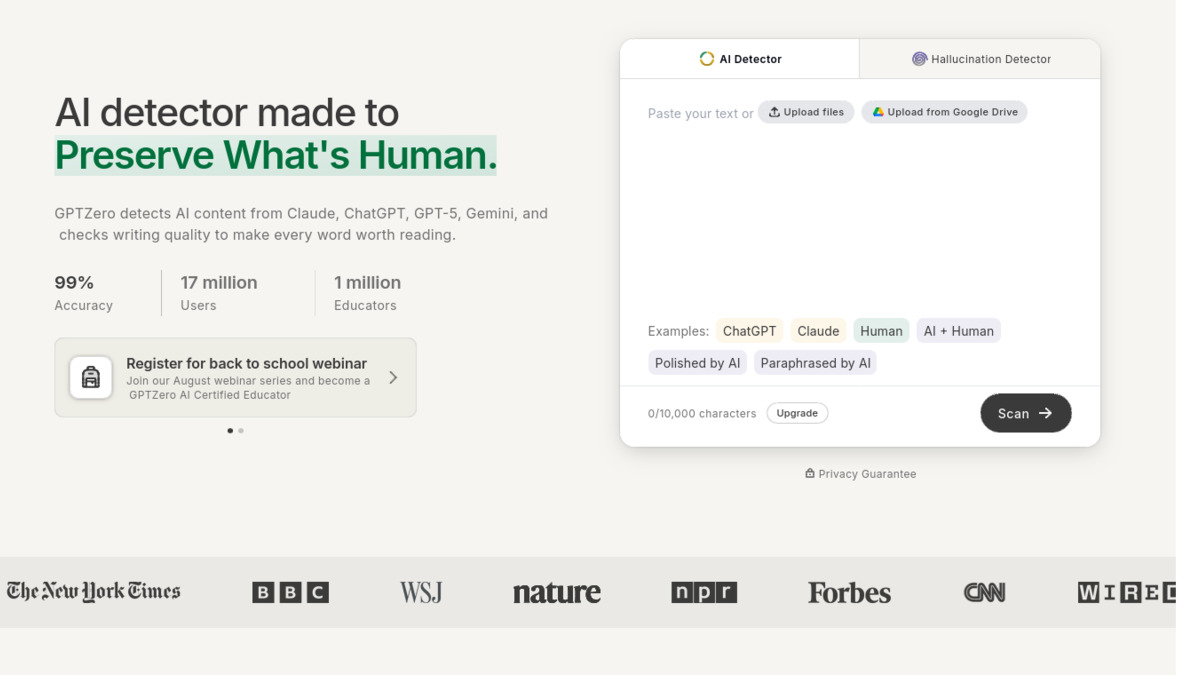 GPTZero's live homepage widget, which lets you paste text and scan it before signing up.
Source: gptzero.me
GPTZero's live homepage widget, which lets you paste text and scan it before signing up.
Source: gptzero.me
The tool's own site lists a 99% accuracy figure prominently on its homepage alongside logos from the New York Times, BBC, and Forbes as press credibility markers. That number, like every other vendor's headline claim, is measured on the tool's own test set of raw AI output - not the paraphrased-and-edited cases that make up most real disputes.
Originality.ai
Originality.ai is built for the opposite audience: publishers and marketing teams checking whether contractor-delivered content is truly human, not students. The product bundles AI detection with a plagiarism checker, a fact-checker, a grammar checker, and a readability score in the same scan, which is the strongest case for it over single-purpose competitors.
Pricing runs $14.95/month ($12.95/month billed annually) for the Pro plan with 2,000 credits a month, where one credit covers 100 words of AI-only scanning - roughly 200,000 words monthly. Enterprise is $179/month ($136.58/month annually) for 15,000 credits, API access, and a full year of scan history, per Originality.ai's pricing page. There's also a $30 one-time pay-as-you-go option for 3,000 credits that don't expire for two years.
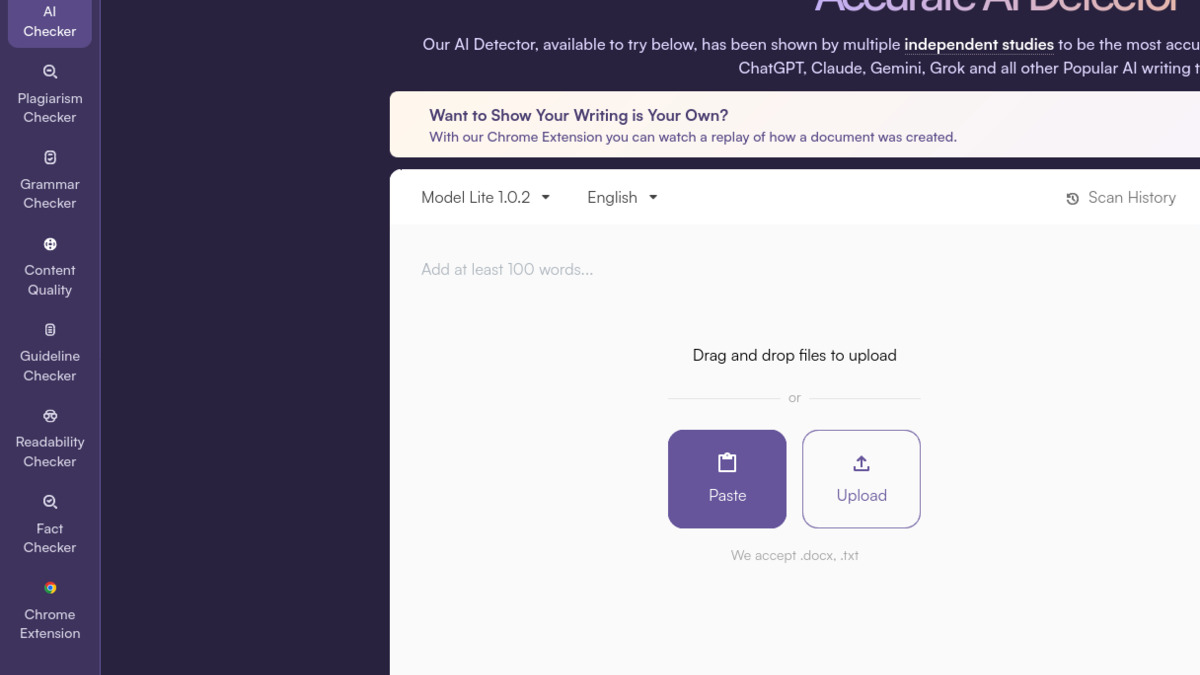 Originality.ai's scanning interface, which lets you pick a detection model version and pull up prior scans.
Source: originality.ai
Originality.ai's scanning interface, which lets you pick a detection model version and pull up prior scans.
Source: originality.ai
The company's own homepage states its detector "has been shown by multiple independent studies to be the most accurate AI Detector they tested" against ChatGPT, Claude, Gemini, and Grok output - a claim worth verifying against whatever specific study is cited before repeating it to a client, since "independent studies" is doing a lot of unspecified work in that sentence.
Copyleaks
Copyleaks leans hardest into enterprise and institutional buyers: LMS integrations, an API, and multilingual detection are the pitch, more than the single-document workflow GPTZero and Originality.ai are built around. The product's homepage claims "99% accuracy backed by independent third-party studies," visible directly on its AI Detector landing page.
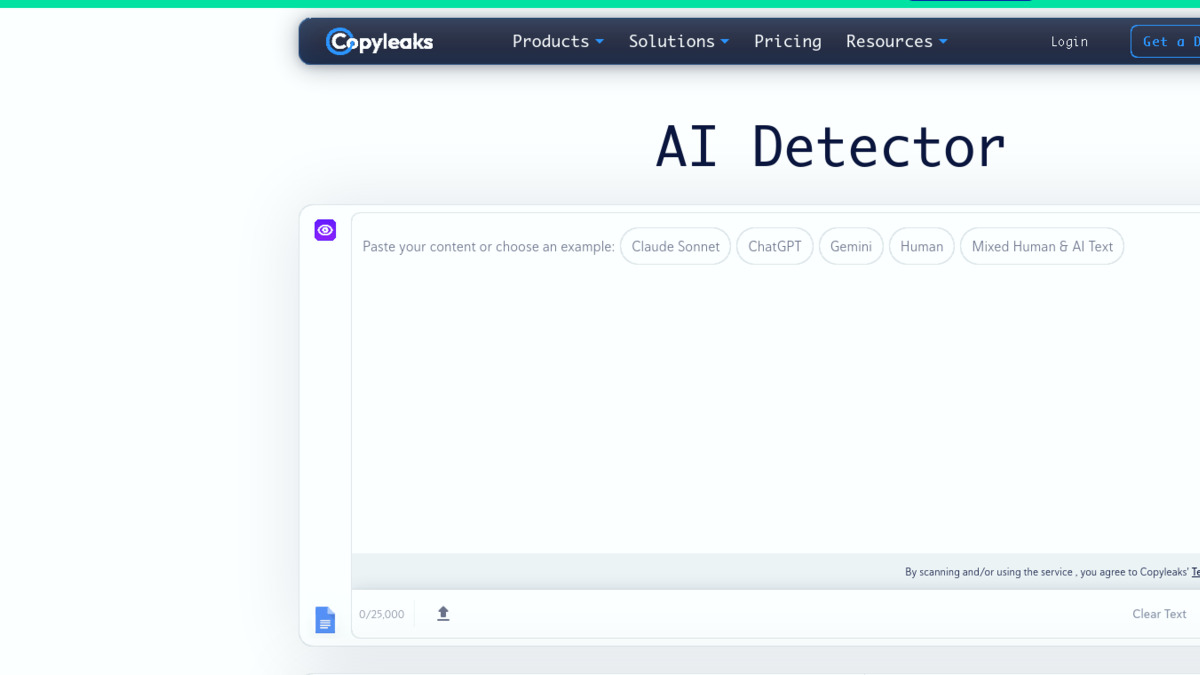 Copyleaks' detector interface, with preset examples for ChatGPT, Gemini, Claude Sonnet, and mixed human/AI text.
Source: copyleaks.com
Copyleaks' detector interface, with preset examples for ChatGPT, Gemini, Claude Sonnet, and mixed human/AI text.
Source: copyleaks.com
Individual pricing (Personal tier, reported around $16.99/month or $13.99/month annual for 25,000 words) isn't the point of the product - Copyleaks' actual pricing page returns a bot-protection wall for automated tools, which is itself a signal the company is tuning for direct sales conversations with schools and enterprises rather than self-serve signups. Budget-conscious individual users are better served elsewhere.
Turnitin
Turnitin is the incumbent almost every university already has a contract with for plagiarism checking, and its AI writing detector ships as an add-on to that existing relationship rather than a standalone product you can sign up for individually. There's no public price list - institutions negotiate per-student licensing based on enrollment, product mix, and contract length, a structure the company has kept opaque since the AI detector launched.
What sets Turnitin apart isn't pricing transparency, it's that the company has published its own limitations research rather than only marketing claims. Its blog post on understanding false positives is a rare instance of a detector vendor documenting where its own tool breaks down, rather than leaving that work entirely to journalists and academics.
"In our testing, when we look at predictions of 20% or more AI writing... false positives are less than 1%. In cases where our model determines that less than 20% of a submission is AI-written, the model is more prone to incorrect predictions." - Turnitin, on its own AI writing detection false positive rate
Winston AI
Winston AI positions itself as the premium option for agencies and editors who need shareable PDF reports rather than a raw score. Its own homepage states plainly: "The only AI detector with a 99.98% accuracy rate."
Pricing starts at $18/month ($10/month billed annually) for 100,000 credits, scaling to $29/month ($16/month annual) for 200,000 credits and $49/month ($26/month annual) for 500,000 credits with unlimited team seats, according to Winston AI's pricing page. A free 14-day trial includes 2,000 credits. The tool also checks for plagiarism and flags AI-produced images alongside text, which most competitors handle as a separate product.
Sapling
Sapling is the detector aimed at developers rather than end users - its main distribution is an API, and its pricing reflects that: a free unlimited checker capped at 2,000 characters per query, and a Pro plan at $25/month ($12/month billed annually) that raises the limit to 50,000 characters. According to Sapling's own product page, the detector claims 97%+ detection on AI-created content and under 3% false positives on human-written text - but only on longer samples, and the same page includes the most direct disclaimer of any vendor covered here: no current AI content detector should be used as a standalone check.
That single line of self-awareness is worth more than most competitors' accuracy percentages. If you're on the other side of this equation - trying to produce writing that reads as clearly human without gaming a detector - see our best AI writing tools and best AI grammar checkers comparisons, since editing tools like Grammarly change surface-level phrasing in ways that can also shift detector scores.
What actually holds up
- Raw, unedited AI text from mainstream chatbots is the case every tool in this list handles well. If you're checking a document nobody bothered to disguise, any of these six will likely flag it correctly.
- Paraphrased or lightly edited AI drafts are where detection quality diverges most and where vendors publish the least verifiable data. Treat any specific accuracy percentage for this scenario with skepticism unless the vendor names its test methodology.
- Non-native English writing is the documented failure mode with the strongest evidence behind it - the Stanford arXiv study's 61.3% average false-positive rate isn't a marketing rebuttal, it's peer-reviewed methodology anyone can read.
- Institutional use (Turnitin, Copyleaks) carries higher stakes than a marketing team screening freelance copy, because a false positive can trigger an academic integrity case rather than just a re-scan.
FAQ
Can AI content detectors be trusted for high-stakes decisions like academic discipline?
No detector vendor covered here claims their tool should be used alone. Turnitin, Sapling, and independent research all show meaningfully higher false-positive rates on edited or non-native English text than headline accuracy numbers suggest.
Which AI detector has the best free tier?
GPTZero's free plan allows 10,000 words per month with no credit card required, the most usable no-cost allowance among the tools compared here. Sapling's free tier is unlimited but capped at roughly 2,000 characters per single check.
Do these detectors work on Claude, Gemini, and other non-ChatGPT models?
Yes. GPTZero, Copyleaks, and Originality.ai all explicitly list ChatGPT, Claude, Gemini, and Grok as covered models on their product pages as of mid-2026.
Why do detectors flag non-native English writers as AI more often?
Detectors score text on predictability and sentence variation. Non-native writers often use narrower vocabulary and more uniform sentence structure, the same statistical signature detectors associate with AI-produced text - a bias documented in a 2023 Stanford arXiv study across seven detectors.
Is there a detector with zero false positives?
No. Every vendor and every independent study reviewed for this article reports a nonzero false-positive rate, and several vendors' own published numbers are lower than what independent testing and journalism have documented in practice.
Best pick
For most content teams and publishers, Originality.ai is the strongest overall package - the bundled plagiarism, fact-checking, and grammar tools justify the $14.95/month entry price better than a single-purpose detector would. For anyone who just needs an occasional free check, GPTZero's 10,000-word monthly allowance is the most usable no-cost option on this list. For institutions already paying for Turnitin, the AI detector add-on is worth enabling only with a clear appeals process - the tool's own data shows its false-positive rate rises well above 1% outside the easiest cases, and the human cost of an unreviewed false accusation isn't something any of these products' accuracy percentages capture.
Sources
- GPTZero Pricing
- Originality.ai Pricing
- Winston AI Pricing
- Sapling AI Content Detector
- Copyleaks AI Content Detector
- GPT detectors are biased against non-native English writers (arXiv, 2304.02819)
- Stanford SCALE repository entry on the same study
- Turnitin: Understanding false positives within our AI writing detection capabilities
- Inside Higher Ed: Turnitin's AI detector, higher-than-expected false positives
- K-12 Dive: Turnitin admits higher false positives in AI writing detection
- The Markup: AI Detection Tools Falsely Accuse International Students of Cheating
✓ Last verified July 29, 2026

