
Best AI Coding IDEs 2026: Cursor, Windsurf, Kiro, Zed, Copilot
A benchmark-driven comparison of the five leading AI coding IDEs in 2026, covering pricing, agent capabilities, and who each one is actually built for.
 10 min read
The AI coding IDE market looked very different twelve months ago. Cursor was the clear frontrunner, Windsurf was a scrappy $15/month challenger, and GitHub Copilot was the safe enterprise default. Then AWS shipped Kiro in May 2026, Windsurf got acquired by Cognition and is now absorbing the Devin cloud agent platform, and Zed hit version 1.0 with an open protocol for plugging in any AI agent. The field is truly competitive now, and the differences between tools have gotten sharper.
I've spent time testing all five to figure out what actually matters. This isn't a feature checklist - it's about where each editor earns its money versus where it falls short.
TL;DR
- Cursor is still the strongest daily driver for agentic coding at $20/month, with background agents and BugBot integration that nothing else matches yet
- GitHub Copilot is the best value for teams already on GitHub, at $10/month for individuals with the widest IDE coverage of any tool here
- Kiro is the most interesting new entrant - AWS's spec-driven approach cuts rework on complex features, though it's unproven at scale
How We Evaluated
Five tools made this comparison: Cursor, Windsurf (now migrating toward Devin Desktop), GitHub Copilot, Kiro, and Zed. Evaluation criteria: tab completion quality, multi-file agent capability, pricing transparency, context handling, and real-world friction. Where available, third-party benchmarks like SWE-bench Verified scores are included. Where benchmarks don't exist, I note that directly rather than guessing.
Cursor - The Agentic Standard
Cursor crossed $100M ARR in under two years, which tells you something about developer appetite for an AI-native IDE done well. Built on VS Code, it replaces most of the workflow you'd expect from an IDE while layering in multi-model AI access all through.
The headline features in 2026 are Background Agents and BugBot. Background Agents let you spin up parallel coding tasks - one agent working on a feature branch while you continue editing in the main view. BugBot, now integrated with usage-based billing, scans pull requests and can automatically spin up a cloud agent to propose fixes directly on the PR. Neither is sci-fi; both work reliably enough to change your workflow.
The credit system, introduced in June 2025 after some community backlash over surprise charges, is worth understanding before you commit. Every plan includes a monthly credit pool equal to the subscription price: $20 on Pro, $60 on Pro+, $200 on Ultra. Tab completions and Auto mode use credits at low rates. Manually selecting Claude Opus 4 or GPT-5 for a complex multi-file refactor will burn through them faster. Most developers on Pro report that $20 covers normal use comfortably, but heavy agent users report needing Pro+ within weeks.
The cursor-vs-windsurf-2026 comparison goes deeper on the head-to-head, but the short version is: Cursor wins on autocomplete speed and small-edit fluency. A standardized March 2026 test found Cursor completed a responsive data table component in 2 rounds of prompting versus 3 for Windsurf and 5 for Copilot with manual fixes.
Pricing: Hobby free (limited), Pro $20/month, Teams $40/user/month, Enterprise custom.
Best for: Developers who want the most capable agentic coding tool and are comfortable spending $20-60/month for regular agent use.
Windsurf - Flow State, Now With Devin
Windsurf's 2026 story is complicated by acquisition. Google poached the founding team for $2.4 billion, then Cognition picked up what remained - the product and the team - for $250 million. The product is now absorbing Devin, Cognition's autonomous coding agent, with the combined offering gradually becoming "Devin Desktop."
That context matters because Windsurf's direction has shifted. The standalone IDE isn't going away, but the roadmap is now oriented around Devin cloud integration, and some features that would improve the local editing experience are visibly deprioritized.
What you get today is still strong. Cascade, Windsurf's core agent mode, reads your entire repository, tracks edits made during the session, and executes multi-step tasks across multiple files. Codemaps provide AI-annotated visual code navigation - a unique feature with no direct equivalent in any of the other tools here. The SWE-1.6 proprietary model, released April 7, 2026, runs at 950 tokens/second on the fast tier and carries zero quota cost for all users including Free. That's a meaningful practical advantage: you get fast, capable completions on the base model without chewing into your monthly quota.
Windsurf raised Pro from $15 to $20/month in March 2026, which made the pricing differential with Cursor disappear. A new Max tier at $200/month arrived at the same time for heavy users. Teams plans went from $30 to $40/user/month.
Pricing: Free, Pro $20/month, Max $200/month, Teams $40/user/month, Enterprise custom.
Best for: Developers who want Cascade's flow-state approach and plan to use Devin cloud agents for autonomous tasks; teams with EU compliance requirements (Windsurf has relevant certifications).
GitHub Copilot - The Broadest Ecosystem
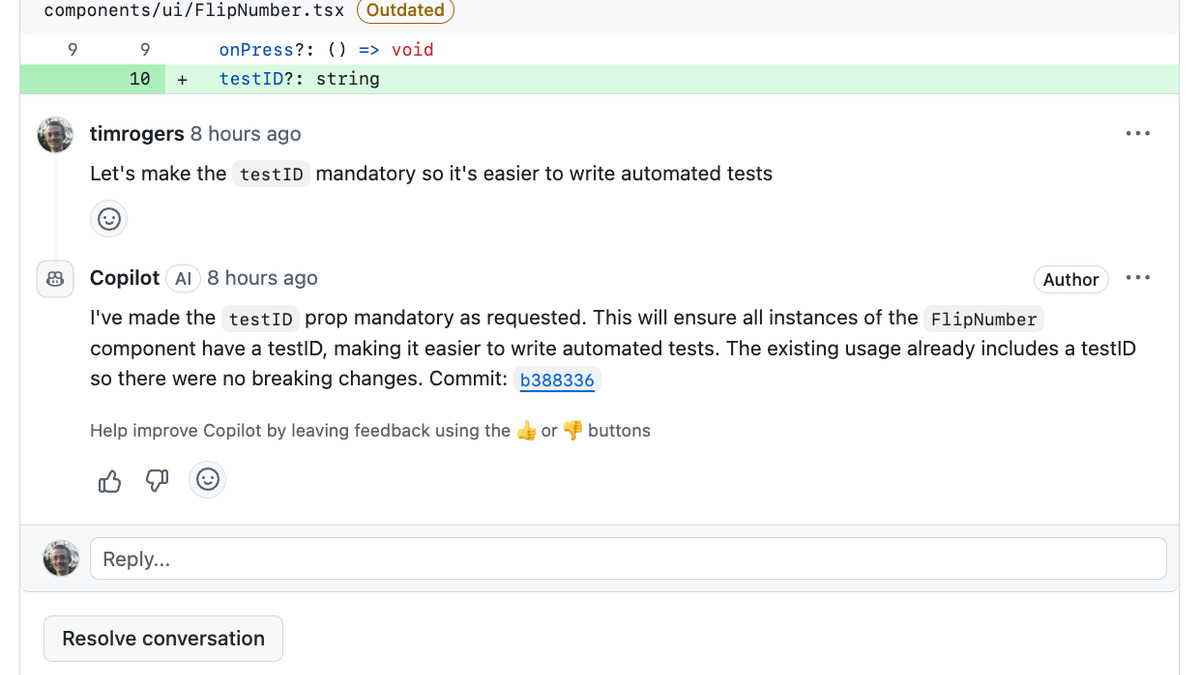 GitHub Copilot's Coding Agent can handle issues-to-PRs autonomously inside VS Code.
Source: github.com
GitHub Copilot's Coding Agent can handle issues-to-PRs autonomously inside VS Code.
Source: github.com
GitHub Copilot has 4.7 million paid subscribers and 90% Fortune 100 adoption, numbers that reflect something real: it's the only tool here that works across VS Code, JetBrains, Xcode, Neovim, Visual Studio, and Eclipse. If your team isn't willing to switch editors, Copilot is the only serious option.
The Coding Agent feature - which converts GitHub Issues into pull requests autonomously - is the headline addition for 2026 and genuinely useful for teams with well-specified issue backlogs. For greenfield agentic coding, it still lags behind Cursor. But for GitHub-native teams doing gradual feature work, the issues-to-PRs flow reduces the overhead that makes AI coding agents frustrating in practice.
Copilot moved to usage-based billing on June 1, 2026. Every plan now comes with a monthly pool of GitHub AI Credits (1 credit = $0.01 USD). Pro at $10/month includes $10 worth of credits, Pro+ at $39/month includes $39. This mirrors what Cursor and Windsurf have already done, though Copilot's base price is still meaningfully lower for individual developers.
The Free tier is genuinely usable: 2,000 completions and 50 agent requests per month. For developers who want to see if AI coding assistance is worth paying for, Copilot Free is a reasonable starting point. See the best-ai-coding-free-tier-2026 comparison for how the free tiers across all five tools compare.
Pricing: Free (2,000 completions, 50 agent requests), Pro $10/month, Pro+ $39/month, Business $19/user/month, Enterprise $39/user/month.
Best for: Teams on GitHub who need multi-IDE support, lowest per-seat cost at team scale, and tight integration with GitHub Actions and issue tracking.
Kiro - Spec-Driven and New
AWS launched Kiro internationally on May 7, 2026 - not as a feature update but as a ground-up replacement for Amazon Q Developer. The design bet is spec-driven development: before writing any code, Kiro creates three structured markdown files - requirements.md, design.md, and tasks.md - that formalize the acceptance criteria and implementation plan. The agent builds to the spec, not the prompt.
Teams using spec-driven development report meaningfully less rework on complex features, because acceptance criteria surface misunderstandings before code is written rather than after.
This approach sounds bureaucratic until you've spent time debugging an agent that built the right thing for the wrong spec. Agent hallucination on complex features usually isn't about the model's capability - it's about ambiguous requirements. Kiro's spec files force that ambiguity into the open upfront.
Agent Hooks are Kiro's other distinguishing feature. Hooks are event-driven automations that fire when you save or create files. A hook on file save can trigger unit test generation. A hook on new file creation can run a security scan. The result is a development loop where quality checks happen in the edit cycle rather than post-commit. MCP (Model Context Protocol) support lets Kiro connect to external tools - databases, REST APIs, custom integrations - through the same standard the broader agent ecosystem uses.
Built on Code OSS (the open-source VS Code base), Kiro uses a credit model. New users get 500 bonus credits on first sign-in, valid for 30 days. After that, overages are charged at $0.04/credit.
Kiro is the newest tool here by a wide margin. The spec-driven workflow has a learning curve, and the agent hooks system requires configuration before it delivers value. For teams willing to invest in setup, it's the most methodical approach to agentic coding available. For solo developers who want immediate productivity gains, it's the wrong choice today.
Pricing: Free (50 credits), Pro $20/month (1,000 credits), Pro+ $40/month (2,000 credits), Power $200/month (10,000 credits).
Best for: Teams shipping complex features with multiple contributors, AWS-native shops, developers who've been burned by agents drifting from intent on long tasks.
Zed - Speed and Simplicity
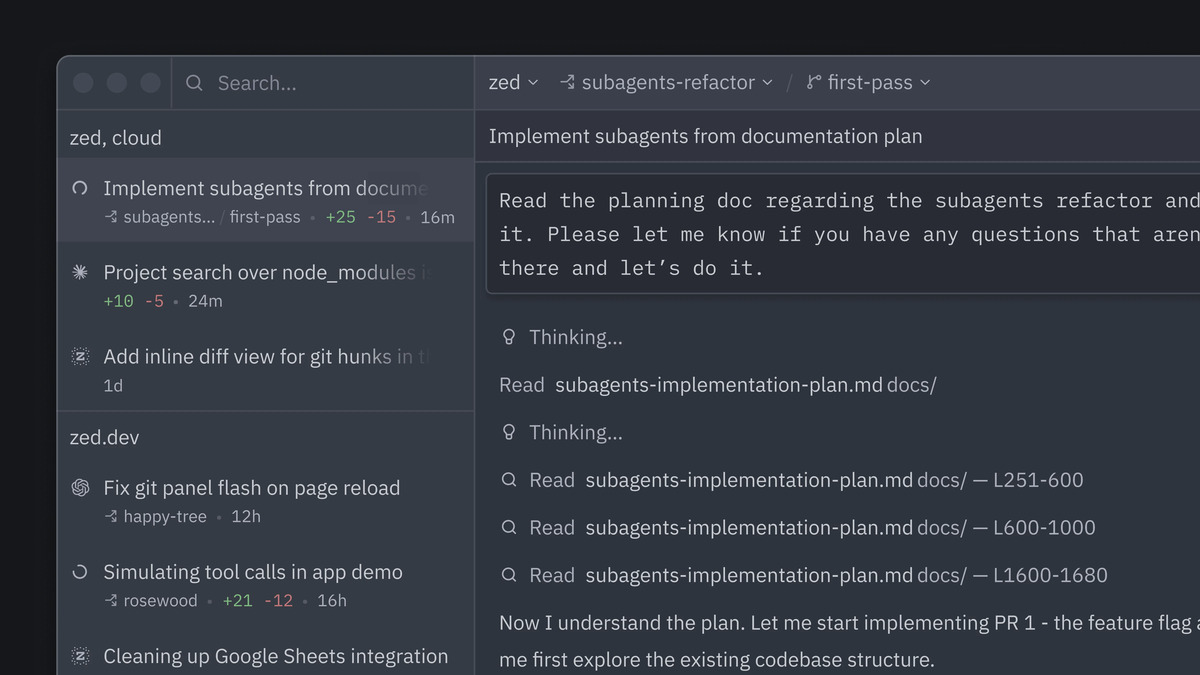 Zed v1.0 ships with parallel agent threads and native ACP integration for Claude Code, Codex, and Gemini CLI.
Source: zed.dev
Zed v1.0 ships with parallel agent threads and native ACP integration for Claude Code, Codex, and Gemini CLI.
Source: zed.dev
Zed 1.0 shipped April 29, 2026 - five years of development, written in Rust. The performance numbers are real: 0.6 second cold start, 222MB RAM. On large codebases where other editors accumulate indexing overhead, the difference in snappiness is perceptible within minutes.
The Agent Client Protocol (ACP) is Zed's strategic move. Instead of building a single proprietary agent, Zed ships an open protocol that lets you run Claude Code, Codex, Gemini CLI, Goose, Cline, or any ACP-compatible agent directly inside the editor's agent panel. You pick the agent for the task, not the editor for the agent. In January 2026, Zed and JetBrains co-launched the ACP Agent Registry - a directory of agents discoverable and connectable directly from inside the editor.
Zeta2, Zed's edit-prediction model, predicts your next edit as you type and offers it as a tab-completable suggestion. On Pro, edit predictions are unlimited. The in-house agent uses Claude or GPT. For multi-step agentic tasks, the ACP external agent integration is the stronger path.
For developers who find Cursor or Windsurf too heavy or expensive, Zed Pro at $10/month is the sharpest alternative. It's not trying to compete with Cursor on agent depth - it's competing on editor fundamentals with AI integrated cleanly on top.
The best-ai-coding-agents-2026 roundup covers agent performance including Zed's ACP-connected Claude Code setup in more detail.
Pricing: Free (50 AI prompts, 2,000 edit predictions/month), Pro $10/month (unlimited predictions, hosted models), Business $30/seat/month.
Best for: Performance-conscious developers, large codebases, teams that want to pick their AI agent independently from their editor.
Side-by-Side Comparison
| Cursor | Windsurf | GitHub Copilot | Kiro | Zed | |
|---|---|---|---|---|---|
| Entry paid price | $20/mo | $20/mo | $10/mo | $20/mo | $10/mo |
| Team price | $40/user | $40/user | $19/user | $40/user | $30/seat |
| Base editor | VS Code | VS Code | Plugin | Code OSS | Native (Rust) |
| Proprietary model | No | SWE-1.6 | No | No | Zeta2 (predictions) |
| Multi-file agent | Composer | Cascade | Coding Agent | Specs + Hooks | ACP agents |
| Free tier | Limited | Limited | 2,000 completions | 50 credits | 50 prompts |
| IDE coverage | VS Code fork | VS Code fork | 6+ IDEs | VS Code fork | Native only |
| Cloud agents | Yes (Background) | Yes (Devin) | Yes (Issues-to-PRs) | No | Via ACP |
| MCP support | Yes | Yes | Yes | Yes | Via ACP |
| Unique differentiator | BugBot, credits depth | Codemaps, SWE-1.6 free | Multi-IDE, GitHub native | Spec-driven, hooks | ACP protocol, speed |
Which One Should You Pick
Choose Cursor if you want the most capable agentic editor available today and you're doing regular multi-file work. The credit model has rough edges, but Background Agents and BugBot represent real workflow improvements that the other tools don't match yet.
Choose Windsurf if you want something close to Cursor's capability with Codemaps' visual navigation and you're planning to run Devin cloud agents for autonomous background tasks. Be aware that the product's roadmap is now Cognition's to set.
Choose GitHub Copilot if your team can't switch editors, you need tight GitHub integration, or you're tuning for the lowest per-seat cost at team scale. The Coding Agent is legitimately useful for GitHub-native issue workflows.
Choose Kiro if you're building complex, multi-week features with a team and you're willing to invest in the spec-driven workflow upfront. Not the right pick for solo exploratory work.
Choose Zed if editor performance matters to you, you work in large codebases, or you want to run Claude Code (or another external agent) without being locked into a particular editor's agent stack.
The claude-code-vs-cursor-vs-codex comparison covers the pure agent capability question separately from the IDE question - worth reading if you're considering running Claude Code as your primary agent regardless of which editor you choose.
Sources
- Cursor Pricing - cursor.com
- Kiro IDE Pricing - comparateur-ia.com
- GitHub Copilot Plans - github.com/features/copilot/plans
- Updates to GitHub Copilot Billing (June 1, 2026) - GitHub Changelog
- Windsurf Pricing 2026 - cloudzero.com
- Introducing Kiro - kiro.dev/blog
- Zed Pricing - zed.dev/pricing
- Zed Agent Client Protocol - zed.dev/acp
- Claude Code in Beta in Zed - zed.dev/blog
- Cursor vs Windsurf vs Copilot 2026 - codeant.ai
- Windsurf SWE-1.6 Review - dev.to
- AWS Kiro Launch - TechRadar
✓ Last verified June 10, 2026

