
Best AI Chatbot Builders 2026: 6 Platforms Tested
A hands-on comparison of the top AI chatbot builder platforms in 2026, covering pricing, features, integrations, and which type of team each tool fits.
 11 min read
The chatbot builder market looks nothing like it did two years ago. GPT-based knowledge retrieval killed the old decision-tree model, and every vendor scrambled to bolt LLM capabilities onto their existing flows. The result is a messy category where "AI chatbot builder" can mean six different things depending on which vendor is pitching you.
TL;DR
- Best for developers and complex workflows: Botpress - LLM-agnostic, 190+ integrations, free tier available
- Best for e-commerce and live chat: Tidio - native Lyro AI + live chat + Shopify integration in one product
- Best for quick knowledge-base bots: Chatbase - live in under an hour, $40/month entry point
- Best for voice + chat agents: Voiceflow - the only builder with native voice/phone support
- Best for social media marketing: ManyChat - leads Instagram, WhatsApp, and Facebook automation
- Pricing models vary wildly - per-seat, per-resolution, and per-message all lead to different total costs at scale
I tested six platforms across October-March, focusing on three dimensions: how fast you can go from zero to a working bot, how much you pay once volume scales, and how much control you actually have over the underlying LLM behavior.
The Six Platforms
The tools covered here span the full range of use cases. Botpress and Voiceflow target developers and product teams building multi-channel agents. Chatbase and SiteGPT aim at small businesses that want a FAQ bot running by end of day. Tidio combines chatbot and live chat into a support-focused product. ManyChat plays a different game completely, built around social media messaging automation rather than website embeds.
One notable absence: Drift. Salesloft shut down the Drift product in March 2026, redirecting customers to Salesloft's own engagement suite. Any article you find recommending Drift is now out of date.
Botpress - Best for Technical Teams
Botpress has been around for a decade and deployed over a million bots. The current platform is a visual flow editor with full API access - you get drag-and-drop conversation design with code hooks, custom integrations, and direct LLM routing.
The LLM-agnostic architecture is the biggest selling point. You can route to OpenAI, Anthropic, Mistral, or a self-hosted model on the same bot, switching providers based on task. That's not something most competitors offer cleanly. Botpress also supports 190+ pre-built integrations covering CRMs, support tools, and communication channels, whereas Voiceflow often requires manual API work for the same connections.
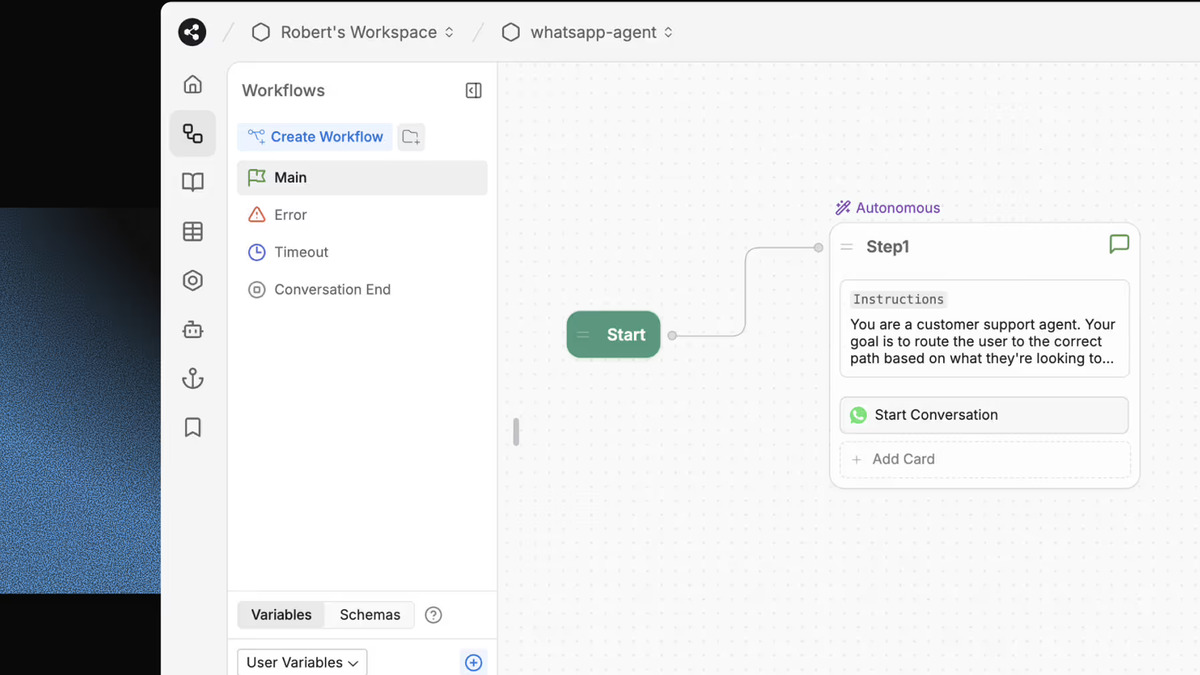 The Botpress Studio visual editor combines drag-and-drop flow design with built-in conversation testing.
Source: botpress.com
The Botpress Studio visual editor combines drag-and-drop flow design with built-in conversation testing.
Source: botpress.com
Pricing
| Plan | Monthly price | Messages/mo | Notes |
|---|---|---|---|
| Pay-as-you-go | $0 + AI Spend | 500 | $5 LLM credit included |
| Plus | $79/mo | 5,000 | Human handoff, analytics |
| Team | $445/mo | 50,000 | Role-based access, priority support |
| Managed | $1,245/mo | Custom | Built and maintained by Botpress |
| Enterprise | Custom | Custom | Dedicated support manager |
AI Spend - LLM token costs - is billed at provider rates with no markup on top. Botpress includes a $5 monthly credit. At low volumes, the free tier handles proof-of-concept work without a credit card.
The Plus plan at $79/month is where most small teams will land. It adds human handoff (required for any real support workflow) and conversation insights. The jump to Team at $445/month is steep, but it covers 10x the message volume and real-time collaboration.
Where Botpress falls short: the free tier limits you to 500 messages per month, which runs out in a day for any real deployment. The credit system for AI Spend adds a variable cost that can be hard to predict.
Voiceflow - Best for Voice + Chat Agents
Voiceflow is the only platform in this comparison that handles both chat and voice natively. You can build an agent that runs on your website, routes to a phone number via Twilio, and answers voice calls - without stitching together separate tools. That makes it a genuine choice for customer service teams handling both digital and telephony channels.
The canvas-based interface is often compared to Figma. You draw conversation flows visually, with blocks lighting up during testing so you can follow the execution path in real time. It supports multiple LLM backends (GPT-4.1, Claude, Llama, Gemini), and you can swap providers per-step if your workflow calls for it.
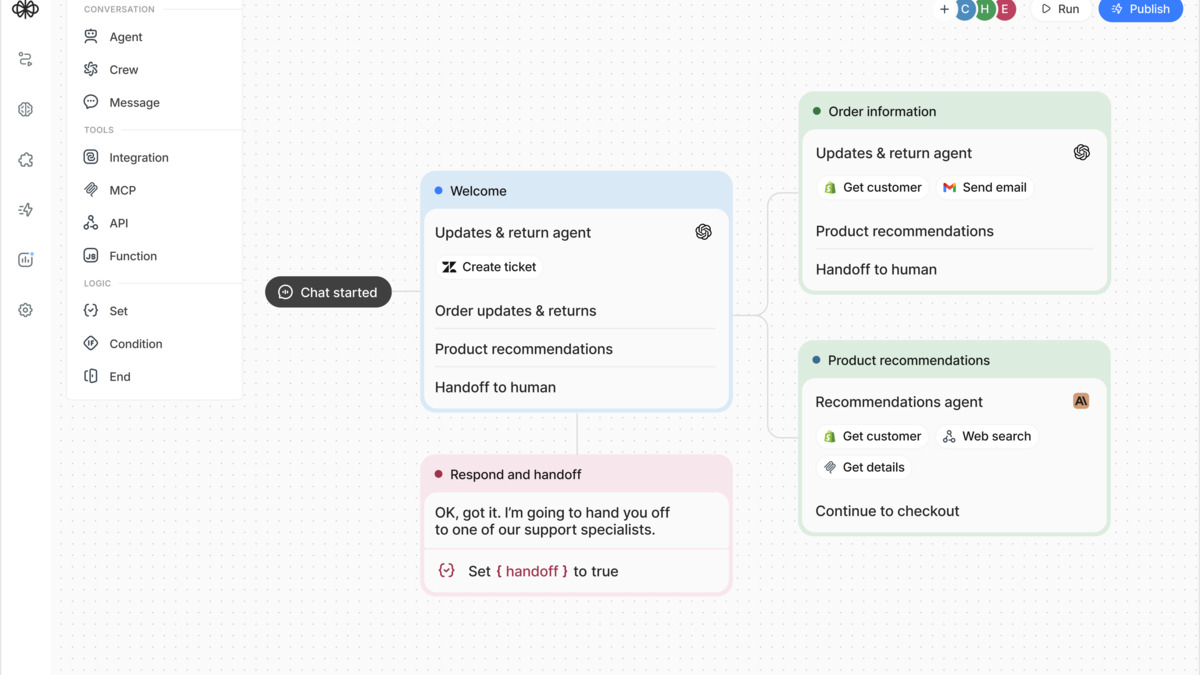 Voiceflow's canvas interface lets teams map conversation flows visually, with live flow execution highlighting during testing.
Source: voiceflow.com
Voiceflow's canvas interface lets teams map conversation flows visually, with live flow execution highlighting during testing.
Source: voiceflow.com
Pricing
| Plan | Monthly price | Credits/mo | Extra editor seats |
|---|---|---|---|
| Starter | Free | 100 | - |
| Pro | $60-$120/mo | 10,000 | $50/seat/month |
| Business | $150-$1,000/mo | 10,000-200,000 | $50/seat/month |
| Enterprise | Custom | Unlimited | Custom |
The credit system needs explanation. Message-based interactions consume credits at 1x-20x depending on message size. Voice calls consume 20 credits base plus 0.075 credits per minute. A phone agent running at volume will burn through credits significantly faster than a chat-only bot.
Extra editor seats cost $50/month each - a detail that surprises teams expecting per-workspace pricing. For a five-person product team, that adds $200/month to any Pro or Business plan cost.
Where Voiceflow falls short: the editor seat pricing model scales poorly for larger teams. Live chat handoff requires API integration work that Tidio and Botpress handle natively.
Tidio - Best for E-commerce Support
Tidio solves a specific problem: you want a chatbot, live chat, and AI automation in a single product without stitching together three vendors. The Lyro AI engine handles autonomous resolution of support queries, while human agents stay on the same platform for escalations.
The Shopify integration is notably strong. Lyro can answer order status questions, check product availability, and handle common purchase inquiries by pulling live data from your Shopify store - not just static knowledge base content. For e-commerce support teams, that's a meaningful difference from a generic FAQ bot.
Pricing
| Plan | Monthly price | Conversations | Lyro AI |
|---|---|---|---|
| Starter | $24.17/mo | 100 | 50 conversations (one-off) |
| Growth | $49.17/mo+ | 250+ | Available as add-on |
| Plus | $749/mo | Custom | Custom |
Lyro AI pricing is separate. It starts at $39/month for 50 AI conversations per month, with per-conversation costs available for higher volumes. That add-on structure means the effective price for a team using both live chat and AI automation is higher than the base plan suggests.
The free trial includes 50 Lyro conversations to test quality before committing. Based on testing, Lyro's response accuracy on product-specific questions is solid when the knowledge base is well-structured, but it can surface irrelevant context when documentation is thin.
Where Tidio falls short: Lyro's AI isn't model-agnostic - you're locked into Tidio's backend. No custom LLM routing. The Plus plan at $749/month is a large jump from Growth.
Chatbase - Best for Fast Knowledge-Base Bots
Chatbase is the simplest tool in this comparison. You feed it your documentation, website content, or uploaded files, pick a LLM backend, and deploy a chatbot to your site. The setup truly takes under an hour if your content is already organized.
The platform supports 15+ AI models across six providers - OpenAI GPT-5.2, Anthropic Claude Opus 4.6, Google Gemini 3 Pro, xAI Grok 4, Moonshot AI Kimi K2, and DeepSeek. Model switching is a dropdown, not an integration task.
Pricing
| Plan | Monthly price | Credits/mo | Key limits |
|---|---|---|---|
| Hobby | $40/mo | 1,500 | 1 agent |
| Standard | $150/mo | 10,000 | Multiple agents |
| Pro | $500/mo | 40,000 | Advanced analytics |
| Enterprise | Custom | Custom | SSO, SLA |
The credit model is relatively transparent. Extra credits cost $12 per 1,000/month. Removing the "Powered by Chatbase" branding adds $39/month. Custom domains add $59/month. These add-ons can push the effective Hobby plan cost toward $140/month once you include the minimums most businesses need.
Chatbase is SOC 2 Type II certified with GDPR compliance and AES-256 encryption - reasonable baseline for a tool handling customer queries on business data.
Where Chatbase falls short: it's a knowledge retrieval tool, not a workflow builder. You can't design multi-turn conversation logic, trigger external API calls based on intent, or build branching flows. For anything more complex than FAQ handling, you hit the ceiling quickly.
ManyChat - Best for Social Media Automation
ManyChat is built for a different use case than the other tools here: automating conversations on Instagram DMs, WhatsApp, Facebook Messenger, TikTok comment flows, and SMS. If you're running marketing campaigns that produce social media responses, ManyChat automates that volume in ways a traditional chatbot builder can't.
The contact-based pricing model is worth understanding. You pay based on how many contacts you're actively messaging. If your audience grows mid-month, you get bumped up automatically and charged pro-rata.
Pricing
| Plan | Monthly price | Key features |
|---|---|---|
| Free | $0 | Limited automations |
| Pro | From $15/mo | Contact-based scaling |
| Business | $69/mo | 5 team members |
| Advanced | $139/mo | Advanced reporting |
| Elite | Custom | Custom usage limits |
AI features - Intent Recognition, AI Step, Flow Builder Assistant - are a $29/month add-on on Pro, or included in Elite. WhatsApp conversations carry Meta's per-conversation fees on top of the ManyChat plan: $0.02-$0.08 per conversation depending on region and conversation type, per Meta's own billing.
Where ManyChat falls short: it's not a website chat tool. If you need a widget on your website or a customer support interface, ManyChat is the wrong product. The AI features are also add-ons, not built in.
Head-to-Head Comparison
| Botpress | Voiceflow | Tidio | Chatbase | ManyChat | |
|---|---|---|---|---|---|
| Entry price | Free | Free | $24.17/mo | $40/mo | Free |
| LLM choice | Any | Multiple | Fixed | 15+ models | Fixed |
| Voice/phone | No | Yes | No | No | No |
| Live chat | Yes (Plus+) | Via API | Yes (native) | No | No |
| Social media | Limited | No | No | No | Yes (core) |
| E-commerce | Via integration | Via integration | Shopify native | Via integration | Via integration |
| Self-hostable | Partial | No | No | No | No |
| Free tier | Yes (500 msg) | Yes (100 credits) | Trial only | Yes (limited) | Yes (limited) |
Which Platform Fits Which Team
For a small e-commerce business running on Shopify, Tidio is the clearest path. The native Shopify integration and combined live chat + AI automation mean you're not juggling separate tools. Start with Growth at around $50/month, add Lyro AI once you know the volume.
For a developer or product team building a multi-channel agent, Botpress is the strongest choice. The LLM flexibility, 190+ integrations, and code access mean you won't hit walls as requirements grow. The free tier is real enough to prototype on.
For a team needing phone and chat coverage, Voiceflow is the only option in this list that handles voice natively. The credit model needs monitoring at scale, but the feature coverage is unique.
For a business that just needs a FAQ bot deployed this week, Chatbase wins on simplicity. It's not a platform for complex logic, but for a documentation chatbot or a customer support assistant trained on your help center, it works and it's cheap to start.
For social media marketing teams running high-volume Instagram or WhatsApp campaigns, ManyChat is built for exactly that. No other tool here handles TikTok comment automation or WhatsApp broadcast sequences with the same depth.
The real cost gap isn't in the base plans - it's in the add-ons. Lyro AI, extra editor seats, branding removal, and WhatsApp conversation fees can double or triple what you see on the pricing page.
The Case Against Per-Resolution Pricing
One model I haven't covered in depth: Intercom's Fin AI Agent, which charges $0.99 per resolved conversation with a minimum of 50 resolutions per month. The logic is that you only pay when the AI actually solves a problem. At low resolution volumes, it's expensive. At scale - if Fin handles thousands of support tickets per month - the per-resolution model can undercut per-seat pricing clearly.
Intercom's broader platform starts at $29/month for the Essential plan, with Fin AI sitting on top of that. If you're already in the Intercom ecosystem for customer messaging, Fin is worth evaluating as an add-on rather than switching to a standalone chatbot builder.
For teams not already using Intercom, the combined cost of the platform plus Fin at scale gets complex to model before you commit.
Final Picks
If I had to pick a default recommendation for most small-to-medium teams: start with Botpress on the free tier, verify your use case, then move to Plus when you need human handoff and analytics. The LLM flexibility and integration breadth mean you're not locked into a platform that can't grow with you.
For teams where Shopify is the primary data source and live chat is a requirement, Tidio is the more practical choice - fewer pieces to connect.
The tools covered in this comparison overlap with the broader AI workflow automation tools category. If your chatbot needs to trigger multi-step workflows rather than just answer questions, review that comparison alongside this one. For teams building more complex AI systems, the best AI agent frameworks roundup covers lower-level infrastructure options that these builders sit on top of.
 AI chatbot widgets handle customer queries across web and mobile, with the best platforms supporting live-agent handoff when the bot can't resolve an issue.
Source: pexels.com
AI chatbot widgets handle customer queries across web and mobile, with the best platforms supporting live-agent handoff when the bot can't resolve an issue.
Source: pexels.com
Sources
- Botpress Pricing - official pricing page
- Voiceflow Pricing - official pricing page
- Tidio Pricing - official pricing page
- Chatbase Pricing - official pricing page
- ManyChat Pricing 2026 - plans explained
- Intercom Fin AI Agent Pricing - official page
- Botpress vs Voiceflow comparison - chatimize.com
- ManyChat pricing explained 2026 - setsmart.io
- Tidio pricing in 2026 - eesel.ai
- Chatbase review 2026 - lindy.ai
- Botpress AI review 2026 - gptbots.ai
- Voiceflow pricing in 2026 - ringly.io
✓ Last verified April 8, 2026

