

Academy's New Rules Bar AI Performances and Scripts
The Academy banned AI-generated actors and human-authored scripts from the 99th Oscars, codifying union positions just weeks after the WGA secured its new four-year studio deal.
They summarize our coverage. We write it.
Newsletters like this one rebroadcast our headlines - often without the full review, the source reading, or the analysis underneath. Our weekly briefing sends the work they paraphrase, straight from the desk, before they get to it.
Free, weekly, no spam. One email every Tuesday. Unsubscribe anytime.
The Academy banned AI-generated actors and human-authored scripts from the 99th Oscars, codifying union positions just weeks after the WGA secured its new four-year studio deal.
Deezer now receives 75,000 AI-generated tracks a day, 44% of all new uploads, while AI music accounts for just 1-3% of total streams and 85% of those are flagged as fraud.

A missing .npmignore entry in Claude Code 2.1.88 exposed 512,000 lines of TypeScript source, spawned the fastest-growing GitHub repo ever, and revealed unshipped features Anthropic never announced.
Starting April 24, GitHub will use Copilot Free and Pro users' interaction data to train AI models by default - with opt-out buried in settings.
A 300-page Senate discussion draft would declare AI training on copyrighted works is not fair use, sunset Section 230, and preempt 38 state AI laws.

Encyclopedia Britannica and Merriam-Webster filed suit against OpenAI in a New York federal court, alleging ChatGPT copied nearly 100,000 articles and dictionary entries without a license.
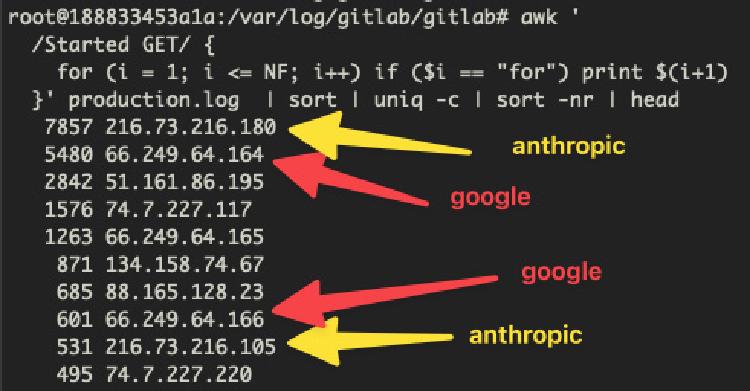
AI training crawlers from Anthropic, Google, and OVHcloud knocked a French national research institute's GitLab server offline for hours - nobody at CNRS's Institute of Complex Systems could work.

ByteDance suspended the global launch of its AI video model Seedance 2.0 after Disney, Paramount Skydance, and other studios sent cease-and-desist letters alleging copyright infringement.

Meta will pay News Corp up to $50 million per year for three years to license Wall Street Journal and other content for Meta AI training and chatbot responses.

Claude Sonnet 4.6 identifies itself as DeepSeek when prompted in Chinese, just one day after Anthropic accused DeepSeek of industrial-scale distillation attacks. The cause is training data contamination, not an identity crisis - but the timing is spectacular.

From pirated libraries to destroyed books to ancient manuscripts, AI companies have consumed millions of copyrighted works and are now approaching the limits of available human text. Here is what they used, what they stole, and what they are looking for next.

Stanford researchers proved that Claude, Gemini, Grok and GPT-4.1 can reproduce entire copyrighted novels from memory. Some models didn't even need jailbreaking.
