
Speech Turing Tests, Smart Routing, Pseudocode Agents
New research reveals no speech AI passes a Turing test, adaptive routing slashes LLM costs 82%, and pseudocode planning transforms agent reliability.
They summarize our coverage. We write it.
Newsletters like this one rebroadcast our headlines - often without the full review, the source reading, or the analysis underneath. Our weekly briefing sends the work they paraphrase, straight from the desk, before they get to it.
Free, weekly, no spam. One email every Tuesday. Unsubscribe anytime.
New research reveals no speech AI passes a Turing test, adaptive routing slashes LLM costs 82%, and pseudocode planning transforms agent reliability.

Rankings of AI models on competition mathematics benchmarks including AIME 2025, IMO, MathArena, and FrontierMath, measuring the cutting edge of mathematical reasoning.
Zhipu AI's 744B open-source model GLM-5 was trained entirely on Huawei Ascend chips and now competes with GPT-5.2 and Claude Opus on major benchmarks.

Rankings of the best AI models and agent frameworks on agentic benchmarks measuring real-world task completion, web navigation, function calling, and multi-turn tool use.
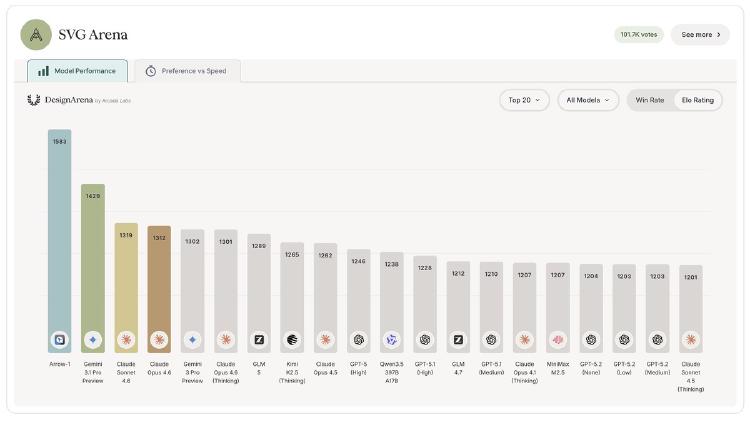
Arrow 1, a purpose-built SVG generation model from a16z-backed QuiverAI, reached the top of SVG Arena with an Elo of 1583 one day after launch - shattering Gemini 3.1 Pro's previous record of 1421 by 162 points.

Google's Gemini 3.1 Pro more than doubles its predecessor's reasoning scores and introduces adjustable thinking modes, but latency issues and preview-status quirks keep it from a clean sweep.
xAI's Grok 4.20 beta1 takes the top spot on LMArena's Search Arena with an ELO of 1226, beating GPT-5.2 and Gemini 3. It also lands fourth on the Text Arena at 1492, within striking distance of Claude Opus 4.6.

A data-driven comparison of Alibaba's Qwen3.5-27B and Google's Gemma 3 27B - two 27B dense models that share a parameter count and almost nothing else.

A data-driven comparison of Alibaba's Qwen3.5-27B and Mistral's Small 3.2 - two Apache 2.0 dense models in the 24-27B range with very different benchmark profiles and deployment strengths.
A data-driven comparison of Alibaba's Qwen3.5-27B and Microsoft's Phi-4 - a 27B hybrid architecture versus a 14B STEM specialist, testing whether raw parameter count or training efficiency wins in practice.
David vs Goliath: Qwen3.5-35B-A3B activates 3B parameters and beats Llama 4 Scout's 17B active on MMLU-Pro, GPQA, and coding benchmarks - but Scout's 10M context window and native multimodal support tell a different story.
A data-driven comparison of Alibaba's Qwen3.5-35B-A3B and NVIDIA's Nemotron 3 Nano 30B-A3B - two ~30B MoE models activating ~3B parameters that take fundamentally different architectural approaches to the same problem.
