Stanford 2026 AI Index - Cash In, Transparency Out
Stanford's 2026 AI Index shows global investment hitting $581B in 2025, while foundation model transparency scores fell by a third as capabilities raced ahead of governance.
They summarize our coverage. We write it.
Newsletters like this one rebroadcast our headlines - often without the full review, the source reading, or the analysis underneath. Our weekly briefing sends the work they paraphrase, straight from the desk, before they get to it.
Free, weekly, no spam. One email every Tuesday. Unsubscribe anytime.

Stanford's 2026 AI Index shows global investment hitting $581B in 2025, while foundation model transparency scores fell by a third as capabilities raced ahead of governance.

Kevin Weil, Bill Peebles, and Srinivas Narayanan all left OpenAI on the same day as the company dismantles its consumer moonshots and sharpens its focus on enterprise revenue ahead of a potential IPO.

Snap cut 16% of its workforce on April 15, citing AI-generated code as the direct cause. The stock jumped. The workers left. Here is what the company's own numbers actually say.

A new PwC survey of 1,217 executives finds 74% of AI's economic returns go to just 20% of companies, while 56% of CEOs report no measurable benefit from their AI investments.

Stanford HAI's 2026 AI Index finds the US-China model gap has effectively closed, GenAI has hit 53% global adoption faster than any prior technology, and young software developers are the first casualties of the labor shift.

A UPenn-BU paper models AI-driven layoffs as a Prisoner's Dilemma: each firm wins by automating, but when everyone does it, collapsing demand makes every firm worse off. Their proposed fix is a Pigouvian tax on automated tasks.

OpenAI published a 13-page policy blueprint proposing robot taxes, a public wealth fund for every American, and government-run 4-day workweek pilots as AI reshapes the economy.

Three OpenAI executives shift roles simultaneously days after closing a $122 billion round, raising questions about leadership continuity before an expected 2026 IPO.

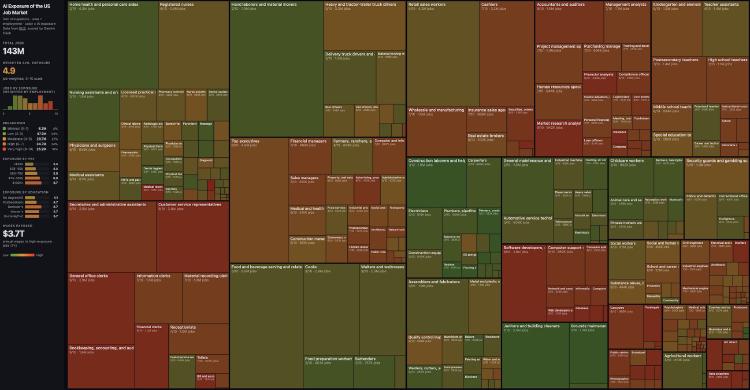
Andrej Karpathy scored 342 US occupations on a 0-10 AI exposure scale using BLS data - 42% of jobs score 7+, representing 59.9 million workers and $3.7 trillion in wages. He then deleted the GitHub repo.

ServiceNow CEO Bill McDermott told CNBC that AI agents could drive college graduate unemployment into the mid-30% range, while his own company has automated 90% of customer service use cases.

RentAHuman.ai is a marketplace where AI agents hire humans via MCP or REST API for real-world tasks, but 590,000 workers are chasing just 11,300 bounties and most gigs turn out to be startup marketing.

Anthropic's new 'observed exposure' metric ranks 800+ occupations by actual AI usage, not just theoretical risk. Computer programmers top the list at 75%. Unemployment hasn't spiked - but young workers entering exposed fields are finding fewer jobs.