
Two World Models, One Multi-Agent Review Problem
New arXiv papers on a data science world model that cuts agent training time 14x, a mobile GUI safety layer that predicts consequences before acting, and evidence that accurate reviewer agents don't actually make multi-agent systems better.
 8 min read
Today's arXiv batch had a theme running through it without anyone planning it that way. Two separate teams built world models to make agents faster and safer before they act, in data science pipelines and on mobile phones respectively. A third team asked a more uncomfortable question: does adding a reviewer agent to your multi-agent pipeline actually help, or does it just look like it does? The answer complicates a design pattern a lot of people have already shipped.
TL;DR
- DSWorld - A world model for data science agents predicts what a pandas operation or model fit will do before running it, cutting RL training time by roughly 14x
- Mobile agents get a consequence predictor. SeerGuard forecasts what a tap or swipe will actually do before the phone executes it, more than tripling a safety-utility score
- Reviewer agents that catch more errors don't necessarily fix more of them. A study of 4,181 math problems found the reviewer with lower precision produced better final answers
DSWorld: Simulating Before You Compute
Autonomous data science agents work by trial and error. They write a transformation, run it, check the output, and adjust. That loop is expensive when the dataset is large or the model being trained takes minutes per epoch, and it gets worse fast when the agent is being trained with reinforcement learning, which needs thousands of rollouts to converge.
A team from HKUST(GZ), the Guangzhou campus of Hong Kong University of Science and Technology, led by Zherui Yang, Fan Liu, and Hao Liu, built DSWorld to sidestep the expense. The idea borrows a concept from robotics: instead of executing every candidate operation against real data, train a model that predicts what would happen if you did. The paper's term for this is a Data Science World Model, one that models state transitions conditioned on the current workflow and a proposed operation.
The framework itself has four moving parts. A structured state representation encodes what the workflow currently looks like. A cost-aware router decides, for any candidate operation, whether it's cheap enough to just run for real or expensive enough to warrant a prediction instead. Cheap operations get lightweight real execution. Expensive ones go through an LLM-based simulator trained specifically to predict the resulting state. Training that simulator required building an 8,000-scale dataset of transition trajectories, and the team introduced what they call Reflective World Model Optimization, an error-aware reinforcement learning strategy that improves the simulator's prediction accuracy over training.
 A data science agent has to reason about what a transformation or model fit will produce long before it finishes running - the same problem DSWorld targets with simulated rollouts.
Source: unsplash.com
A data science agent has to reason about what a transformation or model fit will produce long before it finishes running - the same problem DSWorld targets with simulated rollouts.
Source: unsplash.com
The headline numbers: DSWorld speeds up RL-based agent training by about 14 times and search-based inference by 3 to 6 times, while staying competitive on final task performance. On the narrower metric of transition prediction itself, the simulator beats the strongest LLM baseline by 35.6%. For anyone building or fine-tuning AI agents that touch real compute budgets, that's the kind of number that changes whether a training run is feasible on a given GPU allocation at all. It's a similar bet to the one made in a recent paper on world models for planning, just applied to a different domain with a much more concrete cost justification.
SeerGuard: Predicting the Damage Before the Tap
Mobile GUI agents that can navigate apps, fill in fields, and complete multi-step tasks on a phone are becoming common, and they're dangerous in a specific way: a wrong tap can send money, delete a message thread, or submit a form that can't be undone. Most safety layers built for these agents are reactive. They watch for a bad outcome after an action executes and try to catch it there, which is too late if the action was itself irreversible.
SeerGuard, from a team including Xue Yu, Bo Yuan, and Junlan Feng, flips the order. It screens instructions before the agent starts, then predicts the consequence of each individual action before the phone executes it. The core piece is a Safety-Augmented World Model (SAWM), built on top of Qwen3-VL-8B-Instruct and trained with multi-task supervision that pairs next-state prediction with a safety risk label. Rather than trying to render what the next screen would look like pixel by pixel, which is expensive and mostly irrelevant to safety, SAWM predicts a semantic text description of the outcome: what changes, and whether that change is risky.
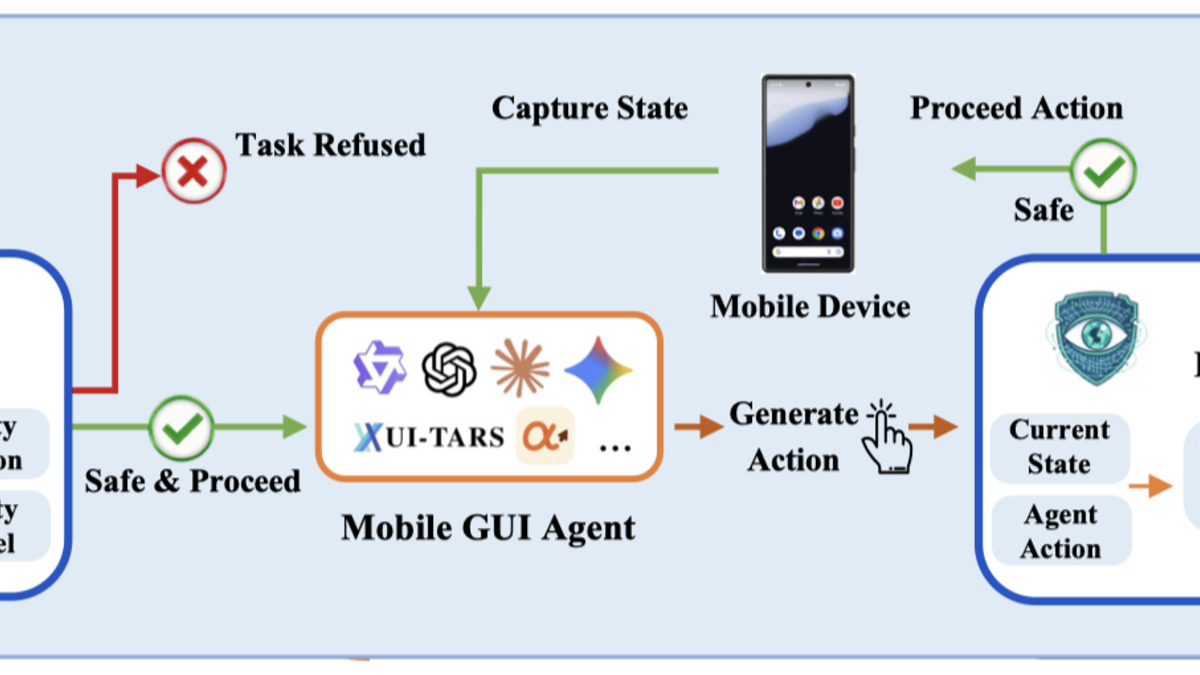 SeerGuard screens the instruction first, then asks its world model to predict what each candidate action would actually do before the mobile GUI agent taps anything.
Source: seerguard.github.io
SeerGuard screens the instruction first, then asks its world model to predict what each candidate action would actually do before the mobile GUI agent taps anything.
Source: seerguard.github.io
The training set behind SAWM runs to 148,000 examples pooled from general textual safety data, re-annotated risk trajectories from mobile app interactions, and a dedicated next-state QA set. Tested on Qwen3-VL-8B-Instruct, SeerGuard pushed the safety-utility score from 0.191 to 0.596 while cutting the risk-cost score from 0.347 to 0.130. The gains held on other backbones too: risk-cost on Gemini-3.1 dropped from 0.368 to 0.180, and on GPT-5.1 from 0.301 to 0.145. The authors are upfront that the system still misses some fine-grained risks and occasionally flags benign tasks as unsafe, and that how well it works depends partly on how well the underlying agent plans and grounds its actions in the first place. Still, for a class of agents that's quickly moving from lab demo to something people let run on their own phones, a layer that predicts the outcome before committing to it is a meaningfully different safety posture than the reactive checks most browser and computer-use agents rely on today.
When a Better Reviewer Makes Things Worse
The third paper is the one that should make anyone building a multi-agent pipeline pause. Chih-Hsuan Yang, Jingyan Jiang, and colleagues from Argonne National Laboratory and Oregon State University set out to test a design pattern that shows up constantly in agent frameworks: add a specialized reviewer agent that checks the work of a planner and executor, and let it send work back for revision when something's wrong. It sounds like a reasonable way to catch errors. Their paper argues that reasonable isn't the same as effective.
They ran two setups against all 4,181 competition-level problems in Omni-MATH, spanning ten tiers of difficulty. One was a hierarchical planner-executor-reviewer (PER) pipeline, where the reviewer's job is narrow and its verdict is a separate signal fed back to the executor. The other was a broadcast-style peer discussion among three agents with confidence-weighted speaking order, where all three had to unanimously approve an answer before it could be submitted.
 Testing multi-agent designs against thousands of competition-level math problems, rather than a handful of easy benchmark items, is what let the reviewer-decoupling effect surface at all.
Source: unsplash.com
Testing multi-agent designs against thousands of competition-level math problems, rather than a handful of easy benchmark items, is what let the reviewer-decoupling effect surface at all.
Source: unsplash.com
By the metric that's supposed to matter, the PER reviewer won convincingly: 0.861 precision at detecting errors versus 0.644 for broadcast. But final accuracy went the other way. Broadcast reached 89.2% on the full problem set; PER reached 85.2%, and a single agent iterating on its own without any reviewer landed at 78.8%. The gap between detecting a mistake and actually fixing it was stark: reviewer-guided repairs changed the submitted answer only 33.6% of the time under PER, against 93.5% under broadcast.
The authors call this reviewer-solver decoupling. In PER, a correct critique can exist as a data point without ever changing what the executor submits, because critique and decision-making run as separate steps that the executor can silently ignore. Broadcast makes that harder because the feedback lives inside the same shared context the group has to jointly approve. The researchers even tried forcing the PER executor to explicitly acknowledge reviewer feedback before proceeding. It backfired, dropping accuracy from 85.2% to 82.5%. A softer fix, embedding the reviewer's guidance directly into the executor's working context rather than treating it as a discrete verdict, recovered some ground to 86.3%, still short of broadcast. The gains from any of this collaboration were also concentrated on the hardest problems: negligible on tiers 1 and 2, then 10 to 20 percentage points on tiers 6 through 9, which is exactly where a single agent starts running out of ideas on its own.
The practical read for anyone building multi-agent systems is that a reviewer stage's error-detection numbers aren't a proxy for whether it improves outcomes. If the pipeline routes critique as a separate signal the executor can route around, precision is largely wasted effort. Architectures that force feedback into the same context the next decision gets made from seem to close that gap, though not all the way.
What Connects Them
Two of these three papers reach for the same trick: build a model that predicts consequences before committing to an action, whether the action is a data transformation or a phone tap. That's a sensible response to a common bottleneck, since real execution is expensive or risky and a good simulator is neither. The third paper is a reminder that plausible-looking agent architecture doesn't automatically deliver plausible-looking results. A reviewer that's demonstrably better at spotting errors can still make a pipeline worse if nothing forces its output to actually change what happens next. Anyone stacking review or verification stages onto an agent pipeline this year should be measuring uptake, not just detection.
Sources:

