
Yahoo Scout Review: Old-School Links, New-School AI
Yahoo Scout is the rare AI search engine that puts source links front and center - here's whether that philosophy holds up in practice.
 8 min read
Yahoo Scout is doing something that should be obvious but isn't: it's an AI search engine that actually wants you to click away from it. In a market where Google, Perplexity, and ChatGPT compete to keep users inside their own answer loops, Scout treats visible blue hyperlinks as the product feature, not an afterthought. After testing it across general, finance, and sports queries from its January 2026 beta through its June expansion into vertical AI tools, that bet holds up better than I expected - but not without caveats.
TL;DR
- 7.4/10 - the AI search engine with the most honest relationship with its sources
- Link transparency is genuine: up to nine prominent source links per answer, not buried icons
- Personalization data advantage is real in theory but unverified by independent benchmarks
- Best for existing Yahoo users; cold-start users get a capable but unexceptional AI answer engine
What Yahoo Scout Actually Is
Scout isn't trying to be an AI companion. It's not building toward AGI and it doesn't want you to talk to it about your feelings. It's a fast, structured answer engine available at scout.yahoo.com, embedded across Yahoo News, Finance, Sports, and Mail - and built on technology from Anthropic and Microsoft.
Yahoo's CEO Jim Lanzone called this "the white whale of turnarounds" in a March interview with Fortune. The company was bought by Apollo Global Management for $5 billion in 2021, when its relevance had long since faded. Scout is the first coherent product argument for why that wasn't a mistake.
The core product logic is straightforward: use Claude to synthesize answers, ground them via Microsoft Bing's web index, and display sources prominently rather than hiding them behind citation numbers or hover-state tooltips. If you're used to Perplexity's tiny superscript numbers or ChatGPT's carousel-format link appendices, Scout's nine visible blue hyperlinks per response look almost aggressively web-native.
The Stack Underneath
Scout is built on three external components that Yahoo doesn't own: Anthropic's Claude for language modeling, Microsoft Bing's grounding API for web indexing, and Microsoft Advertising for monetization. Yahoo owns the distribution, the brand relationships, and the data.
That data is the actual bet. Yahoo claims 500 million user profiles, a knowledge graph covering more than one billion entities, and 18 trillion tracked consumer events annually across its properties. The argument is that this lets Scout produce more relevant, more personalized answers than a competitor starting from scratch with the same Claude API access.
It's a credible argument. It hasn't been independently tested.
What we can observe is that the personalization layer works at the ecosystem level: if you're logged in and follow a stock on Yahoo Finance, that watchlist surfaces in your Scout answers. If you've clicked through Yahoo Sports coverage of a specific team, those preferences shape how Scout frames sports queries. The system is pulling from actual behavioral signals, not inferred intent.
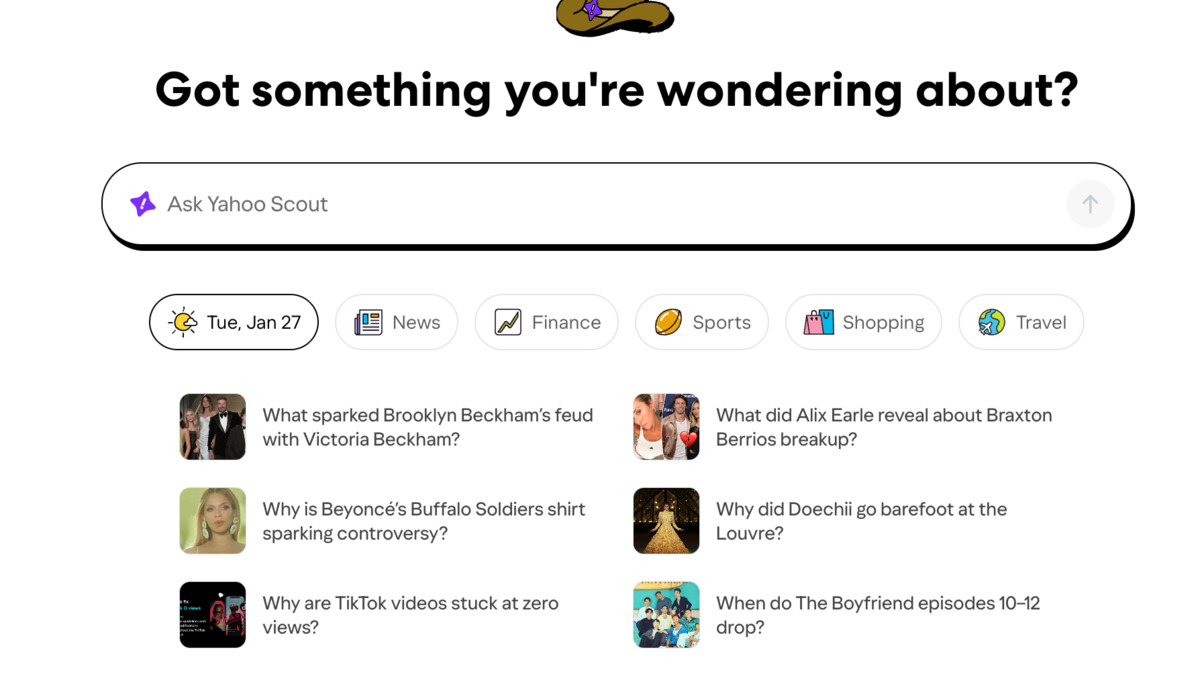 Yahoo Scout displays source links as prominent blue text throughout answers - a deliberate contrast to competitors that hide citations behind icons or footnote numbers.
Source: spyglass.org
Yahoo Scout displays source links as prominent blue text throughout answers - a deliberate contrast to competitors that hide citations behind icons or footnote numbers.
Source: spyglass.org
How It Performs
I tested Scout across three categories that represent its actual use cases.
General Knowledge
For factual queries - biographies, historical events, technical explanations - Scout performs well. Answers are accurate, structured with headers and bullet points where appropriate, and consistently include direct source links. The tone is neutral to the point of blandness, which is either a feature or a bug depending on what you want from a search tool.
I didn't catch it hallucinating during testing, though Claude's grounding approach via Bing reduces but doesn't remove that risk. Yahoo hasn't published accuracy benchmarks against independent datasets, which is frustrating for anyone trying to make a systematic comparison.
Finance Queries
This is where Scout's data advantage shows most clearly. Financial answers update every ten minutes with real-time pricing data, and the "Ask Yahoo Scout" integration inside stock quote pages pulls from Yahoo Finance's own analysis with web sources. When I asked about earnings expectations for a mid-cap tech company, Scout returned a structured answer with both consensus estimates and linked analyst notes - the kind of synthesis that would take several minutes to compile manually.
The June 2026 Finance integration also handles comparative questions well. "Which is growing faster, cloud or AI infrastructure spend" returned a structured breakdown with sourced figures rather than a vague summary.
Sports and the Kevin O'Connor Problem
The most interesting experiment in Scout's vertical rollout is "Ask Kevin O'Connor" - a chatbot inside Yahoo Sports' NBA Draft guide trained on O'Connor's written work, podcast transcripts, and scouting notes, answering in his voice and perspective.
Yahoo isn't building a general assistant - it's building a vertically integrated answer layer on top of content assets it already owns.
It works better than it should. Asking about specific draft prospects returned answers that read like abbreviated versions of O'Connor's actual analysis, with his characteristic blend of statistical context and positional reads. The tone holds up across multiple queries without drifting into generic AI-speak.
What this reveals about Yahoo's strategy is more interesting than the feature itself. Yahoo isn't building a general assistant - it's building a vertically integrated answer layer on top of content assets it already owns. The Kevin O'Connor chatbot is the logic of Scout applied to a specific journalist's corpus. It works because Yahoo owns both the distribution and the underlying content.
The Source-First Difference
The competitive positioning is real but needs to be looked at carefully. Scout isn't better at finding information than Google's AI Overviews. It isn't more conversational than Perplexity. What it does differently is make source attribution a first-class UI element rather than a disclosure.
The most visible comparison is with Google AI Mode, which embeds links less prominently for a clean answer surface, and Perplexity, which uses numbered superscript citations that require deliberate attention to parse. Scout's blue inline links look like traditional web results woven into AI synthesis - which is the point.
Whether this drives meaningful publisher traffic is still an open question. Yahoo's CPC business model creates financial incentive to produce clicks, which aligns with publisher interests in a way that Google's Overviews don't. But the metric that would validate this claim - referral traffic data from publishers using Scout - hasn't been made public.
MyScout: The Personalized Layer
MyScout, launched in March 2026, adds a customizable homepage to the Scout experience. Logged-in users can arrange tiles for email previews, stock watchlists, sports scores, weather, and news topics - effectively turning scout.yahoo.com into a personal dashboard.
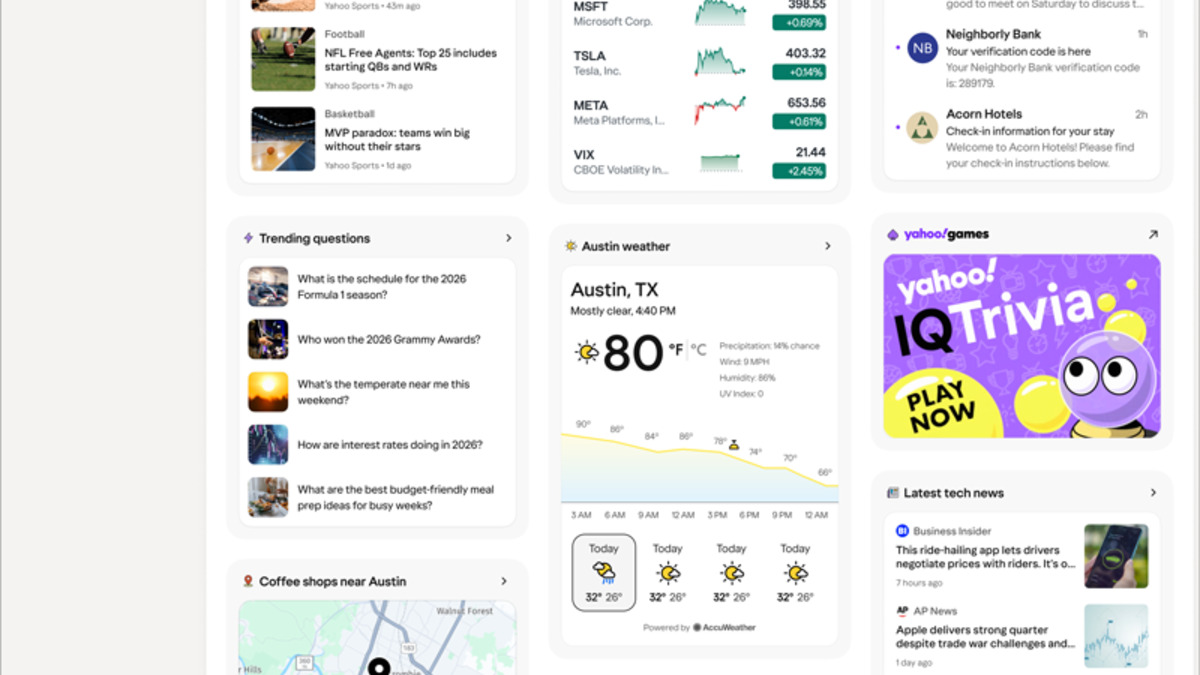 MyScout lets logged-in users arrange tiles from across Yahoo's properties into a single personalized dashboard - email, stocks, sports scores, and news in one place.
Source: yahooinc.com
MyScout lets logged-in users arrange tiles from across Yahoo's properties into a single personalized dashboard - email, stocks, sports scores, and news in one place.
Source: yahooinc.com
The tiles update on different cadences: stock prices in near real-time, email summaries when new messages arrive, sports scores at game completion. For heavy Yahoo ecosystem users - people who use Yahoo Mail, check Yahoo Finance daily, and follow a sports team - this is genuinely useful as a single-pane-of-glass replacement for visiting multiple Yahoo properties separately.
For users outside that ecosystem, it's a customizable start page that requires buying into Yahoo's data relationship. That trade-off is worth being clear about. MyScout works because Yahoo has years of behavioral data on its users. It works less well, or not at all, if you're signing up fresh.
Strengths
- Source transparency is the clearest and most consistent differentiation from any competitor
- Finance vertical integration produces genuinely useful real-time answers for investment research
- Zero cost to users, funded by CPC ads rather than subscriptions, which lowers the barrier to try it
- Personalization draws on real behavioral data rather than inferred preferences
Weaknesses
- No independent accuracy benchmarks have been published or allowed by Yahoo
- Completely dependent on Anthropic and Microsoft - any change in those partnerships shifts the product
- Limited appeal outside the Yahoo ecosystem; cold-start users get a capable but generic AI answer engine
- Personalization transparency is poor; the system doesn't explain how user data shapes specific answers
- Sports and Finance vertical AI is excellent but limited to those verticals for now
Verdict
Yahoo Scout is a better product than it had any right to be, built on a coherent philosophy that the AI search market mostly ignores. The link-forward approach isn't just ethical positioning - it's a viable monetization strategy, it aligns Yahoo's interests with publishers, and it makes Scout feel more like a search engine and less like an answer machine trying to replace the web.
The data advantage argument needs independent validation before anyone should accept it as a competitive moat. And the cold-start experience - Scout without Yahoo account history - is solid but not differentiated enough to pull users away from established habits.
Score: 7.4/10
For Yahoo's existing 250 million US users, Scout is worth enabling immediately. For everyone else, it's the most publisher-honest AI search tool available, with caveats around the personalization claims that haven't yet been tested against real-world benchmarks.
Our earlier news coverage covered the deal structure and who gains from the Anthropic and Microsoft partnership stack. The product has matured since that March launch, with the Finance and Sports integrations converting what was a general AI search tool into something closer to a vertical-native answer engine.
Sources
- Search Engine Land - Yahoo Scout launch review
- Yahoo Inc. - Yahoo Sports and Yahoo Finance introduce Scout AI experiences
- Yahoo Inc. - Introducing MyScout personalized homepage
- Spyglass - Yahoo Scout Flips the Script on AI Search
- Digital Trends - Yahoo Scout challenges Perplexity and Google AI Mode
- Search Engine Journal - Yahoo Scout delivers classic search flavor
- ALM Corp - Yahoo Scout AI Search Guide
- TechGlimmer - Yahoo Scout monetization and CPC advertising model

