
Muse Spark 1.1 Review: Cheap, Capable, US-Only
Meta's second Muse Spark ships with a real API, a 1M-token context window and the cheapest pricing among frontier-class agents, but only US developers can touch it.
 10 min read
TL;DR
- 7.6/10 - the cheapest capable agentic model on the market, undercut by a geofence Meta hasn't explained
- Went from no public API and a weak coding score to a real, priced offering in three months flat
- Trails Claude Opus 4.8 and GPT 5.5 on every head-to-head coding benchmark, sometimes by a wide margin
- Worth testing if you're a US developer tuning for cost per agentic task; skip it everywhere else, because you legally can't use it yet
Three months ago I wrote off Muse Spark as a consumer toy with no path to developers - a model with truly strong health benchmarks and a Terminal-Bench score that trailed the frontier by double digits. Meta didn't just fix that gap. It shipped a whole new model, priced it lower than anything comparable, and put Mark Zuckerberg on X for the first time in three years to announce it himself. That's not a routine dot-release rollout. It's Meta signaling, loudly, that it intends to compete on agentic coding rather than concede the category.
Muse Spark 1.1 launched July 9 with a public preview of Meta's new Model API, a million-token context window with active memory management, and pricing that undercuts Claude Sonnet 5, GPT-5.6 Sol, and Kimi K3 by a wide margin. I spent time with the announcement materials, the independent benchmark data that followed, and the early developer reactions to figure out whether the price actually buys competitive capability, or just cheap tokens.
What Changed Since April
The original Muse Spark shipped free at meta.ai with no API, a 262K context window, and a company admission, in its own release notes, that there was "a gap between Muse Spark and the models already available" on coding. It won on HealthBench Hard and lost everywhere a developer would care about, which I covered in detail in the model card at the time.
1.1 rebuilds the agentic layer from the ground up. Context jumps to 1 million tokens, but Meta's more interesting claim is what sits on top of it: active summarization and retrieval that compacts earlier steps in a session instead of just building up tokens until the window fills. That distinction matters more than the raw number for anyone running long agentic sessions - a multi-hour debugging loop or a multi-file migration - where the model needs to remember what it decided forty steps ago without re-reading the whole transcript.
Meta went from "we admit there's a gap on coding" to a priced, US-preview API in three months. The model's coding scores still trail the frontier. The pricing doesn't.
The model is also trained to act as both orchestrator and subagent inside larger multi-agent systems, delegating pieces of a task to parallel instances of itself to cut latency. That's architecturally similar to what Grok 4.20 does with parallel agents, though Meta's version is built into the base model rather than layered on top through a routing system.
The Benchmarks, Read Skeptically
Meta's own materials lean on an "Internal Coding Bench" that shows Muse Spark 1.1 at 68.3, just behind Opus 4.8 at 69.0 and ahead of GPT 5.5 at 67.1. That's a proprietary evaluation the company built and the company chose which competitors to include in, so treat it as marketing until someone outside Meta reproduces it. The independently reported numbers tell a less flattering, more useful story.
| Benchmark | Muse Spark 1.1 | Claude Opus 4.8 | GPT 5.5 |
|---|---|---|---|
| Terminal-Bench 2.1 | 80.0 | 82.7 | 83.4 |
| SWE-Bench Pro | 61.5 | 69.2 | 58.6 |
| DeepSWE 1.1 | 53.3 | 59.0 | 67.0 |
| MCP Atlas (tool use) | 88.1 | 82.2 | 75.3 |
| JobBench (tool use) | 54.7 | 48.4 | 38.3 |
| Humanity's Last Exam (w/ tools) | 62.1 | 57.9 | 52.2 |
On pure coding, Muse Spark 1.1 loses every comparison in that table, sometimes by double digits against GPT 5.5 on DeepSWE. What it does do is win convincingly on agentic tool use: MCP Atlas, JobBench, and tool-augmented Humanity's Last Exam all favor Meta's model over both rivals. That's a coherent story, not a cherry-picked one - Meta built an agent foundation, not a coding specialist, and the benchmarks reflect that split cleanly.
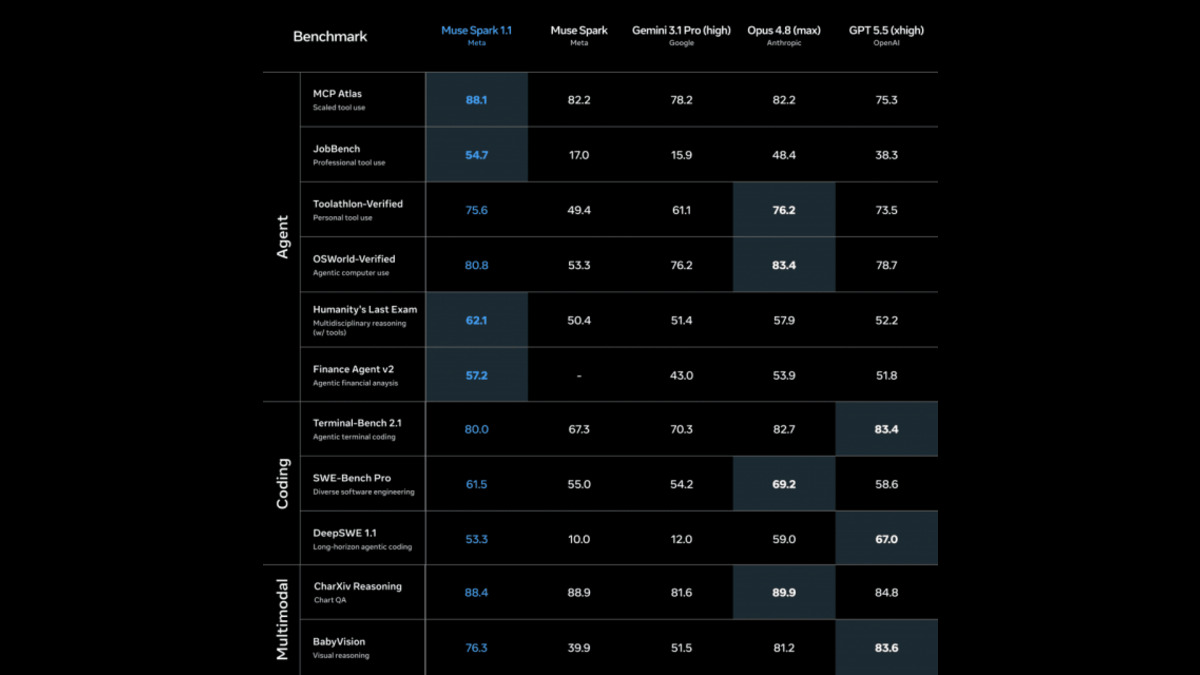 Third-party compiled benchmark table. Muse Spark 1.1 leads on agent and tool-use tasks, trails on head-to-head coding, and closed most of the gap the original Muse Spark left open.
Source: officechai.com
Third-party compiled benchmark table. Muse Spark 1.1 leads on agent and tool-use tasks, trails on head-to-head coding, and closed most of the gap the original Muse Spark left open.
Source: officechai.com
The comparison that actually matters is against Muse Spark 1.0. On DeepSWE 1.1, the original model scored 10.0. Version 1.1 scores 53.3. That's the real headline: not that Muse Spark beats the frontier, but that Meta closed most of a brutal gap in one release cycle.
Testing It Myself, Sort Of
Meta hasn't opened the API outside the US, which meant I couldn't run my own coding prompts against it the way I normally would. Simon Willison had preview access and built a CLI plugin, llm-meta-ai, to poke at it before most developers could. He ran his standard pelican-on-a-bicycle SVG test - not a serious coding benchmark, as he's the first to admit, but a fast read on a model's spatial reasoning and output discipline.
 Muse Spark 1.1's attempt at Simon Willison's pelican test. The bicycle geometry is correct; the pelican reads as blocky but recognizable.
Source: simonwillison.net
Muse Spark 1.1's attempt at Simon Willison's pelican test. The bicycle geometry is correct; the pelican reads as blocky but recognizable.
Source: simonwillison.net
His verdict: functional, a little rough around the edges. "The bicycle is the correct shape. The pelican is a little blocky but still recognizable." He also counted roughly 16 built-in tools available through the model, including a Python interpreter with pandas and numpy, web search, HTML/SVG rendering, and visual grounding, and compared the overall setup to Claude Artifacts. That tool spread is doing real work in Meta's flagship demo: the model builds a small chat web app inside OpenCode, takes an automated screenshot of the running result, traces a visible UI bug back to the responsible code, fixes it, and confirms the fix before handing control back. That's a closed perception-to-code loop, not a scripted trick, and it's the kind of workflow that actually predicts whether a model is useful day to day.
Early access partners back that up with specifics rather than generic praise. Replit's Amjad Masad called it "a complete agentic foundation," citing the million-token context, multimodal input, and parallel tool calling together. Cline's Saoud Rizwan pointed at the price-to-capability ratio specifically: "strong tool use at a price point that makes it viable to run real coding workloads at scale." Box tested it against an internal enterprise evaluation set and called it "competitive with today's leading frontier models" without claiming it leads. Those are useful, hedged endorsements, not press-release boilerplate.
The Price Actually Is the Story
| Model | Input ($/M tokens) | Output ($/M tokens) |
|---|---|---|
| Muse Spark 1.1 | $1.25 | $4.25 |
| Claude Sonnet 5 | $2.00 (intro) / $3.00 | $10.00 (intro) / $15.00 |
| Kimi K3 | $3.00 | $15.00 |
| GPT-5.6 Sol | $5.00 | $30.00 |
Output pricing is where the gap turns dramatic: Muse Spark 1.1 runs 58% cheaper than Sonnet 5's introductory rate and 86% cheaper than GPT-5.6 Sol. Combine that with a 1M-token context that's actively managed rather than passively stored, and the practical cost of a sustained agentic session - one long research loop or coding run instead of chunked re-prompts - shifts more than the per-token sticker price suggests. On OpenRouter, cached input runs $0.15 per million tokens and web search adds $2.50 per 1,000 queries, plus OpenRouter's standard 5.5% service fee on top of Meta's own rates.
That pricing is only reachable if you're in the United States. Meta's Model API and the OpenRouter listing both restrict access to US developers, with no announced timeline for anyone else. I checked the OpenRouter listing directly, and the restriction sits in a plain warning banner above the pricing table, not buried in fine print.
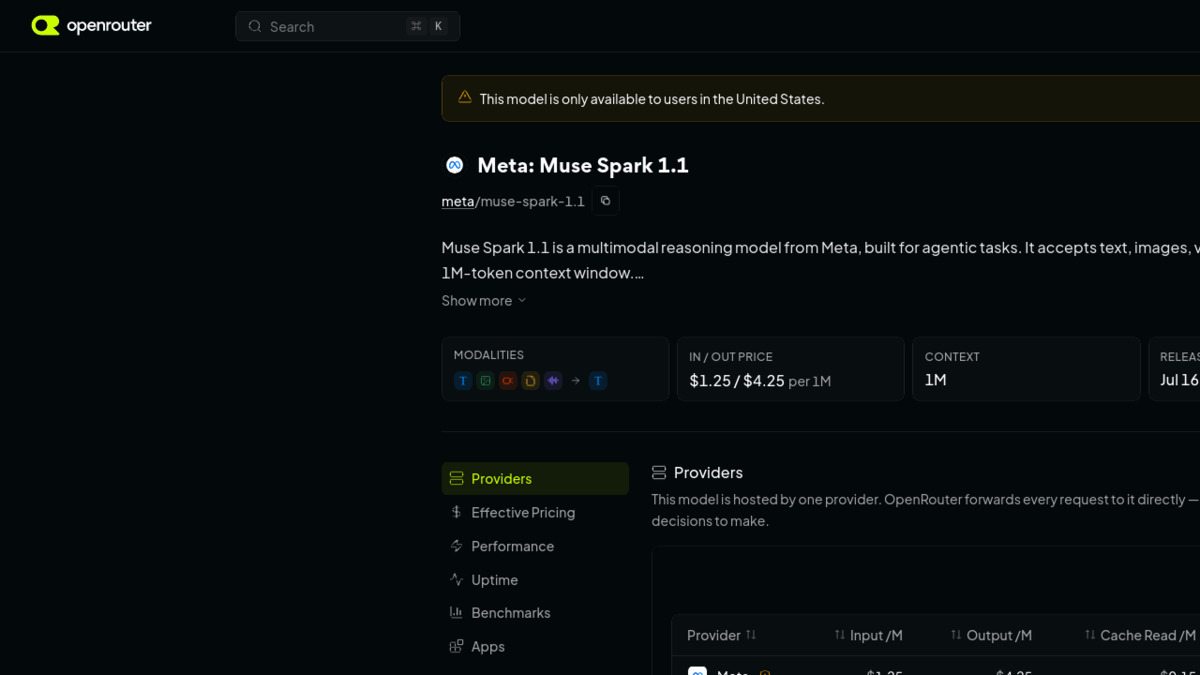 OpenRouter's listing for Muse Spark 1.1. The access restriction is the first thing on the page, above the price.
Source: openrouter.ai
OpenRouter's listing for Muse Spark 1.1. The access restriction is the first thing on the page, above the price.
Source: openrouter.ai
That's a real problem for a model being marketed on cost efficiency. A developer in London or Berlin or Bangalore can read every benchmark in this article and still can't spend a dollar on the thing. Meta hasn't explained the restriction publicly beyond calling it a preview limitation, which leaves the obvious guesses - compute allocation, regulatory caution, or simple rollout sequencing - unconfirmed.
The Safety Number Nobody's Marketing
One data point deserves attention exactly because Meta isn't promoting it. In Meta's own evaluation report, a Muse Spark 1.1-powered agent solved 5 of 869 tasks on an automated exploit-generation benchmark within a two-hour window, and 7 of 869 within four hours. GPT-5.6 Sol, by comparison, solved 216 of the same 869 tasks within two hours and 293 within six, according to its own system card. Meta classifies Muse Spark's cybersecurity risk as "moderate or lower" under its Advanced AI Scaling Framework, and on this specific measure, the model is nowhere near frontier offensive capability.
Read that two ways. It's reassuring if you're worried about agentic models automating exploit development - Muse Spark 1.1 simply isn't there yet. It's also a data point that the same architecture trailing on SWE-Bench Pro and DeepSWE is trailing here too, for what looks like the same underlying reason: this generation of Muse Spark hasn't caught up to Anthropic and OpenAI's frontier reasoning depth, even where Meta invested specifically in agentic behavior.
Strengths
- Cheapest pricing among frontier-adjacent agentic models: $1.25/$4.25 per million tokens, well under Sonnet 5, Kimi K3, and GPT-5.6 Sol
- Leads independently reported benchmarks on tool use and agentic reasoning: MCP Atlas, JobBench, tool-augmented Humanity's Last Exam
- Real, working perception-to-code loop demonstrated in the OpenCode demo, not just a benchmark claim
- Massive generation-over-generation jump on agentic coding (DeepSWE 1.1: 10.0 to 53.3) in three months
- 1M token context with active compaction, not just a bigger passive window
- Early partner feedback from Replit, Cline, and Box is specific and credible, not generic praise
Weaknesses
- Trails Claude Opus 4.8 and GPT 5.5 on every direct coding benchmark tested (Terminal-Bench 2.1, SWE-Bench Pro, DeepSWE 1.1)
- US-only access on both Meta's own API and OpenRouter, with no stated timeline for anyone else
- Headline "68.3 vs 69.0" comparison comes from Meta's own proprietary benchmark with a self-selected competitor set
- No independent SWE-bench Verified score yet; external validation is still catching up to the launch
- Cybersecurity capability (and general reasoning depth by extension) measurably behind GPT-5.6 Sol on offensive benchmarks
- Still a public preview, not a stable production release - rate limits and long-term pricing aren't locked in
Verdict: 7.6/10
Muse Spark 1.1 is the best argument yet that Meta's Superintelligence Labs bet on Alexandr Wang is producing something more than reorganized org charts. The model doesn't lead on pure coding benchmarks, and it shouldn't be your first choice if raw SWE-bench performance is what you're optimizing for - Opus 4.8 and GPT 5.5 both beat it there, sometimes clearly. What it does do is make the cost of running an agentic tool-use workload dramatically cheaper without a proportional capability tradeoff, and it does that against a starting point, three months ago, that was truly uncompetitive.
The restriction to US developers is the thing holding this back from an easy recommendation. A model can't win a price war it's only allowed to fight in one country. Until Meta lifts that gate, Muse Spark 1.1 is a strong option for a specific audience and a preview of intent for everyone else.
Sources
- Introducing Muse Spark 1.1 - Meta AI Blog
- Meta enters the crowded AI coding battle with Muse Spark 1.1 - TechCrunch
- Meta Announces Muse Spark 1.1, Beats Claude Opus 4.8 And GPT 5.5 On Some Benchmarks - OfficeChai
- Introducing Muse Spark 1.1 - Simon Willison
- Muse Spark 1.1 - API Pricing & Benchmarks - OpenRouter
- Muse Spark 1.1 Evaluation Report - Meta AI
- Mark Zuckerberg Posts On X For First Time In 3 Years To Launch Muse Spark 1.1 - OfficeChai
- Meta puts Muse Spark 1.1 on OpenRouter, then locks out the rest of the world - Startup Fortune

