
Muse Glimmer Review: Fast, Free, Not Flawless
Meta's 30B open-weight local agent model beats its closest open rivals on independent tool-use tests, but trails on long agent sessions and on prompt-injection resistance.
 10 min read
TL;DR
- 7.8/10 - the strongest tool-use model you can run entirely offline on one GPU, with real gaps once a session runs long
- Independent testing backs the pitch: LM Studio's own BionicBench puts Glimmer at 83.3% task completion versus 77.7% for both Gemma 4 31B and Qwen3.6-27B
- Trails Qwen3.6-27B on extended terminal and desktop-control tasks, and posts a worse prompt-injection attack success rate than Gemma 4
- Worth downloading if you want a truly private local agent on a 24GB+ GPU; skip it if your workload runs multi-hour terminal sessions or you need the tightest agentic security posture available at this size
Muse Glimmer arrived on Hugging Face this morning as a 30-billion-parameter bet that Meta can win the local-agent category outright, four months after abandoning open weights for its frontier tier completely. I spent the day reading through Meta's own evaluation data, the independent numbers that showed up within hours of launch, and the reception from the people actually running quantized builds on their own hardware. The short version: this is a truly capable model for anyone who wants agentic tool use without a network call, and the independent numbers mostly back Meta's claims. It isn't, however, the clean sweep the announcement implies, and one safety metric buried in Meta's own model card deserves more attention than it's getting.
Running It: What Testers Actually Found
Same-day third-party numbers are rare for a model this size, but LM Studio published its own comparison the day Glimmer shipped. Its BionicBench evaluates 18 real-world agent tasks, coding, Word and Excel editing, PDF generation, screenshot reading, spanning the kind of work an actual desktop agent does rather than a single benchmark category. Glimmer completed 83.3% of tasks, ahead of both Gemma 4 31B and Qwen3.6-27B at 77.7% apiece. That's not Meta's own harness. It's a partner running its own suite on its own hardware, and it landed in Glimmer's favor by a clear six-point margin.
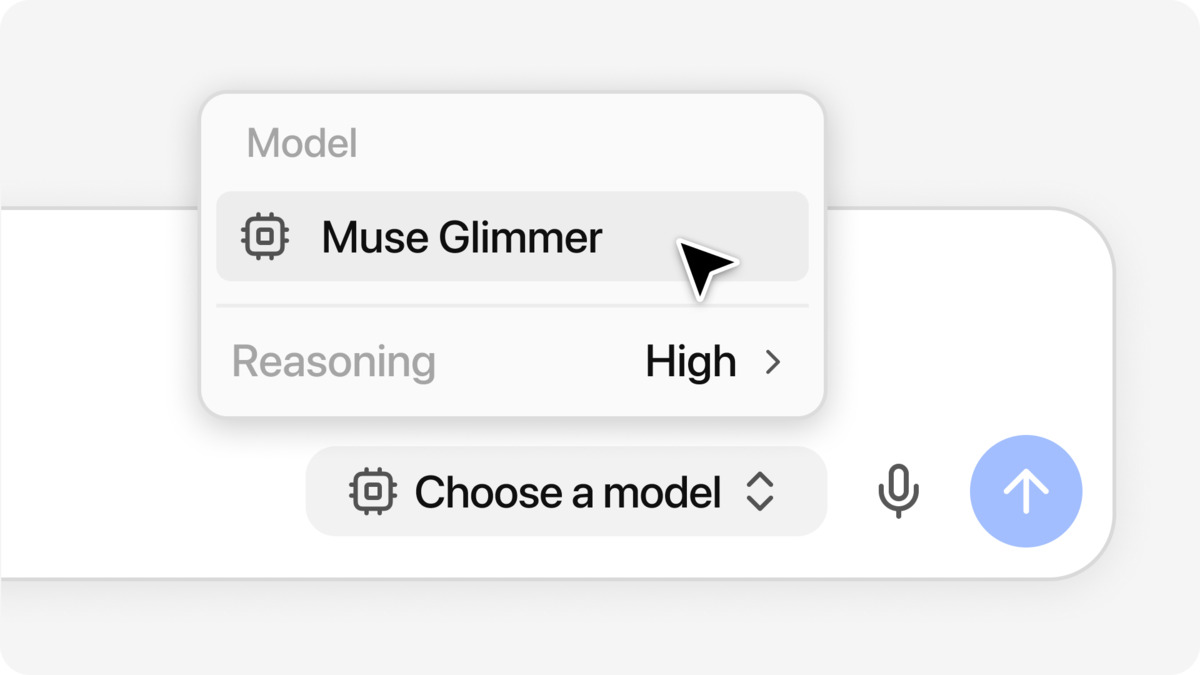 LM Studio shipped day-one support for Muse Glimmer in its Bionic agent interface, the same setup used to run its independent BionicBench comparison.
Source: lmstudio.ai
LM Studio shipped day-one support for Muse Glimmer in its Bionic agent interface, the same setup used to run its independent BionicBench comparison.
Source: lmstudio.ai
Reception among people actually running the weights was cautiously positive within hours. The launch thread on Hacker News had pulled 623 points and 335 comments by the time I checked it, with one early commenter noting that "the people I know who have stable non-public test cases are reporting impressive results" against Qwen3.6-27B specifically, a useful signal because it predates any benchmaxxing concerns tied to the public eval suite. Unsloth had GGUF builds live within the same window.
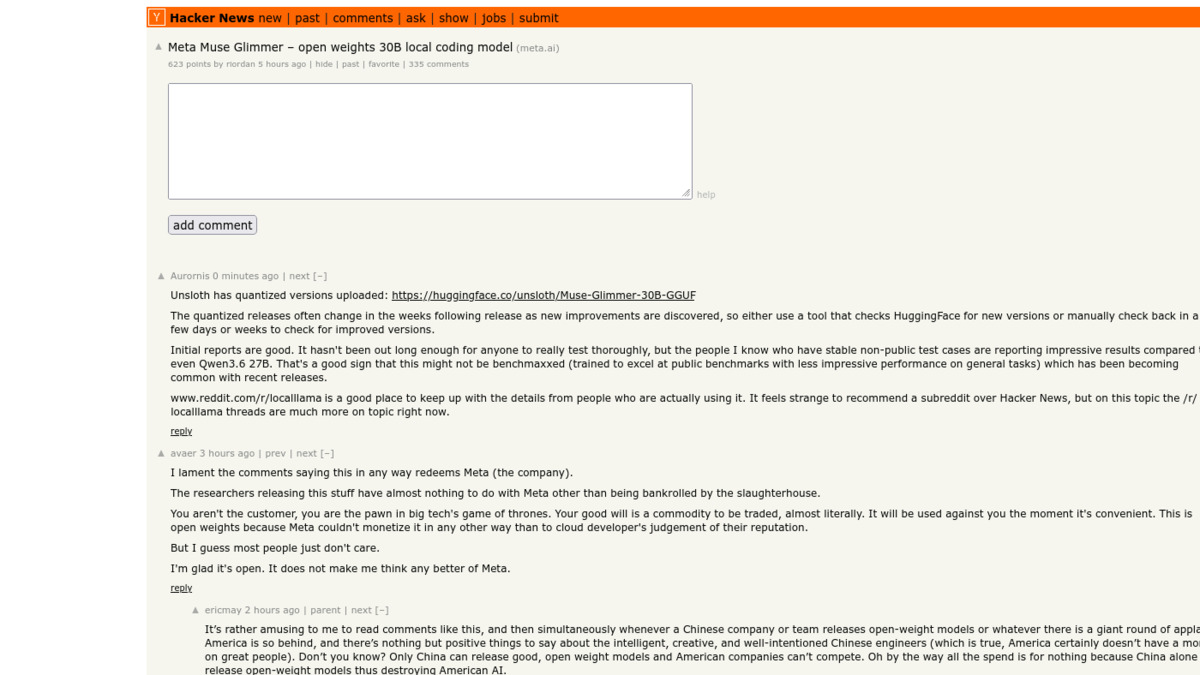 The Hacker News launch thread drew 623 points and 335 comments within its first day, with commenters split between technical praise and skepticism of Meta's motives.
Source: news.ycombinator.com
The Hacker News launch thread drew 623 points and 335 comments within its first day, with commenters split between technical praise and skepticism of Meta's motives.
Source: news.ycombinator.com
Not every reaction was about the model itself. The top-voted comment on that thread dismissed the release as reputation management outright: "Your good will is a commodity to be traded, almost literally." A reply pushed back with a fair point about inconsistent standards, that identical open-weight strategies get applause from Chinese labs and suspicion from Meta. Neither argument changes what the weights do, but both shaped how the release was read on day one.
The Hardware Math
Meta's headline claim is that Glimmer runs on a single consumer GPU, and the spec sheet backs it up more carefully than most local-model marketing does. The base model needs 55GB or more at full BF16 precision. The 4-bit quantized build drops that under 20GB, which is what makes a 24GB card viable at all. Kingy.ai's independent hardware breakdown adds a detail Meta's own materials gloss over: the optional vision projector adds 1.4GB and the DFlash speculative-decoding drafter adds another 1.63GB, both running with the base weights rather than instead of them. Its practical recommendation is to start with the 17GB K-Quant build on a 24GB card, validate text-only performance first, then add the vision and DFlash components while watching memory headroom rather than assuming the marketing number includes everything you'll actually load.
NVIDIA's own deployment guide, published with the launch, reports roughly 20,000 tokens per second in aggregate serving throughput on a single GPU through its NIM containers, a batched-serving figure rather than the single-session speed one developer would see typing into a terminal. That distinction matters. Meta's own single-stream number, 233 tokens per second on an RTX 5090 with DFlash active, is the more relevant figure for a solo developer, and NVIDIA's dense-architecture framing explains part of why it holds up: Glimmer activates every parameter on every token rather than routing through experts, so a single GPU doesn't pay the mixture-of-experts tax it would serving a sparser model of similar total size.
"Glimmer is more interesting as an inference design than as a checkpoint."
That's Karina Nguyen's framing in a Semaphore analysis published the same day, and it's the most useful reframe I found in a day of reading benchmark tables. Her point is that describing Glimmer as "a 17GB quantized model" undersells the engineering: a 16:1 grouped-query attention ratio that shrinks the KV cache aggressively, hybrid local-global attention layers, and official calibrated quantization and speculative decoding shipped on day one rather than bolted on by the community weeks later. Whether that adds up to more useful agent capability per gigabyte than Qwen3.6-27B or Gemma 4 is exactly the question the benchmarks below try to answer, unevenly.
Fine-tuning is a separate story from running inference, and Meta's own numbers are less friendly there. A LoRA supervised fine-tune needs one 80GB H100 with checkpointing and a microbatch of one. A full fine-tune needs eight of them running FSDP. The model that fits on a gaming GPU for inference still needs data-center iron to customize, which is worth knowing before anyone assumes "runs on consumer hardware" extends to training.
Benchmarks: Convincing in Parts
Meta compares Glimmer against Gemma 4 31B and Qwen3.6-27B, the two open-weight models closest to it in size, and says it leads on 5 of 8 published agentic benchmarks. The table backs that up, with a caveat that shows up the moment a task runs long.
| Benchmark | Muse Glimmer | Gemma4-31B | Qwen3.6-27B |
|---|---|---|---|
| MCP Atlas (tool use) | 75.5 | 54.2 | 62.5 |
| DeepSearch QA | 74.6 | 61.7 | 71.1 |
| AIME 2026 | 94.7 | 89.2 | 94.1 |
| GPQA Diamond | 83.5 | 85.7 | 84.2 |
| SWE-Bench Pro | 51.2 | 36.9 | Not reported |
| Terminal-Bench 2.1 | 51.7 | Not reported | 60.7 |
| OSWorld-Verified | 65.9 | Not reported | 75.6 |
The MCP Atlas margin is the widest gap in either direction across the whole comparison, and it's the benchmark Meta built its entire pitch around: scoped, precise tool calls against a schema. Terminal-Bench and OSWorld-Verified tell the opposite story. Both measure sustained multi-step sessions inside a real terminal or desktop, and Qwen3.6-27B wins both by wide margins. Read together, Glimmer is the sharper tool for a bounded task with a clear success condition, and the weaker one once an agent has to keep state and recover from its own mistakes across dozens of steps.
The Safety Numbers Meta Isn't Marketing
Buried in the same model card as the benchmark tables is a safety evaluation nobody in the launch coverage led with. Meta ran Glimmer through Siren AgentDojo, a benchmark that measures how often a model falls for a prompt injection embedded in tool output rather than in the user's actual instructions, and reported the results next to Gemma 4 and Qwen3.6-27B.
| Metric | Muse Glimmer | Gemma4-31B | Qwen3.6-27B |
|---|---|---|---|
| Siren AgentDojo attack success rate (lower is better) | 28.4 | 25.6 | 40.3 |
| Siren AgentDojo utility | 94.2 | 90.8 | 92.7 |
| CI Memories violation rate (lower is better) | 26.4 | 12.1 | 53.4 |
| CI Memories coverage | 64.8 | 53.0 | 66.9 |
Glimmer sits in the middle of the pack on both measures, clearly better than Qwen3.6-27B but clearly worse than Gemma 4. On CI Memories, which tests whether an agent leaks or misuses information it shouldn't carry across a session, Meta's own model more than doubles Gemma's violation rate. None of these numbers are disqualifying on their own, and Meta rates Glimmer's overall agentic risk as "moderate or lower." But a model marketed specifically for "always-on local agent workflows," the kind that reads your files and your screen continuously, is exactly the deployment shape where a one-in-four prompt injection success rate matters more than it would in a chat app. This is a genuine trade-off buried three tables down from the headline numbers, not a footnote.
Free to Run, Not Free of Politics
Zuckerberg paired the release with a 6,500-word essay, "The Future Is for Everyone," arguing that US restrictions on open-weight AI risk ceding the category to Chinese labs. 404 Media's response was blunt, calling the piece's utopian framing something that "requires one to have been recently concussed or to willfully ignore how this technology is being used today." That reaction lands harder given Meta's own history: the company closed the open-source door on its frontier tier in April, and Glimmer is a distillation of that closed model rather than the frontier checkpoint itself. Meta has promised open weights for Muse Spark 1.2 "in the coming weeks," announced at the same event, with no date, license, or parameter count attached today. Until that lands, Glimmer, useful as it is, is Meta claiming the open-source banner for a compressed derivative while keeping the model it was actually derived from behind a paid API.
Strengths
- Independent BionicBench result (83.3% versus 77.7% for both rivals) backs the tool-use pitch beyond Meta's own harness
- Widest benchmark margin of the whole comparison on MCP Atlas, the tool-calling benchmark closest to real agent work
- Apache 2.0 with no commercial restrictions, day-one GGUF and ExecuTorch builds, and broad runtime support at launch
- Truly private: no network call required once weights are downloaded, verified on RTX 5090, M5 Max, and M4 Max
- DFlash speculative decoding is shipped and calibrated by Meta, not left to the community to bolt on weeks later
Weaknesses
- Clearly behind Qwen3.6-27B on Terminal-Bench 2.1 and OSWorld-Verified, the two benchmarks that best simulate a long agent session
- Prompt-injection attack success rate (28.4%) is worse than Gemma 4's (25.6%), a real gap for a model built for always-on agent workflows
- CI Memories violation rate more than double Gemma 4's, on a benchmark that specifically measures agent memory leakage
- Fine-tuning still requires data-center-class hardware (1-8x H100) despite inference running on a single consumer GPU
- Most comparison numbers still come from Meta's own harness; LM Studio's BionicBench is the only fully independent test available at launch
Verdict: 7.8/10
Muse Glimmer does what Meta says it does for the task it was built for. A developer who wants an agent that calls tools accurately, reads a screenshot, and never leaves the machine now has a genuinely strong option that beats its two closest open-weight rivals on the one independent benchmark available at launch. That's a real result, not a marketing number dressed up as one.
It stops short of a clean win. Qwen3.6-27B is still the better choice for anyone running long terminal or desktop-control sessions, and Gemma 4 holds a meaningful edge on the safety numbers that matter most for a model designed to run unsupervised. Neither gap is disqualifying, but both cut against the "beats the field" framing Meta's launch materials lead with. Download it for scoped agentic tool use on hardware you already own. Don't assume it's the safest or the most durable choice for a multi-hour autonomous session until someone outside Meta reproduces the numbers that matter most for that use case.
Sources
- Introducing Muse Glimmer: An Open Agentic Model That Runs on Your Device - Meta AI Research
- meta-models/Muse-Glimmer-30B - Hugging Face
- Meta is back with Muse Glimmer: local, agentic, multimodal, and open source - Hugging Face Blog
- Run Muse Glimmer locally - LM Studio Blog
- Muse Glimmer 30B: Benchmarks, Hardware & How to Run - Kingy.ai
- Run Local Agentic AI Workflows with Meta's Muse Glimmer on NVIDIA - NVIDIA Technical Blog
- Everyone Is Looking at Meta's Glimmer-30B the Wrong Way - Semaphore
- Meta Muse Glimmer - open weights 30B local coding model - Hacker News
- Mark Zuckerberg Posts Deranged 6,500-Word Essay About Giving Everyone AI Superintelligence - 404 Media

