
Mistral Vibe 2.0 Review - Europe's CLI Coding Agent
Mistral Vibe 2.0 pairs the open-weight Devstral 2 model with a terminal-native coding agent. We tested it head-to-head against Claude Code and Codex.
 9 min read
Mistral AI has never been shy about punching above its weight. The Paris-based lab that once turned the AI world on its head with a torrent file has now set its sights on the agentic coding market - a space currently led by Claude Code, GitHub Copilot, and OpenAI's Codex. Vibe 2.0, launched in late January 2026, pairs Mistral's new Devstral 2 model family with a fully open-source CLI agent. The pitch is hard to ignore: near-frontier coding performance at a fraction of the cost, with the option to run everything on your own hardware.
TL;DR
- 7.5/10 - A capable and radically cheaper alternative to Claude Code, best suited for cost-conscious teams and open-source purists
- Devstral 2 hits 72.2% on SWE-bench Verified - competitive among open-weight models but still trailing frontier closed models
- Rate-limiting bugs, unclear usage caps, and occasional freezes reveal a product that shipped before its infrastructure was fully ready
- Ideal for enterprise teams wanting fine-tunable, self-hosted coding AI; less suited for individual developers who need absolute top-tier quality
What Is Mistral Vibe 2.0?
Vibe is Mistral's terminal-native coding agent. Think of it as the French answer to Claude Code - a CLI tool that reads your codebase, understands project structure and Git status, and lets you drive multi-file changes through natural language conversation. Version 2.0 is a significant upgrade over the original, adding custom subagents, slash-command skills, Model Context Protocol (MCP) support, and a clarification system that asks before it acts when your intent is ambiguous.
Installation is straightforward:
curl -LsSf https://mistral.ai/vibe/install.sh | bash
Or if you prefer Python's uv or pip:
uv tool install mistral-vibe
The CLI requires Python 3.12+ and officially targets Unix environments, though it runs on Windows too. It works best in modern terminals like Alacritty, Ghostty, Kitty, or WezTerm - older terminal emulators may choke on the TUI rendering.
The Model Under the Hood - Devstral 2
The real story behind Vibe 2.0 is the model powering it. Devstral 2 is a 123B-parameter dense transformer with a 256K context window, and its smaller sibling, Devstral Small 2, packs 24B parameters with the same context length. Both are open-weight: Devstral 2 ships under a modified MIT license, Devstral Small 2 under Apache 2.0.
The benchmarks tell an interesting story. Devstral 2 scores 72.2% on SWE-bench Verified, a benchmark that tests AI systems on real GitHub issue resolution. Devstral Small 2 manages 68.0% - remarkable for a model you can run on a single high-end consumer GPU. For context, as tracked in our coding benchmarks leaderboard, Claude Opus 4.6 with extended thinking currently leads at around 80.8%, with Claude Sonnet 4.6 at 79.6%. Devstral 2 is competitive, but it isn't at the frontier.
Where things get more compelling is the cost calculus. Devstral 2 is priced at $0.40 per million input tokens and $2.00 per million output tokens. Devstral Small 2 comes in at $0.10/$0.30. Mistral claims up to 7x better cost efficiency compared to Claude Sonnet on real-world tasks - and while that specific multiplier depends on the workload, the raw price difference is undeniable. The models are also free via API during the launch period.
There's an important licensing caveat for enterprises: Devstral 2's modified MIT license includes a revenue restriction clause. Companies with global monthly revenue exceeding $20 million must negotiate with Mistral's sales team or use the hosted API. Devstral Small 2's Apache 2.0 license has no such restriction - a crucial distinction for mid-sized companies eyeing self-hosted deployments.
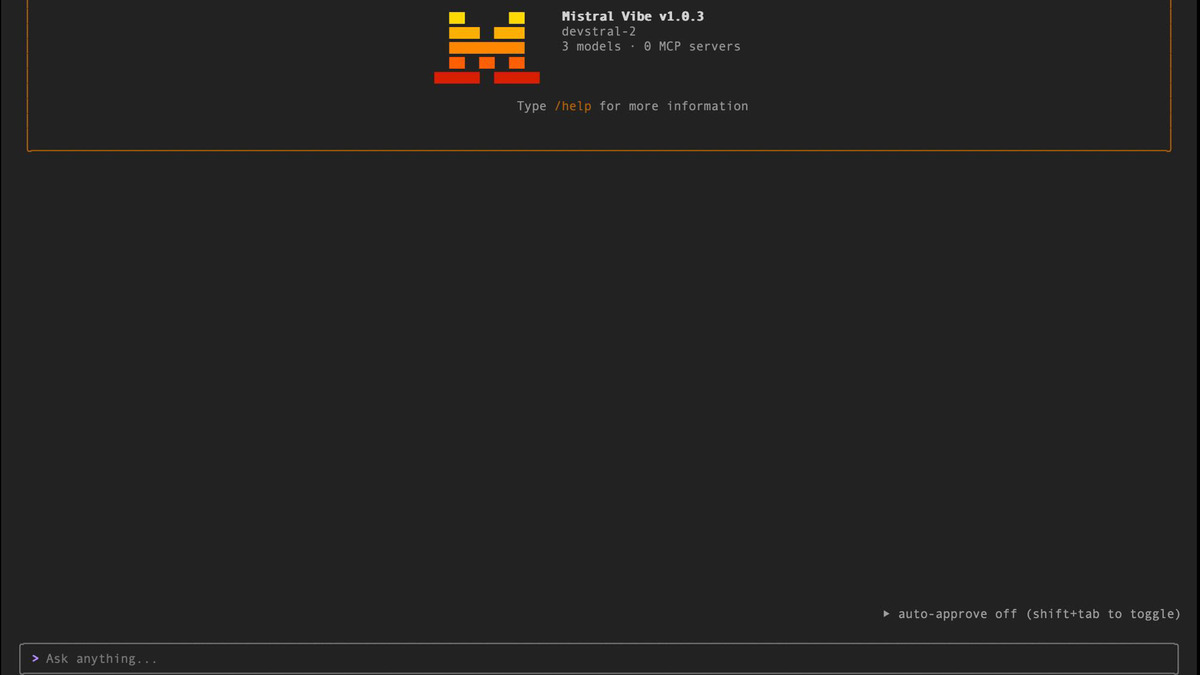 The Mistral Vibe CLI interface - a terminal-native coding agent built on the Textual framework with syntax highlighting and streaming responses.
Hands-On - What Works
Codebase Understanding
Vibe 2.0 is truly impressive at grasping project structure. On first launch, it scans your file tree and Git status, building a working mental model of the repository. Ask it to explain the authentication flow in a Django project or trace a bug through a multi-service architecture, and it handles the navigation well. The 256K context window means it can ingest sizable portions of a codebase without chunking, which is a real practical advantage over smaller-context competitors.
Subagents and Skills
The 2.0 release introduces custom subagents - specialized mini-agents you can build for recurring tasks like deployment scripts, PR reviews, or test generation. You define them in TOML configuration files under ~/.vibe/agents/, and invoke them on demand. Slash-command skills work similarly, letting you load preconfigured workflows for linting, documentation generation, or CI/CD operations. These are genuinely useful features that Claude Code and Codex haven't yet matched in the same structured way.
MCP Integration
Vibe supports the Model Context Protocol for connecting to external tools - databases, APIs, custom services - via HTTP, streamable-HTTP, and stdio transports. Configuration lives in config.toml, and you get fine-grained control over which tools are enabled and at what permission level. For teams already invested in the MCP ecosystem, this is a smooth integration path.
Safety and Control
One thing Mistral clearly thought about is the trust model. Vibe splits large tasks into steps and asks for confirmation before making edits or running shell commands. It shows a full preview diff before applying changes. The permission system is configurable per-tool, with options ranging from "always allow" to "always ask." For a CLI tool with shell access, this is not optional - it's essential.
Hands-On - What Does Not Work
Rate Limiting and Stability
This is where the experience sours. GitHub Issues for Mistral Vibe are littered with complaints about rate limiting - vague "rate limit exceeded" errors that don't explain what limit was hit or by how much. Some developers report the CLI simply freezing on "generating" with no error message and no timeout. Others found that after upgrading to 2.0, their API keys stopped working completely. These aren't edge cases; they point to infrastructure that wasn't ready for the load that a GA launch brings.
Mistral's own documentation acknowledges that Le Chat Pro subscribers can "continue beyond limits with pay-as-you-go at API rates," but the actual limits remain frustratingly opaque. When your coding agent silently stalls in the middle of a multi-file refactor, the cost savings start to look less appealing.
 Vibe handles routine coding tasks well, but trails frontier closed models on complex multi-step refactors spanning many files.
Code Quality Gap
In human evaluation studies conducted using Cline scaffolding, Devstral 2 wins against DeepSeek V3.2 with a 42.8% win rate versus 28.6% loss rate. But Claude Sonnet 4.5 remains "significantly preferred" according to Mistral's own published results. In my testing, Vibe 2.0 handled straightforward tasks - adding tests, refactoring functions, fixing linter errors - competently. But on more complex multi-step work involving architectural reasoning across a dozen files, it occasionally lost track of dependencies or proposed changes that broke the build. Claude Code, powered by Opus 4.6 or Sonnet 4.6, simply doesn't do this as often.
Windows and Terminal Quirks
While Vibe technically runs on Windows, the experience is rough. The TUI rendering breaks in standard cmd.exe and even some configurations of Windows Terminal. On Linux and macOS, you need a modern terminal emulator - if you are still using the default GNOME Terminal or macOS Terminal.app, expect rendering glitches. This is a solvable problem, but it creates unnecessary friction for developers assessing the tool for the first time.
Pricing and Plans
Vibe 2.0 is bundled with Mistral's Le Chat subscription tiers:
| Plan | Price | What You Get |
|---|---|---|
| Experiment | Free | Limited Vibe access for testing |
| Pro | $14.99/month | Full Vibe CLI + Devstral 2 access |
| Team | $24.99/seat/month | Pro features + unified billing, priority support |
There's a 50% student discount on the Pro plan, which is a nice touch. For comparison, Anthropic's Claude Code requires a Max subscription at $100/month or API credits via a Pro plan at $20/month with usage limits. The price gap is significant - Vibe Pro costs less than a sixth of Claude Code's most capable tier.
The API pricing for direct Devstral 2 access ($0.40/$2.00 per million tokens) undercuts nearly every frontier coding model on the market. If you're an enterprise spinning up dozens of agents, the economics are compelling.
 Devstral 2's open-weight licensing makes it one of the few frontier-class coding models you can self-host, fine-tune, and deploy behind your own firewall.
Who Is This For?
Vibe 2.0 occupies a specific - and underserved - niche. It's the best option available today for teams that want:
- Open-weight models they can fine-tune on proprietary codebases, internal frameworks, and domain-specific languages
- Self-hosted deployment for regulatory compliance or data sovereignty
- Cost-efficient agentic coding at scale, where per-token pricing matters
- European data residency - Mistral's infrastructure is EU-based, which matters for GDPR-sensitive organizations
If you're an individual developer who just wants the best coding AI regardless of cost, Claude Code with Sonnet 4.6 or Opus 4.6 remains the stronger choice. If you need tight IDE integration rather than a CLI workflow, Cursor or Windsurf will serve you better. But if you're building a team-wide coding infrastructure and open weights matter, Vibe 2.0 is the most serious contender in the market.
Strengths
- Devstral 2 delivers strong coding performance for an open-weight model, hitting 72.2% on SWE-bench Verified
- Dramatically cheaper than closed alternatives - up to 7x more cost-efficient than Claude Sonnet per Mistral's benchmarks
- Custom subagents and slash-command skills offer structured automation beyond basic chat-and-edit
- 256K context window handles large codebases without chunking
- Full MCP support for tool integration
- Apache 2.0 licensed CLI, open-weight models with permissive licensing
- EU-based infrastructure for data sovereignty compliance
Weaknesses
- Rate limiting is poorly documented and unreliable, with frequent unexplained throttling
- Code quality trails frontier closed models on complex multi-step tasks
- CLI freezes and API key issues reported by multiple users since the 2.0 launch
- Devstral 2's modified MIT license restricts companies above $20M monthly revenue
- Windows support is officially second-class; even some Linux/macOS terminals have rendering issues
- Enterprise fine-tuning requires engaging directly with Mistral's sales team
Verdict - 7.5/10
Mistral Vibe 2.0 is the most credible open-weight challenge to the coding agent duopoly of Claude Code and Codex. The Devstral 2 model delivers genuine value - not quite frontier performance, but close enough that the 7x cost savings and the ability to self-host and fine-tune make a real business case. The subagent system and MCP integration show thoughtful product design that goes beyond simply wrapping a model in a CLI.
But the launch has been rough around the edges. Rate-limiting confusion, CLI freezes, and API key breakage are not the kind of bugs you shrug off in a tool developers rely on for production work. Mistral has the model quality to compete; now it needs the infrastructure and developer experience to match.
If you're assessing terminal-based coding agents today, Vibe 2.0 deserves a serious look - especially if open weights, EU data residency, or per-token economics are non-negotiable requirements. For everything else, the incumbents still have the edge. But the gap is narrowing, and Mistral is narrowing it faster than most expected.
Sources
- Mistral Vibe 2.0 Announcement
- Devstral 2 and Mistral Vibe CLI Launch
- Mistral Vibe GitHub Repository
- VentureBeat - Mistral Launches Powerful Devstral 2 Coding Model
- VentureBeat - European AI Challenger Goes After GitHub Copilot
- Mistral Vibe CLI Documentation
- Mistral Pricing
- SWE-bench Verified Leaderboard
- Cline Blog - Devstral 2 Release
- Devstral 2 on HuggingFace
