
Luma Agents Review: Creative AI That Actually Ships
Luma Agents coordinates text, image, video, and audio from a single brief using the Uni-1 unified model - a genuine architectural leap, with some real rough edges still showing.
 9 min read
Six days after launch, I've been testing Luma Agents hard enough to have a real opinion. The short version: this is the most architecturally interesting creative AI product released this year, and it's also truly unfinished in ways that matter for serious production work. Both things are true.
TL;DR
- 7.8/10 - A real architectural step forward for multimodal creative AI, held back by opaque model routing and dependency risks
- Uni-1's shared token space for language and images is the most honest integration I've tested; reasoning and rendering feel like one thing rather than two bolted together
- External API dependencies on Google, OpenAI, and ByteDance create a supply chain you can't control - enterprise teams should think hard about that before committing campaigns to this stack
- Who should use it: Creative agencies running high-volume campaign localization, production companies testing AI-assisted workflows, early adopters willing to work around rough edges. Skip it if you need guaranteed SLAs, character reference consistency, or full transparency into which model created what.
What Luma Is Actually Selling
Luma launched Luma Agents on March 5, 2026, at an event in San Francisco that included Jon Erwin of the AI-assisted Biblical drama House of David (now streaming on Prime Video) and representatives from Publicis Groupe and Serviceplan. The pitch is direct: give the system a creative brief and a reference image, and it plans, creates, assesses, and delivers across text, image, video, and audio - without you switching between tools.
That pitch sounds like every creative AI product released in the past two years. What makes this one different is the architecture underneath it.
The agents are built on Uni-1, Luma's first model in its Unified Intelligence family. Uni-1 is a decoder-only autoregressive transformer - the same basic building block as GPT and Claude - but trained to interleave text tokens and image patches in a single shared vocabulary. The model doesn't receive a text prompt and then hand off to a separate diffusion model. It reasons about the image and creates it within the same forward pass, as one continuous sequence. CEO Amit Jain put it plainly at the launch: "Intelligence shouldn't be fragmented by modality. Unified systems reason holistically."
That's a vendor quote, so treat it with appropriate skepticism. But in practice, the difference is perceptible.
Testing the Uni-1 Architecture
On RISEBench - a benchmark measuring reasoning-informed visual editing across temporal, causal, spatial, and logical tasks - Uni-1 scores 0.51, narrowly ahead of Google's Nano Banana 2 at roughly 0.505 and OpenAI's GPT Image 1.5 at approximately 0.50. The scores are close. What matters is where the gap shows up: complex editing instructions involving scene coherence and multi-step composition. When I asked Uni-1 to place a product in a specific environment while preserving shadows consistent with a reference light source, it handled the physics correctly on the first attempt. GPT Image 1.5 required two iterations to get there.
The shared token space also improves fine-grained visual understanding in ways that aren't obvious from the benchmark alone. Luma's own evaluation shows that training a model to produce images materially improves its ability to reason about regions, objects, and spatial relationships - not just produce them. Luma says Uni-1 nearly matches Google's Gemini 3 Pro on object recognition, which is a stronger claim and one I couldn't fully verify independently in six days of testing.
The demo case that circulated at launch - generating an entire aging sequence of a pianist from childhood to old age from a single reference image, maintaining consistent camera angles and scene composition - held up when I tried similar prompts. Temporal consistency across a produced sequence is one of the harder problems in image AI, and Uni-1 handles it without the composition drift I see from competitors.
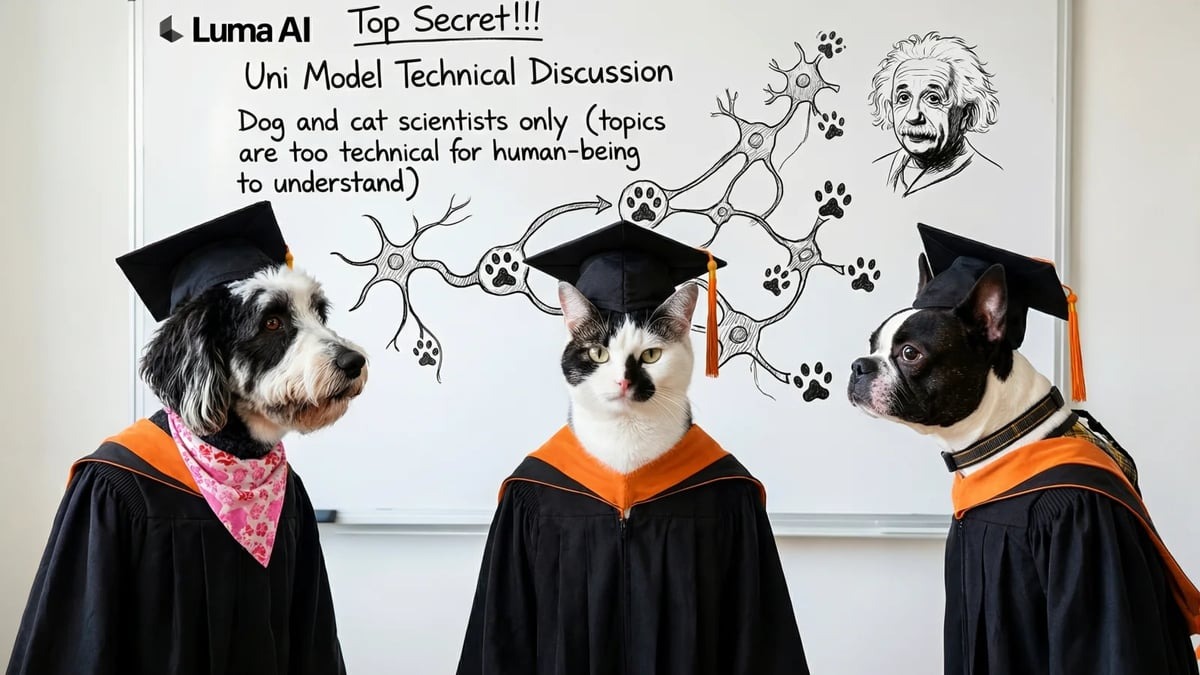 Luma's Uni-1 page illustrates the decoder-only architecture that processes text and images as one interleaved sequence rather than two separate pipelines.
Source: lumalabs.ai
Luma's Uni-1 page illustrates the decoder-only architecture that processes text and images as one interleaved sequence rather than two separate pipelines.
Source: lumalabs.ai
The Agent Orchestration Layer
Uni-1 handles image reasoning and generation. The agent layer on top coordinates everything else. When a brief requires video, the system routes to Ray3.14, Veo 3, Sora 2, or Kling 2.6 depending on requirements. Audio goes to ElevenLabs. ByteDance's Seedream handles image storyboarding. The full list of coordinated external models runs to eight.
Ray3.14, Luma's current video model, is 4x faster and 3x cheaper than its predecessor at 720p and now supports native 1080p output. That's a real improvement. Our Seedance 2.0 review covered ByteDance's video stack separately; seeing Seedream appear as a component inside a competitor's orchestration layer is one of the stranger dynamics in current AI.
The self-refinement loop is the part I found most valuable in practice. The agent assesses its own outputs against the original brief, rejects assets that don't meet quality or brand criteria, and iterates before presenting results. This isn't just a retry mechanism - it uses the same structured internal reasoning that makes Uni-1's generation quality work. In one test, I gave it a brief with specific color temperature and composition requirements; it flagged two generated images as non-compliant and regenerated them without my intervention.
The case study that got attention in the press involved compressing what a global brand described as a year-long, $15 million advertising campaign into 40 hours and under $20,000 in AI costs. The brand's name wasn't disclosed publicly, but Adidas and Mazda are among confirmed early adopters. I can't verify the $15 million figure or the timeline compression independently. What I can verify is that the platform passed the brand's internal quality controls - which tells you something, though it doesn't tell you what standard those controls apply.
 Ray3.14, Luma's current video engine, produces native 1080p at 4x the speed and one-third the cost of its predecessor.
Source: lumalabs.ai
Ray3.14, Luma's current video engine, produces native 1080p at 4x the speed and one-third the cost of its predecessor.
Source: lumalabs.ai
Pricing and Who It's For
Plans start at $30/month (Plus), $90/month (Pro, 4x agent usage), and $300/month (Ultra, 15x usage), with custom enterprise pricing. Annual billing saves 20%. The free tier lets you test basic Dream Machine features but doesn't include the full agent orchestration stack.
For context: Runway's Standard plan at $15/month provides 625 credits, while Luma's previous Creative tier offered more credits but with non-commercial restrictions. The new agent pricing isn't directly comparable to either - this is aimed at agencies and production companies running repeatable workflows, not individual creators making social content. If you're in the latter category, the subscription cost makes no sense unless you're creating high volumes.
Luma Agents is available through the same Dream Machine interface. If you've used it for video generation, the agent layer appears as an additional capability rather than a separate product. Still, the system's current rollout is described as gradual; not all enterprise features are available to all users at once.
Creative teams shouldn't have to spend their time coordinating tools. They should spend it creating. Agents aren't shortcuts. They're collaborators.
What the Agent Gets Wrong
The routing logic for external model selection is opaque. When the system decides to use Veo 3 instead of Ray3.14 for a particular clip, it doesn't tell you why. For agencies managing brand consistency and rights clearances, that matters - different models have different terms of service and different output characteristics. A video clip produced by Veo 3 may look different from one produced by Kling 2.6, and you can't currently specify model preference at the sub-task level.
Character reference consistency is missing from Ray3.14. This is a real gap for commercial production, where brand spokespeople, recurring characters, and talent likenesses need to stay stable across assets. Luma's previous Ray3 model supported character references in certain workflows; Ray3.14 doesn't, and there's no public timeline for restoring it.
The dependency stack is also a strategic concern I'd flag for any enterprise assessing this seriously. The agent coordinates across Google (Veo 3, Nano Banana Pro), OpenAI (GPT Image 1.5, Sora 2), and ByteDance (Seedream). Any of those providers can change pricing, restrict access, or deprecate their model on their own timeline. Luma is building a product whose quality ceiling depends substantially on companies that also compete with it.
The learning curve for non-technical users is real. Prompt sensitivity - needing to be specific about composition, lighting, and style to get consistent results - hasn't gone away just because there's an agent layer on top. The agent will do more with a good brief and less with a vague one. That's not a flaw; it's the nature of current generative AI. But the marketing positioning around fully autonomous creative work overstates what the system reliably delivers.
 Luma's interface integrates image, video, and agent controls in a single workspace, though the full agent orchestration stack requires a paid plan.
Source: lumalabs.ai
Luma's interface integrates image, video, and agent controls in a single workspace, though the full agent orchestration stack requires a paid plan.
Source: lumalabs.ai
Strengths and Weaknesses
Strengths:
- Uni-1's unified token space produces measurably better spatial reasoning and scene coherence than chained pipeline approaches
- Self-refinement loop works and reduces iteration cycles in practice
- Ray3.14's speed and cost improvements make high-volume video production much more viable at the Pro tier
- 76+ style presets with genuine style consistency, not just filter-level variation
- Enterprise clients including Publicis Groupe and Serviceplan Group suggest real production deployments, not just demos
Weaknesses:
- Model routing logic is a black box; no per-sub-task model control
- Character references not supported in Ray3.14 - a regression from the previous version
- External API dependencies on Google, OpenAI, and ByteDance create pricing and availability risk
- Gradual rollout means enterprise feature availability is inconsistent
- No third-party independent benchmarks published yet; Uni-1 scores come from Luma
Verdict
Luma Agents is the most interesting creative AI product of early 2026. It's also a product that launched six days ago, and it shows. The underlying architecture - particularly the Uni-1 unified token model - is a genuine advance over the "text model plus image model bolted together" approach that most competitors still use. On RISEBench reasoning tasks, Uni-1 leads every image model currently available, including competitors' flagship offerings.
But "architecturally interesting" and "production-ready for enterprise campaigns" aren't the same thing. The missing character reference support in Ray3.14, the opaque model routing, and the multi-vendor dependency chain are real problems for agencies running regulated or brand-sensitive workflows. The $15 million campaign compression story is compelling; it'd be more compelling with a named client and independently verified output quality metrics.
For creative teams willing to work at the frontier and manage the rough edges: this is worth testing seriously at the Pro tier ($90/month). For enterprise procurement decisions involving committed campaign budgets: wait for the full enterprise rollout and verify the SLA terms before signing anything.
Score: 7.8/10
The architecture earned a higher score. The production gaps earned it back down.
Sources
- Luma Launches Luma Agents Powered by Unified Intelligence for Creative Work - BusinessWire
- Luma launches creative AI agents powered by its new 'Unified Intelligence' models - TechCrunch
- UNI-1 model page - Luma AI
- Luma AI's new Uni-1 image model tops Nano Banana 2 and GPT Image 1.5 on logic-based benchmarks - The Decoder
- Ray3.14 is here: Native 1080p, 3x cheaper and 4x faster - Luma AI Blog
- Luma Agents Just Compressed a $15 Million Campaign Into 40 Hours and $20,000 - EntrepreneurLoop
- Luma AI raises $900 million in funding round led by Saudi AI firm Humain - CNBC
- Luma AI Uni-1: The Revolutionary Unified AI Model - AICost Blog
- Luma Launches Luma Agents Powered by Unified Intelligence - Channel Post MEA
- Plans & Pricing - Luma AI

