
LongCat-2.0 Review: China's Stealth Coder
Meituan's 1.6T open-source coding model secretly topped OpenRouter for two months before revealing itself - and the price-to-performance math is hard to argue with.
 10 min read
For two months, a model nobody had heard of was quietly dominating developer charts on OpenRouter. It ranked first on Hermes Agent workspace by monthly call volume, second on Claude Code, third across OpenClaw deployments. No press release. No benchmark blog post. No founder tweet. Just 10.1 trillion tokens processed and a +242% monthly growth rate under the alias "Owl Alpha."
TL;DR
- 8.0/10 - Best price-to-performance ratio for agentic coding right now, with real-world proof from a two-month anonymous deployment
- Top strength: $0.75/M input tokens with free cached reads, 59.5 SWE-bench Pro, and a native 1M context window that actually works
- Top weakness: Weights still not published (MIT license means little without the files), all benchmarks are vendor-reported, and enterprise SLA is nonexistent
- Use it if your primary workload is long-context agentic coding and cost matters; skip it if you need a general-purpose frontier model or enterprise support guarantees
On June 30, 2026, Meituan - China's largest food delivery platform, which has been quietly building one of the country's most ambitious AI labs - pulled back the curtain. Owl Alpha was LongCat-2.0, a 1.6-trillion-parameter open-source coding model trained end-to-end on domestic Chinese ASICs. No NVIDIA hardware anywhere in the stack.
The reveal upended the usual narrative around Chinese AI. This wasn't a PR-heavy launch with a coordinated benchmark drop. It was a retroactive unmasking of a model that had already earned its place by merit alone.
How the Blind Trial Changed the Story
The Owl Alpha deployment started April 24, 2026, four days after the model first appeared in private testing. Meituan offered free access with daily token quotas of 5M to 10M tokens per user, which is generous enough to attract real workloads rather than casual experimentation.
What grew under those conditions wasn't artificial adoption. Developers routed their actual agent workflows through it because it performed. By the time Meituan uncovered the identity, Owl Alpha had built up 11 trillion tokens in throughput and was sitting at the global top-three by daily volume across all models on OpenRouter.
 Owl Alpha topped OpenRouter developer charts for two months before being uncovered as LongCat-2.0.
Source: cryptobriefing.com
Owl Alpha topped OpenRouter developer charts for two months before being uncovered as LongCat-2.0.
Source: cryptobriefing.com
This matters because it sidesteps the usual problem with AI model benchmarks: the potential for labs to optimize specifically for test conditions. A model that holds a top-two position on Claude Code deployments, by call volume, over two months is a model developers actually found useful in production. That's a harder signal to fake than a number on SWE-bench.
Architecture: Three Clever Ideas
LongCat-2.0 is a Mixture-of-Experts model, which is no longer unusual. What makes the architecture interesting is three specific engineering choices stacked on top of the standard MoE foundation.
LongCat Sparse Attention
Standard transformer attention scales quadratically with sequence length - double the tokens, quadruple the compute. For a 1M-token window, that's simply unworkable at inference costs that make sense commercially. LongCat Sparse Attention (LSA) replaces full attention with a selective approach: the model identifies the tokens most worth attending to and skips the rest, dropping the scaling to linear. Meituan claims this isn't a sliding-window approximation, but actual full-sequence access across all layers. That's a meaningful distinction. Sliding windows break long-range dependencies; true sparse attention preserves them while managing compute.
Zero-Computation Experts
The 1.6T total parameter count is mostly theoretical. Active parameters per token swing between 33B and 56B, averaging around 48B, via a mechanism called ScMoE. Simple tokens - punctuation, common function names, whitespace - route to minimal subnetworks and return almost unchanged. Complex tokens engage more expert capacity. The result is a dynamic compute budget rather than a fixed cost, which is how Meituan reports a 1.5x MFU (model FLOP use) improvement over their earlier models despite the massive parameter count.
MOPD Expert Integration
Post-training splits into three specialist clusters: Agent Experts for tool use and self-correction, Reasoning Experts for multi-hop logic, and Interaction Experts for instruction following. Rather than fine-tuning sequentially, which tends to make one capability degrade as another improves, Meituan used Multi-Teacher On-Policy Distillation to merge them into a single model. The practical result is that the model doesn't fall apart on instruction following when you push it through extended agentic tool-call chains - a failure mode common in models fine-tuned only on coding tasks.
Benchmark Performance
The headline number is 59.5 on SWE-bench Pro, the current standard for assessing AI on real software engineering tasks. That edges GPT-5.5 (58.6) and beats Gemini 3.1 Pro (54.2) by a meaningful margin. The honest read: 0.9 points over GPT-5.5 is inside noise margin at this scale, so "narrowly competitive" is the right frame, not "ahead."
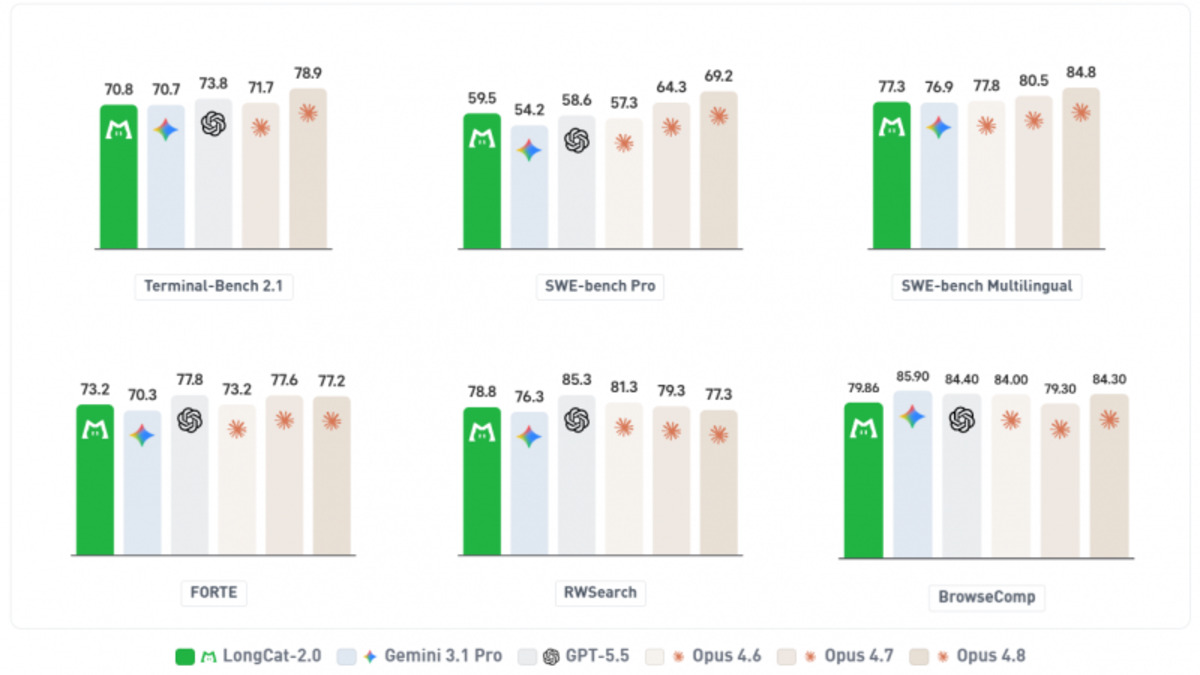 LongCat-2.0 benchmark results showing competitive positioning against frontier coding models.
Source: siliconangle.com
LongCat-2.0 benchmark results showing competitive positioning against frontier coding models.
Source: siliconangle.com
The broader picture from the SWE-bench coding agent leaderboard puts this in context. As of early July 2026, Claude Mythos 5 leads at 80.3%, Claude Fable 5 is at 80%, Claude Sonnet 5 at 63.2%, and Claude Opus 4.8 around 69.2%. LongCat-2.0 at 59.5 sits in the second tier - competitive with GPT-5.5, behind Claude's current production models.
| Benchmark | LongCat-2.0 | GPT-5.5 | Claude Sonnet 5 | Gemini 3.1 Pro |
|---|---|---|---|---|
| SWE-bench Pro | 59.5 | 58.6 | 63.2 | 54.2 |
| SWE-bench Multilingual | 77.3 | n/a | n/a | n/a |
| Terminal-Bench 2.1 | 70.8 | n/a | n/a | n/a |
| FORTE | 73.2 | 77.8 | n/a | n/a |
| BrowseComp | 79.9 | n/a | n/a | n/a |
| RWSearch | 78.8 | n/a | n/a | n/a |
Two caveats apply to all these numbers. First, every score here is vendor-reported from Meituan's internal evaluation suite. Independent third-party confirmation hasn't landed yet. Second, the multilingual and terminal benchmarks have no cross-model comparison available yet, so LongCat-2.0's 77.3 on SWE-bench Multilingual and 70.8 on Terminal-Bench 2.1 are hard to contextualize until other labs run the same tests.
FORTE at 73.2 is more telling. That benchmark grades agents on day-to-day office tasks across 15 professions, which is a proxy for general-purpose capability. LongCat-2.0 ties Claude Opus 4.6 but trails GPT-5.5's 77.8 - suggesting the model's sweet spot really is code, not general workflows.
Real-World Performance
The Decrypt review ran LongCat-2.0 through a game-building task and found it "visibly behind Claude Fable and Opus 4.8 but ranking near Sonnet 4.6." That maps to the benchmark data. For iterative coding tasks where you're asking the model to write, debug, and refactor over a long session, quality-per-dollar becomes the relevant metric rather than absolute ceiling performance.
Where LongCat-2.0 has an edge that benchmarks don't fully capture is the 1M token context window in practice. Most competing models either cap out below 1M or charge a significant premium for extended context. LongCat-2.0's free cached reads change the economics of long-context agentic loops dramatically. If you're passing the same codebase header repeatedly across an agent session, those cached tokens cost zero, not $0.75/M. For workloads where cached tokens represent 60-80% of total input, the effective per-task cost drops below anything a proprietary model offers at comparable quality.
The API uses both OpenAI-compatible and Anthropic-compatible endpoints, which means plugging it into existing Claude Code, OpenClaw, or Kilo Code setups requires minimal configuration changes - usually just swapping the base URL and API key.
Pricing and the Hardware Story
At standard pricing, LongCat-2.0 is 6-7x cheaper per input token than GPT-5.5. With free cached reads on a long-context codebase session, the gap widens further.
| Model | Input | Output | Notes |
|---|---|---|---|
| LongCat-2.0 (standard) | $0.75/M | $2.95/M | Cached reads free |
| LongCat-2.0 (promo) | $0.30/M | $1.20/M | Limited window |
| Claude Sonnet 5 | $2.00/M | $10.00/M | - |
| GPT-5.5 | $5.00/M | $30.00/M | - |
The pricing is aggressive enough to suggest Meituan is subsidizing adoption, at least partly. The flash-sale token packs - released four times daily at Beijing time 10:00, 16:00, 21:00, and 23:00 - point to real compute constraints on the ASIC cluster. You can't buy unlimited capacity on demand the way you can on AWS or Google Cloud, which matters for production deployments.
That constraint connects to the hardware story. LongCat-2.0 was trained and served on a 50,000-card cluster of domestic Chinese ASICs - the first trillion-parameter model to complete both training and inference without NVIDIA hardware. This is significant independently of the model's quality. The Chinese AI ecosystem has been navigating export controls on advanced compute for years, and domestic chip investment has accelerated in response. LongCat-2.0 is the most direct evidence yet that the ecosystem can produce frontier-adjacent models on that hardware.
For comparison, the GLM series from Zhipu AI has also been pushing frontier boundaries on domestic compute - the GLM-5.2 review covers similar territory - though GLM-5.2 skews more toward general-purpose reasoning while LongCat-2.0 specializes in code.
The Open Source Promise - Partially Fulfilled
LongCat-2.0 is MIT licensed. The weights are "coming soon" on Hugging Face and GitHub, both of which currently show placeholder pages. Until the weights are actually published, "open source" here means "API access with favorable terms" rather than the self-hosting freedom the license implies.
For teams running on the open-source LLM leaderboard hoping to self-host, this is a genuine blocker. A 1.6T MoE requires major multi-GPU infrastructure even with dynamic activation, but teams with that infrastructure - enterprise AI shops, academic clusters, national research organizations - can't yet assess whether self-hosting makes operational sense. Meituan has said weights are coming; the timeline is unspecified.
This is worth flagging because the MIT license is part of the competitive positioning. DeepSeek's V4 Pro review covered a similar pattern: open-weight promises that shipped before the competitive window closed. Whether LongCat-2.0 follows the same path or delays until the promo pricing period ends will reveal a lot about Meituan's actual stance on openness.
Strengths
- Native 1M token context with linear-complexity attention - not a windowed approximation
- Free cached context reads are a real cost advantage for long agent sessions
- 59.5 SWE-bench Pro is truly competitive with GPT-5.5, backed by blind real-world adoption data
- OpenAI and Anthropic-compatible API means minimal integration friction with existing toolchains
- MIT license sets up self-hosting as a future option once weights land
- Trained completely on domestic Chinese ASICs - a meaningful infrastructure milestone regardless of model quality
Weaknesses
- Weights aren't published; MIT license is currently theoretical
- All benchmarks are vendor-reported; independent verification is pending
- Flash-sale compute structure suggests constrained capacity at launch
- No enterprise SLA, rate limit documentation, or dedicated support tier
- Trails Claude Sonnet 5 on SWE-bench Pro (59.5 vs 63.2) and Claude Opus 4.8 on FORTE
- SWE-bench Pro edge over GPT-5.5 is 0.9 points - inside measurement noise
Verdict
LongCat-2.0 earns an 8.0/10 for teams whose primary workload is long-context agentic coding. The Owl Alpha blind trial is the most honest endorsement a model can receive - real developers, real workloads, no brand recognition to lean on. The 1M token context window with free cached reads and competitive SWE-bench positioning make it a serious option against GPT-5.5, especially on cost-sensitive production workloads.
The model isn't a frontier leader. Claude Sonnet 5 scores higher on SWE-bench Pro and Claude Opus 4.8 is meaningfully better on general agent benchmarks. But the question isn't which model is best in a vacuum - it's which model gives your team the best output per dollar on your actual workload. For long-context coding agents processing large codebases repeatedly, the math currently favors LongCat-2.0.
The caveats are real. No weights yet. No enterprise support. Compute capacity appears limited. If any of those matter for your deployment context, the score drops to 7.0 or below. But for teams willing to operate within the current constraints, this is the cheapest route to near-frontier coding capability in mid-2026.
Sources
- LongCat-2.0 official model page - Architecture specs, benchmark tables, training details
- LongCat-2.0 release announcement - Official release post
- VentureBeat: Meituan open sources LongCat-2.0 - Full coverage of the reveal and hardware angle
- Decrypt: LongCat-2.0, the stealth AI model that was quietly topping OpenRouter - Owl Alpha backstory, blind trial data, and game-building test
- CryptoBriefing: OpenRouter Owl Alpha hits 10.1T monthly tokens - Token volume and ranking breakdown
- SiliconAngle: Meituan open-sources LongCat-2.0 - Independent coverage with ASIC context
- MarkTechPost: Meituan Releases LongCat-2.0 - Architecture technical breakdown
- CryptoBriefing: LongCat-2.0 undercuts GPT-5.5 and Claude Sonnet 5 on pricing - Pricing comparison analysis
- SWE-bench Pro Leaderboard 2026 - Current rankings and model comparisons
- LongCat-2.0 on Hugging Face - Model card and (pending) weights

