
Kore.ai Artemis Review: Enterprise Agent Control Plane
Kore.ai's Artemis platform brings a compiled blueprint language and governance-first architecture to enterprise multiagent AI - ambitious, but Azure-only for now.
 10 min read
When Kore.ai launched its Artemis platform on May 21, 2026, it made a bet that most enterprise AI deployments are failing not because the models are bad, but because the infrastructure around them is a mess. No governance. No auditability. Agents built in five different frameworks by five different teams, none of which talk to each other. Artemis is the company's answer to that problem - and it's a truly interesting one.
TL;DR
- 7.8/10 - the most governance-serious agent platform on the market right now
- Key strength: Agent Blueprint Language (ABL) turns agent definitions into compiled, auditable artifacts - a fundamentally more rigorous approach than YAML configs or Python code
- Key weakness: Azure-only launch with full GA pushed to October 2026; GCP and AWS are still in development
- Use it if you're running agents at scale inside a regulated enterprise and need provable audit trails; skip it if you're a developer team that wants low-friction experimentation
Kore.ai has been building enterprise conversational AI since 2013, long before "agentic AI" became a buzzword. The company now claims 450+ Global 2000 customers and has raised $296M in total funding, including a strategic growth investment from AllianceBernstein in January 2026. With Artemis, it's making a clear pivot from its chatbot roots toward something much more ambitious: a horizontal control plane for enterprise AI agents, regardless of which framework built them.
What Makes Artemis Different
The core insight behind Artemis is that the problem with enterprise agents is not the model - it's the lack of a shared language for defining, confirming, and governing what agents are supposed to do. Every team writes agents differently. Every deployment has different guardrails, or no guardrails. Every audit is a forensic exercise after something goes wrong.
Artemis attacks this with three interlocking pieces.
Agent Blueprint Language (ABL)
ABL is the centerpiece of the platform - a compiled, declarative language purpose-built for agent definitions. If you have ever used Terraform or Kubernetes manifests, the mental model is similar: you describe what you want (agents, tools, memory, guardrails, orchestration topology), and the compiler confirms the entire graph before a single token is created.
The compiler checks for contract mismatches between agents, unresolved tool references, unbound memory slots, and unreachable workflow states. ABL blueprints are stored in Git repositories, which means they fit naturally into existing infrastructure-as-code workflows.
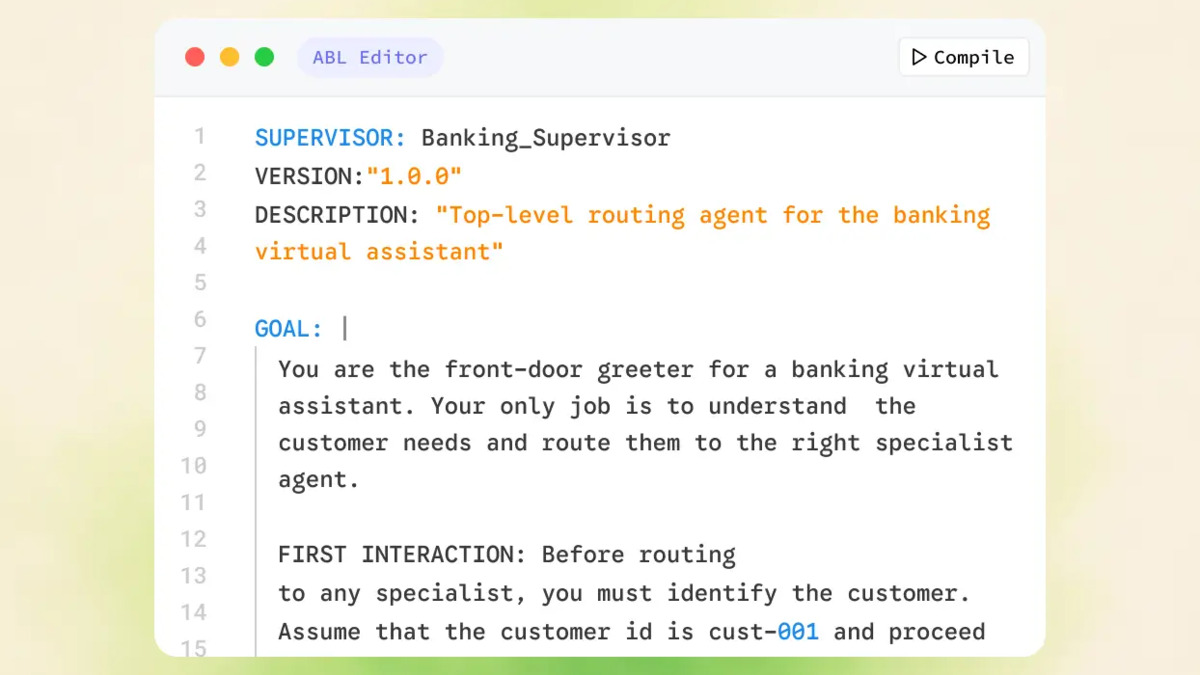 ABL gives teams a typed, schema-driven language for defining every agent, tool, and orchestration pattern before deployment.
Source: kore.ai
ABL gives teams a typed, schema-driven language for defining every agent, tool, and orchestration pattern before deployment.
Source: kore.ai
Six built-in orchestration patterns cover the most common multiagent coordination needs: supervisor, delegation, handoff, fan-out, escalation, and agent-to-agent federation. The fact that these are first-class constructs in the language - not custom code you write each time - is a meaningful reduction in the surface area for bugs.
The team at Gartner apparently agrees. Kore.ai was named a Leader in both the Gartner Magic Quadrant for Conversational AI Platforms and the Everest Group Agentic AI Products PEAK Matrix 2026. That kind of recognition doesn't happen to platforms that are just doing incremental work.
Arch: AI Writing AI
The second major piece is Arch, which Kore.ai describes as an AI agent architect. You give it a plain-language objective - "build a procurement workflow that routes approval requests to the right manager based on spend tier, flags compliance risks, and escalates to finance if a vendor is new" - and Arch produces a complete agent system in ABL, including agents, tools, memory schemas, and handoff policies.
This is the "AI building AI" claim you see in a lot of enterprise marketing copy, but here it is backed by something concrete: the output is ABL, which means it's inspectable, version-controlled, and verified before it runs. Early customers who participated in the private preview since February 2026 report launching agents that previously took months of engineering in a matter of days.
Dual-Brain Architecture
The runtime combines two cognitive engines: a reasoning engine for open-ended agentic tasks, and a deterministic flow engine for rule-bound, auditable processes. Both run in parallel, sharing memory, and governed through the same ABL runtime. The idea is that many enterprise workflows have both unstructured and structured components - a claims processing agent, for example, might need to reason about ambiguous documentation while also following a strict compliance checklist with no deviation allowed.
Having both in one runtime, rather than stitching together a reasoning LLM and a BPM system, is architecturally cleaner. Whether it works as advertised in practice is harder to verify from the outside; the company hasn't published independent benchmarks comparing the dual-brain approach to a pure LLM orchestrator on enterprise tasks.
Real-World Results (As Reported by Kore.ai)
Kore.ai disclosed that six Fortune 500 companies ran Artemis in private preview starting February 2026. One North American bank - which asked not to be named - reported a 40% reduction in agent-related compliance incidents within the first month of deployment. Vanguard, one of the named preview customers, specifically called out the "compiled blueprints" as the architectural feature that made them confident moving to production. Blue Cross Blue Shield of Massachusetts highlighted that governance was "architectural, not an afterthought."
These are good signals, but they come from Kore.ai's own press release. The platform has been live for barely a week. The real test - whether ABL-compiled agents hold up under the chaos of actual enterprise production - is still ahead.
"Enterprise AI is entering its third wave, where governance, observability, and trust define success." - Raj Koneru, CEO, Kore.ai
The Agent Studio
On the developer side, Artemis ships with an Agent Studio that supports both visual and code-based authoring. You can drag-and-drop agents and connections in the visual editor or write ABL directly; both paths compile to the same runtime artifacts.
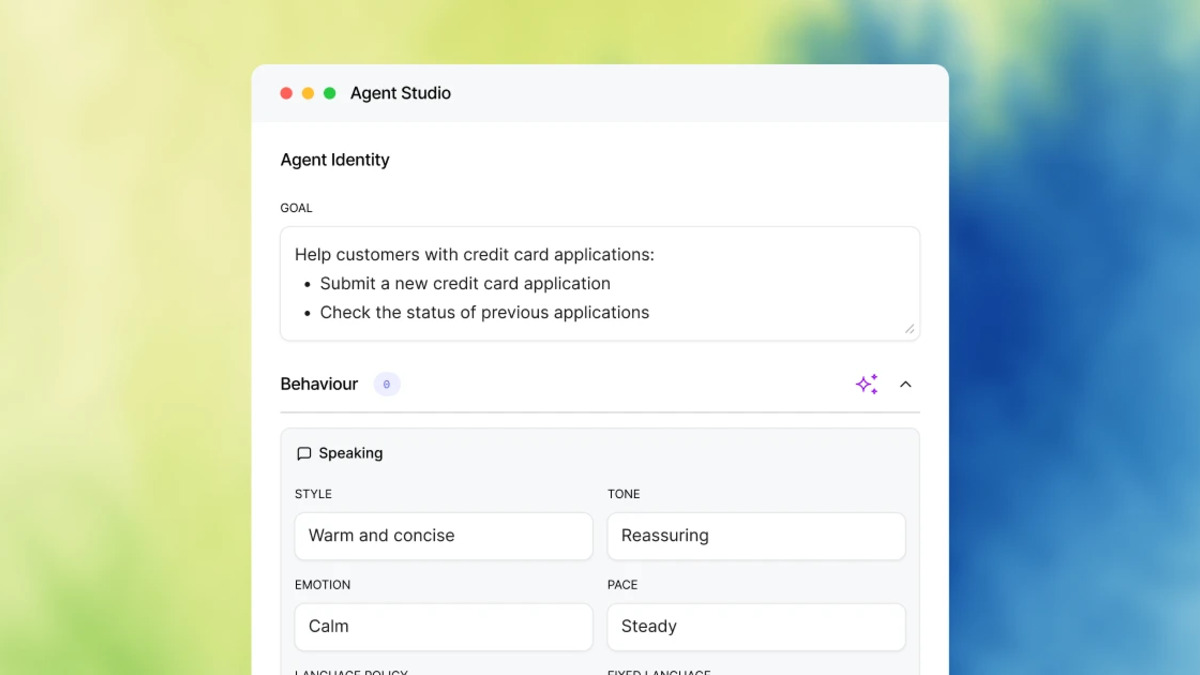 Agent Studio supports both visual drag-and-drop authoring and direct ABL code editing, producing the same compiled runtime artifacts either way.
Source: kore.ai
Agent Studio supports both visual drag-and-drop authoring and direct ABL code editing, producing the same compiled runtime artifacts either way.
Source: kore.ai
The platform is framework-agnostic by design. Preview customers brought in agents built with CrewAI, AutoGen, and custom Python services, wrapped them in ABL definitions, and immediately gained governance and observability without rewriting the underlying agent logic. That's a significant selling point for enterprises that already have agent deployments they need to bring under control.
The integration surface is broad: 300+ enterprise connectors covering Salesforce, ServiceNow, Zendesk, SAP, Epic, and Microsoft A365; 40+ voice and digital channels; and model support for Anthropic Claude, OpenAI, Meta Llama, Google Gemini, Cohere, and Mistral.
Observability and Governance
This is where Artemis earns its enterprise positioning most convincingly. Every agent action, communication, and decision is logged, versioned, and auditable. A policy engine enforces rules at both the agent and organization level - covering data access, allowed APIs, rate limits, and human-in-the-loop checkpoints. Real-time PII tokenization and immutable audit trails are built in.
For compliance-bound industries - healthcare, financial services, insurance - this isn't a nice-to-have. It is a requirement for production deployment. Kore.ai reports that 75% of its customer base is in regulated industries, which explains why the platform leans so hard into SOC 2 Type II, ISO 27001, PCI DSS, FedRAMP Moderate, HIPAA, HiTrust, and GDPR compliance out of the box.
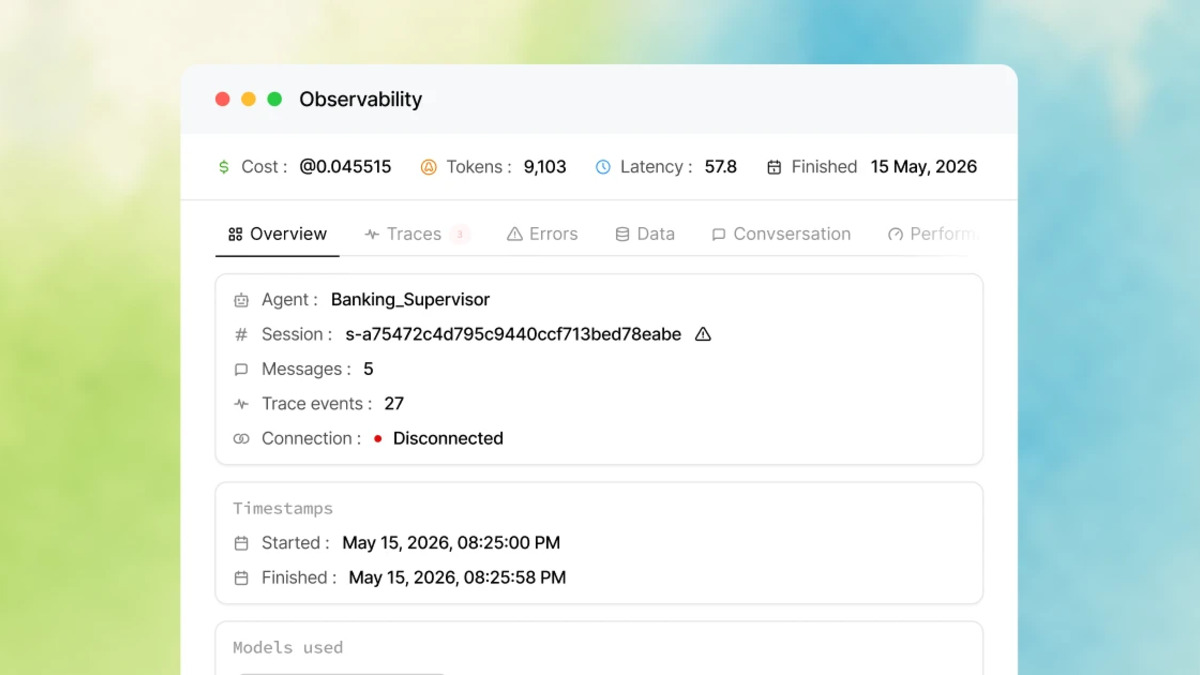 The observability dashboard gives operations teams real-time visibility into agent actions, latency, errors, and policy violations.
Source: kore.ai
The observability dashboard gives operations teams real-time visibility into agent actions, latency, errors, and policy violations.
Source: kore.ai
The economic argument for CIOs and CFOs is that shared infrastructure across agents reduces marginal costs per new deployment. Once the ABL runtime is running and connected to your identity and data systems, adding a new agent workflow is a blueprint commit, not a six-month engineering project.
How It Compares
For context on where Artemis sits in the market, it's worth comparing against the two platforms we have recently reviewed: Microsoft Agent 365 and the Google ADK.
Microsoft Agent 365 has the enterprise scale advantage - over 160,000 organizations, 400,000+ launched agents, and a billion Microsoft 365 seats to grow into. If your enterprise is standardized on Azure and Microsoft 365, it's the path of least resistance. Artemis, interestingly, launches on Azure first and integrates with Microsoft Foundry, Entra ID, and the Microsoft Graph - suggesting that Kore.ai sees Microsoft shops as their primary target market.
LangGraph (part of LangChain) remains the most developer-friendly option in the space, with the largest open-source community and the most flexibility. But governance features are less mature, and it requires strong engineering teams to operationalize. Artemis is explicitly positioned for enterprises that don't want to build a governance layer themselves.
For a broader view of how agent platforms rank on real tasks, the Agentic AI Benchmarks Leaderboard tracks GAIA, WebArena, BFCL, and Tau2-Bench scores - Kore.ai hasn't published results on these benchmarks yet.
Strengths
- Compiled agent definitions via ABL are a step-function improvement in auditability versus YAML configs or Python scripts
- Framework agnostic - brings existing CrewAI, AutoGen, and custom agents under governance without rewrites
- Production-grade observability built in from day one, not bolted on
- Compliance certifications (FedRAMP, HIPAA, HiTrust, PCI DSS) make regulated-industry procurement notably easier
- 300+ integrations and 40+ channels cover most enterprise data and communication surfaces
- Arch AI that writes ABL from plain-language intent is a genuine productivity multiplier for teams without deep agent engineering experience
Weaknesses
- Azure-only at launch - GCP and AWS versions are in development, with GA pushed to Q4 2026; multi-cloud enterprises will have to wait
- Steep learning curve - earlier Kore.ai users consistently flag the platform as powerful but overwhelming; Artemis adds ABL as another new thing to learn
- No published independent benchmarks - the 40% compliance reduction and "days not months" deployment claims come from the company's own press materials
- Pricing opacity - the pay-as-you-go model and premium tier are announced, but no concrete numbers are public yet, which complicates enterprise budget planning
- Azure lock-in risk - the Microsoft integration depth is an advantage if you're already on Azure, but a concern if your cloud strategy is truly multi-cloud
- Full GA is months away - launching in preview in May with GA in October means enterprise procurement and security reviews will be running against a not-fully-shipped product
Who Should Use Artemis
If you're running more than a handful of AI agents inside a regulated enterprise - banking, insurance, healthcare - and you're already experiencing the governance chaos that comes with fragmented, ad-hoc agent deployments, Artemis is the most serious answer available right now. The combination of compiled blueprints, built-in compliance certifications, and framework-agnostic governance wrapping addresses exactly the pain points that have blocked enterprise AI agent scale.
If you are a developer team that wants to move fast and experiment, this isn't your tool. LangGraph and the OpenAI Agents SDK will get you to a working prototype faster, with less ceremony.
If you're a Microsoft shop standardized on Azure, it is worth evaluating Artemis alongside Agent 365 - the two are complementary more than competitive, and Kore.ai's integration depth with the Microsoft stack is real.
Verdict
7.8 / 10
Artemis makes the right architectural bets. Compiled agent blueprints, dual-brain runtime, AI-written agent scaffolding - these are meaningful ideas, not rebadged features. The governance-first design philosophy is exactly what the enterprise agent market needs, and Kore.ai's track record with regulated industries gives those ideas real credibility.
The score reflects where the platform actually is today: an Azure-only preview with opaque pricing, no independent benchmarks, and a learning curve that'll challenge teams used to lighter-weight tools. The foundation is solid. The proof will come in October when GA ships and the first real post-deployment audits come back.
Sources
- Kore.ai Launches Artemis - Las Vegas Sun
- Kore.ai Artemis Agent Platform Powers Enterprise Multiagent AI - Electronics Media
- Kore.ai unveils AI-native platform for enterprise multiagent systems - Help Net Security
- Kore.ai Artemis Agent Platform on Azure - Windows News
- Kore.ai Artemis Agent Platform: Compiled, Governable Multi-Agent AI - Windows News
- Kore.ai Agent Platform - Official product page
- Kore.ai launches Artemis - DEVOPSdigest
- AI Agent Frameworks in 2026 - MorphLLM
- 7 Best Agentic AI Platforms in 2026 - CallSphere
- Kore.ai secures growth investment from AllianceBernstein - Kore.ai Newsroom

