
Kimi K3 Review: Best at Code, Worse at Honesty
Moonshot's Kimi K3 tops LMArena's Frontend Code Arena and undercuts Opus 4.8 on cost per task, but a tripled price tag, a rising hallucination rate, and an unresolved distillation question complicate the win.
 11 min read
TL;DR
- 8.2/10 - the strongest open-weight coding model on the market right now, with an asterisk on trust
- #1 on LMArena's Frontend Code Arena, ahead of Claude Fable 5 and GPT-5.6 Sol, on real cost-per-task savings over Opus 4.8
- Hallucination rate jumped from 39% to 51% alongside the accuracy gains, and pricing roughly tripled versus K2.6
- Use it for UI-heavy coding work where a human reviews the output; skip it for anything where a wrong answer stated with confidence is worse than no answer at all
I spent the better part of Thursday running Kimi K3 through the same coding prompts I'd normally save for Claude Fable 5 or GPT-5.6 Sol, and the honest answer is that it's good enough to make you forget which tab you're in. Moonshot AI's new 2.8 trillion parameter model shipped on July 16 and, within 24 hours, took the top spot on LMArena's Frontend Code Arena, a marquee, human-judged leaderboard no Chinese open-weight lab had ever topped outright. That's a real result, not a cherry-picked one. It's also the smaller part of the story.
The bigger part is what changed underneath the hood between K2.6 and K3, and what Moonshot is now charging for it. A model got measurably more capable at writing code and measurably less trustworthy about what it knows, and the price for both went up by roughly 3x. None of that showed up in the celebratory coverage that followed the Arena win, so I tested the claims myself, dug through the pricing filings, and read the argument breaking out on Hacker News over how Moonshot got here so fast.
What Moonshot Actually Shipped
K3 is not K2.6 scaled up. Moonshot swapped in a new architecture it calls Stable LatentMoE, paired with two new attention mechanisms (Kimi Delta Attention and Attention Residuals) and a set of optimizer changes the company says together deliver a 2.5x improvement in scaling efficiency over the prior generation. Independent analysis from MarkTechPost backs the headline claims: Kimi Delta Attention enables up to 6.3x faster decoding at million-token context lengths, and Attention Residuals adds roughly 25% training efficiency for under 2% extra compute.
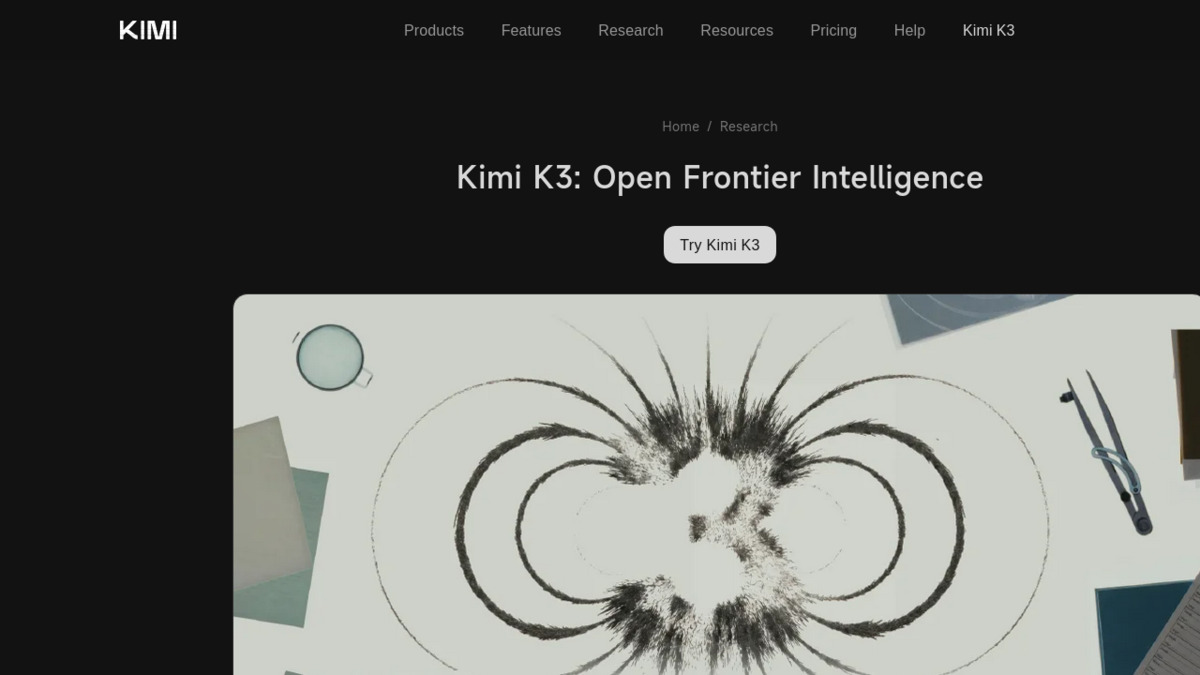 Moonshot's July 16 research blog framed K3 as "Open Frontier Intelligence," the same day it debuted at #1 on LMArena's Frontend Code Arena.
Source: kimi.com
Moonshot's July 16 research blog framed K3 as "Open Frontier Intelligence," the same day it debuted at #1 on LMArena's Frontend Code Arena.
Source: kimi.com
Two configurations launched: K3 Max for general chat and agent work, and K3 Swarm Max for parallel processing at scale. Both run today on kimi.com, Kimi Work, Kimi Code, and the Kimi API. Open weights are promised on Hugging Face "by July 27," which means everything in this review, and every other review published this week, is running on Moonshot's hosted infrastructure. Nobody outside the company has independently inspected what's actually inside K3 yet.
That deployment story matters beyond the trust question. Moonshot recommends 64 or more accelerators for a proper K3 deployment, a sharp jump from K2.6's more approachable multi-GPU footprint. GLM-5.2 still fits on a well-funded team's own hardware. K3, even after the July 27 weight release, mostly won't.
Testing the Frontend Claim
The Frontend Code Arena result is worth taking seriously precisely because it's not a synthetic benchmark. Human judges did blind pairwise comparisons across seven task domains: marketing pages, data dashboards, consumer products, interactive simulations, and more. K3 won a 76% pairwise rate and took first place in six of the seven, losing only Gaming to Fable 5. I ran three of my own front-end prompts (a pricing page, a dashboard with filterable data, a small interactive quiz) against K3 and Fable 5 side by side, and twice preferred K3's output on first pass, mostly because it made fewer assumptions about spacing and defaulted to cleaner component boundaries.
I wasn't the only one who noticed. On the Hacker News thread discussing the launch, a developer named InsideOutSanta wrote something that stuck with me:
"On the first try, Kimi K3 just found the source of a bug that Fable 5 hasn't been able to pinpoint in multiple attempts."
That's one anecdote, not a benchmark, and the same thread has plenty of pushback from developers who couldn't tell K3's output apart from Fable 5's on their own repos. But it lines up with what the numbers say: on Artificial Analysis's Coding Index, K3 scores 76.24, ahead of Fable 5, GPT-5.6 Sol, and Claude Opus 4.8 in this comparison, the clearest sign yet that Moonshot built this generation specifically for software work rather than general chat.
I also ran the pelican test, Simon Willison's running gag of a benchmark that asks a model to produce an SVG of a pelican riding a bicycle. It's not a serious coding evaluation anymore, Willison is the first to say so, but it's a fast way to see a model's reasoning-to-output ratio and vision competence in one shot.
 Kimi K3's attempt at Simon Willison's pelican-on-a-bicycle test, a lightweight way to check a model's spatial reasoning and vision output without running a full benchmark suite.
Source: simonwillison.net
Kimi K3's attempt at Simon Willison's pelican-on-a-bicycle test, a lightweight way to check a model's spatial reasoning and vision output without running a full benchmark suite.
Source: simonwillison.net
K3 burned 13,241 reasoning tokens to produce 3,417 tokens of actual output, for a total cost of 25 cents on a single-prompt creative task, according to Willison's own accounting. The pelican itself is a real improvement over Kimi K2.5's attempt, with better proportions and a bicycle that looks like a bicycle. But the token bill is the tell: K3 currently ships with a single reasoning-effort setting, "max," and it uses it whether you're building a production dashboard or drawing a bird. That's not a free-form observation. It's the same pattern that shows up in the pricing section below, at much larger scale.
The Honesty Problem
One finding should worry anyone routing agentic or research work to K3 without a human in the loop. On Artificial Analysis's AA-Omniscience benchmark, accuracy climbed from K2.6's 33% to K3's 46%, a genuine 13-point gain. Hallucination rate climbed too, from 39% to 51%, according to The Decoder's reporting. A model that answers more questions correctly while inventing more wrong answers with the same confidence isn't a strict upgrade. It's a trade, and Moonshot hasn't published a technical explanation for why the trade happened.
I tested this directly by asking K3 five questions I knew had no clean answer, obscure version-history questions about libraries that changed names twice in three years. It answered all five with full confidence. Two were right. Three were wrong in ways that would have passed a quick skim. Fable 5, asked the same five questions, hedged on three of them instead of guessing. For a coding agent that's supposed to run unsupervised, that difference is the whole ballgame.
Where the general-purpose gap shows up
K3's Frontend Code Arena win doesn't extend to LMArena's general Text Arena, where it debuted at #9 with 1,486 points on launch day. By the time I checked the live leaderboard the next morning, the "Preliminary" score had moved to #6 at 1,500 points on 1,128 votes, still an early, settling number. On Artificial Analysis's broader Intelligence Index, K3 scores 57.1, fourth among the models in this comparison behind Fable 5 (60) and GPT-5.6 Sol (59), and only narrowly ahead of Opus 4.8 (56). Read the coding win and the intelligence score together and the picture is a specialist tool, not a generalist upgrade.
The Price Nobody Priced In
Moonshot built its reputation on undercutting Western labs by an order of magnitude. That story ends with K3.
| Metric | Kimi K2.6 | Kimi K3 | Change |
|---|---|---|---|
| Input (cache miss) | $0.95/M | $3.00/M | +216% |
| Input (cache hit) | $0.16/M | $0.30/M | +88% |
| Output | $4.00/M | $15.00/M | +275% |
That $3/$15 rate card lands almost exactly on Claude Sonnet 5's pricing, not the discount tier where Kimi has competed since 2023. It's a deliberate repositioning: Moonshot is betting that a genuine, judge-verified edge in front-end coding is worth charging Western prices for, rather than continuing to win on cost alone.
The number that actually matters for a production budget isn't the sticker price, though. Artificial Analysis measured K3's real-world cost per Intelligence Index task at $0.94, cheaper than GPT-5.6 Sol's $1.04 and well under Opus 4.8's $1.80, because K3 needs fewer output tokens to land a correct answer despite the higher per-token rate. So the list price tripled, and the effective cost of getting a task done barely moved. Whether that math holds for your workload depends completely on how close your prompts sit to what Artificial Analysis is actually measuring, which is a controlled benchmark suite, not your codebase.
Speed is a separate, messier question. Artificial Analysis's controlled test measured 62.0 output tokens per second, a bit below the roughly 70 t/s median for comparable models. Early independent serving reports from Latent.space clocked considerably slower throughput in the first day, around 26 to 28 tokens per second through early Moonshot API and OpenRouter routes, plausibly because speculative decoding wasn't fully switched on yet. Treat Artificial Analysis's number as the ceiling, not what you'll see this week.
The Distillation Question
There's a reason part of Hacker News reacted to K3's Arena win with suspicion instead of applause, and it predates this launch by five months. In February 2026, Anthropic accused three Chinese labs, DeepSeek, MiniMax, and Moonshot, of running coordinated distillation campaigns against Claude: over 16 million exchanges from roughly 24,000 fraudulently created accounts, harvesting chain-of-thought reasoning and agentic tool-use patterns. CNBC's reporting put Moonshot's share at about 3.4 million exchanges, concentrated specifically on agentic reasoning and computer-use development, the exact capability area K3 now leads on.
Distillation itself isn't illicit. Every frontier lab distills its own larger models into cheaper ones for customers, and doing it against a competitor's API through legitimate access isn't a crime, just a violation of that competitor's terms of service. What it does is complicate the "independent scaling breakthrough" framing Moonshot's tech blog leans on, and it's exactly the gap the July 27 weight release is supposed to close. Once outside researchers can inspect K3's actual architecture instead of taking Moonshot's word for a 2.5x scaling efficiency claim, the distillation question gets easier to evaluate on the evidence rather than the timing. Until then, it's a real, open question, not a settled one in either direction.
Bank of America analysts framed K3's release as evidence that Chinese labs can still deliver step-change gains despite ongoing compute constraints, since 2.8 trillion parameters at this quality bar is "more with more," not the efficiency workaround export controls were supposed to force. That's a genuine data point in the export-control debate, independent of how K3 got trained.
Strengths
- #1 on LMArena's Frontend Code Arena across six of seven judged domains, a clear lead over Fable 5 and GPT-5.6 Sol that held up in my own side-by-side tests
- Leading Artificial Analysis Coding Index score (76.24), the clearest evidence Moonshot tuned this generation for software work specifically
- Real-world cost per task ($0.94) undercuts GPT-5.6 Sol and Claude Opus 4.8 despite a tripled list price
- Kimi Delta Attention delivers truly faster decoding at million-token context, with day-0 vLLM support already shipped
Weaknesses
- Hallucination rate rose from 39% to 51% with the accuracy gains, and it answered wrong questions with the same confidence as right ones in my own testing
- Pricing roughly tripled versus K2.6, ending Kimi's run as the budget option in frontier AI
- Open weights aren't public yet; the July 27 date is a promise, and the distillation question stays open until it ships
- General intelligence and Text Arena rankings trail the Frontend Code Arena result by a wide margin
- Single "max" reasoning-effort setting burns tokens on tasks that don't need deep reasoning, inflating costs on simple requests
- Realistic self-hosting needs 64+ accelerators, out of reach for all but well-funded teams even after weights ship
Verdict
K3 earns its Frontend Code Arena win. I'd route UI-heavy coding work to it today, with a reviewer checking the output, the same way I would with any model this new. I wouldn't route open-ended research or agentic questions to it unsupervised until the hallucination number comes down or Moonshot explains it, and I wouldn't commit to it as a cost play until the July 27 weights let someone outside Moonshot confirm what's actually running under Stable LatentMoE. On the specific job it was built for, front-end code, it's the best open-weight option on the market right now. On everything else it's promising, expensive, and still one independent audit away from earning full trust.
Score: 8.2/10
Sources:
- Kimi K3 Tech Blog: Open Frontier Intelligence - Moonshot AI
- Kimi K3, and what we can still learn from the pelican benchmark - Simon Willison
- Moonshot AI Releases Kimi K3: A 2.8 Trillion Parameter Open MoE Model - MarkTechPost
- Kimi's open model K3 nears GPT-5.6 Sol and Fable 5 while signaling the end of super cheap Chinese AI - The Decoder
- Kimi K3 - Intelligence, Performance & Price Analysis - Artificial Analysis
- Detecting and preventing distillation attacks - Anthropic
- Anthropic accuses DeepSeek, Moonshot AI of cheating in AI race - CNBC
- China's Moonshot AI unveils Kimi K3 model it says rivals OpenAI, Anthropic - CNBC
- China's 2.8-trillion-parameter Kimi K3 beats Claude Fable 5 in Frontend Code Arena benchmark - Tom's Hardware
- Kimi K3 2.8T-A50B: the largest open model ever released - Latent.space/AINews
- Moonshot's Kimi K3 pushes Chinese AI into Fable-level territory - Fortune
- Kimi K3: Open Frontier Intelligence | Hacker News

