
Kimi K2.7 Code Review: Open Weights Enter Copilot
Moonshot AI's Kimi K2.7-Code became the first open-weight model in GitHub Copilot's picker, pairing genuine cost savings with a benchmark story that only Moonshot has verified.
 10 min read
Moonshot AI shipped Kimi K2.7-Code on June 12, 2026, as a narrow coding refresh of K2.6. Three weeks later, on July 1, it became something more notable: the first open-weight model GitHub ever added to Copilot's model picker, sitting alongside proprietary options from OpenAI, Anthropic, Google, and Microsoft. That placement, not the model card, is why this review exists now. A capable coding model with unverified benchmarks is one story. The same model landing inside the world's most-used AI coding assistant, hosted on Microsoft's own infrastructure, is a different one.
TL;DR
- 7.6/10 - a truly cheap, capable coding model whose headline benchmarks still come only from Moonshot itself
- GitHub Copilot integration solves the biggest objection to using a Chinese-developed model: your code now routes through Azure, not Moonshot's servers
- Every published benchmark gain is measured on Moonshot's own test suites, with no independent SWE-bench, LiveCodeBench, or DeepSWE numbers at launch
- Good fit for cost-sensitive teams running high-volume agentic coding; weak fit for anyone who needs peer-reviewed proof before switching
What Actually Changed From K2.6
Moonshot didn't touch the underlying architecture. K2.7-Code keeps the same 1-trillion-parameter Mixture-of-Experts design as K2.6, with 32 billion active parameters per token, 384 experts, and the 400-million-parameter MoonViT vision encoder carried over unchanged. Pricing didn't move either: $0.95 per million input tokens on a cache miss, $0.19 on a cache hit, $4.00 per million output tokens, per Moonshot's platform documentation.
What changed is where the reinforcement learning budget went. Moonshot retrained the reward model around end-to-end coding tasks, MCP tool-call chains, and long-horizon agent workflows, and the result is a model that reportedly needs about 30% fewer reasoning tokens to reach the same or better conclusions than K2.6. Thinking mode stays mandatory; the API returns an error if a client tries to disable it, and sampling is locked server-side at temperature 1.0 and top_p 0.95.
Three days after the base release, Moonshot shipped a companion HighSpeed variant that trades some of that reasoning depth for raw throughput, up to 180 tokens per second on median-length coding inputs versus the standard model's pace, at a higher $1.90/$8.00 per-million rate. It's a latency option for interactive use, not a replacement for the base model on tasks where correctness matters more than speed.
The GitHub Copilot Story Is the Real News
On July 1, GitHub announced that Kimi K2.7 Code was rolling out to Copilot Pro, Pro+, and Max subscribers, selectable in the model picker across VS Code 1.127.0+, Visual Studio 17.14.6+, JetBrains 1.9.1-251+, Xcode, Eclipse, Copilot CLI, and github.com. A week later, on July 7, Business and Enterprise plans followed, though administrators there must explicitly flip on the Kimi K2.7 Code policy - it stays off by default.
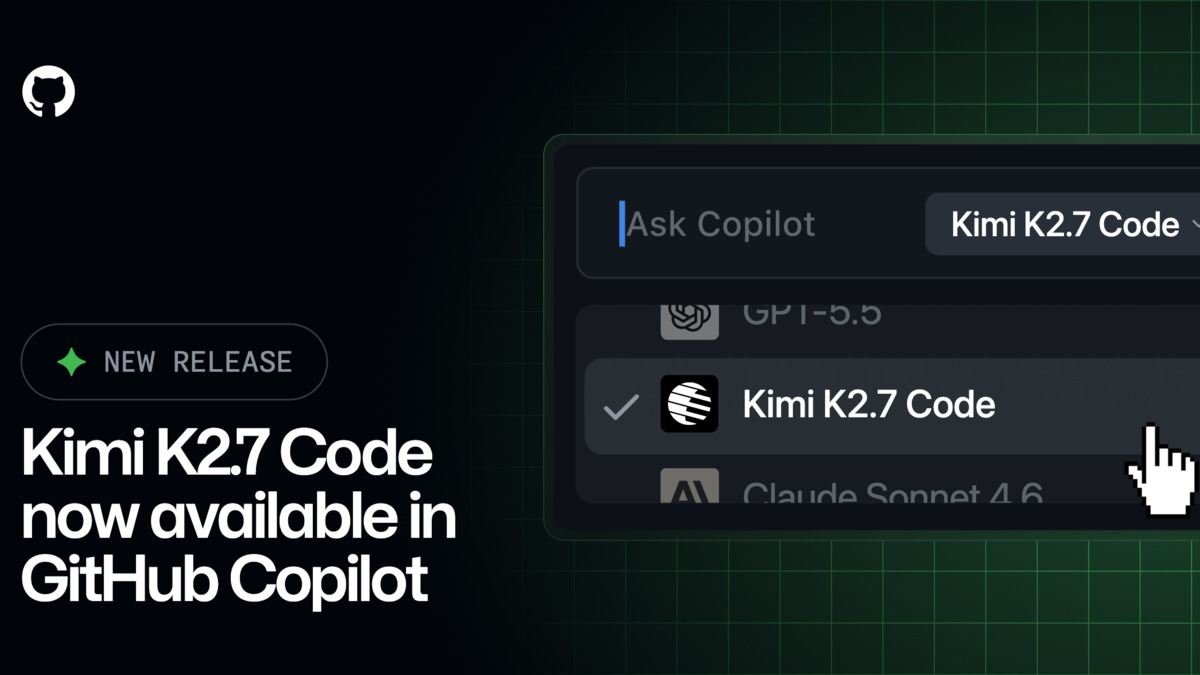 GitHub's own announcement graphic shows Kimi K2.7 Code checked in the model picker, next to GPT-5.5 and Claude Sonnet 4.6.
Source: github.blog
GitHub's own announcement graphic shows Kimi K2.7 Code checked in the model picker, next to GPT-5.5 and Claude Sonnet 4.6.
Source: github.blog
GitHub's framing was direct: this is "the first open-weight model offered as a selectable option in the Copilot model picker." That distinction matters more than it might sound. Copilot's picker now spans five labs - OpenAI, Anthropic, Google, Microsoft, and Moonshot - and every prior slot went to a closed, proprietary model. Kimi K2.7 Code broke that pattern specifically because its weights are public and inspectable, not despite it.
"The first open-weight model offered as a selectable option in the Copilot model picker, giving you more choice and a lower-cost option for your coding workflows." - GitHub Changelog, July 1, 2026
Billing and the Fine Print
Inside Copilot, Kimi K2.7 Code runs on GitHub's usage-based AI Credit system, billed at provider list pricing, which lands roughly in the same tier as GPT-5.4 mini rather than a flagship model rate. Annual-plan subscribers get a 0.9x multiplier when using Auto routing instead of pinning the model directly, on top of the standard 10% Auto-mode credit discount all paid plans receive. None of that's unique to Kimi, but it does mean the model's cost advantage over API list pricing partially compresses once it's wrapped in Copilot's credit system, since GitHub, not Moonshot, sets the effective rate developers pay.
The Data Governance Angle Nobody Talks About Enough
Moonshot AI is based in Beijing, and that fact carries real weight for teams weighing whether to send proprietary source code through the hosted Kimi API. China's 2017 National Intelligence Law requires domestic organizations to cooperate with state intelligence requests, and the country's Data Security and Cybersecurity Laws add data-localization obligations on top. None of that is unique to Moonshot among Chinese AI labs, but it's a real consideration weighed against sending code to any US-based frontier lab instead.
The Copilot integration changes that calculus in one specific way. Prompts and completions routed through Kimi K2.7 Code inside Copilot run on Microsoft Azure infrastructure, the same hosting arrangement Copilot uses for its other third-party models, not on servers Moonshot operates directly. Code queries stay inside Microsoft's cloud perimeter at inference time. That's not a guarantee about training data or model behavior, but it's a genuine, meaningful difference from calling the Moonshot API directly - and it's the strongest practical argument for why an enterprise wary of a Chinese-hosted endpoint might still greenlight Kimi K2.7 Code through Copilot specifically.
Teams that want the strongest version of that guarantee can skip both routes and self-host: the Modified MIT license permits it, and native INT4 quantization brings the ~595GB full model down to something an 8x H100 node can serve with vLLM or SGLang. That's out of reach for most teams, but it's an option no closed frontier lab offers at any price.
 Kimi K2.7-Code's weights, license, and full architecture details are published openly on Hugging Face.
Source: huggingface.co
Kimi K2.7-Code's weights, license, and full architecture details are published openly on Hugging Face.
Source: huggingface.co
Benchmark Performance: Read the Fine Print
This is the part of the K2.7-Code story that deserves the most scrutiny. Every number Moonshot published at launch comes from its own proprietary test suites. As of publication, no independent organization has re-run the model on SWE-bench Verified, SWE-bench Pro, LiveCodeBench, DeepSWE, GPQA Diamond, or AIME under controlled, shared conditions, a gap TechTimes flagged within days of release and one Moonshot still hasn't closed.
| Benchmark | K2.6 | K2.7-Code | Claude Opus 4.8 | GPT-5.5 |
|---|---|---|---|---|
| Kimi Code Bench v2 | 50.9 | 62.0 | 67.4 | 69.0 |
| Program Bench | 48.3 | 53.6 | 63.8 | 69.1 |
| MCP Mark Verified | 72.8 | 81.1 | 76.4 | 92.9 |
| MCP Atlas | 69.4 | 76.0 | 81.3 | 79.4 |
Every benchmark above is Moonshot's own except where noted. The pattern holds across the table: K2.7-Code improves meaningfully over K2.6, and still trails GPT-5.5 on most metrics, with one exception. On MCP Mark Verified, which scores tool use across five human-verified environments (Notion, GitHub, Filesystem, Postgres, and Playwright), K2.7-Code's 81.1 beats Claude Opus 4.8's 76.4. Because those environments are widely used outside Moonshot's own test harness, that's the closest thing to a third-party-adjacent result in the entire release.
The skepticism has a specific origin point. When K2.6 launched, a developer publicly asked Moonshot why the model scored 24% on the independent DeepSWE benchmark, tied with GPT-5.4-mini, while leading on Moonshot's in-house suites. Moonshot hasn't submitted K2.7-Code to DeepSWE either, and the same gap between vendor-run and neutral-harness scores has shown up in GPT-5.5 and Claude Opus 4.8 launches this year too - it's an industry pattern, not one unique to Moonshot, but Moonshot's public numbers happen to be the most exposed to it right now.
What Independent Reviewers Found Instead
Without a shared leaderboard, third-party writeups have leaned on qualitative testing. Flowtivity's review places K2.7-Code behind GPT-5.5 on most coding tasks and behind Claude Opus 4.8 on raw tool-use precision, while noting DeepSeek V4 edges it out on pure reasoning and GLM-5.1 on code generation specifically. PureAI Labs' aggregated review of developer community feedback found consistent complaints about verbosity - the model over-explains its answers by default - and "lost in the middle" context degradation on very large codebases, with praise for handling 200-300 sequential tool calls in a single agentic session without losing track of state.
Pricing and Where to Access It
| Access point | Input | Output | Notes |
|---|---|---|---|
| Moonshot API (standard) | $0.95/M (cache miss) | $4.00/M | $0.19/M on cache hit |
| Moonshot API (HighSpeed) | $1.90/M | $8.00/M | Up to 180 tok/s |
| GitHub Copilot | Provider list rate | Provider list rate | Billed via Copilot AI Credits, roughly GPT-5.4 mini tier |
| Self-hosted | Free (Modified MIT) | Free | ~595GB disk, INT4 quantized |
Against GPT-5.5's $5/$30 per-million rate, the raw API pricing is roughly 5 to 7 times cheaper on a like-for-like basis, and the 30% reasoning-token reduction compounds that further in agentic pipelines running thousands of tasks a day. Reddit threads collected in PureAI Labs' review describe developers who moved entire coding workflows off Claude specifically for this reason, reporting 75-90% API spend reductions with no proportional drop in task completion on routine work. That tracks with what the numbers above would predict for high-volume, mechanically-verifiable coding tasks; it says less about work that depends on judgment rather than throughput.
The Modified MIT license permits commercial self-hosting and redistribution, with an attribution requirement that only triggers above 100 million monthly active users or $20 million in monthly revenue - the same threshold Cursor tripped with its K2.5 deployment last year. For everyone below that bar, it's effectively unrestricted.
Strengths
- First open-weight model in GitHub Copilot's model picker, running on Azure infrastructure rather than Moonshot's own servers
- Genuine 5-7x cost advantage over GPT-5.5 at list pricing, before the 30% reasoning-token efficiency gain compounds it further
- Beats Claude Opus 4.8 on MCP Mark Verified (81.1 vs 76.4), the release's most credible tool-use signal
- Handles 200-300 sequential tool calls in a single agentic session without losing state, per independent developer reports
- Modified MIT license with a high attribution threshold makes commercial self-hosting practical for most teams
- Available across nearly every major IDE surface on day one of the Copilot rollout
Weaknesses
- Every headline benchmark comes from Moonshot's own test suites - no independent SWE-bench, LiveCodeBench, or DeepSWE scores exist for this release
- Trails GPT-5.5 on most published coding and agentic benchmarks, sometimes by double digits
- Mandatory thinking mode adds token overhead on simple tasks that don't need extended reasoning, and sampling parameters are locked server-side
- Verbose by default; developers routinely need system prompts to rein in over-explained answers
- Context degrades on very large codebases despite the 256K window
- Self-hosting requires ~595GB of storage and multi-GPU infrastructure, putting it out of reach for most individual teams
Verdict
Kimi K2.7-Code is a truly useful model wrapped in a launch story that oversells its verification. The 30% reasoning-token efficiency gain is real and matters at scale. The MCP Mark Verified result against Claude Opus 4.8 is the one number in this release that stands on ground firmer than Moonshot's own test harness. Everything else in the benchmark table needs an asterisk until an independent lab runs it.
What makes this review worth writing in July rather than back in June is Copilot. Routing K2.7-Code through Azure instead of Moonshot's own infrastructure removes the single biggest practical objection enterprises have raised about Chinese-developed coding models, without requiring anyone to stand up their own H100 cluster. For teams running high-volume, mechanically verifiable coding workflows where cost is the binding constraint, that combination is worth testing against whatever you're running today. For anything where you need to trust the output without checking it, wait for someone other than Moonshot to publish the numbers first.
Score: 7.6/10
Sources
- Kimi K2.7 Code is generally available in GitHub Copilot - GitHub Changelog
- Kimi K2.7 now available for Copilot Business and Enterprise - GitHub Changelog
- moonshotai/Kimi-K2.7-Code on Hugging Face
- Moonshot AI Releases Kimi K2.7-Code - MarkTechPost
- Kimi K2.7-Code Adds HighSpeed Mode but Skips Independent Benchmark Submission - TechTimes
- Open-Weight AI Enters GitHub Copilot: Kimi K2.7 Code Costs Less, Audits Differently - TechTimes
- Kimi K2.7 Complete Review: Benchmarks, Cost, and Local Inference - Flowtivity
- Kimi Code Review 2026: Is K2.7 the Best Open-Source Coding Agent for the Price? - PureAI Labs
- Kimi K2.7 Code - API Pricing & Benchmarks - OpenRouter
- Kimi K2.7 Code Quickstart - Kimi API Platform
- Meet Kimi K2.7 Code HighSpeed - Moonshot AI on X

