
Grok 4.5 Review: Agentic Speed at Half the Price
xAI's Grok 4.5 tops AutomationBench and costs 80% less per agentic task than Opus 4.8, but neutral coding benchmarks and a doubled hallucination rate complicate the story.
 9 min read
xAI released Grok 4.5 on July 8, 2026 with a two-sentence pitch from Elon Musk: "Opus-class model, but faster, more token-efficient and lower cost." After two days of close examination - independent benchmarks, user testing reports, and a careful look at what xAI chose not to publish - that description is accurate in some ways and misleading in others. The model earns its cost case for high-volume agentic work. The headline numbers, though, depend heavily on who runs the evaluation, and a sharp jump in hallucination rates introduces a risk the launch coverage mostly glossed over.
TL;DR
- 7.8/10 - strongest cost-per-task option at near-frontier level, but with meaningful caveats
- Tops AutomationBench-AA at 51.4%, ahead of Fable 5 (48.6%) and Opus 4.8 (48.5%) on real agentic workflows
- Hallucination rate doubled from 25% to 54% on AA-Omniscience - it knows more, but is far more confident when wrong
- Best for high-volume agentic pipelines where cost is the constraint; skip for anything requiring factual reliability
What Grok 4.5 Actually Is
The model runs on xAI's V9 foundation - a 1.5-trillion-parameter mixture-of-experts architecture. At that scale, MoE routing means the active parameter count per inference is substantially lower than a 1.5T dense model would be, which is how xAI sustains 80-91 tokens per second throughput. The V9 base completed its primary training run in late May 2026; Grok 4.5 added real Cursor developer session data on top.
That Cursor connection matters more now than it did a month ago. SpaceX picked up Cursor in June 2026 for $60 billion in stock, pending Q3 close. Grok 4.5 was jointly trained with Cursor before that deal closed, which means the model carries session data from Cursor's user base - real debugger interactions, multi-file diffs, and developer corrections. Cursor CEO Michael Truell called it "the first model we've built for more than software engineering."
One caveat Cursor disclosed at launch deserves attention: an earlier snapshot of the Cursor codebase accidentally ended up in Grok 4.5's training data. This inflates scores on any CursorBench-derived evaluation. Independent benchmarks like DeepSWE and SWE-Bench Pro use their own infrastructure and aren't affected - which is why those neutral numbers matter more than the provider-controlled ones.
Grok 4.5 ships with a 500K token context window, down from the 1M window on Grok 4.3. xAI hasn't explained the reduction. For teams running large codebase analysis or long-document work, that's a real downgrade the launch blog didn't acknowledge.
Benchmark Performance: A Tale of Two Harnesses
The coding benchmarks tell two stories depending on which evaluation framework runs them.
| Benchmark | Grok 4.5 | Fable 5 | Opus 4.8 | GPT-5.5 |
|---|---|---|---|---|
| DeepSWE 1.0 (provider harness) | 62.0% | 66.1% | 55.75% | 64.31% |
| DeepSWE 1.1 (neutral harness) | 53% | 70% | 59% | 67% |
| Terminal Bench 2.1 | 83.3% | 84.3% | 78.9% | 83.4% |
| SWE-Bench Pro | 64.7% | 80.4% | 69.2% | 58.6% |
| AutomationBench-AA (agentic) | 51.4% | 48.6% | 48.5% | - |
The gap between DeepSWE 1.0 and DeepSWE 1.1 is the most important number in the table. On the provider-controlled harness, where xAI designs the scaffolding, Grok 4.5 beats Opus 4.8 by 6 points. On the neutral mini-swe-agent harness, it drops 9 points and finishes below both Opus 4.8 and GPT-5.5. A 9-point swing is too large to chalk up to randomness - it suggests the model is sensitive to how task scaffolding is set up, which matters for anyone planning to build their own agentic pipelines on top of it.
Terminal Bench 2.1 is the cleaner story. All four models cluster within 5.4 points, with Grok 4.5 at 83.3% basically matching GPT-5.5. On SWE-Bench Pro, Grok 4.5 ranks third - ahead of GPT-5.5 but behind both Fable 5 (80.4%) and Opus 4.8 (69.2%).
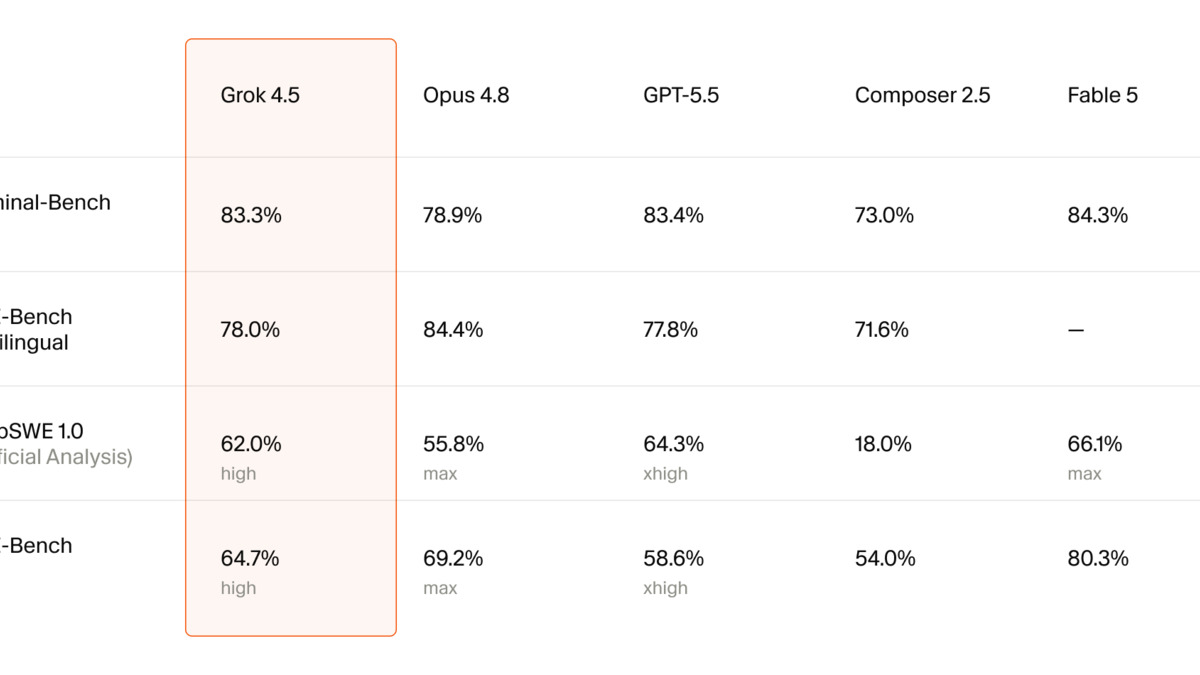 Cursor's official benchmark chart for Grok 4.5 launch, comparing performance across key coding and engineering evals.
Source: cursor.com
Cursor's official benchmark chart for Grok 4.5 launch, comparing performance across key coding and engineering evals.
Source: cursor.com
On the Artificial Analysis Intelligence Index, the model currently sits at 54, ranking #8 among 186 assessed models. It launched at #4, but rankings shift as new models enter the field. Either way, it's comfortably in the top tier for a model at this price point.
What the Knowledge Benchmarks Say
xAI didn't publish GPQA Diamond or MMLU-Pro scores at launch, so direct reasoning comparisons remain incomplete. The most revealing knowledge benchmark is Artificial Analysis's AA-Omniscience, which evaluates factual accuracy alongside hallucination rates.
Grok 4.5 improved in raw accuracy: from 35% on Grok 4.3 to 52%. The hallucination rate moved in the opposite direction, from 25% to 54%. The model is more likely to be correct, but when it's wrong, it's now considerably more likely to sound certain about it. For legal, research, or financial work, that combination is harder to manage than a model that hallucinates less but is easier to catch when it does.
The Agentic Argument
The one area where Grok 4.5 leads without qualification is agentic task performance.
Artificial Analysis tested it on AutomationBench-AA, which covers 657 tasks across 40 simulated enterprise apps including Gmail, Slack, Salesforce, and HubSpot. Grok 4.5 scored 51.4% - the first model to complete more than half of workflow objectives without violating business constraints. Fable 5 landed at 48.6% and Opus 4.8 at 48.5%, both at roughly four times the per-task cost.
"Grok 4.5 is an Opus-class model that's fast and low cost - a significant step up over any model we've developed so far." - Michael Truell, Cursor CEO
On Snorkel's GDPVal+ evaluation, which uses around 2,000 professional domain tasks, Grok 4.5 reached a 29% mean pass rate against 22% for GPT-5.5 and 21% for Opus 4.8. The gains were concentrated in domains requiring deep professional judgment: legal work at 40% (vs 27-28%), education at 58% (vs 35-42%), and healthcare at 35% (vs 23-25%).
The agentic tool use score from Artificial Analysis shows Grok 4.5 at 33%, the best single result across all models in that evaluation. For actual multi-step workflows involving real enterprise software, the model's practical performance tops what pure coding benchmarks suggest.
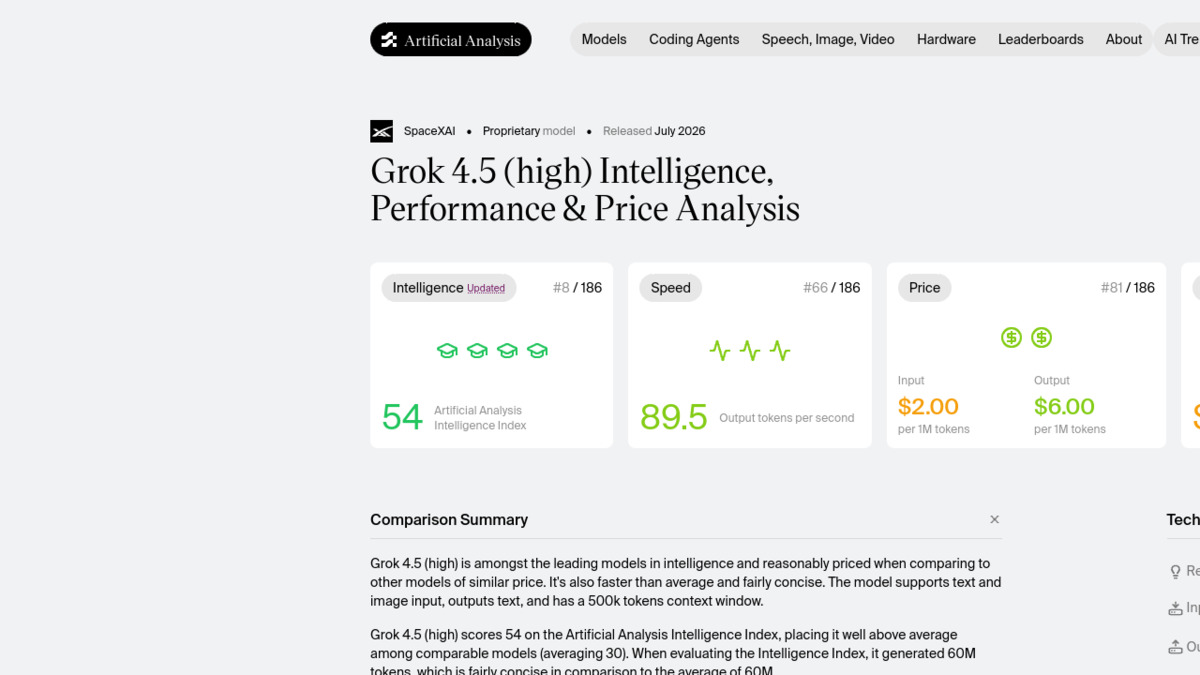 Artificial Analysis ranks Grok 4.5 at #8 on the Intelligence Index with a score of 54, measuring well above average on speed at 89.5 tokens per second.
Source: artificialanalysis.ai
Artificial Analysis ranks Grok 4.5 at #8 on the Intelligence Index with a score of 54, measuring well above average on speed at 89.5 tokens per second.
Source: artificialanalysis.ai
Token Efficiency and What It Means for Cost
The efficiency numbers are the clearest edge in the Grok 4.5 case. On SWE-Bench Pro, the model used an average of 15,954 output tokens per task. Opus 4.8 used 67,020. That's a 4.2x gap.
When you combine lower per-token pricing ($6/M output vs $25/M for Opus 4.8) with 4.2x fewer tokens consumed per task, the effective cost difference becomes sizable. Independent testing measured Grok 4.5 at roughly $0.49 per completed coding-agent task against about $1.375 for Opus 4.8 on equivalent token counts - about 2.8x cheaper on a like-for-like basis. Some analyses, accounting for worst-case Opus token verbosity, put the gap wider.
The efficiency advantage comes from how Grok Build structures tasks: short, targeted tool calls rather than verbose responses. That approach works well when the calls are accurate. It can boost errors when they aren't, since mistakes compound across long task chains.
The Hallucination Problem
The AA-Omniscience result deserves its own section because it doesn't show up in most launch coverage.
Grok 4.5's hallucination rate of 54% - up from 25% on Grok 4.3 - isn't unusual for a model trained with aggressive capability scaling. Larger MoE models learn to be more confident across more domains, and that confidence doesn't always track accuracy. The issue isn't that the model fails more often; accuracy genuinely improved. The issue is that it now fails with more conviction, which makes hallucination detection harder in practice.
For coding tasks where outputs are verifiable through tests, this is a manageable risk. For tasks producing text, analysis, or conclusions that humans accept without automated verification, the doubled hallucination rate is a more serious concern.
"Grok 4.5 improved in knowledge accuracy from 35% to 52% - and its hallucination rate rose from 25% to 54%. It knows more. It's also more confident when it's wrong." - Artificial Analysis, July 2026
Pricing and Availability
At $2/M input and $6/M output, Grok 4.5 prices well below its nearest performance competitors. Prompts above 200K tokens switch to $4/M input and $12/M output, so long-context work costs more than the headline rate suggests - worth factoring into any cost projection for document-heavy pipelines.
The Cursor-specific fast variant runs at $4/M input and $18/M output, with roughly double the throughput for latency-sensitive workflows.
At launch, the model is available through the xAI API, in all Cursor plans, through Microsoft Office add-ins, and on gateways including OpenRouter. EU access isn't included at launch; xAI has targeted mid-July 2026 for regional availability with no exact date confirmed.
One comparison worth making within the xAI lineup: Grok 4.3 sits at roughly 53 on the Artificial Analysis Intelligence Index against Grok 4.5's 54 - a difference of one point. Grok 4.5 costs 60% more per input token and offers half the context window. For teams whose workloads don't specifically need agentic task-completion or high-volume throughput, Grok 4.3 remains a defensible choice.
Strengths
- AutomationBench-AA #1: 51.4% on 657 real enterprise workflow tasks, the only model above 50%
- Per-task cost: roughly 2.8-17x cheaper than Opus 4.8 depending on token consumption patterns
- Speed: 89.5 tokens per second measured by Artificial Analysis, fast enough for interactive workflows
- Professional domain gains: strong improvements in legal, education, and healthcare tasks on GDPVal+
- Broad launch availability: API, Cursor, Microsoft Office add-ins, and major model gateways from day one
Weaknesses
- Neutral harness benchmark gap: DeepSWE 1.1 drops from 62% (provider harness) to 53% (neutral), suggesting scaffold sensitivity
- Doubled hallucination rate: 54% on AA-Omniscience vs 25% on Grok 4.3 - improved accuracy with worse calibration
- Context window cut: 500K tokens vs 1M on Grok 4.3, with no public explanation
- SWE-Bench Pro at 64.7%: third out of four in the benchmark set, behind Fable 5 (80.4%) and Opus 4.8 (69.2%)
- EU unavailable at launch: regulatory review, expected mid-July
- CursorBench contamination: training data overlap inflates scores on Cursor-derived evals; only affects that specific harness
Verdict
Grok 4.5 is a truly competitive model for a specific use case: high-volume agentic pipelines where cost is the primary constraint and outputs are mechanically verifiable. Its #1 position on AutomationBench-AA is the most credible claim in the launch announcement. The token efficiency advantage is real and compounds at scale.
Outside that use case, the picture gets messier. The hallucination rate doubling makes it a poor fit for anything that relies on factual reliability without automated checking. The scaffold sensitivity revealed by the DeepSWE harness comparison matters for teams building their own agent infrastructure. The context window cut from 1M to 500K is unexplained and consequential for certain workloads.
Score: 7.8/10
For developers building agentic workflows on a cost budget, Grok 4.5 is worth serious consideration. For accuracy-critical applications, or for teams already running well on Grok 4.3 without heavy agentic workloads, the upgrade case is weaker than the launch framing implied.
Sources
- Introducing Grok 4.5 - xAI
- Introducing Grok 4.5 - Cursor Blog
- SpaceXAI Releases Grok 4.5 - TechCrunch
- Grok 4.5 Cuts Coding-Agent Cost 80%: Near-Frontier Speed, Higher Hallucinations - TechTimes
- Grok 4.5 (high) Intelligence, Performance & Price Analysis - Artificial Analysis
- AA-Omniscience: Knowledge and Hallucination Benchmark - Artificial Analysis
- Grok 4.5 Beats Fable 5 And Opus 4.8 In Agent AI Test With 51.4% Score - Yellow.com
- SpaceX's Grok 4.5 launches at half the price of rivals - VentureBeat
- Grok 4.5 Testing Results - Snorkel AI
- Grok 4.5 Benchmarks: Pricing, Context, and the Opus Claim - Kingy.ai
- Grok 4.5 vs Claude Opus 4.8 - APIdog

