
Antigravity 2.0 Review: Agent-First, Rocky Launch
Google's Antigravity 2.0 rewrites the platform from a browser IDE into a five-surface agent suite. The architecture is ambitious, the launch was a mess.
 9 min read
Google went from shipping a cloud-based browser IDE to shipping a five-surface agent platform in a single version jump. The original Antigravity, reviewed by James Kowalski in February, was a compelling but constrained product - a 2M context window, fast cloud builds, and deep Gemini integration, all locked inside a browser tab. Version 2.0, announced at Google I/O on May 19, 2026, tears up that architecture and replaces it with something much more ambitious.
TL;DR
- 7.2/10 - genuine multi-agent innovation undermined by a chaotic release week
- Native parallel subagent orchestration and a built-in browser agent put it ahead of Cursor and Claude Code on autonomous workflows
- Launch wiped user configs, CLI wasn't installable, and the free tier dropped from 250 to 20 requests/day
- Worth running alongside your current tools; not ready to replace them
The ambition is real. So is the roughness. Both need to be said clearly before getting into the details.
What Changed in 2.0
The original Antigravity ran in a browser. Every build ran on a Google Cloud Workstation. That design had real advantages - inference close to the compute, no local setup, fast builds - but it required handing your codebase to Google and accepting that offline work was impossible.
Version 2.0 reverses most of those constraints. Google now ships five surfaces: a standalone desktop application, a new Go-based CLI called agy, a SDK for building custom agents, a Managed Agents API for cloud deployment, and an Enterprise Agent Platform layered on Google Cloud. This is no longer a browser product. It's a platform.
The shift is significant enough that calling this an update undersells it. The 1.0 browser IDE and the 2.0 desktop app share Gemini as a backbone. Almost nothing else carries over.
The Desktop App
The 2.0 desktop application puts agent orchestration at the center, not code editing. Google calls the primary view "Mission Control" - a dashboard for managing multiple agents running concurrently on different subtasks.
Where 1.0's "Gravity Mode" executed tasks sequentially inside a single agent context, 2.0's "Technical Director" architecture is parallel. When you describe a complex goal, the main agent decomposes it and spawns independent subagents that run simultaneously. In Google's I/O demo, 93 parallel subagents constructed an OS framework in roughly 12 hours for under $1,000 in compute costs. That specific number came from a controlled vendor demo and should be treated as illustrative rather than reproducible.
Voice control is native - you can speak instructions to the agent without typing, which is more useful during long sessions than it sounds. Deep integrations with Google AI Studio, Firebase, and Android enable direct project export from AI Studio to your local desktop, carrying over full context.
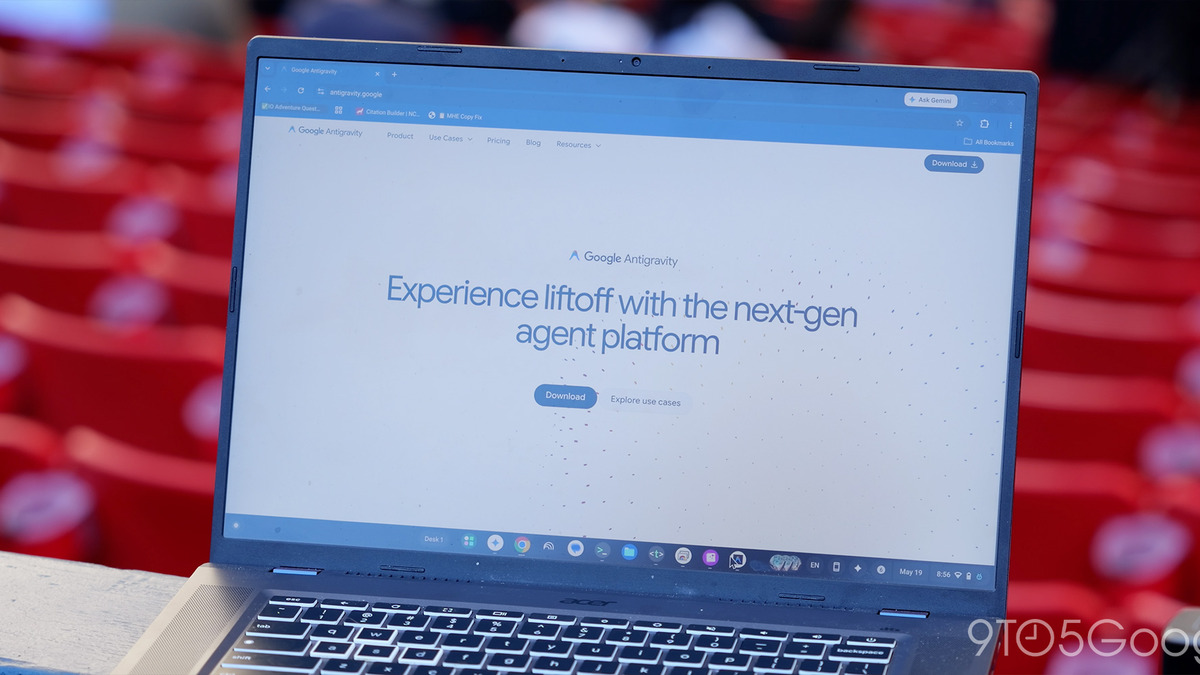 Antigravity 2.0's desktop app centers on agent orchestration rather than a traditional code editor.
Source: 9to5google.com
Antigravity 2.0's desktop app centers on agent orchestration rather than a traditional code editor.
Source: 9to5google.com
The agy CLI
The Gemini CLI is being shut down on June 18, 2026. Its replacement is agy, the new Antigravity CLI, built in Go and advertised as faster and more responsive than the tool it replaces. It shares the same agent harness as the desktop app, so future model improvements apply to both surfaces simultaneously.
Installation is a single command:
curl -fsSL https://antigravity.google/cli/install.sh | bash
The problem at launch: agy wasn't available through Homebrew, apt, or any standard package manager on May 19. Developers facing a forced migration from Gemini CLI - an open-source tool with an active ecosystem - had no installable replacement on day one. The 27-day migration window from a popular open-source tool to a closed-source one that wasn't yet packaged is the sharpest example of Google treating developer trust as a resource it can spend.
What Sets It Apart
Three capabilities separate Antigravity 2.0 from Claude Code and Cursor in ways that matter for teams building complex agentic workflows.
Browser agent. The platform ships with a built-in browser agent that loads your application, navigates it, flags visual regressions, and surfaces issues with the relevant source code. Neither Claude Code nor Cursor offers this natively. For frontend teams running end-to-end UI testing, the built-in browser agent removes a whole class of manual work.
A2A protocol. Google's Agent-to-Agent protocol, backed by over 150 organizations, is natively supported. Where MCP handles agent-to-tool calls, A2A handles agent-to-agent delegation: one specialist agent handing off a subtask to another. Combined with the parallel subagent architecture, Antigravity 2.0 has a multi-agent coordination story that no current competitor matches out of the box. Google's ADK laid the groundwork; Antigravity 2.0 is where that work surfaces for developers directly.
Terminal sandboxing. Agent-executed terminal commands run in a kernel-level isolated environment that restricts writes to your project folder. The mechanism is Apple Seatbelt (sandbox-exec) - the same technology macOS uses to sandbox App Store applications. This is macOS only. Linux and Windows teams get no equivalent, which is a significant gap for CI/CD pipelines and server-side development environments.
Performance
The model powering the platform is Gemini 3.5 Flash, which Google says was co-developed using Antigravity itself. On SWE-bench Verified, the Antigravity platform scores 76.2%. Benchmark tool scores include MCP Atlas at 83.6% and Finance Agent v2 at 57.9%.
Direct model-to-model comparison requires care here: the 76.2% figure reflects the full platform harness rather than model alone. Claude Opus 4.7 holds 64.3% on SWE-Bench Pro, a stricter real-world variant. These are measuring different things. What the numbers do confirm is that Gemini 3.5 Flash is a capable model for coding and agentic tasks - not the regression the free-tier slash might imply.
Google claims Gemini 3.5 Flash runs four times faster than Gemini 3.1 Pro on coding benchmarks. Based on what we observed when reviewing the underlying model, the speed improvement is real, though we haven't independently verified the 4x multiplier in a controlled head-to-head.
One reliability complaint that appeared across early user reports: model labels inside the app are inconsistent. "Gemini 3 Pro" in the model selector may route to different underlying versions depending on load, which makes it hard to know exactly what you're running. Google acknowledged the issue without committing to a fix timeline.
Pricing
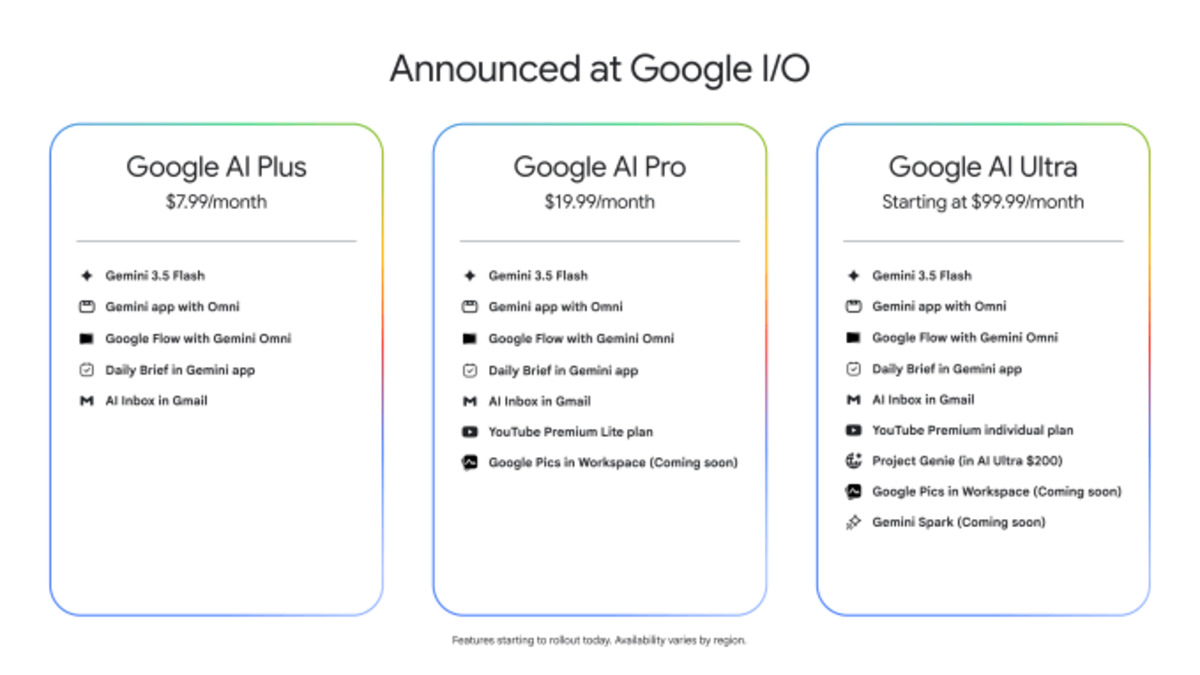 Google's new subscription tiers introduced at I/O 2026, with AI Ultra starting at $100/month.
Source: techcrunch.com
Google's new subscription tiers introduced at I/O 2026, with AI Ultra starting at $100/month.
Source: techcrunch.com
Pricing Tiers
| Tier | Monthly Cost | Limits |
|---|---|---|
| Free | $0 | 20 requests/day |
| AI Pro | $19.99 | Standard |
| AI Ultra | $99.99 | 5x Pro |
| AI Ultra (top) | $200 | 20x Pro |
Credits available at $0.01 each; $199 buys 20,000 credits.
The free tier is where the goodwill collapses. Twenty requests per day isn't enough to assess a tool that promises autonomous multi-step agent workflows. Google effectively moved meaningful evaluation behind a paywall on launch day. The previous 250 daily requests allowed developers to truly test the product; 20 requests allows you to demonstrate that it installs.
The top AI Ultra tier dropped from $250 to $200, which is a real price cut. It's hard to appreciate that generosity while the free tier floor is simultaneously dropping 92%.
Enterprise teams on Gemini Code Assist Standard or Enterprise licenses retain access to Gemini CLI and IDE extensions after June 18. Individual developers on free and Pro plans don't.
The Rocky Launch
Three specific failures define the May 19 launch week.
The automatic update on launch day removed the code editor from existing installations and wiped user configurations. Developers who opened their IDEs after the update found their setups gone. Google pushed a fix quickly, but the optics of a forced migration combined with a launch-day data loss are hard to separate.
The agy CLI was not on any package manager at launch despite the Gemini CLI shutdown running on a 27-day clock. The Register described the transition as a "bait-and-switch" on the open-source developer community that had built workflows around Gemini CLI's transparency and installability.
Google shipped Logic Patch v2.1.4 after reports that the agent was reverting human code edits it classified as inefficient. An AI system that overwrites the human developer's changes without confirmation is a trust problem at the foundation of the product, and it took a post-launch patch to address it.
The community's response was mixed but leaning forward: antigravity-awesome-skills reached 38,000+ GitHub stars in weeks, and the SDK repository hit 605 stars with 96 forks. Developers see the potential. They're annoyed about the execution.
Strengths and Weaknesses
Strengths:
- Parallel subagent orchestration is architecturally ahead of any released competitor
- Native browser agent for end-to-end UI testing without separate tooling
- A2A protocol support with 150+ ecosystem partners
- 76.2% on SWE-bench Verified using full platform harness
- Five-surface platform serves terminal, desktop, and cloud deployment needs
- SDK ecosystem growing quickly despite launch friction
- Genuine Google Cloud integration for enterprise deployments
Weaknesses:
- Launch week wiped user configs, included a Logic Patch, and left CLI off package managers
- Free tier cut from 250 to 20 requests/day - real evaluation requires a subscription
- Terminal sandboxing is macOS only; Linux and Windows teams get no protection
- 27-day migration window from Gemini CLI was too short for a forced open-to-closed transition
- Model labels in-app are inconsistent - you can't always confirm what model you're running
- No plan mode at launch - agents execute before showing their reasoning
Verdict: 7.2/10
Antigravity 2.0 is the most architecturally ambitious developer tool released in 2026. Parallel multi-agent execution, a native browser agent, and A2A protocol integration aren't gradual improvements - they represent a different premise for what a coding environment can be. Google isn't adding AI features to a code editor. It's building a system where agents are the primary actors and the editor is secondary.
That premise is compelling. The execution was not ready.
Wiped configurations on day one, a closed-source CLI that couldn't be installed through normal channels, an agent that needed a patch to stop overwriting human code, and a forced migration from a popular open-source tool with less than a month's notice: these problems aren't cosmetic. They're signs of a platform that shipped before the trust had been earned.
The 7.2/10 reflects genuine capability held back by execution quality. If Google stabilizes the launch issues, extends terminal sandboxing beyond macOS, and restores a meaningful free tier, this becomes a strong recommendation for teams building complex agentic workflows. At the 90-day mark, it's worth a second look. For now, run it with your existing setup - don't replace it.
Sources
- Google Launches Antigravity 2.0 at I/O 2026 - TechCrunch
- Google Antigravity 2.0: CLI, SDK and AI Agents - The Next Web
- Google Antigravity 2.0 at I/O 2026 - MarkTechPost
- Transitioning Gemini CLI to Antigravity CLI - Google Developers Blog
- Bye-bye Gemini CLI - The Register
- Antigravity 2.0 Review: Agent-First Dev Platform With a Rocky Launch - ChatForest
- Antigravity 2.0 vs Claude Code vs Cursor - FindSkill.ai
- AI Models and Benchmarks - Antigravity IDE
- Google Antigravity Agentic Developer Suite - 9to5Google

