
Gemini 3.1 Flash-Lite Review: Fast, Cheap, and Capable
Google's Gemini 3.1 Flash-Lite delivers frontier-class benchmarks at a fraction of the cost of Pro - but a sluggish first-token response and preview-only status mean it's not for every workload.
 9 min read
Google's Gemini 3.1 Flash-Lite arrived on March 3, 2026 with an aggressive pitch: the performance profile of a frontier reasoning model at roughly one-eighth the price of Gemini 3.1 Pro. If that claim holds up in practice, it reshapes the economics of high-volume AI workloads considerably. I spent the past two weeks testing it against that claim across translation, document summarization, multimodal parsing, and structured output generation. The short answer is that the pitch mostly holds up - with two significant caveats that matter a lot depending on your use case.
TL;DR
- 8.1/10 - the best value-per-dollar model at the frontier tier right now
- Beats GPT-5 mini and Claude 4.5 Haiku on most benchmarks at a fraction of the price; 1M-token context window is unique at this price point
- First-token latency averages 6.74 seconds - too slow for interactive chat; long-context retrieval degrades sharply beyond 128K tokens
- Use it for: high-volume batch pipelines, RAG ranking, classification, audio transcription, structured output; skip it for: live chat interfaces, complex reasoning, anything requiring sub-second response
What Google Is Selling
Gemini 3.1 Flash-Lite is built on the same architecture as Gemini 3 Pro, distilled for speed and cost efficiency. The pricing reflects that: $0.25 per million input tokens and $1.50 per million output tokens on the paid tier, compared to $2.00/$18.00 for Gemini 3.1 Pro. For audio inputs, Flash-Lite charges $0.50/M tokens. Batch processing cuts costs in half again.
The model carries a 1,048,576-token context window - 1M tokens - with a 65,536-token maximum output. That context window is, by some margin, the largest available at this price point among competing models. GPT-5 mini tops out around 400K; Claude 4.5 Haiku sits at 200K. On paper, Flash-Lite wins that comparison by a wide margin.
Google is positioning this explicitly as an "intelligence at scale" model - optimized for throughput over single-request latency. That design philosophy shapes everything about where it succeeds and where it falls short.
Benchmark Performance
The official DeepMind model card lists the following scores:
| Benchmark | Gemini 3.1 Flash-Lite | Notes |
|---|---|---|
| GPQA Diamond | 86.9% | Grad-level science reasoning |
| MMMLU | 88.9% | Multilingual knowledge |
| LiveCodeBench | 72.0% | Code generation/completion |
| Video-MMMU | 84.8% | Multimodal video understanding |
| MMMU-Pro | 76.8% | Visual reasoning |
| SimpleQA | 43.3% | Factual accuracy |
| MRCR v2 (128K) | 60.1% | Long context retrieval |
| MRCR v2 (1M) | 12.3% | Full context window retrieval |
The GPQA Diamond score of 86.9% beats Grok 4.1's 84.3% and sits well above the 70-75% range typical of competing mini-class models. The MMMLU multilingual score at 88.9% is also strong - relevant for global deployment pipelines where language variety is a cost driver.
Two numbers stand out for the wrong reasons. SimpleQA at 43.3% is notably low for a frontier model, pointing toward a tendency to hallucinate on specific factual questions. And the MRCR retrieval drop from 60.1% at 128K to 12.3% at 1M is severe - if you're betting on that million-token window for needle-in-a-haystack retrieval, you'll be disappointed. The window is real; reliable retrieval across it isn't.
Independent evaluator Artificial Analysis scored it 34 on their Intelligence Index (21st of 132 models), well above the 19-point median for models at this price tier. That's a useful cross-check on the official numbers.
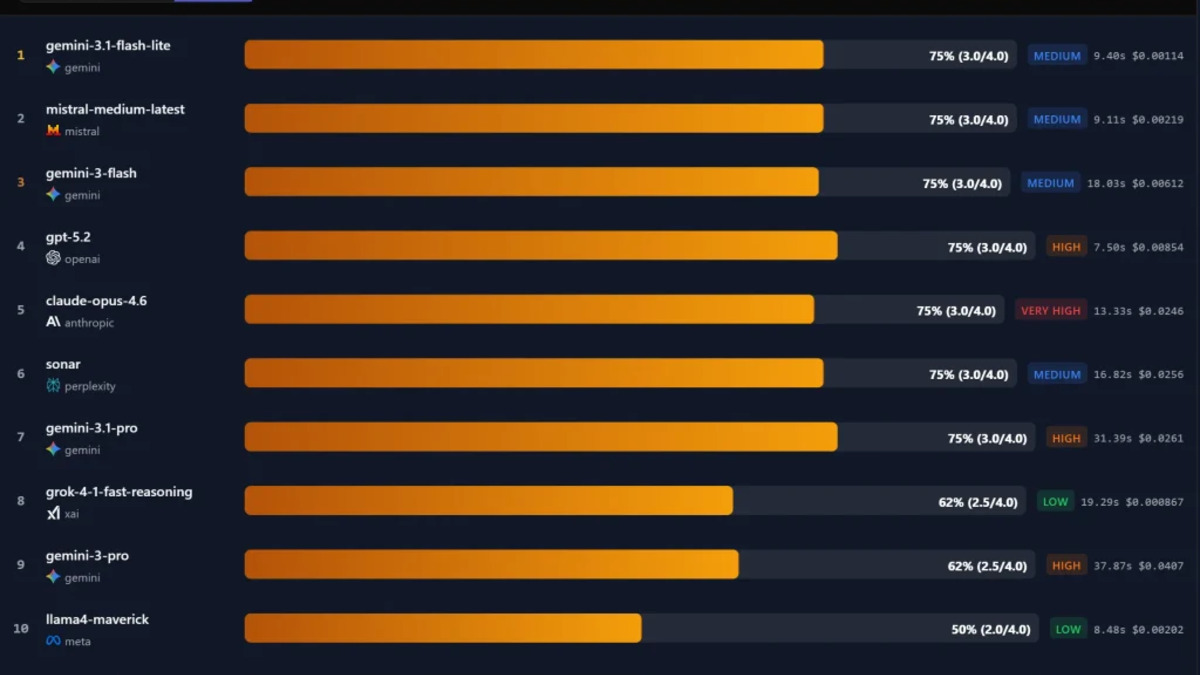 Gemini 3.1 Flash-Lite GPQA Diamond score of 86.9% beats most mini-tier competitors.
Source: deepmind.google
Gemini 3.1 Flash-Lite GPQA Diamond score of 86.9% beats most mini-tier competitors.
Source: deepmind.google
Speed in Practice
The throughput numbers are impressive. Google claims 363 tokens per second output; Artificial Analysis measured 259.5 tokens/second in independent testing. Even at the lower figure, that's roughly twice Claude 4.5 Haiku's throughput and well above GPT-5 mini. For batch workloads - document classification, content moderation queues, large-scale extraction - that speed advantage is meaningful.
The first-token latency is a different story. Artificial Analysis clocked an average of 6.74 seconds time-to-first-token (TTFT), compared to a 1.74-second median for comparable models. That's not a rounding error. In real terms, it means that every individual request feels noticeably sluggish at the start. Google built Flash-Lite for pipelines, not conversations. If your application shows a spinner while waiting for the first word to appear, users will notice.
Google built Flash-Lite for pipelines, not conversations. The throughput is excellent. The first-token wait is not.
The model also creates verbose outputs. Artificial Analysis found it produced 53M tokens across their evaluation suite against a 20M average for peer models. In a batch context, verbosity is manageable - you're often summarizing or classifying anyway. Billing is per output token, though, so a model that writes 2.5x more than necessary can quietly erase the pricing advantage.
Multimodal Inputs
Flash-Lite accepts text, images, audio, video, and PDF files as inputs. Output is text only. For audio, the model handles transcription well - Google cited this as a specific improvement area relative to Gemini 2.5 Flash-Lite. In my tests, transcribing a 45-minute meeting recording and extracting action items worked cleanly, with accurate speaker-agnostic transcription and coherent summaries.
Video understanding via Video-MMMU at 84.8% is one of the stronger scores in the benchmark table. I tested a short product demo video and asked the model to produce a structured product description - the output was accurate and well-organized. Whether that generalizes to complex long-form video analysis, I'm less certain.
PDF parsing performed reliably on financial reports and technical documentation. The model correctly attributed figures to their source tables rather than hallucinating numbers, though the low SimpleQA score is a reminder that factual precision isn't its strongest attribute under adversarial conditions.
Reasoning Modes
Flash-Lite supports four thinking levels: minimal (default), low, medium, and high. Bumping the level trades latency and cost for reasoning depth. In practice, the difference between minimal and medium is noticeable on multi-step problems - the model makes fewer logical errors and catches more constraint violations. For structured output generation, I'd recommend at least low. For anything resembling analysis, medium earns its overhead.
This mirrors the approach in Gemini 3.1 Pro but scaled down. The high mode brings Flash-Lite closer to mid-tier reasoning performance, though it doesn't match the Pro model on genuinely hard tasks.
Where It Beats the Competition
Against GPT-5 mini: Flash-Lite wins on 6 of 11 benchmark categories per Google's published comparisons, with advantages in general knowledge, multilingual performance, math, and multimodal understanding. Flash-Lite is also roughly 37.5% cheaper on input tokens and offers a 2.5x larger context window. GPT-5 mini retains an edge on complex coding tasks.
Against Claude 4.5 Haiku: Flash-Lite is about 4x cheaper on input ($0.25 vs $1.00/M tokens), 3x cheaper on output, and nearly three times faster on throughput. The context window advantage is 5x (1M vs 200K tokens). Haiku remains more polished on instruction-following and maintains a lower TTFT - relevant if latency sensitivity is your primary constraint.
Early Adopter Results
Google's product page documents three early adopter cases with specific numbers:
- Latitude (AI gaming platform): 20% higher task success rates and 60% faster inference compared to their previous model.
- Whering (fashion AI app): 100% consistency in garment classification.
- HubX: ~97% structured output compliance with sub-10-second completions.
These are vendor-curated cases, so appropriate skepticism applies. But the use cases are coherent with the model's strengths - classification and structured extraction reward throughput and instruction-following over raw reasoning.
 Google positions Flash-Lite as its most cost-efficient Gemini 3 model, available in AI Studio and via the Gemini API.
Source: blog.google
Google positions Flash-Lite as its most cost-efficient Gemini 3 model, available in AI Studio and via the Gemini API.
Source: blog.google
Safety Notes
The DeepMind model card reports a -21.7% regression on image-to-text safety compared to Gemini 2.5 Flash-Lite - a significant drop in absolute terms. Google states the model still passes all required launch thresholds and cleared child safety evaluations, but it's worth flagging for applications that process user-uploaded images. Text-to-text safety regressed by a smaller 1.18%. Unjustified refusal rates actually improved (-14.41%), which is welcome - over-refusal is a real usability problem in production.
What I'd Use It For
The model earns its pricing for:
- Large-scale document classification and extraction pipelines
- RAG reranking and relevance scoring at volume
- Audio transcription with summarization
- Multilingual content processing
- Structured output generation where format compliance matters more than depth
I wouldn't use it for:
- Interactive chat interfaces where TTFT matters
- Complex reasoning chains (legal analysis, research synthesis)
- Tasks requiring high factual precision (SimpleQA's 43.3% is a real signal)
- Production workloads that need a SLA (it's still in preview)
The Preview Problem
Flash-Lite is currently in preview status under Google's pre-GA designation, which means no service-level agreement, potential breaking changes, and limited enterprise support. For prototyping and internal tooling, that's fine. For anything customer-facing or tied to a revenue-critical pipeline, the lack of GA guarantees is a genuine risk. The existing news coverage of Gemini 3.1 Pro capacity and quota issues suggests Google's infrastructure under load is not immune to supply constraints either.
The news coverage from the Gemini 3.1 Flash-Lite launch noted that Gemini 3 Pro was retired simultaneously, which compresses the migration path for developers who want a tested path between tiers.
Verdict
Gemini 3.1 Flash-Lite does what Google says it does: high benchmark performance at a low price with enormous throughput. The pricing advantage over both GPT-5 mini and Claude 4.5 Haiku is real, and the 1M context window at $0.25/M input is truly difficult to match. For batch-oriented, high-volume workloads, the economics are compelling.
Two things keep this from a higher score. The 6.74-second TTFT is a design limitation, not a bug - but it's a real constraint that rules the model out for a significant share of use cases. And the 12.3% long-context MRCR score at 1M tokens means the headline feature doesn't reliably deliver what it implies. Advertise a million-token window, and developers will test at a million tokens. Most will find retrieval falls apart well before that.
Score: 8.1/10 - the best cost-efficiency option at the frontier tier right now, for workloads that fit its design.
Strengths
- Cheapest frontier-class model by a wide margin ($0.25/M input)
- 1M-token context window at this price is unique
- Strong throughput - up to 363 tokens/second
- Beats GPT-5 mini and Claude 4.5 Haiku on most benchmarks
- Multimodal inputs including audio and video
- Selectable reasoning depth (minimal/low/medium/high)
- Free tier available via Google AI Studio
Weaknesses
- First-token latency averages 6.74 seconds - too slow for chat
- Long-context retrieval collapses from 60.1% at 128K to 12.3% at 1M
- SimpleQA factual accuracy at 43.3% - hallucination risk on specific facts
- Preview status - no SLA, potential breaking changes
- Image-to-text safety regression (-21.7% vs Gemini 2.5 Flash-Lite)
- Verbose outputs inflate costs in production
- Text-output only (no image/audio generation)
Sources
- Google Blog: Gemini 3.1 Flash-Lite announcement
- DeepMind model card: Gemini 3.1 Flash-Lite
- DeepMind product page: Gemini Flash-Lite
- Google AI Pricing page
- Artificial Analysis: Gemini 3.1 Flash-Lite performance data
- SiliconANGLE: Google launches Gemini 3.1 Flash-Lite in preview
- VentureBeat: Google releases Gemini 3.1 Flash-Lite at 1/8 the cost of Pro
- Artificial Analysis: Flash-Lite vs GPT-5 mini comparison
- Artificial Analysis: Flash-Lite vs Claude 4.5 Haiku comparison
- OpenRouter: Gemini 3.1 Flash-Lite listing

