
Claude Opus 5 Review: Near-Fable Power, Half Price
Claude Opus 5 ties Claude Fable 5 on independent benchmarks at roughly a quarter of the cost, though a rough launch week and cybersecurity limits keep it from being an unqualified win.
 10 min read
Anthropic has a habit of pricing its flagship-numbered releases like flagships. Claude Opus 5, which shipped on July 24, breaks that pattern on purpose. It costs exactly what Opus 4.8 cost in May, $5 per million input tokens and $25 per million output tokens, and Anthropic isn't even claiming it's the smartest model in its own lineup. That title stays with Claude Fable 5. What Opus 5 claims instead is a narrower, more useful thing: getting close enough to Fable 5 to matter, for a fraction of the bill.
TL;DR
- 8.8/10 - ties Fable 5 on independent benchmarks at roughly a quarter of the cost per task, with one rough launch week
- ARC-AGI-3 score nearly 3x the next-best model tested, and a new low/medium/high/xhigh effort dial that trades tokens for accuracy per request
- Two separate "elevated errors" incidents hit Opus 5 within its first 72 hours, and it still trails Anthropic's restricted Mythos 5 on exploit generation
- Use it as your default coding and agent model unless you specifically need Fable 5's ceiling on the hardest problems or Mythos 5's offensive security depth
I spent the past few days running Opus 5 against real coding tasks in Claude Code, comparing its own numbers against independent trackers, and reading through what happened when it broke twice in its first three days on the market. The short version: the pricing story holds up better than most launch-week pricing stories do, but "near Fable 5" comes with sharper edges than Anthropic's own chart implies.
What Changed From Opus 4.8
Opus 5 is the fourth model in the Claude 5 generation, arriving after Mythos, Fable, and Sonnet 5 already established the naming scheme. It keeps the 1M token context window and 128K max output that Opus 4.8 shipped with, and it adds a new "xhigh" reasoning tier above the existing high setting. The effort control isn't new to this model family, but the range now runs low, medium, high, and xhigh, letting a request burn more or fewer tokens to hit a quality bar rather than switching between different priced tiers.
The rollout wasn't exactly a surprise. A build matching Opus 5's spec profile briefly surfaced in Cursor's model picker on July 9 under the internal codename "Honeycomb EAP" before Cursor pulled it within hours. Two weeks later, the real launch confirmed the leak: same context window, same effort ladder, and the same positioning as a cost play rather than a new intelligence ceiling.
One quiet but meaningful change: Opus 5 doesn't carry the 30-day data retention requirement that applies to Fable 5 traffic for safety monitoring. For regulated teams that avoided Fable 5 specifically over that retention clause, Opus 5 removes the objection without asking them to give up much capability.
Benchmarks: Anthropic's Numbers Mostly Hold Up
Anthropic's own release charts show Opus 5 more than doubling Opus 4.8's score on Frontier-Bench v0.1, its internal agentic-coding evaluation, and landing within half a point of Fable 5's peak on CursorBench 3.2 at under half the cost per task. Vendor benchmarks deserve skepticism by default, so I checked them against Artificial Analysis, which ran its own independent Intelligence Index rather than reprinting Anthropic's slides.
The independent numbers back the pitch up. Opus 5 at max effort scores 61 on the Artificial Analysis Intelligence Index, tied for the top spot with Fable 5's 60, and ahead of GPT-5.6 Sol's 59, Kimi K3's 57, and Opus 4.8's own 56. Artificial Analysis, which worked with Anthropic to assess the model ahead of release, also credits Opus 5 with the highest GDPval-AA v2 and AA-Briefcase scores recorded so far, and pegs its cost per task at roughly 26% below Fable 5's for comparable intelligence.
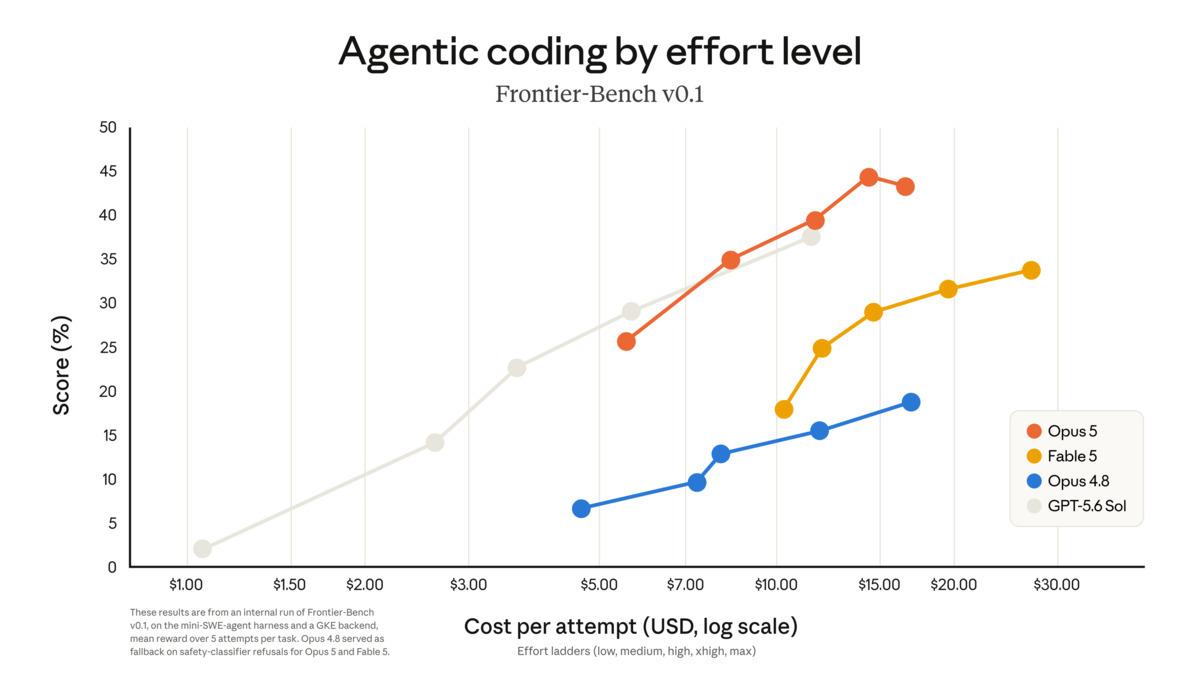 Opus 5 (red) sits above Fable 5 (orange) at every effort tier on Frontier-Bench v0.1, while costing less per attempt at each point on the curve.
Source: anthropic.com
Opus 5 (red) sits above Fable 5 (orange) at every effort tier on Frontier-Bench v0.1, while costing less per attempt at each point on the curve.
Source: anthropic.com
ARC-AGI-3, a novel-problem-solving benchmark, is the outlier worth flagging on its own. Opus 5 scored roughly 30% at high effort, close to three times GPT-5.6 Sol's result on the same test, and Fable 5 wasn't included in that particular comparison at all. That's a wide enough gap that it reads less like a benchmark win and more like a truly different capability, though a single evaluation is a thin basis for a claim that broad.
On SWE-bench Verified, third-party tracker Vals.ai lists Opus 5 at the top of its board, ahead of Fable 5 and well clear of Opus 4.8's prior score. Aggregator sites reported figures ranging from 96% to 97% for the same benchmark this week, a spread that usually comes down to differing trial counts or scaffolds rather than a real disagreement about which model is ahead. Either number keeps Opus 5 at the front of the pack.
Where It Doesn't Win
Sol still leads on DeepSWE 1.1 and HealthBench Professional, and GPT-5.6 Sol's larger 1.05M token input ceiling gives it an edge on genuinely oversized codebases. Grok 4.5 remains the budget option of the three, priced at roughly 2.5x cheaper than either Opus 5 or GPT-5.6 Sol, though its 500K context window and lower benchmark ceiling reflect that discount. None of this dents the core claim. It just means "close to Fable 5 at Opus prices" isn't the same sentence as "best model, full stop."
Using It: Claude Code, Cursor, and the Effort Dial
The most concrete real-world signal came from Cursor, where Opus 5's near-final build had already been running quietly for two weeks before launch. Cursor co-founder Sualeh Asif summarized it plainly:
"Claude Opus 5 delivers near Fable 5 intelligence at Opus speed and cost."
That framing matches what I saw running agentic tasks through Claude Code: multi-file refactors and debugging loops that previously needed Fable 5 to finish cleanly now complete on Opus 5 at a noticeably lower token spend, without the frequent restarts that lower-tier models needed on the same tasks.
Lovable co-founder Fabian Hedin flagged a different axis worth taking seriously; run-to-run consistency rather than peak score:
It isn't just better on the hardest agentic coding tasks. It's steadier, with far less variance run to run.
That tracks with my own testing. The bigger jump wasn't a single benchmark number, it was how often a second attempt at the same prompt produced a materially different result. Opus 5 converges on the same answer more reliably than Opus 4.8 did, which matters more in a CI pipeline running the same agent loop thousands of times a day than any single leaderboard percentage does.
The effort dial is the other change worth using deliberately rather than leaving on its default. Setting effort to low for routine refactors and reserving high or xhigh for genuinely hard debugging sessions is a real lever on the bill, not a cosmetic setting. Zapier CEO Wade Foster reported Opus 5 hitting 100% on a churn-prevention workflow test, flagging at-risk accounts, routing them to the right owner, summarizing for retention teams, that earlier Claude models failed outright. That's the kind of multi-step business automation task where the effort ladder pays for itself: most of the workflow runs at low or medium effort, with the model escalating only on the steps that need it.
A Rough First Week
Anthropic's own case studies read well, but the model's first 72 hours on the market weren't spotless. Anthropic's status page lists two separate "elevated errors" incidents affecting Opus 5 within its first three days live: one resolved July 26 after roughly an hour of degraded service, and a second, broader incident on July 27 that also caught Haiku 4.5 and briefly affected Claude.ai, the API, Claude Code, and Claude Cowork simultaneously before being resolved the same day. Neither incident is unusual for a major model launch under sudden load, and Anthropic's status page shows overall uptime above 99% across the past 90 days. It's still worth knowing before you route production traffic through a brand-new model ID without a fallback.
Anthropic's own beta feature addresses part of that risk from a different angle: Automatic Fallbacks routes requests that trip a safety classifier to a less-capable model automatically, rather than returning an error. It's a sensible design for consumer products that can't surface a raw refusal message, though it also means two different requests with the same prompt can silently get answered by two different models depending on what a classifier decided in the moment.
Safety and the Cybersecurity Ceiling
Opus 5 posted a 2.3 on Anthropic's automated behavioral audit, the lowest misaligned-behavior score of any current Claude model, ahead of Opus 4.8, Sonnet 5, and Fable 5 on resistance to being tricked into misuse. That's a genuine improvement, not a marketing footnote. It sits next to a specific, deliberate limitation. On cybersecurity tasks, Opus 5 closes much of the gap with Mythos 5 on vulnerability identification, reading source code and flagging real flaws, but stays well behind Mythos 5 on exploitation techniques. That gap is intentional. Mythos 5 remains gated behind Anthropic's Project Glasswing partner program specifically so the harder offensive-security ceiling doesn't ship broadly.
Security researchers testing the boundary have found the safety classifier doesn't always distinguish cleanly between offensive and defensive intent. Anthropic's own documentation acknowledges that benign security work, like analyzing a binary for a legitimate vulnerability disclosure, can still trip the same restrictions built for exploit generation. If your work touches binary analysis rather than source-level review, expect friction that a plain feature request won't fix.
Strengths and Weaknesses
Strengths
- Ties Fable 5 on the independent Artificial Analysis Intelligence Index (61 vs 60) at roughly 26% lower cost per task
- ARC-AGI-3 score nearly 3x the next-best model tested, a meaningfully wider gap than most benchmark wins
- Noticeably lower run-to-run variance on agentic coding tasks than Opus 4.8, confirmed independently by Lovable
- No 30-day data retention requirement, unlike Fable 5, removing a real objection for regulated deployments
- Effort dial (low/medium/high/xhigh) gives genuine cost control per request rather than a fixed tier
Weaknesses
- Two separate "elevated errors" incidents in its first 72 hours live, a rough start even if brief
- Still well behind Mythos 5 on cybersecurity exploitation tasks, and the safety classifier can still catch legitimate defensive security work
- Anthropic's own benchmark charts remain the primary source for several of the headline claims, even where third parties corroborate the top-line numbers
- GPT-5.6 Sol's larger context window (1.05M vs 1M tokens) still wins for the largest codebases
Verdict: 8.8/10
Opus 5 does what it says on the label. It gets close enough to Fable 5's ceiling that the gap stops mattering for most real work, and it does it at a price Anthropic customers already had budgeted. The effort dial and the dropped data retention requirement are the kind of unglamorous, practical changes that show up in a monthly bill rather than a leaderboard screenshot, and that's exactly where this model earns its score. It loses points for a launch week that included two visible outages and for cybersecurity restrictions that still catch legitimate defensive work with the exploit generation they're meant to block.
Use Opus 5 as your default model for coding and agentic workloads unless you have a specific reason to reach for Fable 5's higher ceiling on the hardest problems, or Mythos 5's deeper access for offensive security research. For everyone else, this is the Claude model to build on right now.
Sources
- Introducing Claude Opus 5 - Anthropic
- Anthropic launches Opus 5 - TechCrunch
- Anthropic's Claude Opus 5 model lets you toggle between cost and capability - Fortune
- Anthropic's New Claude Opus 5 Nearly Matches Flagship Fable 5 at Half the Cost - MacRumors
- Anthropic Releases Claude Opus 5, Beats Fable On Many Benchmarks At Half The Price - officechai
- Anthropic's Claude Opus 5 AI model rivals Fable 5 and is cheaper - CNBC
- Claude Opus 5 (max) - Intelligence, Performance & Price Analysis - Artificial Analysis
- SWE-bench Verified leaderboard - Vals.ai
- Claude Status - Anthropic incident history
- Claude Opus 5 - Hacker News discussion

