
Agent Platform Pricing Compared - August 2026
Updated August 10: Anthropic's Agent SDK credit plan died before launch, Claude Managed Agents adds a new session-hour billing line, and E2B, Modal, and Daytona all rebuilt their per-second pricing.
 26 min read
TL;DR
- Anthropic announced a separate Agent SDK credit pool on May 14, then cancelled it the day it was supposed to ship (June 15) - programmatic usage still draws from your normal Pro/Max/Team subscription limits.
- Claude Managed Agents launched April 8 with its own billing line: standard token rates plus $0.08 per session-hour of actual running time.
- E2B rebuilt its pricing from a flat $0.000168/second to separate per-second CPU, RAM, and storage meters - and Daytona now charges nearly identical per-second rates after going closed-source in June.
- Modal split its old blended GB-second rate into separate CPU-second and memory-second billing, with GPU pricing added as its own dimension.
- CrewAI now publishes a free Basic tier (50 executions/month) for the first time; Vellum did the opposite and pulled its public Growth tier down to contact-sales only.
- Fly.io dropped its automatic free-tier VM allowance for new signups - what was $0 for 3 shared machines is now pay-as-you-go from the first second.
The Hidden Bill Problem, Still Unsolved
Most agent platform pricing pages still show you the platform fee and nothing else. What they don't show is what the platform spends on your behalf once your agent starts calling a model. That gap hasn't closed since April - if anything it's gotten more complicated, because three of the platforms in this comparison rebuilt their pricing structure completely in the past four months.
I rebuilt the numbers below with a standardized test agent: a research-and-summarize agent that makes three LLM calls per run (one planning, one tool-use, one synthesis), uses roughly 3,000 input tokens and 800 output tokens total, and executes one web search per run. It's a modest, realistic agent, not a multi-step coding agent and not a simple chatbot.
For the LLM cost component, I now use Claude Sonnet 5 as the reference model - Anthropic's current mid-tier and the direct successor to the Sonnet 4.5 pricing this comparison used in April. Sonnet 5 is running introductory pricing of $2/1M input and $10/1M output tokens through August 31, 2026, after which it reverts to $3/1M input and $15/1M output. Swap in your own model of choice; the platform costs below stay the same, only the LLM passthrough line changes.
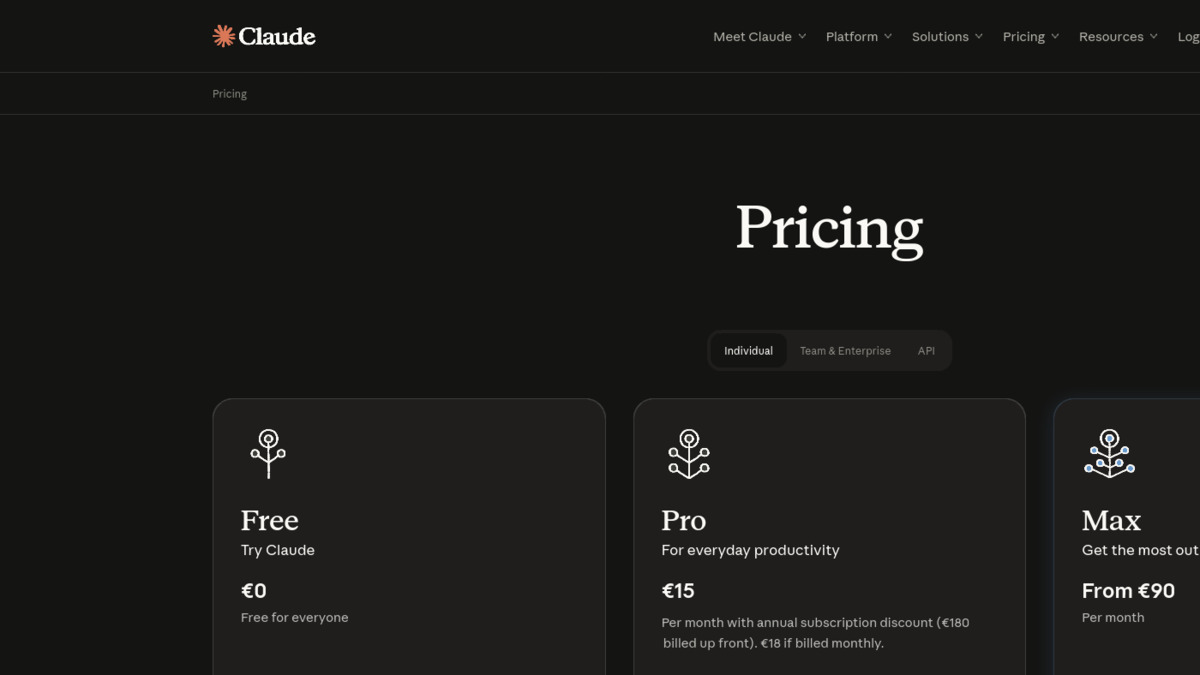 Claude's subscription tiers, the pool the Agent SDK credit split would have carved a chunk out of, before Anthropic cancelled the change on June 15.
Source: claude.com
Claude's subscription tiers, the pool the Agent SDK credit split would have carved a chunk out of, before Anthropic cancelled the change on June 15.
Source: claude.com
Methodology
All platform prices were re-verified August 10, 2026, against public pricing pages. Where a vendor moved to contact-sales-only since April, I note that explicitly instead of guessing. "LLM passthrough" means the vendor routes your API calls through their infrastructure and either passes cost through at list price or marks it up.
For the reference agent, LLM cost is $0.006 (3,000 input tokens at $2/1M) + $0.008 (800 output tokens at $10/1M) = $0.014 per run at Sonnet 5's introductory rate. That climbs to $0.021 per run once standard pricing takes effect September 1. I've replaced the web-search line item with Anthropic's own web search tool pricing - $10 per 1,000 searches, or $0.01 per search - since it's a number I could verify directly against a primary source rather than a third-party aggregator's Tavily estimate. Total LLM+search cost per run: $0.024 at introductory pricing, $0.031 from September 1 onward. This is the figure added to each platform's per-run fee below.
Ranked Pricing Table
Sorted by monthly floor cost. "LLM Passthrough" shows whether the vendor adds markup on LLM calls or passes them through at list price.
| Platform | Monthly Floor | Per-Run Cost | LLM Passthrough | Notes |
|---|---|---|---|---|
| AutoGen Studio | $0 (self-host) | $0 platform | You pay API directly | Open-source only; no managed cloud |
| Anthropic Claude Agent SDK | $0 | $0 (SDK is free) | List price | Agent SDK credit split was cancelled June 15; still draws from your subscription |
| OpenAI Agents SDK | $0 | $0 SDK; tools add-ons extra | List price + surcharges | Code Interpreter $0.03/session; File Search $0.10/GB/day - now on the Responses API |
| Fly Machines | ~$0 idle | ~$0.00002/run (30s, shared-cpu-1x) | You pay API directly | $0.00000078/sec (region-dependent); no automatic free tier for new signups |
| Modal | ~$0 idle | ~$0.00046/run (1 core + 1GiB, 30s) | You pay API directly | Split into CPU-sec + memory-sec billing; $30-$100/mo free credits |
| E2B | $100 one-time credit | ~$0.00056/run (30s, 1vCPU+1GiB) | You pay API directly | Rebuilt from flat per-second to separate CPU/RAM/storage meters |
| Daytona | $200 free compute credit | ~$0.00056/run (30s, 1vCPU+1GiB) | You pay API directly | Now matches E2B's raw per-second rates; went closed-source June 2026 |
| Agno Cloud | $150/mo (Pro) | Included, unlimited | You pay API directly | Was beta/TBD in April; now a public control-plane price |
| Claude Managed Agents | $0 base | LLM + $0.08/session-hour | List price | New: launched April 8, hosted execution + state management |
| LangSmith Deployment (formerly LangGraph Platform) | $39/seat/mo (Plus) | 10k traces included, $2.50/1k over | List price | Rebranded and re-metered around traces, not "LangGraph calls" |
| Lindy AI | $49.99/mo (Plus) | Included ("standard usage") | Bundled - now opaque | Published credit numbers were removed; tiers sold as multiples of usage |
| Griptape Cloud | Free tier | Pay-as-you-go compute | You pay API directly | Bought by Foundry Feb 2026; no pricing changes announced |
| Relevance AI | $19/mo (Pro, annual) | Actions + Vendor Credits | Dual-meter (more transparent) | New model separates platform usage from AI compute cost |
| Vellum | Contact sales | Contact sales | Unknown | Public Free/Growth tiers no longer listed |
| CrewAI | $0 (Basic, 50 exec/mo) | Enterprise: contact sales | Unknown | Free public tier is new; mid-tier and overage rate were both deleted |
| Taskade AI | $16/mo (Pro, annual) | 50,000 AI credits/mo | Bundled | Credit ceilings are now published (were undocumented in April) |
| Mastra Cloud | Not public | Not public | Unknown | Still early access, unchanged since April |
| Cognosys | Discontinued | - | - | Picked up by Cohere as Ottogrid (May 2025), later sunset |
Cost at Scale
This table adds the reference agent's LLM+search cost to each platform's per-run fee, using Sonnet 5's introductory pricing ($0.024/run). Add roughly 29% to every LLM-dependent figure once standard pricing kicks in on September 1.
| Platform | 1k runs/mo | 100k runs/mo | 1M runs/mo |
|---|---|---|---|
| AutoGen/Agno (self-host, Modal compute) | $24 + $0.46 = $24.46 | $2,400 + $46 = $2,446 | $24,000 + $460 = $24,460 |
| Anthropic Claude Agent SDK | $24 | $2,400 | $24,000 |
| OpenAI Agents SDK (no tools) | $24 | $2,400 | $24,000 |
| OpenAI Agents SDK (Code Interpreter) | $24 + $30 = $54 | $2,400 + $3,000 = $5,400 | $24,000 + $30,000 = $54,000 |
| Fly Machines + API | $24 + $0.02 = $24.02 | $2,400 + $2.34 = $2,402 | $24,000 + $23.40 = $24,023 |
| Modal + API | $24 + $0.46 = $24.46 | $2,400 + $46 = $2,446 | $24,000 + $460 = $24,460 |
| E2B + API | $24 + $0.56 = $24.56 | $2,400 + $56 = $2,456 | $24,000 + $555 = $24,555 |
| Daytona + API | $24 + $0.56 = $24.56 | $2,400 + $56 = $2,456 | $24,000 + $555 = $24,555 |
| Claude Managed Agents | $24.67 | $2,467 | $24,667 |
| Agno Cloud (Pro, flat) | $24 + $150 = $174 | $2,400 + $150 = $2,550 | $24,000 + $150 = $24,150 |
| LangSmith Deployment (Plus) | $24 + $39 = $63 | $2,400 + $264 = $2,664 | $24,000 + $2,514 = $26,514 |
| Lindy AI (Plus) | $50 platform + LLM opaque = $50+ | Overage undisclosed = ? | Enterprise = contact sales |
| Relevance AI (Pro) | Team plan required = $234+ | Enterprise = contact sales |
The self-hosted path still wins on raw compute, but the margin over Fly Machines narrowed to almost nothing at these run volumes - Fly's per-second shared-CPU rate is now cheap enough that the platform fee, not the compute, decides which one to pick.
Per-Provider Breakdown
Anthropic Claude Agent SDK: the credit split that never shipped
Pricing: The SDK itself is free. You pay Claude API usage at Sonnet 5's $2/$10 introductory rate (through August 31), then $3/$15 from September 1. Claude Opus 5 runs $5/1M input, $25/1M output. Claude Haiku 4.5 runs $1/1M input, $5/1M output.
What changed: On May 14, 2026, Anthropic announced that Agent SDK usage, the claude -p command, Claude Code GitHub Actions, and third-party apps built on the Agent SDK would move off the shared subscription pool and onto a separate monthly credit - $20 for Pro, $100 for Max 5x, $200 for Max 20x, billed at standard API rates once exhausted. The change was scheduled for June 15. On June 15, Anthropic pulled it, saying it was "reworking the plan to better support how users build with Claude subscriptions" and would give advance notice before trying again. Today, nothing has replaced it: Agent SDK usage still draws from your existing Pro/Max/Team/Enterprise subscription limits, exactly as it did in April.
Best fit: Teams building Claude-native agents who want first-party support for extended thinking and prompt caching, which cuts repeated-context cost by roughly 10x on cache hits.
Gotchas: The reprieve isn't a promise. Anthropic explicitly said a revised proposal is coming, just not this one. If you're budgeting subscription-funded agent workloads for the second half of 2026, don't assume the current subsidy is permanent - build a fallback plan priced at API list rates.
Source: Anthropic Pricing, Claude Platform Pricing Docs
Claude Managed Agents: the new line nobody was tracking in April
Pricing: Standard Claude API token rates for every model, plus $0.08 per session-hour of runtime, billed to the millisecond. Only time spent in running status counts; idle time waiting on user input or a tool confirmation is free. Web search inside a session costs the standard $10 per 1,000 searches.
What you get: Launched April 8, 2026, Claude Managed Agents is Anthropic's hosted execution service - agents run on Anthropic's own infrastructure instead of your servers, with sandboxing, state management, and error recovery handled for you. It replaces the container-hour billing that used to apply to the code execution tool: you're not charged separately for containers on top of session runtime.
Best fit: Teams that want the Agent SDK's model quality without building and operating their own execution layer. A one-hour coding session on Claude Opus 5 with 50,000 input and 15,000 output tokens costs $0.705 uncached, or $0.525 with prompt caching active on 40,000 of those input tokens, per Anthropic's own worked example.
Gotchas: This is a genuinely new cost category, not a rename of something that existed in April. If you were pricing agents purely off token cost, add the session-runtime line before you commit to a budget. It stacks with Fast Mode pricing on Opus 5 and Opus 4.8 ($10/$50 per 1M tokens) and with the 1.1x data-residency multiplier for US-pinned inference.
Source: Claude Managed Agents Docs
LangSmith Deployment (formerly LangGraph Platform)
Pricing: Developer tier: free, 5,000 traces/month, 14-day retention, one seat. Plus: $39/seat/month, 10,000 base traces included (14-day retention), overage at $2.50 per 1,000 traces; extended 400-day retention costs $5/1,000 traces. Enterprise: contact sales.
What changed: LangGraph Platform was rebranded LangSmith Deployment around October 2025 to fold it into the broader LangSmith product line, which now sells five metered services: Observability & Evals, Deployment, Fleet, Engine, and Sandboxes. The billing unit also changed - it's traces now, not "LangGraph calls" - and pricing is per-seat rather than a flat platform fee.
Best fit: Teams already using the LangChain ecosystem who want managed persistence and observability without building their own checkpointing.
Gotchas: A trace and a "LangGraph call" aren't defined the same way the old pricing page implied, so don't reuse April's call-count math to estimate your Plus-tier overage. Model your trace volume against the new 10,000-trace included allowance before assuming $39/month covers you at scale - our reference agent's 100k-run scenario blows past that allowance and adds roughly $225/month in overage.
Source: LangSmith Deployment
CrewAI: a free tier finally showed up
Pricing: Basic (free): 50 workflow executions/month. Enterprise: contact sales, no published rate card. Open-source CrewAI remains free to self-host.
What changed: CrewAI actually published tiered pricing in October 2025 - a free tier, a paid self-serve Professional plan, and Enterprise with a per-execution overage rate. By spring 2026 the Professional tier was gone. By July 2026 the published overage rate was gone too. What's left is a free Basic tier capped at 50 executions/month and an Enterprise tier with no public number.
Best fit: Teams assessing CrewAI's managed cloud at low volume, or organizations already running CrewAI in production that need managed infrastructure instead of DIY deployment.
Gotchas: 50 executions/month is a proof-of-concept allowance, not a production one - our reference agent's 1,000-run/month scenario already needs the sales conversation. If you're comparing CrewAI against LangSmith Deployment on cost, LangSmith is still the only one of the two with a published number past the free tier.
Source: CrewAI
AutoGen Studio and Microsoft's agent surface
Pricing: AutoGen Studio remains open-source (MIT license), no managed cloud offering. Microsoft's Copilot Studio, its separate commercial agent product, is priced at $200/month per publishing tenant plus $0.01 per message beyond the included quota.
What you get: AutoGen is Microsoft Research's multi-agent conversation framework; AutoGen Studio is a low-code layer on top of it. Nothing about the pricing model changed since April - it's still free to self-host, and Copilot Studio is still a separate enterprise product line, not a managed deployment of AutoGen itself.
Best fit: Teams building custom multi-agent conversation patterns who plan to deploy on their own infrastructure (Modal, Fly Machines, or Kubernetes).
Gotchas: No managed persistence at the platform level - you build checkpointing yourself, same as April.
Source: AutoGen
OpenAI Agents SDK: same tool pricing, different API underneath
Pricing: Agents SDK is free. Code Interpreter: $0.03/session (roughly one hour of active use per session). File Search: $0.10/GB/day of vector storage (first GB free) plus $2.50 per 1,000 tool calls.
What changed: The dollar figures for Code Interpreter and File Search didn't move, but the API they run on did. OpenAI's Assistants API - the interface this comparison originally priced these tools against - is being fully retired on August 26, 2026, just over two weeks from this update. The replacement is the Responses API paired with a new Conversations API: Assistants become dashboard-only Prompts, Threads become Conversations, Runs become Responses. There's no automated thread-migration tool.
Best fit: Teams building on GPT models who need managed code execution or file search without standing up their own sandbox or vector store.
Gotchas: If you built on the Assistants API before this update, migrate now - the sunset date is fixed and there's no grace period beyond it. New builds should start directly on the Responses API; the per-session and per-GB tool costs carry over unchanged, but the request and thread structure doesn't.
Source: OpenAI API, OpenAI Deprecations
Lindy AI: less transparent than it used to be
Pricing: Plus: $49.99/month, "standard usage," up to 2 inboxes. Pro: $99.99/month, "3x more usage than Plus," 3 inboxes, computer use, model selection. Max: $199.99/month, "7x more usage than Plus," 5 inboxes. Enterprise: contact sales. Additional credits: $10 per 1,000, and a 7-day trial replaces the old free plan.
What changed: In April, Lindy published exact credit counts per tier (2,000 on Starter, 5,000 on Pro, and so on). That's gone. Tiers are now sold purely as usage multiples with no published credit number, which makes it harder to estimate cost before you're already a paying customer.
Best fit: Non-technical teams building business workflow automations who don't need per-run cost predictability.
Gotchas: You can't model Lindy's cost per agent run the way you could in April. The multiplier language ("3x," "7x") tells you relative usage room between tiers, not an absolute number you can budget against. Simple tasks reportedly consume 1 credit; AI-intensive actions like email parsing or web research can run 5-10 credits, but Lindy doesn't publish the exact rate.
Source: Lindy AI
Relevance AI: the rare platform that got more transparent
Pricing: Free: 200 Actions/month plus $2 in Vendor Credits, 1 user, 1 project. Pro: $19/month (annual billing), 2,500 Actions plus $20 Vendor Credits. Team: $234/month annual (or $349/month billed monthly), 7,000 Actions plus $70 Vendor Credits, 5 build users, 45 end users. Enterprise: contact sales.
What changed: Relevance AI moved to a dual-meter model that separates platform usage (Actions) from AI compute cost (Vendor Credits), replacing the single opaque credit pool this comparison flagged as a problem in April. It's still not a full pass-through - Vendor Credits are Relevance's own unit, not a 1:1 mirror of your underlying model bill - but splitting the two meters is a real improvement in auditability.
Best fit: Teams that want a structured agent-builder platform and are willing to trade some cost transparency for a visual workflow interface and built-in memory layer.
Gotchas: Vendor Credits still aren't a documented exchange rate against raw token costs, so you can't reconstruct your actual LLM spend from the invoice. The jump from Free (200 Actions) to Pro (2,500 Actions) is generous; the jump from Pro to Team ($19 to $234/month) isn't - budget for that cliff if you're scaling past a pilot.
Source: Relevance AI Pricing
Vellum: from transparent pass-through to sales-only
Pricing: No published tiers as of August 2026. The pricing page routes every option to a sales contact form.
What changed: In April, Vellum had a truly useful structure for this comparison: a free Starter tier, a $99/month Growth tier, and LLM API calls passed through at list price from your own keys - one of the few platforms here with fully transparent passthrough. That public structure is gone. Every tier now requires a sales conversation.
Best fit: Engineering teams doing systematic prompt evaluation and regression testing who don't mind a sales call to get a number.
Gotchas: You can no longer model Vellum's cost without contacting them first, which removes it from any self-serve cost comparison. If transparent passthrough pricing is the reason you were considering Vellum, verify the current terms directly before assuming April's numbers still apply - they don't.
Source: Vellum
Agno Cloud: out of beta with a real price tag
Pricing: Pro: $150/month, connects the hosted control plane to one live production AgentOS instance, four seats included, unlimited usage and retention. Enterprise: custom. The open-source Agno framework remains free (Apache 2.0).
What changed: In April, Agno Cloud was in closed beta with no public pricing. It now has one: a flat $150/month for the managed control plane layer sitting on top of your self-hosted AgentOS deployment.
Best fit: Python teams already running Agno's framework who want managed observability and control without waiting for enterprise sales access.
Gotchas: $150/month buys the control plane, not compute - you still run AgentOS itself on your own infrastructure (Modal, Fly Machines, or elsewhere) and pay LLM API costs directly. Don't read "unlimited usage" as "unlimited compute included."
Mastra Cloud
Pricing: Still not publicly listed. Early access only, unchanged since April.
What you get: Mastra remains a TypeScript-first agent framework with Mastra Cloud as the planned managed deployment layer. The open-source framework itself is free and production-usable now.
Best fit: TypeScript/Node.js teams who want a framework-native path and are willing to build on the open-source library while Cloud pricing remains unannounced.
Gotchas: Four months on, this is the one entry in this comparison where nothing changed - which is itself worth flagging if you were expecting a public price by now.
Source: Mastra
Griptape Cloud: new owner, same numbers
Pricing: Free tier available, then usage-based pay-as-you-go. Exact compute rates remain routed through a support-article paywall rather than a public rate card.
What changed: Foundry acquired Griptape in February 2026. Foundry's public statement said there are "no immediate plans" to change pricing, and nothing in this comparison's re-check contradicts that - the free-tier-plus-usage structure looks the same as April.
Best fit: Teams building structured, deterministic AI pipelines - document processing, data extraction, scheduled automation - rather than open-ended research agents.
Gotchas: An acquisition without an announced pricing change is not a guarantee the pricing stays put. Revisit this one at the next update cycle rather than assuming Foundry's ownership is a non-event long-term.
Source: Griptape
E2B Code Execution Sandboxes: pricing rebuilt from the ground up
Pricing: Hobby (free): one-time $100 usage credit, up to 20 concurrent sandboxes, 1-hour max session length. Pro: $150/month, 24-hour session length, 100 concurrent sandboxes (extra concurrency up to 1,100 available). Usage is metered separately: CPU from $0.000014/second (1 vCPU) to $0.000112/second (8 vCPU), RAM at $0.0000045/GiB/second, plus storage.
What changed: April's E2B pricing was one flat rate - $0.000168/second of sandbox time, regardless of how much CPU or RAM you provisioned. That's gone. E2B now meters CPU, RAM, and storage as separate dimensions, and the free tier switched from a monthly-renewing 10 hours to a one-time $100 credit pool that doesn't refill. Pro also moved from $100/month to $150/month.
Best fit: Coding agents or any workflow that needs to run untrusted, AI-generated code in an isolated micro-VM.
Gotchas: The one-time $100 free credit is easy to burn through faster than the old 10-hours-a-month allowance if you're running automated test pipelines, because it doesn't reset. On the upside, separating CPU and RAM billing means a lightweight 1 vCPU / 1 GiB sandbox now costs meaningfully less per run than April's blanket rate implied - roughly $0.00056 for a 30-second run versus $0.005 under the old flat pricing.
Source: E2B Pricing
Daytona: closed-source, and now priced like E2B
Pricing: Pay-as-you-go from a $200 free compute credit, no monthly base fee. CPU: $0.0504/vCPU-hour ($0.000014/second). Memory: $0.0162/GiB-hour ($0.0000045/second). Storage: $0.000108/GiB-hour.
What changed: Two things. First, Daytona's per-second rates now land almost exactly on E2B's - $0.000014/vCPU-second and $0.0000045/GiB-second on both platforms, where April's Daytona had no published per-second number at all. Second, and more consequential: Daytona moved its production codebase to closed source in June 2026, citing the risk of AI-assisted vulnerability scanning against a public repository at a scale no human security team can match. The original open-source repo stays public but frozen - no further updates, fixes, or releases.
Best fit: Coding agents that need a full development environment (cloned repo, installed dependencies, running tests), not just a bare code sandbox.
Gotchas: If you were self-hosting or forking Daytona's open-source build, that path is now frozen at whatever commit existed in June 2026. Compare current per-second rates directly against E2B before picking one - at these numbers, the deciding factor is session length limits and concurrency caps, not raw compute cost.
Source: Daytona, Daytona closed-source announcement
Modal Serverless Compute
 Raw compute is the one part of this comparison where prices only went down - Modal, E2B, and Daytona all now meter CPU and memory as separate, cheaper line items than their old blended rates.
Source: unsplash.com
Raw compute is the one part of this comparison where prices only went down - Modal, E2B, and Daytona all now meter CPU and memory as separate, cheaper line items than their old blended rates.
Source: unsplash.com
Pricing: Starter: $0 base, $30/month in free credits. Team: $250/month base plus compute, $100/month in free credits. CPU: $0.0000131/physical-core/second (0.125-core minimum). Memory: $0.00000222/GiB/second. GPU: from $0.000164/second (T4) to $0.001972/second (B300). Storage: $0.09/GiB/month, with 1 TiB included free.
What changed: April's Modal pricing was a single blended rate - $0.000054/GB-second for CPU-class workloads. That's been split into independent CPU-second and memory-second meters, and GPU pricing (which wasn't broken out by model in April's comparison) is now its own line with eight tiers from T4 up to B300. Free credits also changed: the old flat $30/month credit is now tiered by plan, $30 on Starter and $100 on Team.
Best fit: Python agent backends with bursty or variable load, especially anything that needs GPU access on the same billing surface as CPU.
Gotchas: Splitting CPU and memory into separate meters means right-sizing matters more than it did under blended GB-second pricing - overprovisioning memory now shows up as its own line item rather than being absorbed into a single rate. Storage got a real free allowance (1 TiB/month) it didn't have in April.
Source: Modal Pricing
Fly Machines (VM-per-Agent)
Pricing: Shared-cpu-1x, 256MB RAM: $0.00000078/second in Amsterdam (≈$2.02/month if run continuously; rates vary by region, with Africa and India roughly 40% higher than North America). Performance-1x, 2GB RAM: $0.00001242/second in Amsterdam (≈$32.19/month continuous). Additional RAM: roughly $5 per 30 days per GB. Dedicated IPv4: $2/month; unlimited IPv6 included.
What changed: The per-second rate itself is in the same range as April, but the free allowance isn't. Fly.io no longer gives new signups an automatic free tier - what used to be 3 shared-CPU VMs at no cost is now pay-as-you-go from the first second, though existing legacy-plan customers may still carry old allowances.
Best fit: Agents that need strong process isolation or persistent local state between steps, and that pause for user input long enough to benefit from Fly's suspend/resume model.
Gotchas: If your cost model assumed 3 free VMs for development, rebuild it - new accounts don't get that anymore. At the raw per-second rate, a 30-second run on a shared-cpu-1x machine costs about $0.0000234, which makes Fly the cheapest raw compute in this entire comparison once you account for the narrower CPU/RAM billing split Modal and E2B introduced.
Source: Fly.io Pricing
Taskade AI
Pricing: Free forever plan available. Pro: $16/month (annual billing, $39/month billed monthly), 50,000 AI credits/month, 5 workspaces, 20 members. Business: $49/month (annual, $99/month monthly), 250,000 AI credits/month, 20 workspaces, 50 members.
What changed: April's Taskade pricing had the dollar figures but not the credit ceilings - AI task limits were undocumented outside the help docs. Both are now published on the pricing page itself: 50,000 credits on Pro, 250,000 on Business.
Best fit: Small teams who want AI agent capability embedded in an existing project-management workspace rather than a standalone developer platform.
Gotchas: Credits still bundle platform and LLM cost together with no published conversion rate to tokens, so "cost per agent run" remains something you have to measure in production rather than calculate from the pricing page.
Source: Taskade Pricing
Cognosys: what actually happened
Note: April's version of this comparison described Cognosys as a site returning a 402 error, "appears to be in maintenance." The fuller story: Cognosys was a Vancouver-based startup building autonomous web agents, backed in part by Cohere co-founders Aidan Gomez and Ivan Zhang. It built a product called Ottogrid, and Cohere bought the company in May 2025 with plans to fold Ottogrid's technology into Cohere's North enterprise platform. The standalone Ottogrid product was subsequently sunset, with the founders providing a transition period for existing users. The original cognosys.ai domain remains offline. Do not plan new workloads on this platform.
Source: Cognosys acquisition coverage
The LLM Passthrough Problem
The core problem from April hasn't gone away, but the roster shifted:
Transparent (you pay list price through your own keys): AutoGen, Anthropic Claude Agent SDK, OpenAI Agents SDK, Modal, Fly Machines, E2B, Daytona, Agno (self-hosted).
Dual-meter (platform and LLM costs separated, but not a 1:1 pass-through): Relevance AI, Claude Managed Agents (token cost is transparent; the $0.08/session-hour runtime fee is a separate, published line).
Bundled (LLM costs included, economics opaque): Lindy AI, Taskade AI.
Unknown (contact sales, no public rate card): CrewAI Enterprise, Vellum, Mastra Cloud, Griptape Cloud above free tier.
Relevance AI is the one platform that moved from "bundled and opaque" to "at least separated into two meters" since April - genuine progress, even if Vendor Credits still aren't a documented token exchange rate. Vellum moved the opposite direction, from fully transparent passthrough to no public pricing at all.
Anthropic tried to reprice its most agent-heavy users on 30 days' notice, then reversed course the day the change was supposed to take effect. That's not a stable foundation to budget an agent workload on - build in a buffer for the revised proposal Anthropic says is still coming.
Free Tier Comparison
| Platform | Free Tier | What's Included |
|---|---|---|
| AutoGen Studio | Unlimited | Self-hosted only; you pay LLM API |
| Anthropic Claude Agent SDK | No platform fee | Pay Claude API from first token |
| Claude Managed Agents | No platform fee | Pay Claude API + $0.08/session-hour from first session |
| OpenAI Agents SDK | No platform fee | Pay OpenAI API from first token |
| Modal | $30-$100/month credits (plan-dependent) | Up to ~2,290 core-seconds equivalent on Starter |
| Fly Machines | None for new signups | Pay-as-you-go from first second |
| E2B | $100 one-time credit | Doesn't renew monthly |
| Daytona | $200 free compute credit | Doesn't renew monthly |
| LangSmith Deployment | 5,000 traces/month (Developer) | No cloud deployment beyond local |
| CrewAI | 50 executions/month (Basic) | New as of this update |
| Relevance AI | 200 Actions + $2 credits/month | 1 user, 1 project |
| Agno Cloud | None | Open-source framework is free; Cloud starts at $150/mo |
| Lindy AI | None (7-day trial only) | Paid plan required |
Which Platform for Which Workload
| Use Case | Recommended | Why |
|---|---|---|
| Maximum cost control, Python | AutoGen on Modal or Fly Machines | $0 platform fee, cheapest per-second compute |
| Fully managed agent hosting, Claude-native | Claude Managed Agents | No infra to run; $0.08/session-hour is the only new line |
| TypeScript shop | Mastra (OSS) on Fly Machines | Framework fit, still no Cloud price to compare against |
| Managed persistence + observability | LangSmith Deployment | Trace-based billing, transparent overage rate |
| Code execution in agent, lowest raw cost | E2B or Daytona | Near-identical per-second CPU/RAM pricing now |
| Long-running dev environment agents | Daytona | Full OS environment; verify closed-source status fits your compliance needs |
| Bursty serverless agent backend, GPU included | Modal | Per-second CPU/memory/GPU billing on one platform |
| No-code business workflow agents | Lindy AI or Taskade | Visual builder; budget for opaque credit consumption |
| Semi-transparent no-code alternative | Relevance AI | Dual-meter Actions + Vendor Credits, at least auditable in two parts |
| Claude-native agents with caching | Anthropic Claude Agent SDK | Prompt caching cuts repeated-context cost roughly 10x |
| Free-tier proof of concept | CrewAI Basic | 50 executions/month before you need a sales call |
Price History
May 2025 - Cohere acquires Cognosys, folding its Ottogrid product into Cohere's North platform. Ottogrid is later sunset as a standalone product.
October 2025 - LangGraph Platform is rebranded LangSmith Deployment and re-metered around traces instead of "LangGraph calls."
October 2025 - CrewAI publishes its first public pricing tiers: a free tier, a paid Professional plan, and Enterprise with a stated per-execution overage rate.
April 8, 2026 - Anthropic launches Claude Managed Agents, adding a $0.08/session-hour runtime fee on top of standard token pricing.
Spring 2026 - CrewAI removes its Professional tier; the published per-execution overage rate follows shortly after.
May 14, 2026 - Anthropic announces a separate Agent SDK credit pool, scheduled to take effect June 15.
June 15, 2026 - Anthropic cancels the Agent SDK credit change on the day it was due to launch; usage keeps drawing from existing subscription limits.
June 2026 - Daytona moves its production codebase to closed source, citing AI-assisted vulnerability scanning risk against public repositories.
July 30, 2026 - OpenAI cuts GPT-5.6 Terra and Luna pricing 20% and 80% respectively; Sol's price holds.
August 26, 2026 - OpenAI's Assistants API is scheduled to fully retire, forcing migration to the Responses and Conversations APIs.
FAQ
Is the Anthropic Agent SDK credit system happening or not?
No, not currently. Anthropic announced it for June 15, 2026, then cancelled it that same day. Agent SDK usage still draws from your regular Pro/Max/Team subscription limits, but Anthropic says a revised proposal is coming.
What is Claude Managed Agents and how is it billed?
A hosted agent execution service Anthropic launched April 8, 2026. You pay standard Claude token rates plus $0.08 per session-hour of actual running time, billed to the millisecond, with idle time excluded.
Should I still build on OpenAI's Assistants API?
No. It sunsets August 26, 2026. New builds should target the Responses API and Conversations API directly - the per-session and per-GB tool pricing for Code Interpreter and File Search carries over unchanged.
Is E2B or Daytona cheaper for code execution sandboxes?
They're now nearly identical on raw per-second compute - both charge $0.000014/vCPU-second and $0.0000045/GiB-second. The deciding factors are session length caps, concurrency limits, and whether Daytona's June 2026 closed-source shift matters for your compliance requirements.
What's the cheapest way to run agents in production?
Self-hosting with AutoGen or Agno on Fly Machines is now the cheapest path: $0 framework cost, roughly $0.0000234 in compute per 30-second run, plus LLM API at list price. At our reference workload that's about $24.02 per 1,000 runs, almost completely LLM cost.
Why did Vellum stop publishing prices?
Unclear - the company hasn't stated a reason publicly. As of August 2026 its pricing page routes every tier to a sales contact form, a reversal from April's transparent Free/Growth/Enterprise structure.
Sources:
- Anthropic Pricing
- Claude Platform Pricing Docs
- OpenAI API Pricing
- OpenAI Deprecations
- LangSmith Deployment
- CrewAI
- AutoGen
- Lindy AI Pricing
- Relevance AI Pricing
- Vellum Pricing
- Agno
- Mastra
- Griptape
- Taskade Pricing
- E2B Pricing
- Daytona Pricing
- Daytona closed-source announcement
- Modal Pricing
- Fly.io Pricing
- Cognosys/Cohere acquisition coverage
Also see: LLM API Pricing Comparison 2026, Open Source LLM Hosting Costs, GPU Rental Pricing 2026, and Best AI Agent Frameworks 2026.
✓ Last verified August 10, 2026

