
Yahoo Uses Anthropic Claude to Challenge Google in Search
Apollo-owned Yahoo has launched Scout, an AI answer engine powered by Anthropic Claude, deploying it to 250 million US users as a direct challenge to Google, Perplexity, and ChatGPT.
 6 min read
Apollo Global Management bought Yahoo for $5 billion in 2021 when the company was worth a fraction of its $125 billion dot-com peak. On March 27, CEO Jim Lanzone told Fortune this is "the white whale of turnarounds." The vehicle for that turnaround is Scout, an AI-powered answer engine built on Anthropic's Claude that Yahoo is now launching to nearly 250 million US users.
TL;DR
- Yahoo launched Scout, an AI answer engine powered by Anthropic Claude and grounded on Microsoft Bing's index
- Available at Scout.Yahoo.com and the Yahoo Search app, reaching 90% of US internet users monthly
- Yahoo brings 500 million user profiles, 1+ billion entity knowledge graph, and 18 trillion annual consumer signals to the product
- The business model runs on Microsoft Advertising CPC ads and affiliate commissions - no subscription fees
- CEO Jim Lanzone is pitching a future IPO if Scout succeeds
The Deal Structure
Scout isn't a single partnership - it's a stack. Anthropic provides the Claude model, licensed rather than owned. Microsoft supplies the Bing grounding API that gives Scout its web index. Microsoft Advertising runs the monetization layer. Yahoo provides the proprietary user data and the distribution.
That architecture reflects a deliberate choice: don't train your own model. Lanzone's team decided Yahoo's comparative advantage sits in its data assets, not in large language model research. With 500 million user profiles, a knowledge graph covering more than 1 billion entities, and 18 trillion tracked consumer events annually, Yahoo argues it can build a differentiated product on top of commodity AI infrastructure.
The selection of Claude over competing models was explicit. Yahoo's engineering leadership cited Claude's "speed, clarity, judgment, and safety" as factors in choosing it over alternatives from OpenAI and Google for a consumer-facing product where hallucinations damage brand trust.
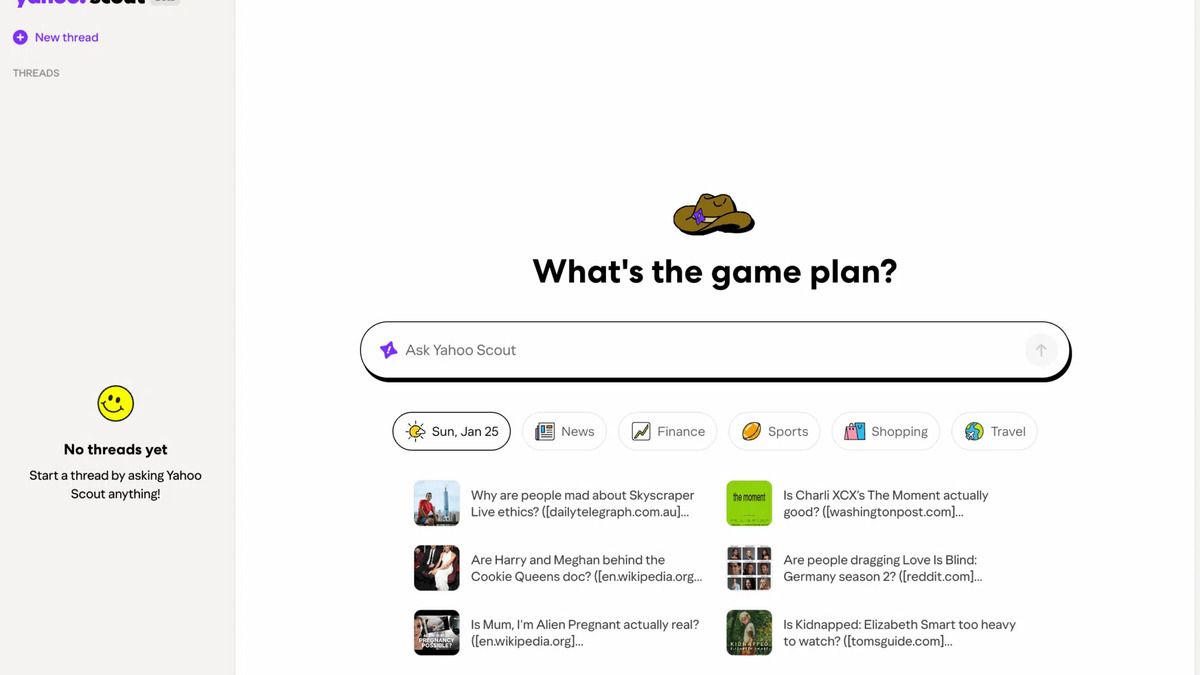 Yahoo Scout's interface features structured answer cards, inline citations, and vertical integrations across Yahoo Finance, Sports, and Mail.
Source: searchengineland.com
Yahoo Scout's interface features structured answer cards, inline citations, and vertical integrations across Yahoo Finance, Sports, and Mail.
Source: searchengineland.com
The Comparison
| Company | Monthly Reach | Backing | AI Model | Primary Revenue |
|---|---|---|---|---|
| Yahoo Scout | 250M US users | Apollo Global ($5B acquisition) | Anthropic Claude | CPC ads, affiliate |
| Perplexity | ~22M users | VC ($20B valuation) | Proprietary | Subscriptions (pivoting) |
| Google AI Overviews | 2B+ globally | Public | Gemini | Search ads |
| ChatGPT | 400M+ weekly | VC ($300B+ valuation) | GPT-5.4 | Subscriptions + API |
On distribution alone, Yahoo has a structural advantage that Perplexity can't easily reproduce. Reaching 90% of US internet users monthly through Yahoo Finance, Yahoo Sports, Yahoo Mail, and Yahoo News means Scout isn't starting from scratch - it has organic insertion points into existing user habits.
Who Benefits
Anthropic
This is a significant distribution win. Scout rolls Anthropic's Claude to a user base that dwarfs what Anthropic can reach through Claude.ai's direct subscription model. As of earlier this year, Anthropic crossed $19 billion in ARR. Every Yahoo Scout query is Claude inference revenue without Anthropic needing to build a consumer product. For a company still unprofitable at scale, enterprise and platform licensing deals like this carry more sustainable economics than competing for B2C subscribers.
Apollo Global Management
Apollo spent $5 billion on Yahoo five years ago. If Scout creates meaningful search revenue and builds toward a credible IPO story, that investment finally has a growth narrative attached to it. The company currently produces "billions in revenue" by Lanzone's account, but remains private and hasn't publicly disclosed specific figures. Scout is the pitch to equity markets that Yahoo is a different kind of asset than the one everyone wrote off a decade ago.
Microsoft
This is the quiet winner. Microsoft Advertising sits on Yahoo's monetization. Microsoft's Bing index grounds Scout's answers. Even as OpenAI and Google compete to displace Bing in AI search, Microsoft collects revenue when Yahoo search succeeds. The arrangement echoes the decade-long Yahoo-Microsoft search deal from 2009, updated for the AI era.
Who Pays
Perplexity
Perplexity's position as the leading AI answer engine is directly threatened by a competitor with ten times its US user reach. Perplexity reached roughly $200 million in annualized revenue and a $20 billion valuation on the back of early adopter subscribers. Yahoo Scout entering the market at zero marginal cost to users - subsidized by ads - undercuts the subscription case that Perplexity depends on.
 Yahoo Scout faces a crowded field: Google AI Overviews, Perplexity, and ChatGPT all occupy the same AI answer engine space.
Source: unsplash.com
Yahoo Scout faces a crowded field: Google AI Overviews, Perplexity, and ChatGPT all occupy the same AI answer engine space.
Source: unsplash.com
Publishers
Yahoo's stated goal is to drive more downstream clicks than other AI engines, and its CPC business model creates financial incentive to do so. But every answer Yahoo Scout creates is still an answer that might have otherwise sent a user to a publisher site. The company's Search Engine Land interview noted affiliate commission disclosures on commerce queries - a practice regulators and publishers will examine.
Google's Comfortable Position
Google's moat isn't search results - it's the advertising infrastructure that funds $200+ billion in annual revenue. Yahoo entering AI search with Microsoft Advertising as its backend doesn't threaten that. What it does do is confirm the market transition: if Yahoo, a company that spent years in structural decline, can credibly launch an AI search product, the category is clearly moving from experiment to infrastructure.
What Happens Next
Scout launched in beta on January 27. The March 27 press push reflects Lanzone positioning the product publicly ahead of what would be needed for any IPO filing process. Profitability timelines and per-query economics remain undisclosed.
The more interesting question is whether Yahoo's data advantage actually matters. Anthropic's Claude is available to any company willing to pay the API bill. Microsoft's Bing index grounds dozens of competing products. What Yahoo is betting is that 18 trillion annual consumer events - the search history, finance browsing, email metadata, sports engagement - produce meaningfully better answers than a cold-start competitor can. That claim hasn't been verified against independent benchmarks.
 Yahoo Finance's real-time market data integration is one of Scout's key differentiators - answers refresh every 10 minutes with financial analysis.
Source: unsplash.com
Yahoo Finance's real-time market data integration is one of Scout's key differentiators - answers refresh every 10 minutes with financial analysis.
Source: unsplash.com
Lanzone called this the white whale of turnarounds. In private equity, that language is either a founder's conviction or a pitch meeting. Scout will need to show retention metrics and revenue per user before markets decide which one it is.
Apollo's timeline is finite. Private equity firms don't hold assets indefinitely. If Scout can build a credible AI search revenue story within 18 to 24 months, Yahoo gets a viable IPO path. If it can't, the asset goes back to being what most observers have assumed since 2016: a legacy media property looking for a buyer.
Sources:

