
US Export Order Forces Global Fable 5, Mythos 5 Shutdown
Commerce Secretary Lutnick ordered Anthropic to disable its two most powerful models worldwide - the first US export control directive ever issued against a commercial LLM.
 Updated
5 min read
Updated
5 min read
At 5:21 PM on Friday, US Commerce Secretary Howard Lutnick signed an export control directive that turned off two of the world's most capable AI models for every user, everywhere. Anthropic received the letter, reviewed it, and disabled Claude Fable 5 and Claude Mythos 5 globally within hours.
It's the first time the United States has issued an export control directive against a commercial large language model. The order's legal theory targeted foreign nationals, but since Anthropic can't verify the nationality of every API caller in real time, the company had no choice but to shut down both models worldwide.
Key Facts
| Directive issued | June 12, 2026, 5:21 PM ET |
| Authority | US Commerce Secretary Howard Lutnick |
| Models suspended | Claude Fable 5 and Claude Mythos 5 |
| Scope | Global access disabled |
| Cited reason | Potential jailbreak enabling software vulnerability scanning |
| First of its kind | Yes - first US export control directive for a commercial LLM |
| Models unaffected | All other Anthropic models remain accessible |
The Directive
What Was Ordered
The directive ordered Anthropic to suspend access to Fable 5 and Mythos 5 for "any foreign national, whether inside or outside the United States, including foreign national Anthropic employees." Anthropic said the letter provided limited specifics but that its understanding is the government "believes it has become aware of a method of bypassing, or 'jailbreaking' Fable 5."
Because real-time nationality verification isn't possible at API scale, Anthropic disabled both models for all users globally to comply.
Why Fable 5 Was Three Days Old
Fable 5 launched June 9 as the public-access version of Mythos - guardrailed, broadly available, and immediately the most capable model most users had ever had access to. It was offline 72 hours later.
Claude Mythos 5 was already under tight access controls through Project Glasswing, limited to roughly 50 vetted organizations including Amazon, Apple, Google, Microsoft, and CrowdStrike. That controlled rollout didn't protect either model when a competitor claimed to have found a bypass.
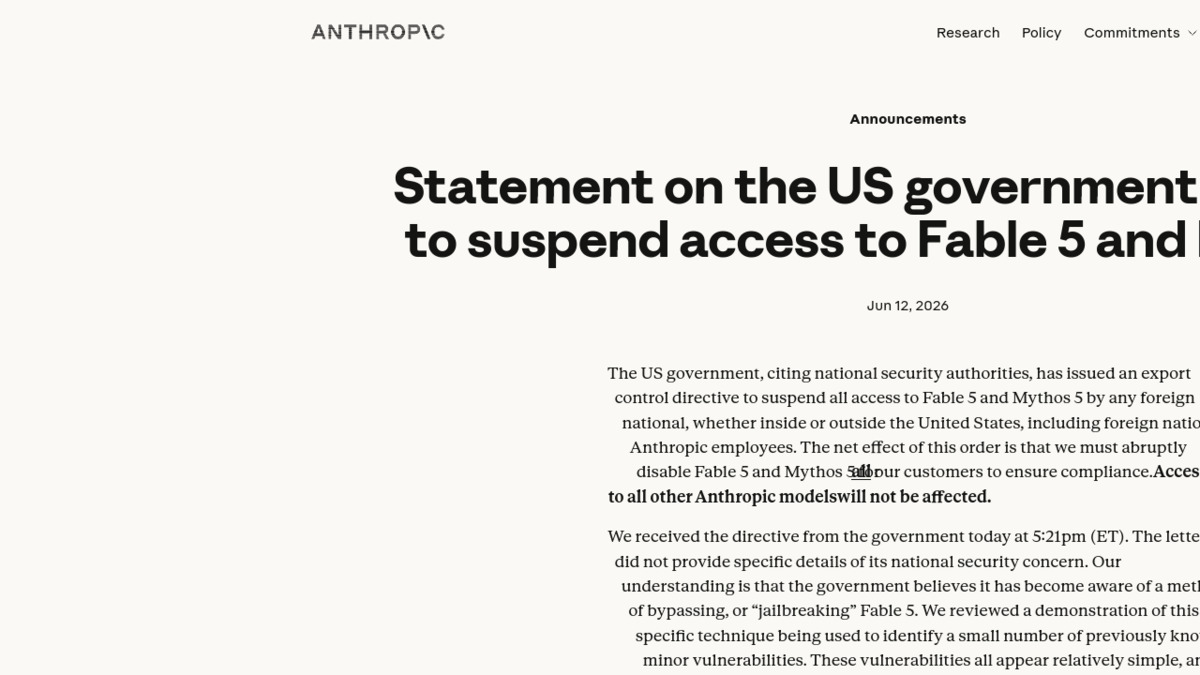 Anthropic posted its public statement Friday evening, confirming both models were disabled globally to comply with the directive.
Source: anthropic.com
Anthropic posted its public statement Friday evening, confirming both models were disabled globally to comply with the directive.
Source: anthropic.com
The Jailbreak Claim
What the Government Cited
The technique at issue is asking the model to read a specific codebase and identify software flaws. Anthropic reviewed a demonstration of this approach and found it "identified a small number of previously known, minor vulnerabilities." The company categorized this as a "narrow, non-universal jailbreak."
No CVE was assigned. No public technical report accompanied the directive.
The GPT-5.5 Problem
Anthropic's strongest counterargument is that the same capability exists in products the government didn't restrict. OpenAI's GPT-5.5 performs comparable vulnerability scanning - a capability documented in security coverage - and remains fully accessible globally. Anthropic stated directly that the jailbreak "is widely available from other models (including OpenAI's GPT-5.5)."
If the standard is "the model can be prompted to analyze code for flaws," every frontier model is in scope. The government drew the line at Fable 5 and Mythos 5, and only at those two.
Anthropic's Defense-in-Depth Problem
Anthropic built Fable 5 using layered monitoring and safeguards rather than trying to make the model jailbreak-resistant at the prompt level. That design is defensible - it's also the design that another company (identity not disclosed) found a narrow path through. Years of public messaging about Mythos's exceptional danger may have drawn government attention that more quietly capable competitors avoided.
The company put it plainly: "If this standard was applied across the industry, we believe it would essentially halt all new model deployments for all frontier model providers."
Model Access: Before and After June 12
| Fable 5 | Claude Opus 4.8 | GPT-5.5 | |
|---|---|---|---|
| Status | Disabled | Active | Active |
| Code vulnerability scanning | Yes | Limited | Yes |
| 1M token context | Yes | Yes | No |
| Export control applied | Yes | No | No |
| Controlled rollout | No | No | No |
The Infrastructure Impact
If you had Fable 5 integrated into a code review pipeline, a developer copilot, or a security scanning workflow, those systems started failing at 5:21 PM Friday without warning. No advance notice. No wind-down period. No SLA protection for downstream applications.
 The US Commerce Department's Bureau of Industry and Security issued the directive under national security export control authorities.
Source: commons.wikimedia.org
The US Commerce Department's Bureau of Industry and Security issued the directive under national security export control authorities.
Source: commons.wikimedia.org
Switching to Claude Opus 4.8 or a competitor isn't a drop-in fix. Fable 5 was trained differently, behaves differently on edge cases, and produces different outputs for the same prompts. Applications that appear to keep running after a model swap can quietly degrade in accuracy in ways that don't surface until something fails in production.
This is new territory for AI infrastructure. US export controls on AI chips disrupted hardware supply chains over months, with lists published in advance. A software directive that disables an API endpoint with roughly five hours' effective notice is a different category of operational risk completely. Every company running production systems on frontier LLM APIs now has to account for it.
Anthropic said it's "working to restore access as soon as possible" but gave no timeline.
What To Watch
Legal Challenge
Anthropic called the directive "a misunderstanding" and said it disagrees with the government's conclusion. That language suggests a legal response is being prepared. Export control orders grounded in national security authorities are difficult to overturn in federal court, and the process is slow. Any challenge is unlikely to restore access quickly.
IPO Consequences
Anthropic's IPO was expected later this year. A government order disabling the company's two most powerful products - with no confirmed restoration date - is a material risk event. Underwriters and institutional investors will need clarity on the directive's legal status and the probability it expands to other models before any S-1 can move forward cleanly.
The Competitive Angle
OpenAI's GPT-5.5 wasn't touched. Google's Gemini 3.1 wasn't touched. The directive landed on Anthropic, the company that had most publicly stressed the danger of its own models. Whether that's coincidence or causation, the outcome is that Anthropic's strongest commercial product is offline while its nearest competitors continue serving the same enterprise use cases unimpeded.
The Commerce Department hasn't commented publicly on whether it plans to extend similar controls to other frontier models.
Sources:
- TechCrunch: Anthropic's safety warnings may have just backfired
- Anthropic: Statement on the US government directive to suspend access to Fable 5 and Mythos 5
- TechTimes: Anthropic Fable 5 Shutdown - US Export Order Forces Global Customer Cutoff
- Nextgov/FCW: Anthropic suspends top AI models after US export control order
Last updated

