
UN AI Commission Launches Without Google or OpenAI
The UN and ITU launched a new AI for Good Global Commission with 40+ founding members, but Google, Meta, and OpenAI are not among them.
 7 min read
The United Nations and the International Telecommunication Union launched the AI for Good Global Commission on July 1, 2026, co-chaired by Salesforce CEO Marc Benioff and Rwandan President Paul Kagame. The body's 40+ founding members span government leaders, enterprise tech executives, and heads of UN agencies. Three of the most consequential AI labs in the world, Google DeepMind, Meta, and OpenAI, aren't on the list.
"The technology is arriving faster than any single governance system can process," Benioff said in remarks accompanying the launch. "Proactive governance is not optional - it's the only viable path."
It's a bold framing from a man whose company sells AI software to enterprises. The commission's mandate is to ensure AI "benefits humanity rather than divides it," with a stated emphasis on bridging the gap between wealthy and developing countries. Whether it can do that without the architects of frontier AI in the room is the question the inaugural session on July 8 in Geneva will have to answer.
TL;DR
- UN and ITU launched a 40+ member AI for Good Global Commission on July 1, 2026
- Co-chaired by Salesforce CEO Marc Benioff and Rwandan President Paul Kagame
- Jensen Huang (NVIDIA), Andy Jassy (Amazon), and Brad Smith (Microsoft) are founding members
- Google DeepMind, Meta, and OpenAI are absent from the founding roster
- First meeting: July 8, 2026 in Geneva - the commission can recommend but not enforce
The Commission
Companies
The tech contingent reads like a partial list of the biggest beneficiaries of AI infrastructure spending. Jensen Huang of NVIDIA, the company whose GPUs underpin most large model training, joined with Andy Jassy of Amazon and Brad Smith of Microsoft - two cloud providers who together sell a large share of the compute capacity that makes frontier AI possible.
From the AI lab side, Anthropic co-founder Jack Clark is listed as a founding member, as is Aidan Gomez, co-founder of Cohere. Anthropic has been public about its willingness to engage with government frameworks, and Cohere has built its business on enterprise and sovereign AI contracts. Both have financial incentives to be seen as governance-friendly.
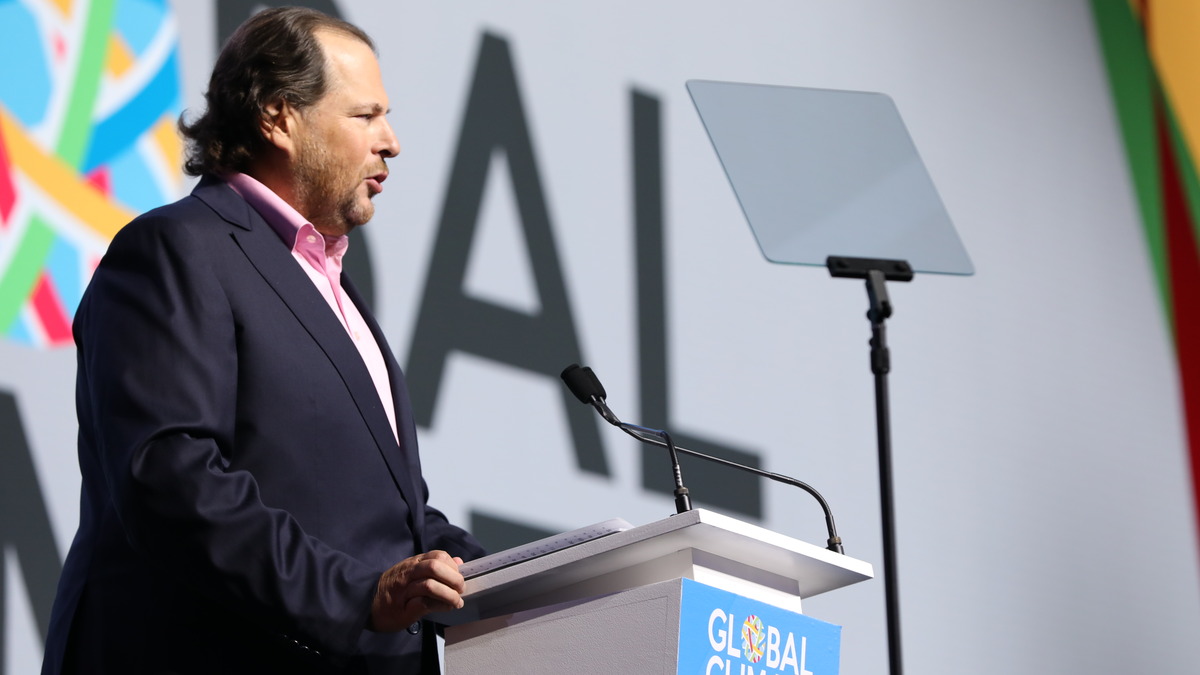 Marc Benioff speaking at the World Economic Forum Annual Meeting. He now co-chairs the UN AI for Good Global Commission.
Source: commons.wikimedia.org
Marc Benioff speaking at the World Economic Forum Annual Meeting. He now co-chairs the UN AI for Good Global Commission.
Source: commons.wikimedia.org
Users
The commission's stated goal of bridging digital divides shows up in its government membership. Leaders from Estonia, Kazakhstan, Namibia, Nigeria, Saudi Arabia, and Singapore joined as founding members, alongside Rwandan President Kagame. This is a deliberate contrast to previous AI governance initiatives that drew heavily from Western capitals and Silicon Valley.
Kazakhstan and Saudi Arabia bring significant sovereign AI investment. Nigeria and Namibia bring the perspective of countries that'll be net receivers of AI's effects - good or bad - without having built the underlying systems. Whether their inclusion is substantive or decorative depends on whether the commission produces enforceable commitments or another set of principles.
The Absent Giants
The gaps in the membership list are as informative as the names on it. Google DeepMind, the lab behind Gemini, is absent. Meta, which has released the most widely rolled out open-weight frontier models through its Llama series, isn't present. OpenAI, the company that put AI on the front pages of every newspaper in the world, is not a founding member.
These are not minor omissions. Any commission attempting to govern AI that excludes the developers of Gemini, Llama, and ChatGPT is working with a significant blind spot. The absence could reflect a strategic choice by those companies - governing AI while also building it creates obvious conflicts. It could also reflect deliberate exclusion. Neither possibility is flattering.
OpenAI has been developing its own governance framework in parallel with its IPO preparations. Google has participated in G7 AI standards discussions through separate channels. Whether they'll eventually join the commission, or continue to work around it, is an open question.
Impact at a Glance
| Stakeholder | Impact | Timeline |
|---|---|---|
| Anthropic, Cohere | Goodwill from joining; early access to commission's working groups | Ongoing from July 8 |
| Google, Meta, OpenAI | Absent from table; risk of framework shaped without them | Depends on whether they join |
| Global South governments | Seat at AI governance table for first time at this level | From inaugural session |
| Enterprise AI buyers | Possible voluntary standards on data, safety, access | 6-12 months if mandate produced |
| General public | No direct impact until (or unless) recommendations gain adoption | Uncertain |
Authority Without Teeth
The commission operates under UN and ITU auspices, which gives it legitimacy but not authority. It can publish recommendations, convene working groups, and broker voluntary commitments. It can't fine companies, mandate safety testing, or prevent a model release. Nothing in its structure gives it the kind of binding power that the EU AI Act has, for instance, over companies operating in European markets.
That's a structural problem, not a criticism of the people involved. Multilateral bodies rarely have enforcement power, especially at launch. The EU AI Act took years of negotiations and still faces significant implementation challenges. The voluntary review framework the White House put in place for US frontier models has already created confusion about what standards actually apply.
 Jensen Huang of NVIDIA is a founding member. NVIDIA supplies the compute infrastructure that trains most frontier AI models.
Source: commons.wikimedia.org
Jensen Huang of NVIDIA is a founding member. NVIDIA supplies the compute infrastructure that trains most frontier AI models.
Source: commons.wikimedia.org
The commission's proponents would argue that the right framing isn't enforcement but coordination. Getting 40+ governments and companies to agree on common definitions of AI safety testing, data rights, and technical capacity-sharing is itself valuable - even if no one can compel compliance. The Bernie Sanders approach to AI governance, which involves 50% equity stakes and forced board representation, hasn't advanced to committee. Voluntary coordination, however imperfect, is what's actually happening.
The commission is intentionally smaller and faster than traditional UN bodies. It can move quickly because it doesn't require General Assembly ratification. That agility comes with a corresponding lack of democratic legitimacy. A body where Salesforce's CEO co-chairs alongside a head of state isn't the same as a body accountable to elected legislatures.
What Happens Next
The inaugural meeting takes place on July 8, 2026, in Geneva during the ITU's AI for Good Global Summit, which runs July 7-10 at Palexpo. Day Zero on July 7 features demonstrations and workshops. The Centre Stage opens July 8, which is when the commission is expected to convene.
 The Palais des Nations in Geneva hosts UN operations in Europe. The AI for Good Global Summit runs July 7-10 at Palexpo, with the commission's inaugural meeting on July 8.
Source: commons.wikimedia.org
The Palais des Nations in Geneva hosts UN operations in Europe. The AI for Good Global Summit runs July 7-10 at Palexpo, with the commission's inaugural meeting on July 8.
Source: commons.wikimedia.org
Concrete success at the first session would look like a mandate with specific, measurable commitments - safety testing thresholds, capacity-sharing mechanisms, or infrastructure access principles that signatories actually agree to track. A communique with general statements about AI benefiting humanity would be the weaker outcome, though not necessarily a fatal one for the commission's longer-term prospects.
The composition of the founding membership sends a clear signal about whose vision of AI governance is being built. NVIDIA, Amazon, Microsoft, Anthropic, and Cohere all have strong incentives to support a governance framework they helped design. The three largest consumer-facing AI labs - Google, Meta, and OpenAI - will either join on terms they can accept, or operate in a world shaped partly by a body they chose not to enter.
Sources:
- UN AI Governance Commission: Jensen Huang, Jassy, and Benioff Named to Global Body - Eastern Herald
- UN and ITU launch AI for Good Commission led by Benioff and Kagame - AI Weekly
- AI Governance Gets Global Push with Launch of AI for Good Global Commission - Electronics Media
- UN Launches Governance Commission Putting AI CEOs Alongside Heads of State - TechTimes
- AI for Good Global Summit 2026 - ITU
- Marc Benioff, Jensen Huang, and World Leaders Launch UN's AI for Good Global Commission - FAQ.com.tw

