
Thinking Machines Opens Inkling - and Admits Its Limits
Mira Murati's Thinking Machines Lab released its first open-weight model, Inkling, and published benchmarks showing it losing to closed rivals on most of them.
 6 min read
Ink dispersing in water. Source: Pexels
Mira Murati's Thinking Machines Lab released its first model with fully open weights on July 15, and the announcement opens with an admission most labs bury on page ten: "It is not the most performant model available today, closed or open." The model is called Inkling, and the company published the numbers to prove its own point.
On Humanity's Last Exam, Inkling scores 30.0% against Claude Fable 5's 53.3%. On SWE-Bench Verified, it trails Claude Fable 5 by more than 17 points. Thinking Machines is betting that none of that matters as much as being the model a company can actually reshape into its own.
TL;DR
- Inkling is a 975B-parameter mixture-of-experts model (41B active) with full open weights under Apache 2.0, released with a smaller preview called Inkling-Small
- It trails closed frontier models like Claude Fable 5 and GPT-5.6 Sol on reasoning and coding benchmarks, a gap the company states upfront rather than hides
- The pitch isn't raw capability. It's customization through Tinker, Thinking Machines' fine-tuning platform, where Inkling is discounted 50% for a limited time
- Post-training bootstrapped on synthetic data from Moonshot AI's Kimi K2.5, a detail buried deep in the technical writeup
The Numbers, Up Front
Thinking Machines put its own model up against five rivals across ten benchmark categories, and Inkling loses more often than it wins. The comparison below pulls the categories most people will actually check first.
| Benchmark | Inkling | Nemotron 3 Ultra | Gemini 3.1 Pro | Claude Fable 5 | GPT-5.6 Sol |
|---|---|---|---|---|---|
| HLE (text only) | 30.0% | 26.6% | 44.7% | 53.3% | 47.2% |
| SWE-Bench Verified | 77.6% | 70.7% | 80.6% | 95.0% | 82.2% |
| Terminal-Bench 2.1 | 63.8%* | 56.4% | 70.7% | 84.6% | 91.9% |
| MMMU Pro | 73.5% | not tested | 82.0% | 84.2% | 83.0% |
| FORTRESS (adversarial safety) | 78.0% | 77.6% | 65.2% | 96.0% | 82.4% |
*Thinking Machines assigns a score of 0 to any Terminal-Bench 2.1 rollout it flags for solution contamination from web search, which depresses Inkling's number relative to less strictly graded runs.
Against Nemotron 3 Ultra, the closest open-weight comparison, Inkling wins on four of these five rows. Against the closed frontier, it wins on none. That split is the whole story of what this release is and isn't.
What Thinking Machines Actually Built
Architecture and Scale
Inkling is a mixture-of-experts transformer with 975 billion total parameters and 41 billion active per token, spread across 256 routed experts with 6 active at a time. It supports a context window up to 1 million tokens, and it was pretrained on 45 trillion tokens spanning text, images, audio, and video. The company trained it completely on Nvidia GB300 NVL72 systems, the same hardware line underpinning the gigawatt compute commitment Nvidia made to Thinking Machines back in March.
With Inkling, the company previewed Inkling-Small, a 276 billion parameter model that draws on just 12 billion active parameters. Despite being the lighter sibling, Inkling-Small matches or beats Inkling on several benchmarks, including HLE with tools (46.6% versus 46.0%) and GPQA Diamond (88.0% versus 87.9%), which the company attributes to pre-training improvements made between the two runs rather than anything Inkling-Small does structurally different.
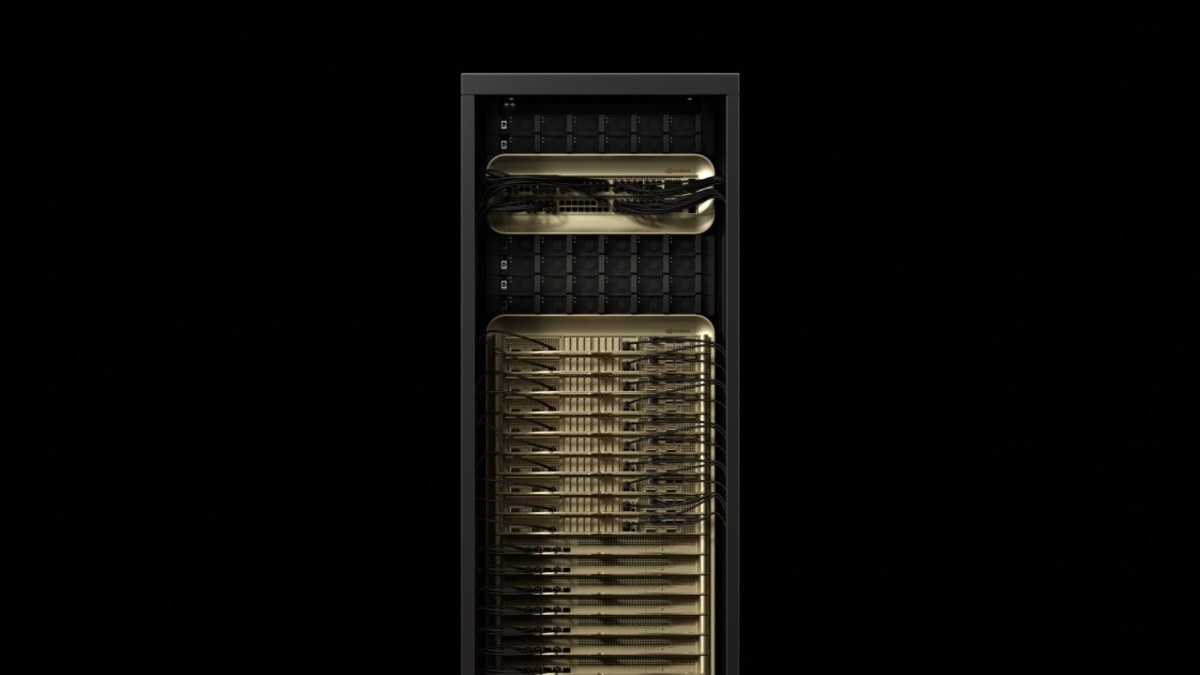 Inkling was trained completely on Nvidia's GB300 NVL72 systems, the rack-scale hardware Thinking Machines locked in through a gigawatt compute deal with Nvidia in March.
Source: nvidia.com
Inkling was trained completely on Nvidia's GB300 NVL72 systems, the rack-scale hardware Thinking Machines locked in through a gigawatt compute deal with Nvidia in March.
Source: nvidia.com
Where It Borrowed From Rivals
Buried in the training section is a detail that will draw scrutiny: Thinking Machines bootstrapped Inkling's post-training with an initial supervised fine-tuning pass on synthetic data generated by other open-weight models, explicitly naming Moonshot AI's Kimi K2.5. The company frames this as a small fraction of total compute, with the bulk going to large-scale reinforcement learning, over 30 million rollouts, on synthetic and human-built environments afterward. It also says its next model will skip the borrowed bootstrap entirely and rely on fully self-contained post-training.
That's a more direct admission than most labs make about where their training data comes from, at a moment when distillation from competitors' outputs has drawn scrutiny across the industry.
A Benchmark Inkling Actually Wins
Buried further down the announcement is a number that cuts against the "not the strongest" framing: on Design Arena's Agentic Web Dev leaderboard, where blinded human evaluators compare generated web apps head to head, Inkling scores 1257, ahead of Gemini 3.1 Pro Preview (1187), Kimi K2.6 (1249), and tied with Claude Opus 4.6. It sits just three points behind GPT-5.6 Sol. On a benchmark judged by humans rather than automated graders, the generalist framing holds up better than the reasoning scores alone would suggest.
The Business Isn't the Model
Thinking Machines is selling access to Tinker, not Inkling itself. The model is available for fine-tuning today at 50% off list pricing for a limited time, with 64K and 256K context tiers, and the company added an "Inkling Playground" to the Tinker console so developers can get a feel for the base model before committing to a fine-tune. Full weights, including a checkpoint quantized for Nvidia Blackwell, are on Hugging Face under an Apache 2.0 license, with inference support already live on Together, Fireworks, Modal, Databricks, Baseten, and open-source runtimes including SGLang, vLLM, and llama.cpp.
"It's an argument that's gaining steam," TechCrunch's Connie Loizos wrote of the open-weights bet, noting that Microsoft CEO Satya Nadella made a similar case in a blog post days earlier: enterprises running proprietary models "pay twice, once in subscription costs, and again by handing over business knowledge embedded in their thousands of prompts."
Inkling is the company's first proprietary model release since a May preview of "interaction models" built for real-time voice and video, and it follows two large compute commitments the company locked in earlier this year: a Google Cloud deal for GB300 access in April and the Nvidia gigawatt commitment in March.
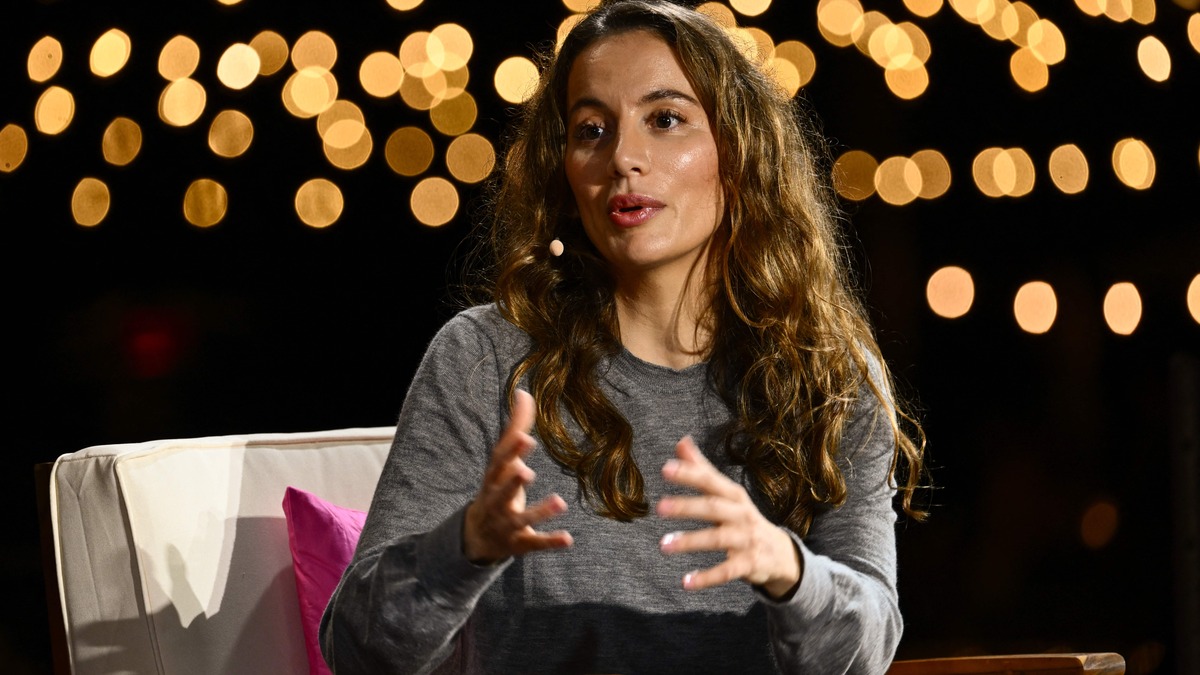 Mira Murati, CEO of Thinking Machines Lab, at a recent public appearance.
Source: techcrunch.com
Mira Murati, CEO of Thinking Machines Lab, at a recent public appearance.
Source: techcrunch.com
What It Does Not Tell You
The announcement doesn't say how Thinking Machines intends to make money once the weights are public. Once a model is downloadable, nothing obligates anyone running it to pay the company that trained it, unlike the metered API access OpenAI and Anthropic sell against Claude Fable 5 or GPT-5.6 Sol. A reported $50 billion fundraising round was said to be coming together last November; multiple outlets reported it had stalled by January, and the company has declined to discuss its funding picture since, beyond Nvidia's disclosed "significant investment" tied to the March compute deal.
It also doesn't disclose full pricing for Tinker beyond the temporary 50% discount, doesn't name the size of the safety red-teaming panel beyond describing it as "external testers," and doesn't explain how it will keep those safety guarantees intact once customers start fine-tuning the model on their own data, something the company itself flags as an open research question. Nemotron 3 Ultra and GLM 5.2 weren't tested on MMMU Pro at all, so the vision comparison in the table above is thinner than the reasoning and coding rows.
Inkling isn't trying to be the best model on the market, and Thinking Machines is unusually blunt about saying so in its own launch materials. Whether that honesty translates into developers actually choosing to fine-tune a generalist over a narrower specialist model is a question the benchmarks in this release can't answer. That one gets settled on Tinker's usage numbers, which the company hasn't published yet.
Sources:

