
Tesla Hid Thousands of Fatal Autopilot Incidents, RTS Says
Swiss broadcaster RTS reopens the 2023 Tesla Files leak in context of the confirmed $243M Miami verdict. The combined record: 2,400+ concealed sudden-acceleration complaints, 1,000+ undisclosed crashes, and a federal court that found Tesla knew.
 9 min read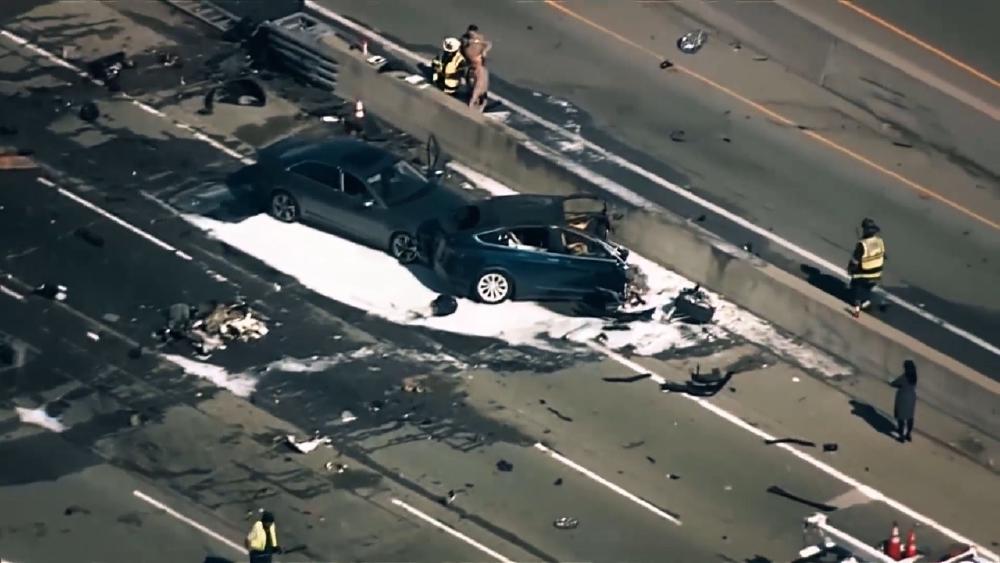
Aerial view of a Tesla crash scene shown in RTS Temps Présent, April 16, 2026. Credit: RTS.
Swiss public broadcaster RTS aired a 47-minute investigation on Thursday night titled Tesla, la face sombre d'Elon Musk ("Tesla, the dark side of Elon Musk"). The piece, broadcast on the Temps Présent magazine show, does not break new documents - it re-reads the 2023 Handelsblatt "Tesla Files" leak against the February 2026 federal court ruling that Tesla still owes $243 million for a fatal Autopilot crash. The combined record it assembles is the most damaging yet assembled against the company in a mainstream outlet this year.
The short version: an internal data cache that Tesla fought to keep buried contains 2,400+ customer complaints of spontaneous acceleration and more than 1,000 accidents tied to Autopilot, most marked "unresolved" in the company's own files. A federal jury in Miami found Tesla knowingly concealed relevant crash data in at least one fatal case. A federal judge confirmed that verdict two months ago. The Swiss broadcaster is the first European primetime outlet to stitch the three pieces together.
TL;DR
- RTS Temps Présent investigation aired April 16, 2026; journalist François Roulet is credited as author of the companion RTS article
- The dossier combines the 2023 Handelsblatt "Tesla Files" leak (100 GB, ~23,000 internal documents) with the Miami federal jury's $243M verdict in the Benavides / Angulo case, now upheld on appeal
- Leak contains 2,400+ sudden-acceleration complaints and 1,500 braking complaints logged 2015-March 2022 across the US, Europe and Asia; many marked "unresolved" in Tesla's own status fields
- More than 1,000 accidents tied to Autopilot in the internal files, per RTS's reading - an order of magnitude beyond what NHTSA's public EA22002 tranche had identified
- In the Miami case, plaintiff experts recovered crash-data Tesla had said was "corrupted"; the recovered log showed the car's Autopilot detected obstacles and did not brake, issuing a warning only at impact
- Tesla's motion to toss the verdict was denied by Judge Beth Bloom on February 20, 2026; the company can still appeal to the Eleventh Circuit
What RTS actually reported
The framing of the Temps Présent piece is forensic rather than editorial. RTS does not claim to have obtained new documents. It reconstructs what the Handelsblatt leak showed in 2023 and asks why the scale only became legally actionable three years later:
"Une fuite de données révèle que Tesla a dissimulé des milliers d'incidents liés à sa conduite autonome. Certains accidents ont été fatals. Un premier verdict condamne le constructeur à verser 243 millions de dollars aux victimes."
Translation: "A data leak reveals that Tesla concealed thousands of incidents tied to its autonomous driving. Some accidents were fatal. An initial verdict has condemned the manufacturer to pay $243 million to the victims."
The specific numbers drawn from the leak, confirmed in the broadcaster's printed summary and consistent with the 2023 Handelsblatt reporting:
| Category | Count | Window |
|---|---|---|
| Customer complaints of spontaneous acceleration | ~2,400 | 2015 - March 2022 |
| Complaints of unintended braking | ~1,500 | 2015 - March 2022 |
| "Phantom stop" reports (false collision warnings) | 383 | 2015 - March 2022 |
| Reports of "unintentional emergency braking" | 139 | 2015 - March 2022 |
| Accidents logged in the internal files | >1,000 | 2015 - March 2022 |
The aggregate file count in the leak was 23,000+ internal documents - customer complaints, service tickets, wage slips, bank details, and Elon Musk's social security number, per the German reporting. Tesla called the source a "disgruntled" ex-service-technician; he received the 2023 Blueprint Europe Whistleblowing Prize for the disclosure.
The Miami case is the legal hinge
The reason RTS's framing lands now is the Miami judgment.
In August 2025, a federal jury in the Southern District of Florida found Tesla 33% responsible for the 2019 crash that killed 22-year-old Naibel Benavides and severely injured Dillon Angulo. The driver, George McGee, was operating a Model S on Autopilot and reached for a dropped phone; the car detected the parked SUV ahead, logged a warning at impact, and did not brake. The jury awarded $43 million in compensatory damages and $200 million in punitive, totaling $243 million.
Tesla moved to throw out the verdict. On February 20, 2026, U.S. District Court Judge Beth Bloom denied the motion, writing that "evidence admitted at trial more than supports the jury verdict." The company retains the right to appeal to the Eleventh Circuit but the punitive component - the $200M - now stands.
The forensic detail RTS dwells on is the crash data. Tesla told investigators the vehicle's internal log was "corrupted" and could not be read. The plaintiffs hired their own experts. The experts recovered the deleted records. The recovered telemetry proved that Tesla had the relevant data "dès le soir de l'accident" - from the night of the crash - while publicly maintaining the file was unrecoverable. That finding, more than any single complaint in the leak, is what converted a civil loss into a punitive one.
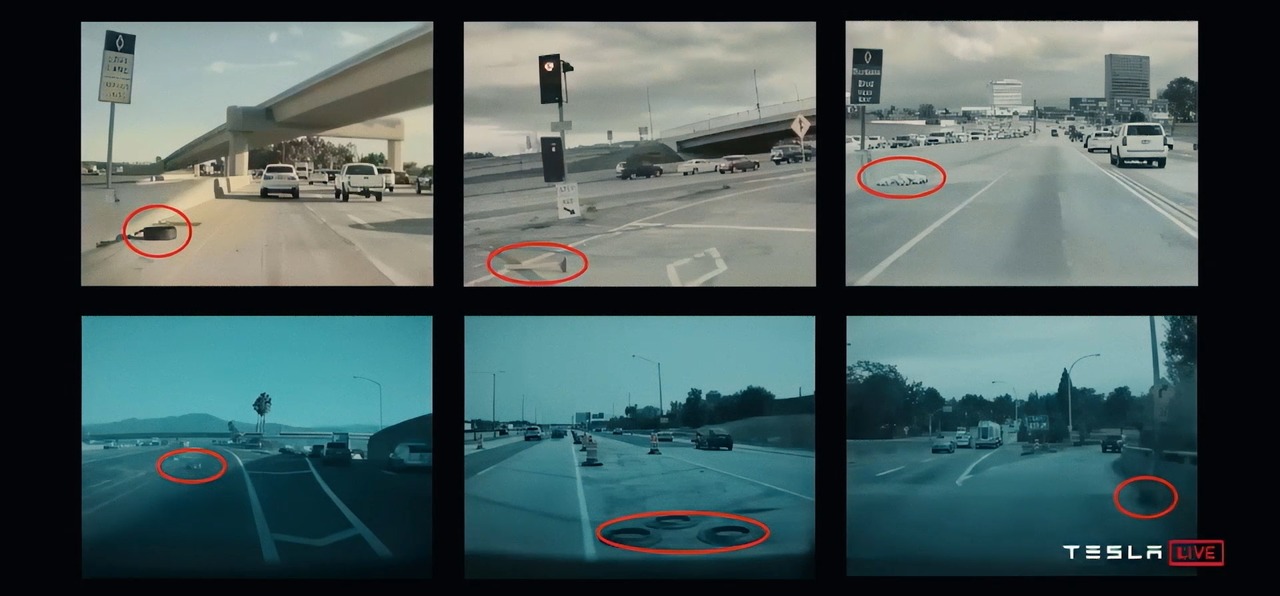 Autopilot perception overlay as shown in the RTS broadcast. The plaintiffs' experts recovered a log proving the system saw obstacles and issued its warning only at impact. Credit: RTS.
Two victims, one quote
The broadcaster elected to give the surviving plaintiff the line of the night:
"Je ne savais pas que le pilote automatique existait. Quand je l'ai découvert, je me suis senti comme un cobaye."
Translation: "I didn't know Autopilot existed. When I found out, I felt like a lab rat."
- Dillon Angulo, survivor of the 2019 Miami crash
Angulo's framing - "cobaye" / lab rat - is the frame that makes the story travel. It reorganizes the question from "is Autopilot safe?" to "who agreed to be part of the test?" The families of bystanders killed by Autopilot-engaged vehicles never opted in. The internal leak showed Tesla knew. The Miami jury found Tesla knew and concealed. The Swiss investigation assembles those three points into a single narrative arc.
Where the regulators sit
The broadcaster also walks through the U.S. enforcement stack, which has thickened considerably in 2026:
| Agency | Action | Status |
|---|---|---|
| NHTSA (ODI) | Upgraded the EA22002 visibility investigation to engineering analysis on March 18, 2026 | Final stage before recall authority |
| NHTSA scope | Covers 3.2 million Tesla vehicles (Model S, X, 3, Y, Cybertruck) | Insurance Journal, March 20 |
| NHTSA findings | 9 crashes tied to visibility-degradation failures including 1 fatality, 2 injuries; 6 additional under review | Public ODI file |
| DOJ | Active investigation into whether Tesla misled consumers about Autopilot and FSD capabilities | Ongoing since 2022; referenced by RTS |
| Tesla's own admission | Told NHTSA that "data and labeling limitations" prevented uniform identification of crashes | NHTSA believes this caused under-reporting |
The last row is the one that ties the leak and the regulator together. Tesla itself has now told NHTSA, in writing, that its internal crash-identification pipeline under-reported the population of incidents - the same structural gap the 2023 Handelsblatt files exposed from the inside.
What it does not prove
RTS is careful, and worth being careful with in return.
- The 2,400 / 1,000 figures are complaints and company-logged accidents, not confirmed defects. A "spontaneous acceleration" complaint does not establish that a vehicle accelerated without driver input. In the U.S., NHTSA's formal investigations have historically attributed most sudden-acceleration reports to pedal misapplication rather than systems failure.
- Cause of fatal crashes remains case-by-case. The Miami jury attributed 33% of fault to Tesla and 67% to the distracted driver. The verdict is landmark because it established the 33% at all, not because it zero-ed out driver responsibility.
- The leak is from May 2023. Anything Tesla has logged or fixed since then is not in it. That does not absolve the company of the window it covers, but the NHTSA visibility probe is measuring a different, more recent cohort of incidents.
- The RTS piece is a secondary investigation. No new whistleblower is named. The value is in the synthesis, not the sourcing.
Why this one matters anyway
The RTS synthesis converts three disconnected data points - a 2023 German data leak, a 2025 Miami verdict, and a 2026 NHTSA escalation - into a single, investor-legible story of concealment. That narrative is what plaintiffs' lawyers and agency staff will now carry into the next round of litigation and the next round of NHTSA findings.
In the wider AI-safety context we've been tracking - autonomous AI systems operating with degraded oversight, humanoid robots being pushed to market at a pace faster than their harness can absorb, cyber-capable models shipping with corporate cover before safety guardrails - Tesla's Autopilot is the reference case. It has been deployed at scale for longer than any other consumer-facing autonomous system. The thesis that "the company knew and chose not to say" is now supported by a federal judgment and an unauthorized copy of the company's own ticket queue.
It also lands two days after the RTS newsroom's companion piece on the NHTSA escalation, and three days after the Miami court order was entered into PACER. Temps Présent is a weekly magazine show on a national broadcaster watched by roughly a million viewers in French-speaking Switzerland. It is not TMZ. When its editors decide a corporate scandal is worth 47 minutes of primetime, that is itself a regulatory signal.
What to watch
- Whether the Eleventh Circuit grants Tesla's anticipated appeal in the Benavides case. If the appeals court declines to review or upholds Judge Bloom, the $200M punitive bar becomes the floor for the pending cohort of cases. Tesla still has to pay, per Engadget's reading of the February order.
- Whether NHTSA's engineering analysis converts to a recall order. The agency is one procedural step away; the Electrek analysis reads the March filing as functionally final.
- Whether the DOJ's parallel fraud probe surfaces charges. The 2023 Handelsblatt leak has been in federal hands since its publication; the Miami verdict has now certified a "concealment" fact pattern a prosecutor can reference.
The autonomous-driving product is still on the road. The verdict, the leak, and the regulator are all now pointing at the same thing. Tesla's next appellate brief is the document that matters.
Sources:
- RTS - Comment Tesla a caché des accidents fatals pour continuer à tester la conduite autonome sur les routes (April 17, 2026)
- TechCrunch - Tesla loses bid to overturn $243M Autopilot verdict (Feb 20, 2026)
- CNBC - Tesla loses bid to toss $243 million verdict in fatal Autopilot crash suit (Feb 20, 2026)
- Engadget - A judge ruled Tesla still has to pay $243 million for a fatal crash involving Autopilot
- Carscoops - Tesla Whistleblower Leaks 23,000 Internal Files (May 2023)
- InsideEVs - Tesla Files: 100 GB Of Confidential Data Leaked To German Newspaper
- Benzinga - Tesla Data Leak Exposes FSD Safety Nightmare As Complaints Run Into Thousands
- CNBC - German authorities looking into possible data protection violations by Tesla
- Electrek - Tesla is one step away from having to recall FSD in NHTSA visibility crash probe (March 19, 2026)
- Insurance Journal - NHTSA Upgrades Probe into 3.2M Teslas Over Self-Driving Crashes
- NHTSA - Additional Information Regarding EA22002 Investigation (PDF)
- PBS NewsHour - U.S. opens new investigation into Tesla's Full Self-Driving system after fatal crash

