
SpaceX Acquires Cursor for $60B in Enterprise AI Push
SpaceX signed a merger agreement to acquire Anysphere, maker of AI coding tool Cursor, for $60 billion in stock just four days after the company's record-breaking Nasdaq IPO.
 7 min read
SpaceX signed a merger agreement on June 16 to acquire Anysphere - the company behind the AI coding tool Cursor - for $60 billion in all-stock. The deal comes four days after SpaceX's $1.75 trillion Nasdaq IPO, which closed June 12 as the largest public offering in US market history. It's expected to close in Q3 2026 subject to regulatory approval.
Cursor shareholders will receive SpaceX Class A common stock in exchange for their shares at a conversion ratio based on the volume-weighted average of SpaceX stock over the seven trading days before close.
TL;DR
- SpaceX signed a $60B all-stock merger agreement on June 16; Q3 2026 close pending regulatory review
- Cursor reached $3B ARR by May 2026, growing from $100M in January 2025 - the fastest ARR ramp in enterprise software history
- 67% of Fortune 500 companies use Cursor; 50,000+ enterprise customers
- Cursor was compute-limited training its Composer models; Colossus gives access to 230,000+ GPUs in Memphis
- Microsoft looked and passed; Cursor went to SpaceX instead
- What happens to Claude, GPT, and Gemini integrations inside Cursor is not yet addressed publicly
What Anysphere Built
Anysphere was founded in 2022 by four MIT students: Michael Truell (CEO, 25 years old), Sualeh Asif, Arvid Lunnemark, and Aman Sanger. Truell, a former Google intern, turned down a full-time Google offer to build what's now the second-largest AI coding platform by market share.
The core product is a fork of Visual Studio Code with AI layered into every surface - autocomplete, chat, multi-file edits, and autonomous agents that can open pull requests when they finish a task. Cursor 3, released in early 2026, rebuilt the IDE around agents, adding Background Agents and Cloud Agents that run off the developer's local machine.
How Cursor Actually Works
The architecture is straightforward but the implementation is what separates Cursor from simpler wrappers. On project open, Cursor indexes every source file in the repository, builds a local semantic index, and chunks relevant fragments into model context on each request. This makes suggestions aware of code written months ago in a different directory.
Developers configure per-project behavior in a .cursorrules file at the project root:
# .cursorrules
You are an expert TypeScript engineer working on a Next.js 15 project.
Always use the App Router. Never use `any` types.
When writing API routes, validate input with Zod.
Prefer server components unless client interactivity is required.
The file gets injected into system context for every AI interaction in that project. Enterprise teams use it to enforce coding standards across hundreds of repositories without a central linter rewrite.
The Business
The revenue trajectory has no comparable precedent in enterprise software:
| Date | ARR |
|---|---|
| January 2025 | $100M |
| June 2025 | $500M |
| November 2025 | $1B |
| February 2026 | $2B |
| May 2026 | $3B |
Cursor hit $100M ARR faster than Stripe, Figma, or GitHub. It doubled to $2B in under a year from $1B. Enterprise accounts for roughly 60% of total revenue. EMEA customers include British Airways, BP, Deliveroo, Nokia, and Sanofi. The company projects passing $6B ARR by end of 2026 - and based on the trajectory, that's not promotional math.
The company raised at a $50B valuation in its last round before the deal, making this $60B acquisition a 20% premium to that figure.
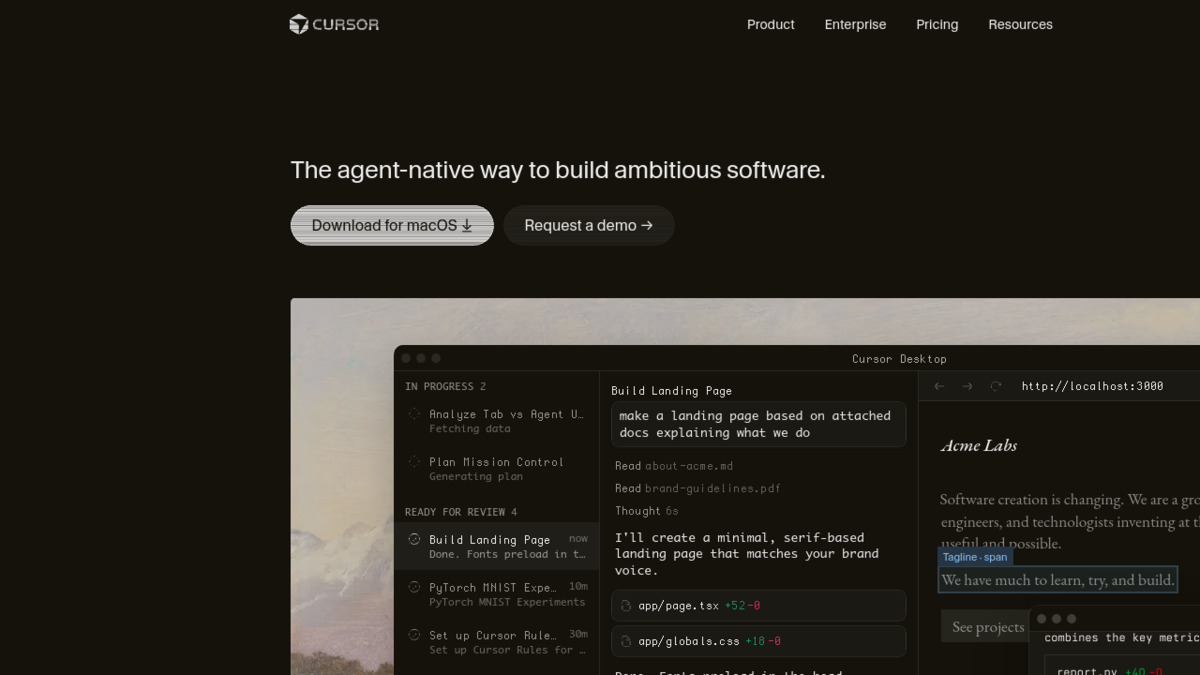 Cursor's interface after version 3.0, rebuilt around agents that can run in the background and across the cloud.
Source: cursor.com
Cursor's interface after version 3.0, rebuilt around agents that can run in the background and across the cloud.
Source: cursor.com
What SpaceX Gets
After the xAI-SpaceX merger finalized in May 2026, the combined entity had Grok for general chat and reasoning but nothing in the developer toolchain. GitHub Copilot still holds roughly 77% of the AI coding market. Cursor is the fastest-growing challenger.
This deal gives SpaceX a developer product with enterprise distribution already built in.
Compute the Hard Way
Cursor's founding team was explicit about their constraint: training their own coding models required compute they didn't own. They'd been buying GPU time on spot markets and renting capacity from cloud providers. Composer 2.5, the current version of their proprietary coding model, was already being trained on xAI's Colossus cluster in Memphis before the merger agreement was signed.
The Colossus infrastructure Cursor now gains access to:
| GPU Type | Count | Added |
|---|---|---|
| NVIDIA H100 | 150,000 | 2024 |
| NVIDIA H200 | 50,000 | Late 2025 |
| NVIDIA GB200 | 30,000 | Late 2025 |
| Total | ~230,000 | Dec 2025 |
Expansion currently underway targets 555,000 GPUs total at 2 gigawatts of power capacity, with about $18 billion in hardware already purchased. For a team that had previously been bottlenecked on compute budget, this isn't an incremental upgrade.
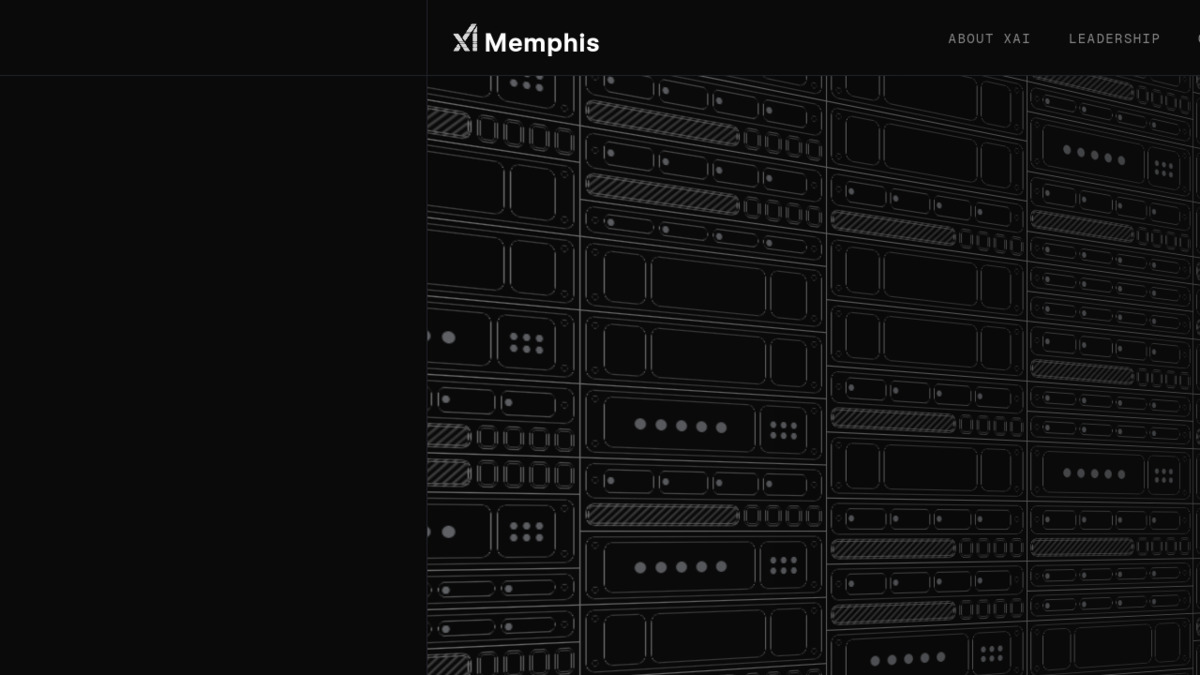 xAI's Colossus supercluster in Memphis, now the world's largest single-site AI training installation.
Source: x.ai
xAI's Colossus supercluster in Memphis, now the world's largest single-site AI training installation.
Source: x.ai
Enterprise Distribution
SpaceX has active enterprise contracts across defense, government, and commercial aerospace. Cursor's 50,000 enterprise customers represent a massive software channel that SpaceX doesn't currently serve. Selling AI coding tools into regulated industries is a natural extension - and one that competitors with more consumer-facing identities (OpenAI, Anthropic) find harder to execute.
What Changes for Developers
Cursor today supports 15+ model providers including Anthropic's Claude, OpenAI's GPT family, and Google Gemini. Developers pick their model per task; many use Claude for long-context edits and GPT-5 for fast autocomplete. That flexibility is one of the reasons Cursor has won over VSCode's existing user base.
None of that is guaranteed post-acquisition. xAI has a clear interest in routing Cursor traffic to Grok models.
| Feature | Current (Anysphere) | Post-Acquisition (SpaceX) |
|---|---|---|
| Multi-model support | 15+ providers including Claude, GPT, Gemini | Likely shifts toward Grok primary; others TBD |
| Composer training compute | Rented from cloud providers | Colossus (230K+ GPUs, expanding to 555K) |
| Enterprise channel | Direct Cursor sales | SpaceX enterprise + government routes |
| Open source pricing tier | Free up to limits | No announced changes |
| Third-party integrations | Linear, GitHub, Jira, Figma | No announced changes |
Neither SpaceX nor Anysphere has publicly addressed what happens to non-Grok model support after close.
Where It Falls Short
The deal has real problems, and the engineering community is already pointing them out.
Regulatory exposure is substantial. The FTC and DOJ have been examining AI acquisitions more carefully since 2025. A $60B deal by a company that completed a $1.25 trillion merger three months ago will get attention. EU review adds further timeline risk for the EMEA customers Cursor spent the past 18 months building.
Microsoft can respond without buying anything. GitHub Copilot sits inside every enterprise Microsoft agreement. Copilot agents in VS Code are getting better quickly, and Microsoft has $13.75B sunk into Anthropic and multi-billion commitments to OpenAI. Cursor's real moat was model-agnostic flexibility - if that erodes under xAI, the differentiation erodes with it.
Multi-model is the product. Developers didn't choose Cursor over Copilot because of one model. They chose it because they could swap Claude in for a long refactor, use Gemini Flash for fast autocomplete, and run a local Ollama model for sensitive code. Narrowing that to Grok-first changes the value proposition materially.
Engineer retention is an open question. Anysphere's approximately 300 engineers chose to work at a small San Francisco startup. Not all of them signed up to work at a Musk company. The founders have already demonstrated they can attract top talent; keeping it under new ownership is a different problem.
The original option deal covered in April gave SpaceX the choice between a $10B collaboration payment or a full $60B acquisition. SpaceX chose the acquisition, which says something about how seriously they view the developer toolchain as core infrastructure. Whether Cursor's existing users agree with that framing depends largely on what happens to the model menu once regulatory close finalizes.
See also: Claude Code vs Cursor vs Codex comparison
Sources:
- SpaceX acquires Cursor owner Anysphere for $60 billion - Let's Data Science
- SpaceX buys Cursor-maker Anysphere for $60B - TechFundingNews
- SpaceX Acquires Cursor for $60 billion - Techzine Global
- Cursor (company) - Wikipedia
- SpaceX Acquires Cursor AI for $60B After Microsoft Passes - HeyGoTrade
- The Colossus AI Supercomputer - Data Center Frontier
- Michael Truell Biography 2026 - Millionaire Script

