
Shopify Activates AI Storefronts for Millions of Merchants
Shopify activated Agentic Storefronts by default on March 24, making products from millions of merchants discoverable and purchasable inside ChatGPT, Microsoft Copilot, and Google's AI channels.
 6 min read
On March 24, Shopify flipped the switch for every eligible merchant on its platform. No setup required. No app to install. Millions of Shopify stores are now discoverable inside ChatGPT, Microsoft Copilot, and Google AI channels - by default.
The move marks a structural shift in how products reach buyers. If the last decade was about social commerce (selling through Instagram and TikTok), the next one appears to be about conversational commerce - and Shopify is betting it can own the infrastructure layer here the same way it owned it for DTC brands.
TL;DR
- Shopify activated Agentic Storefronts by default for all eligible US merchants on March 24, 2026
- Products from millions of merchants are now discoverable inside ChatGPT, Microsoft Copilot, and Google AI Mode with no merchant action required
- AI-driven traffic to Shopify stores is up 7x and AI-attributed orders are up 11x since January 2025
- Shopify and Google co-developed the Universal Commerce Protocol (UCP) - Walmart, Target, Visa, Mastercard, and Stripe have signed on
- A new "Agentic Plan" lets non-Shopify brands add their products to the Shopify Catalog to reach AI shopping channels
The Deal Structure
Shopify's agentic commerce play involves three distinct partnerships, each with different economics and integration depth.
| Platform | Status | Checkout Experience | Additional Fee |
|---|---|---|---|
| ChatGPT (OpenAI) | Live, default-on | Redirects to merchant storefront | None (Instant Checkout moving to Apps) |
| Microsoft Copilot | Live | Copilot Checkout (in-conversation) | Not disclosed |
| Google AI Mode | Live (select brands) | Redirects to merchant storefront | None |
| Gemini app | Rolling out | Redirect | None |
| Meta (Universal Commerce Protocol) | Coming soon | TBD | TBD |
The fee structure is less dramatic than early reporting suggested. When OpenAI launched its "Instant Checkout" feature in January 2026, the company charged merchants a 4% fee on completed in-chat sales - stacked on top of standard payment processing costs. That structure, combined with Shopify's ~2.9% processing fee and platform cut, meant a merchant could lose around 9 cents on every dollar from a ChatGPT sale.
The March 24 launch changes the model. OpenAI moved Instant Checkout to its "Apps" framework, and the new Agentic Storefronts default sends buyers from ChatGPT to the merchant's own online store. Shopify says there are no additional transaction fees beyond standard processing under this model. Google and Gemini never charged a platform fee.
Who Benefits
Merchants Who Were Already Winning Online
Shopify's own data shows what's at stake. AI-driven traffic to its merchants' stores is up 7x since January 2025. AI-attributed orders - purchases where an AI assistant referred the buyer - are up 11x over the same period. These numbers come from Harley Finkelstein, Shopify's president, and they describe what's happening before most merchants have done anything to optimize for AI discovery.
For brands already strong on search - those with clean product data, competitive pricing, and fast checkout - the Agentic Storefronts default is a free distribution expansion. Their products appear in ChatGPT conversations without any integration work. Fenty Beauty, Monos, and KEEN are among the named early adopters.
"We're making every Shopify store agent-ready by default." - Tobi Lütke, Shopify CEO
Non-Shopify Brands Seeking a Shortcut
Shopify's new "Agentic Plan" extends the same AI channel access to merchants who don't use Shopify as their primary ecommerce platform. These brands can add products to the Shopify Catalog - which now contains billions of products and powers discoverability across ChatGPT, Copilot, and Google's AI surfaces - without migrating their store. Pricing for the Agentic Plan wasn't disclosed at launch.
OpenAI
ChatGPT gets a product catalog covering millions of SKUs from established brands overnight. OpenAI's commerce lead Neel Ajjarapu framed the move as expanding ChatGPT's utility: "Shopping in ChatGPT begins with discovery - helping people explore options, compare products, and find what truly fits their needs." OpenAI also gains behavioral data on how buyers respond to product recommendations inside chat - data that no pure search engine has at this scale.
Who Pays
The Infrastructure Battle Behind the Announcement
The more consequential development isn't the merchant-facing product. It's the Universal Commerce Protocol. Shopify and Google co-developed UCP as an open standard for how AI agents discover, query, and transact with any merchant across the web. The protocol supports REST, MCP (Model Context Protocol), the Agent Payments Protocol (AP2), and Google's Agent2Agent (A2A) standard.
Walmart, Target, and Etsy joined as retail signatories. American Express, Mastercard, Visa, and Stripe joined on the payments side. The breadth of that coalition - assembled in under three months - suggests the major players believe a commerce protocol war is worth fighting now rather than ceding the standard to a single platform.
The competing approach comes from OpenAI. Its Agent Commerce Protocol (ACP) runs through OpenAI's own infrastructure, with Stripe handling payments. Unlike the decentralized UCP model, ACP puts OpenAI between the merchant and the buyer - which is exactly what the UCP coalition aims to avoid.
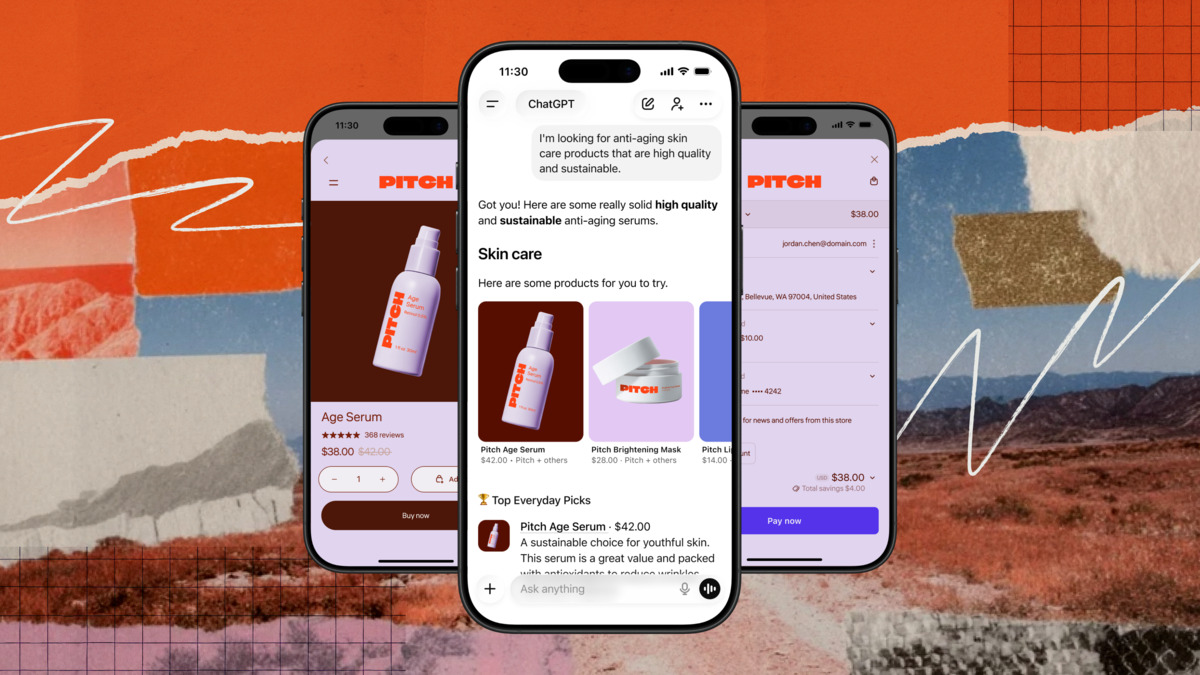 Shopify's March 24 announcement graphic showing how merchants connect to ChatGPT, Copilot, and Gemini through a unified infrastructure layer.
Source: shopify.com
Shopify's March 24 announcement graphic showing how merchants connect to ChatGPT, Copilot, and Gemini through a unified infrastructure layer.
Source: shopify.com
Merchants Who Didn't Notice the Default
Shopify emailed its merchant base ahead of the launch: "Buyers can find your products and complete purchases inside ChatGPT. This agentic storefront channel will launch by default for your store." Merchants who didn't read that email are now participating in AI commerce without knowing it.
That opt-out structure is standard for new Shopify channel launches, and merchants can toggle individual AI platforms off from their admin dashboard. But it puts the burden of disengagement on sellers rather than requiring active adoption. For most merchants, that's fine. For brands with distribution conflicts, exclusivity agreements, or region-restricted products, it's a compliance issue they'll need to resolve manually.
This connects to a broader pattern Shopify has established - as explored in the payment infrastructure race between Visa, Mastercard, Stripe, and Google - where the company positions itself as the neutral rails beneath whichever AI chat interface wins the consumer relationship.
The Bigger Bet
Shopify's pitch to analysts and investors is that AI commerce isn't a feature - it's a new distribution channel analogous to mobile or social commerce, and Shopify wants to be the platform layer beneath all of it. That's the strategic logic behind UCP. If every major AI assistant uses UCP to discover and transact with merchants, Shopify wins regardless of whether ChatGPT, Gemini, or Copilot becomes the dominant shopping interface.
 Agentic commerce moves product discovery into conversations - a structural shift from search-and-click to ask-and-buy.
Source: modernretail.co
Agentic commerce moves product discovery into conversations - a structural shift from search-and-click to ask-and-buy.
Source: modernretail.co
That's also why the Tobi Lütke AI agent experiment - where Shopify's own CEO used AI agents to optimize Liquid, the templating engine underlying every Shopify theme - matters more than it looked like a developer story. Shopify has been building internal fluency with agentic tools for months. The merchant product is an extension of that.
The 7x traffic and 11x order numbers are real. They predate the default activation, which means the actual volume could be substantially higher within the next quarter as AI shopping behavior becomes normalized. What isn't clear yet is how conversion rates in AI-referred traffic compare to direct search - a number Shopify hasn't released.
The editorial question is whether Shopify's infrastructure-layer strategy holds when Amazon, which has its own AI shopping assistant (Rufus) and doesn't need Shopify's catalog, decides this market is worth contesting. Amazon wasn't among the UCP signatories.
Sources:

