
Sarvam Raises $234M to Power India's Sovereign AI
Bengaluru-based Sarvam hit a $1.5 billion valuation after HCLTech put in $150 million, betting India can build its own AI stack and stop routing sensitive data through American clouds.
 Updated
6 min read
Updated
6 min read
India now has its first sovereign AI unicorn. Bengaluru-based Sarvam AI closed a $234 million first tranche of a $300 million Series B on June 15, 2026, reaching a $1.5 billion post-money valuation. HCLTech, India's third-largest IT services firm, led the round with a $150 million strategic commitment - the largest single bet any Indian IT giant has made on a homegrown foundation model company. Bessemer Venture Partners joined, with Khosla Ventures and Peak XV Partners continuing from earlier rounds.
TL;DR
- Sarvam raised $234M at $1.5B valuation, becoming India's first sovereign AI unicorn
- HCLTech put in $150M - a strategic move to sell India-controlled AI to banks, insurers, and governments nervous about US cloud dependency
- Sarvam 105B and 30B run across 10 Indian languages, already launched with 17 million farmers and 45 million insurance policyholders
- Next targets: agentic AI, coding models, and cybersecurity applications
The timing isn't subtle. The US Commerce Department's export order that disabled Anthropic's Fable 5 and Mythos 5 globally earlier this month gave India's sovereign AI argument its sharpest edge yet. Europe is now demanding its own AI independence for the same reason. Sarvam is the clearest example of what a country does when it decides not to wait.
What Sarvam Actually Built
The Model Stack
Sarvam's foundation isn't a single model - it's a full stack built from scratch in India.
At the top sits Sarvam 105B, a 105-billion-parameter mixture-of-experts model with a 128,000-token context window. The company claims it matches larger reasoning models on academic benchmarks, though "larger reasoning models" isn't a specific comparison and no independent evaluation has been published.
The Sarvam 30B runs below it: 30 billion parameters, 32,000-token context, optimized for edge deployment where cost matters more than peak capability. Both models were unveiled at the India AI Impact Summit in New Delhi in February 2026.
Beyond the LLMs, Sarvam has built Saaras V3 (speech-to-text supporting multiple Indian languages), Sarvam Vision (a document understanding model trained specifically for handwritten Indian text and OCR at government document scale), and Indus, a beta AI agent app on mobile app stores. The company has also teased Sarvam Kaze, an AI-powered wearable designed and built in India, planned for launch later this year.
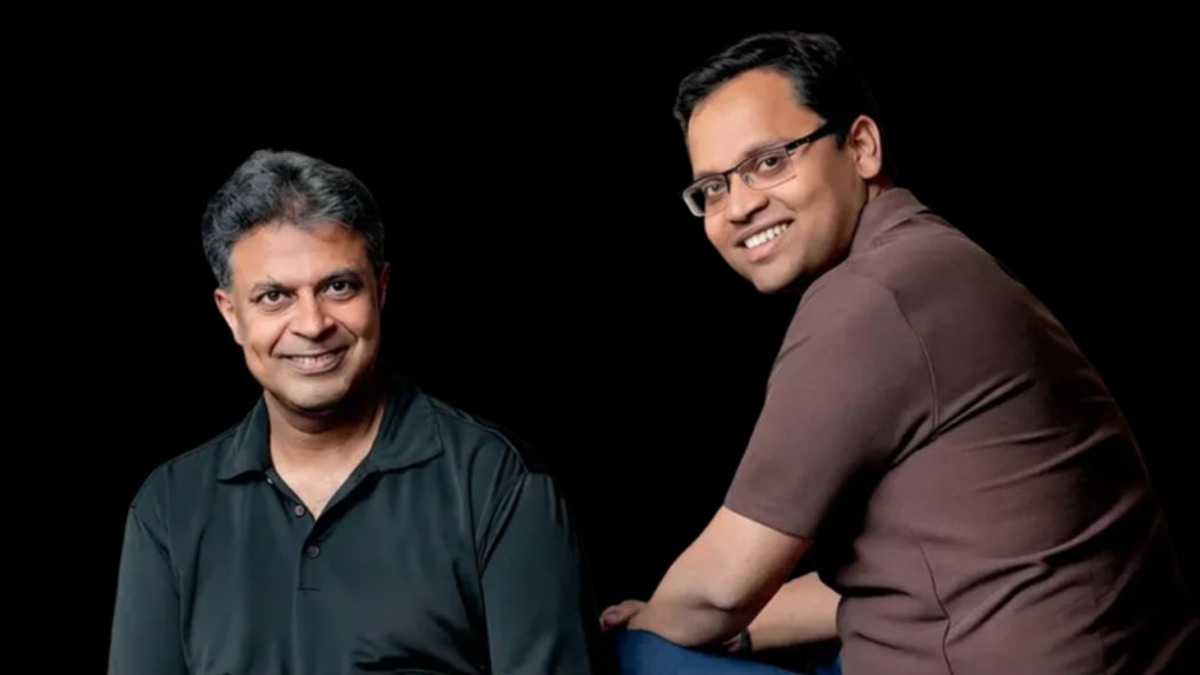 Sarvam AI co-founders Dr. Vivek Raghavan and Dr. Pratyush Kumar, both alumni of AI4Bharat at IIT Madras.
Source: storyboard18.com
Sarvam AI co-founders Dr. Vivek Raghavan and Dr. Pratyush Kumar, both alumni of AI4Bharat at IIT Madras.
Source: storyboard18.com
Language Coverage That Changes the Equation
India has 1.4 billion people. Fewer than 200 million speak English as a first language. Every AI company that built on English-first models has effectively left the rest of the country with second-class tools.
Sarvam supports 10 languages today: Hindi, Tamil, Telugu, Malayalam, Punjabi, Odia, Gujarati, Marathi, Kannada, and Bengali. The 22 scheduled languages under India's Constitution are the eventual target. Co-founder Pratyush Kumar's framing is direct:
"Research-led innovation to create AI that works at India's scale... models that understand our voices, read our documents, and serve intelligence at a cost every enterprise and government can afford."
Kumar and his co-founder Vivek Raghavan both came out of AI4Bharat at IIT Madras - India's open-source language AI research effort - which means the team's priorities were shaped by multilingual real-world deployment before any VC money entered the picture.
The HCLTech Bet
Why India's IT Giant Went In-House
HCLTech isn't an AI research firm. It sells software and services to banks, insurers, and governments. A $150 million bet on a 3-year-old startup makes sense only if you understand what HCLTech is actually buying.
The answer isn't the model weights. It's the sales pitch. For any HCLTech client that handles sensitive Indian citizen data - Aadhaar records, banking transactions, healthcare files - routing that data through OpenAI's or Anthropic's servers creates a compliance and sovereignty problem. A model developed, launched, and governed entirely in India eliminates that problem.
HCLTech CEO C Vijayakumar made the logic explicit: "Our investment marks a significant step toward building India's trusted and globally competitive AI ecosystem."
The plan is straightforward: Sarvam's model capability plus HCLTech's enterprise relationships and 220,000-person engineering workforce. The enterprise sale becomes a two-part pitch: the AI is good enough, and it never leaves Indian jurisdiction.
The Cap Table Signal
The investor mix signals something beyond domestic ambition. Bessemer Venture Partners, Khosla Ventures, and Peak XV aren't firms that back companies purely on national pride. They put capital into Sarvam because the total addressable market for AI that works in Indian languages, at Indian data sovereignty requirements, is genuinely large - and no US competitor is positioned to own it.
 Sarvam's 300-person team builds models, inference infrastructure, and enterprise products in India.
Source: unsplash.com
Sarvam's 300-person team builds models, inference infrastructure, and enterprise products in India.
Source: unsplash.com
Production Numbers That Validate the Thesis
The most useful data in any foundation model company's pitch is whether the model actually runs in production. Sarvam's deployment numbers are harder to dismiss than benchmark claims.
The company's voice agents gathered agricultural data from 17 million farmers for India's Ministry of Agriculture and Farmers Welfare in a pilot that ran across four states in late 2025. The Ministry is now expanding coverage. Sarvam also reached 45 million insurance policyholders for policy renewal workflows.
Day-to-day platform metrics: 2 million conversations per day, 10 million API calls daily, 500,000 hours of audio transcribed per month, and 35 million document pages digitized. These aren't projections. They reflect Sarvam's existing government and enterprise contracts.
Sarvam was selected in April 2025 by India's Ministry of Electronics and Information Technology to develop an indigenous foundation model under the IndiaAI Mission, which provided compute resources and gave the company access to national-scale datasets that no private competitor can easily copy.
What Sarvam Is Not
The benchmarks Sarvam cites are self-reported. No independent evaluation has been published comparing Sarvam 105B against GPT-4o, Gemini 1.5 Pro, or Claude 3.5 Sonnet on Indian-language tasks. The "matches larger reasoning models" claim is unverifiable from outside the company.
OpenAI and Anthropic are still India's most widely used AI providers. English-language tasks, coding, and complex reasoning remain areas where Sarvam hasn't published head-to-head comparisons. The company's edge is domain-specific: Indian languages, Indian documents, Indian regulatory constraints, Indian pricing requirements.
The $300 million round isn't closed yet either. The $234 million is a first tranche. Sarvam will need the remaining capital to close, and the planned uses - agentic AI models, coding assistants, cybersecurity - are all areas with established, well-funded competitors.
India's February AI Impact Summit produced $350 billion in pledged infrastructure investments from Microsoft, Google, Reliance, and Adani. The compute side was covered. Sarvam's unicorn round fills the model side. The country now has both pieces of the stack it needs to build AI without asking anyone's permission.
Sources:
- Sarvam Series B Announcement - sarvam.ai
- Sarvam becomes India's newest AI unicorn with $234 million funding round led by HCLTech - TechCrunch
- Sarvam AI becomes unicorn with $234 million funding; HCLTech leads with $150 million - BusinessToday
- Sarvam is India's newest AI unicorn after a $234m round - The Next Web
- Sarvam AI - Wikipedia
Last updated

