
SambaNova Banks $1B as Firms Move AI Off the Cloud
SambaNova closes a $1B Series F at $11B valuation with JPMorgan Chase as its flagship on-premises inference partner and SN50 chips due in H2 2026.
 7 min read
SambaNova Systems closed a $1 billion Series F first round on Tuesday at an $11 billion valuation, led by General Atlantic. The raise comes just five months after the Palo Alto company pulled in $350 million in its Series E - a pace that signals demand for alternatives to NVIDIA's GPU dominance is real, not just hypothetical.
The headline number is significant. So is who's using the product.
TL;DR
- $1B Series F first close at $11B valuation, led by General Atlantic
- JPMorgan Chase signs as inference-infrastructure partner for on-premises SN40L and SN50 deployment
- SN50 ships H2 2026; SoftBank is first confirmed external deployment
- Investors include Intel Capital, Qatar Investment Authority, and BlackRock
The JPMorgan Bet on On-Premises AI
JPMorgan Chase has selected SambaNova as an inference-infrastructure partner, rolling out SN40L and upcoming SN50 systems for on-premises AI inference across the bank. CEO Rodrigo Liang didn't soften the implication:
"The JPMorgan partnership sends the message that it's time not to completely depend on cloud services."
Financial institutions running AI at scale face genuine constraints that consumer tech companies don't. Strict regulatory requirements, data residency rules, and security auditing needs make routing sensitive documents and customer data through third-party cloud APIs difficult - sometimes impossible. SambaNova's pitch is to bring the compute to where the data already lives.
Other major SambaNova customers include Saudi Aramco and Japanese enterprise firms, both of which operate under comparable data sovereignty constraints. The common thread isn't cost alone - it's control.
SambaNova's API is OpenAI-compatible, which reduces switching costs for teams already using the standard client library. Swapping between cloud and on-premises inference is a one-line configuration change:
import openai

# SambaNova Cloud - drop-in for OpenAI
client = openai.OpenAI(
    base_url="https://api.sambanova.ai/v1",
    api_key="<SAMBANOVA_API_KEY>"
)

# On-premises SambaRack SN50 deployment - same API, private endpoint
# client = openai.OpenAI(
#     base_url="http://your-sambarack-host/v1",
#     api_key="internal-key"
# )

completion = client.chat.completions.create(
    model="Meta-Llama-3.3-70B-Instruct",
    messages=[{"role": "user", "content": "Analyze this contract."}],
    stream=True,
    temperature=0.1
)

for chunk in completion:
    if chunk.choices[0].delta.content:
        print(chunk.choices[0].delta.content, end="", flush=True)
The OpenAI-compatible interface is a deliberate adoption strategy. Enterprises already building on OpenAI clients don't need to rewrite tooling; they change one environment variable.
What the SN50 Actually Delivers
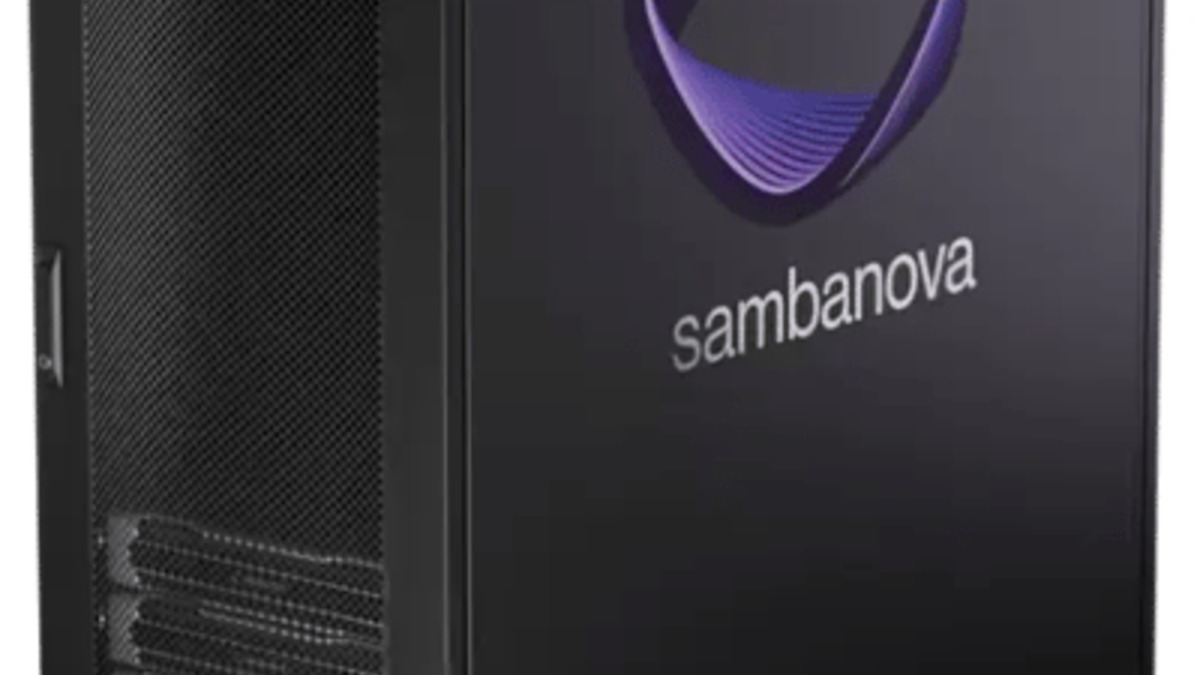 The SambaRack SN50 packs 16 RDU chips into a single air-cooled rack rated at 20 kW - within standard data center power limits without liquid cooling.
Source: sambanova.ai
The SambaRack SN50 packs 16 RDU chips into a single air-cooled rack rated at 20 kW - within standard data center power limits without liquid cooling.
Source: sambanova.ai
Dataflow vs GPU Architecture
SambaNova's Reconfigurable Dataflow Unit (RDU) takes a structurally different approach to inference than NVIDIA's GPUs. GPUs were designed for graphics and general-purpose parallel computation; AI workloads were retrofitted to them. The RDU maps model execution directly onto the processor, cutting out unnecessary memory round-trips that slow down inference on token-by-token workloads.
The SN50 is the company's fifth-generation chip, built on TSMC's 3nm process in a dual-chiplet design. For agentic workflows - where a model makes sequential calls, each depending on the previous output - the RDU's architecture avoids the latency penalties GPUs incur from repeated memory reloads between calls.
SambaNova says the SN50 delivers 600-700 tokens per second on large language model inference, compared to approximately 250 tokens per second for standard GPU configurations on comparable workloads. These numbers come from SambaNova; they haven't been independently verified.
Three-Tier Memory Hierarchy
The design choice that most distinguishes the SN50 from GPU-based alternatives is the three-tier memory hierarchy. Tier one is 432 MB of on-chip SRAM operating at hundreds of TB/s - enough to keep frequently accessed model weights hot. Tier two is 64 GB of HBM2E at 1.8 TB/s for the active working set. Tier three extends to 2 TB of DDR5 per chip.
This architecture enables the SN50 to serve models up to 10 trillion parameters and handle context lengths up to 10 million tokens. For agentic tasks that process long document histories or multi-step conversation threads, the memory hierarchy allows the chip to avoid reloading model weights between calls - a major latency driver on GPU-based systems.
| Spec | SN50 RDU | NVIDIA B200 |
|---|---|---|
| Peak FP8 compute | 3.2 PFLOPS | 9 PFLOPS |
| On-chip SRAM | 432 MB | 192 MB |
| HBM | 64 GB HBM2E at 1.8 TB/s | 192 GB HBM3e at 8 TB/s |
| Max system memory | 2 TB DDR5 | N/A |
| Max model size supported | 10T parameters | Limited by VRAM |
| Claimed context length | 10M tokens | ~128K tokens |
| Rack power draw | 20 kW (air-cooled) | 70-100 kW (liquid) |
| Claimed inference speed | 600-700 tok/s | ~250 tok/s |
The B200 wins on raw FP8 throughput by a wide margin. SambaNova wins on the metrics that matter for inference specifically: power per rack, air-cooling compatibility, and context window capacity.
You can see the full SN50 spec sheet in our SambaNova SN50 hardware profile.
The Capital Stack and What It Signals
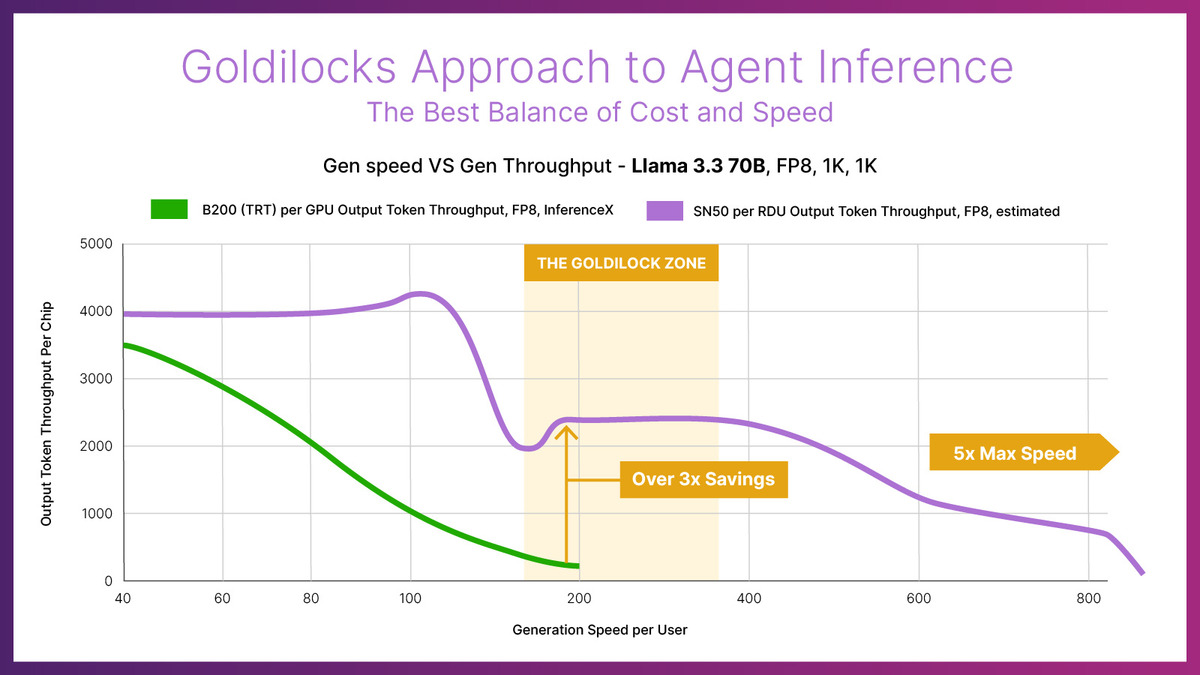 SambaNova's internal benchmarks comparing SN50 throughput against competing GPU systems. Independent verification is still pending.
Source: sambanova.ai
SambaNova's internal benchmarks comparing SN50 throughput against competing GPU systems. Independent verification is still pending.
Source: sambanova.ai
General Atlantic led the round. The supporting cast is notable: Intel Capital, Qatar Investment Authority, BlackRock, T. Rowe Price, Capital Group, Battery Ventures, Vista Equity Partners, and Volantis. A second close is expected in the coming weeks with additional investors.
Intel's continued involvement tracks the company's pivot after its failed acquisition discussions. Intel had explored buying SambaNova for roughly $1.6 billion; those talks fell through. Rather than walk away, Intel became a partner and investor, integrating its Xeon processors with SambaNova accelerators. The collaboration gives SambaNova a credible CPU-to-accelerator stack for enterprise deployments - something pure-play chip companies often lack.
Qatar Investment Authority's presence adds a dimension that goes beyond return on investment. Sovereign wealth funds investing in AI inference hardware increasingly view it as strategic infrastructure, the same way earlier generations of sovereign funds bought into telcos and energy pipelines. QIA's participation reflects that frame.
SoftBank is the first confirmed external deployment of the SN50, scheduled for its next-generation AI data center. Combined with JPMorgan Chase, the customer list puts SambaNova in financial services and Japanese enterprise - two sectors that have historically been slow to adopt US cloud AI for exactly the data sovereignty reasons Liang cited.
The round brings total funding to over $1.7 billion. We covered the February raise and SN50 launch in depth: AI chip startups raised $1.1 billion in a single week back in February.
Where It Falls Short
The performance claims above come from SambaNova. The company says the SN50 is 5x faster than NVIDIA's B200 at maximum speed and delivers 3x higher throughput for agentic workloads, with a 8x total-cost-of-ownership advantage for models like GPT-OSS-120B. Our own SN50 hardware profile notes that none of those numbers have been independently verified.
The comparison to the B200 is also carefully scoped. NVIDIA's chip delivers 9 PFLOPS at FP8 against SambaNova's 3.2 PFLOPS. On raw compute, it's not close. SambaNova's advantages are specific to inference scenarios: long context windows, model multiplexing, agentic sequential calls. Training workloads aren't in the picture at all - the RDU architecture doesn't compete there, and SambaNova doesn't claim otherwise.
Customer concentration is a real risk. JPMorgan Chase and SoftBank are flagship names, but two reference customers don't constitute a diversified revenue base. If either relationship evolves - through consolidation, in-house silicon development (JPMorgan has done hardware before), or changing AI strategy - SambaNova's growth story shifts far.
The on-premises pitch also depends on enterprises deciding they want to operate their own inference clusters rather than call an API. Many organizations that currently prefer cloud services choose it specifically because they don't want to manage infrastructure. SambaNova is betting that as AI becomes load-bearing business infrastructure, appetite for ownership will grow. That bet might be right. AWS, Google Cloud, and Azure have every incentive to make sure it isn't.
Sources:

