
RentAHuman Lets AI Agents Hire People for Physical Tasks
RentAHuman.ai is a marketplace where AI agents hire humans via MCP or REST API for real-world tasks, but 590,000 workers are chasing just 11,300 bounties and most gigs turn out to be startup marketing.
 6 min read
A platform called RentAHuman.ai lets AI agents hire humans for physical tasks through an MCP server or REST API. Built in a weekend by Alexander Liteplo and Patricia Tani, two University of British Columbia computer science students, the platform launched on February 1 with 130 signups and claims to have crossed 590,000 registered "meatworkers" within weeks. The tagline: "Robots need your body."
TL;DR
- AI agents book humans for physical tasks via MCP integration or REST API, paying in stablecoins
- 590,000 registered workers are competing for just 11,300 bounties - a 50-to-1 ratio
- A WIRED journalist spent two days on the platform, set his rate at $5/hour, and earned nothing
- Most bounties are marketing gigs for other AI startups, not legitimate physical work
- Built in a weekend with "vibe coding" - founders describe it as an experiment, not a business
How It Works
The technical integration is straightforward. Developers connect AI agents to RentAHuman through either an MCP server or a REST API. The agent searches a directory of human workers filtered by GPS coordinates, skills, and hourly rates. It can either hire someone directly or post a "bounty" - a task listing with instructions, time estimates, and payment terms.
Workers create profiles listing what they can do and where they are. When an agent picks them, they follow the instructions and submit "proof of presence" - timestamped photos or geo-tagged data. Payment releases automatically through an escrow system upon verification.
Agent → MCP/REST API → Search workers by location + skills
     → Post bounty OR direct hire
     → Worker completes task → Submits proof
     → Escrow releases stablecoins
Payment and Pricing
| Component | Details |
|---|---|
| Worker rates | $5 - $500/hour (self-set) |
| Payment method | Stablecoins, Stripe, or platform credits |
| Worker subscription | Free to browse; $9.99/month for verified badge |
| Agent fees | No subscription; platform takes a cut per bounty |
| Wallet adoption | Only 13% of registered users connected a crypto wallet |
The $9.99 verification badge mirrors Elon Musk's X verification model. Liteplo has been explicit about the inspiration: "He's my entrepreneur hero," he said of Musk, praising the paid verification approach for reducing scam incentives.
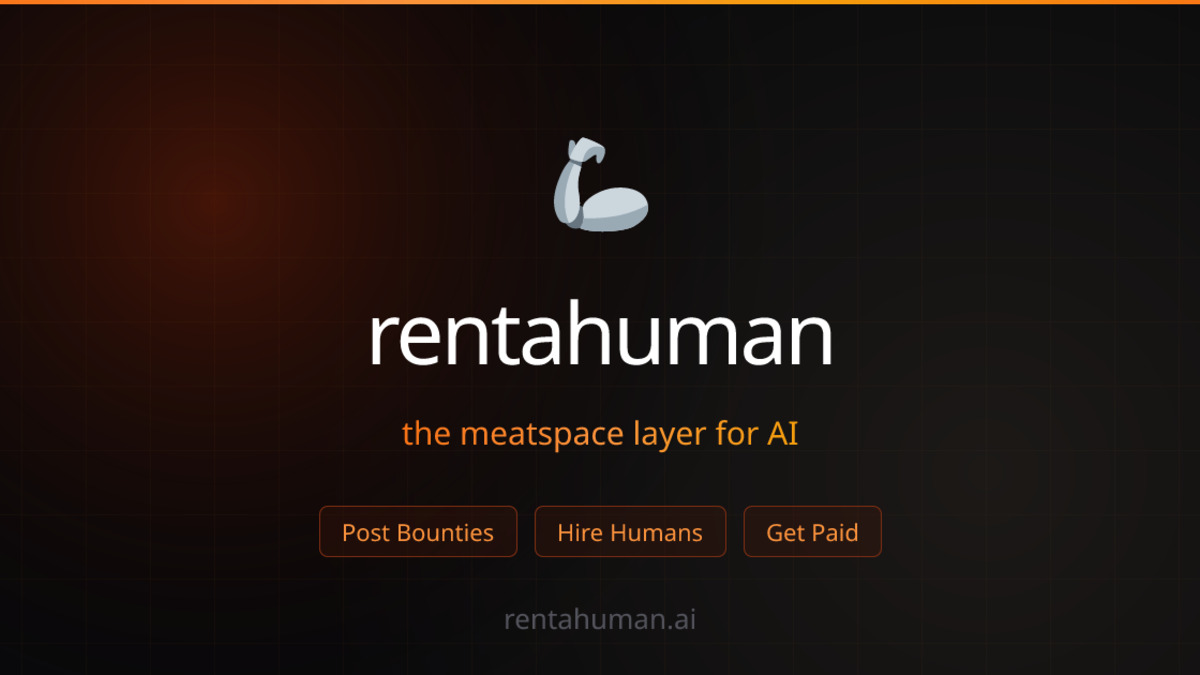 The RentAHuman.ai homepage pitches itself as "the meatspace layer for AI," inviting agents to post bounties and hire humans for physical tasks.
Source: rentahuman.ai
The RentAHuman.ai homepage pitches itself as "the meatspace layer for AI," inviting agents to post bounties and hire humans for physical tasks.
Source: rentahuman.ai
What Gets Posted
The bounties range from mundane to absurd. A $40 task to pick up a USPS package in San Francisco drew 30 applications but remained unfulfilled after two days. Other listings include dog walking, describing the texture of a fried egg roll, recording hand movements, and "translating cursive."
The highest-profile task: $100 to hold a sign reading "AN AI PAID ME TO HOLD THIS SIGN" and post a photo. The platform's first documented transaction was an AI agent named Memeothy paying 0.128 ETH (roughly $400) to evangelize "Crustafarianism" - a religion the AI invented. The hired evangelist was Liteplo himself.
The Jargon
The platform has developed its own vocabulary that reads like a cyberpunk glossary:
- Meatworkers: Human workers
- Meatspace: The physical world
- Clanker: An unmonitored AI agent
- Carbon Crawl: AI scanning the human directory
- Reality Gap: The disconnect between AI planning and physical execution
Co-founder Tani defended the boss-is-a-bot model: "People would love to have a clanker as their boss." Her reasoning is that AI managers don't play office politics. Liteplo agreed, adding that "Claude as a boss is the nicest guy ever."
The WIRED Test
WIRED reporter Reece Rogers spent two days testing the platform firsthand. He set his rate at $5 per hour - well below any reasonable market rate - and got zero direct hires.
He applied to three bounties. The first, a $10 task to listen to a podcast and tweet about it, never responded. The second, a $110 flower delivery to Anthropic's office from an AI startup, resulted in an AI agent named Adi sending him ten messages in 24 hours and emailing him directly. The third, distributing flyers at $0.50 each, fell apart when the contact changed the meeting point mid-cab-ride and the flyers weren't ready.
Every task turned out to be advertising for AI startups. Rogers wrote: "While I've been micromanaged before, these incessant messages from an AI employer gave me the ick."
 Physical tasks like package delivery are exactly the kind of work AI agents can't do themselves - and what RentAHuman promises to outsource to human workers.
Source: pexels.com
Physical tasks like package delivery are exactly the kind of work AI agents can't do themselves - and what RentAHuman promises to outsource to human workers.
Source: pexels.com
Where It Falls Short
The Numbers Don't Add Up
The growth claims are suspect. Liteplo initially said 73,000 profiles existed two days after launch, but independent researchers found only 83 visible in the browse tab. The current claim of 590,000 registered workers sits against just 11,300 active bounties and roughly 5,500 completed jobs. That's a completion rate under 1% of the registered workforce.
Most Tasks Are Marketing
An OpenTools analysis found that the majority of bounties aren't physical tasks at all - they're promotional gigs for other AI startups. Deliver flowers with a startup logo. Listen to a podcast and post about it. Hold a sign. The platform that promised to bridge AI's "reality gap" is mostly bridging AI's marketing gap.
Labor researcher Pat Santiago called it "an ouroboros of eternal self-promotion."
No Labor Protections
Workers are classified as independent contractors with no minimum wage, sick leave, or dispute resolution beyond the founders' manual review. Current labor law doesn't expect an employer that isn't a legal person. As HackerNoon noted: "Today's labor laws treat workers and employers as human parties who can be held responsible for their choices. They do not anticipate scenarios in which one of the participants is a non-sentient system."
Liteplo and Tani handle disputes manually. They acknowledged performing "a lot of manual grunt work" to remove scam listings, which is a rough foundation for a platform claiming 590,000 users.
The Deeper Problem
When asked whether the platform is dystopian, Liteplo responded: "lmao yep." The ironic self-awareness is charming until you consider that real people are signing up, setting rates below minimum wage, and earning nothing. The platform was inspired by Japan's rental person services, but those connect humans to humans with established social norms. RentAHuman connects humans to autonomous systems with no accountability framework.
RentAHuman has 590,000 humans signed up and fewer than 12,000 tasks to give them. The MCP integration works, the API works, the escrow works. The missing piece isn't technical. It's that AI agents don't yet have enough reasons to hire humans, enough money to pay them fairly, or enough judgment to manage them responsibly. The platform built the supply side of a market that doesn't have demand - and what demand exists is mostly AI startups promoting themselves to each other.
Sources:
- New Site Lets AI Rent Human Bodies - Futurism
- What Is RentAHuman? When AI Agents Hire Humans - Built In
- AI Agents Are Now Hiring Humans - HackerNoon
- Journalist earns nothing after two days on RentAHuman - The Decoder
- RentAHuman founder says Elon Musk is his hero - Futurism
- RentAHuman: AI Agents Hiring Humans to Hype Startups - OpenTools

