
South Korea Bets $400M on Rebellions to Rival Nvidia
South Korean AI chip startup Rebellions has closed a $400M pre-IPO round at a $2.34B valuation, with the government's Korea National Growth Fund leading Seoul's first direct bet under its K-Nvidia initiative.
 6 min read
Rebellions, the Seoul-based AI inference chip startup, closed a $400 million pre-IPO round on Monday at a $2.34 billion valuation. The round was led by Mirae Asset Financial Group and included 250 billion won ($166 million) from South Korea's Korea National Growth Fund - the first direct capital deployed under the government's "K-Nvidia" effort, a five-year national program to build a domestically owned competitor to Nvidia.
The round brings Rebellions' total capital raised to $850 million. More than $650 million of that came in the past six months alone, following a $250 million Series C in September 2025 that valued the company at $1.4 billion.
TL;DR
- $400M pre-IPO closed at $2.34B valuation, led by Mirae Asset and Korea National Growth Fund
- Government's $166M stake is the first investment under South Korea's K-Nvidia program
- Two new products launched: RebelRack inference compute unit and RebelPOD scalable cluster
- IPO targeting South Korean exchange in H2 2026 or early 2027
- $850M raised total; $650M in last six months
The Deal in Context
Rebellions wasn't a blank-slate startup when this round closed. The company merged with Sapeon Korea - the AI chip unit spun out of SK Telecom - in December 2024, creating what both companies called Korea's first AI chip unicorn. That deal brought Samsung, SK Hynix, SK Telecom, and KT onto the cap table alongside earlier backers Arm, Saudi Aramco, and Kindred Ventures. Mirae Asset now joins that list as lead investor, along with the Korean government as a direct shareholder for the first time.
| Funding Event | Date | Amount | Valuation |
|---|---|---|---|
| Series C | Sep 2025 | $250M | $1.4B |
| Pre-IPO Round | Mar 2026 | $400M | $2.34B |
| Total raised | - | $850M | - |
The K-Nvidia effort context matters here. South Korea announced earlier this month that it'd allocate 150 trillion won ($112.5 billion) over five years through its National Growth Fund, splitting the allocation roughly between AI and semiconductors. Rebellions is the first company to receive capital directly from that fund. Seoul isn't just hoping a champion emerges; it's actively picking one.
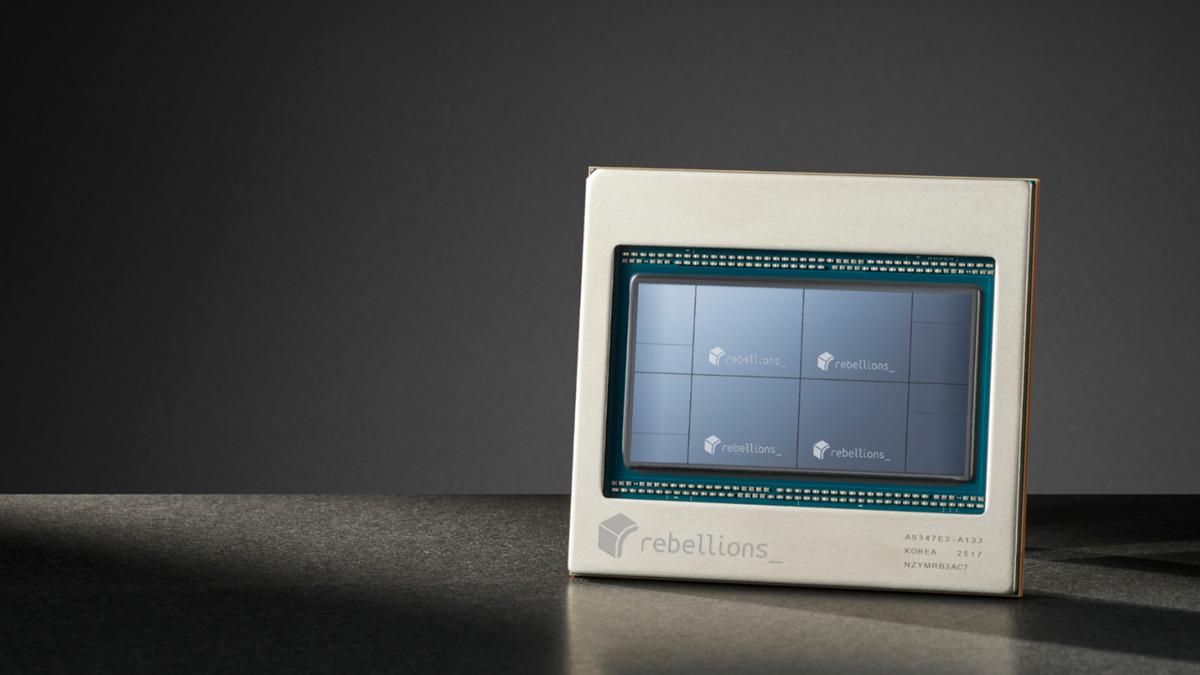
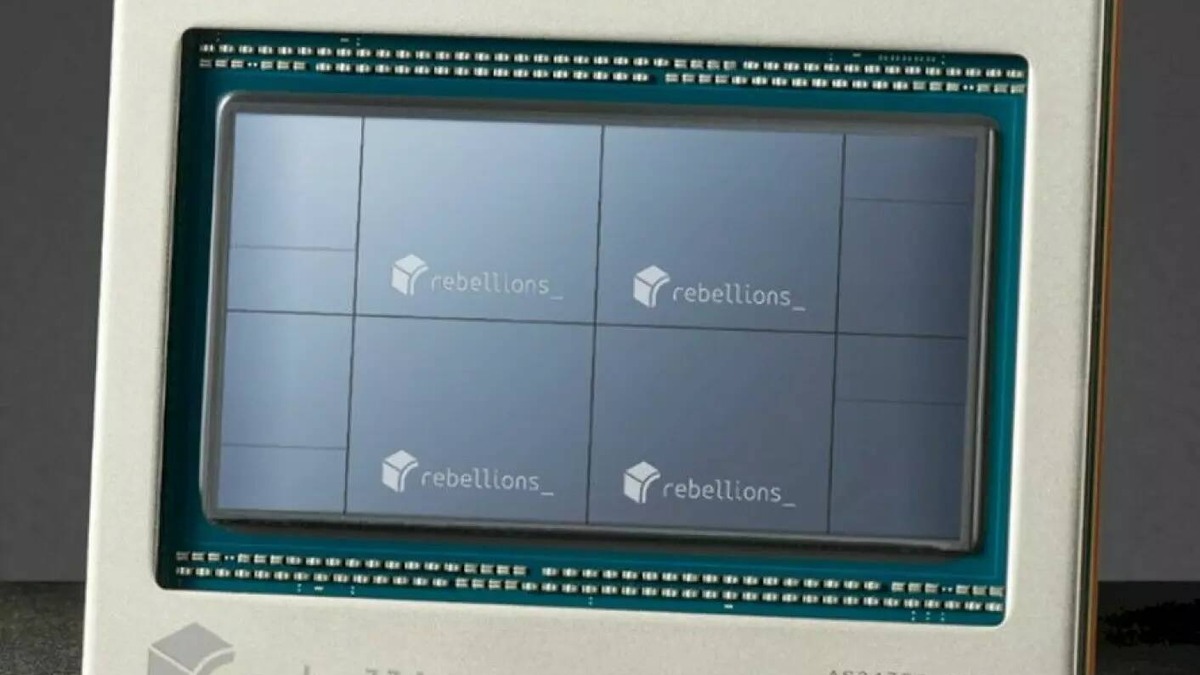 The Rebel100 uses a quad-chiplet architecture with four Samsung-manufactured compute dies connected via UCIe Advanced interconnects.
Source: theregister.com
The Rebel100 uses a quad-chiplet architecture with four Samsung-manufactured compute dies connected via UCIe Advanced interconnects.
Source: theregister.com
Who Benefits
South Korea's industrial strategy
For Seoul, this round is a data point in a much larger argument: that South Korea can produce not just chip memory (which Samsung and SK Hynix already dominate) but the logic chips that run AI workloads. Nvidia's dominance in AI accelerators has become a policy concern across multiple governments, and South Korea's proximity to Nvidia's supply chain - Samsung makes Rebellions' chiplets - gives it structural advantages that few countries can replicate.
Rebellions merged with Sapeon last year, reducing South Korea's domestic AI chip field from three players to two, with Furiosa AI the remaining rival. Seoul is now concentrating its bet on a single flagship rather than spreading funding across multiple local players. That focus either accelerates the company or leaves the country with a single point of failure.
Enterprise customers watching inference costs
Every major cloud provider and enterprise AI shop is looking for alternatives to Nvidia's pricing on inference hardware. Rebellions is targeting exactly this gap. The Rebel100 accelerator runs at 1 petaFLOP FP16 or 2 petaFLOP FP8, draws 600 watts per card, and fits into standard 19-inch air-cooled chassis. That last detail is deliberate: existing enterprise data centers can deploy it without infrastructure upgrades. CEO Sunghyun Park's framing captures the pitch:
"AI is now measured by its ability to operate in the real world - at scale, under power constraints, and with clear economic return."
The software stack matters too. Rebellions built on vLLM, PyTorch, Triton, Hugging Face, and OpenShift rather than creating proprietary tooling. The company's CBO Marshall Choy, recently hired to run U.S. expansion, put it plainly: "If you've used any of these technologies in any other context, you already know how to use Rebellions."
That's a direct shot at the friction cost of adopting non-Nvidia hardware, which has historically required significant re-engineering.
 The RebelRack packs 32 Rebel100 accelerators delivering 64 petaFLOPS FP8 compute across four air-cooled nodes.
Source: siliconangle.com
The RebelRack packs 32 Rebel100 accelerators delivering 64 petaFLOPS FP8 compute across four air-cooled nodes.
Source: siliconangle.com
Who Pays
What Mirae Asset is betting on
Mirae Asset Venture Investment is the lead on a pre-IPO round that assumes a successful Korean stock listing at or above today's valuation. Eung-Suk Kim, Vice Chairman and CEO of Mirae Asset Venture Investment, described it as a strategic bet: "We are proud to support Rebellions as a strategic partner in demonstrating its capabilities and value on the global stage." That's polished language for a bet that inference demand grows fast enough, and Nvidia alternatives mature fast enough, for Rebellions to hold its valuation through a listing.
The risk is real. Every Nvidia challenger in this cycle - Groq, Cerebras, Taalas, and others - is competing for the same enterprise pipeline. Rebellions has shipped hardware and has paying customers, which puts it ahead of several peers, but it hasn't publicly disclosed revenue numbers.
The IPO equation
Rebellions is targeting a domestic South Korean exchange listing in the second half of 2026, with early 2027 as the outer bound. The timeline is tight. The company needs to demonstrate enough US customer traction - Choy was hired specifically to build that pipeline - to justify a valuation that has tripled in six months. A listing before US revenue scales is possible but carries real dilution risk if public markets reprice the sector before the IPO closes.
The pre-IPO round structure also signals that institutional investors wanted in before public market pricing, which is a reasonable read of the inference chip market right now. AI chip startups raised over $1 billion in a single week earlier this year, and the appetite for Nvidia alternatives hasn't softened. Physical AI investment is also accelerating, with $11 billion committed in Q1 alone, driving inference demand across robotics and edge deployments. Rebellions' timing is not accidental.
What the Hardware Actually Is
The Rebel100 is a chiplet design - four compute dies made by Samsung, packaged with 144 GB of HBM3e memory, connected via UCIe Advanced interconnects. The chiplet architecture was a deliberate choice to reduce yield risk on large monolithic dies and leverage Samsung's existing advanced packaging. At ISSCC 2026, Rebellions presented data claiming performance comparable to Nvidia's H200 at a lower power envelope, though independent verification of that claim has not been published.
The RebelRack bundles 32 of those accelerators into a single production-ready unit: 64 petaFLOPS FP8 compute, 4.6 TB of HBM3e, and 153.6 TB/s aggregate memory bandwidth across four nodes with quad-400 Gbps networking. The RebelPOD scales that to 8-128 nodes over 800 Gbps Ethernet, sized for hyperscale deployments.
This positions Rebellions differently from Taalas, which is hardcoding specific models into fixed-function silicon. Rebellions is building general-purpose inference infrastructure that runs existing open-source stacks. The trade-off is flexibility versus peak efficiency for a specific workload.
$400 million buys Rebellions a credible shot at a 2026 IPO and the US market entry its valuation demands - but the inference chip market will have no patience for a company that misses its customer milestones.
Sources:
- AI chip startup Rebellions raises $400 million at $2.3B valuation - TechCrunch
- Samsung-backed AI chip firm Rebellions raises $400 million ahead of IPO - CNBC
- Rebellions Closes $400M Pre-IPO and Launches RebelRack and RebelPOD - Rebellions press release
- Rebellions eyes global expansion with rack-scale AI platform - The Register
- South Korea launches K-NVIDIA push with $38B investment - UPI
- Rebellions lands $400M in funding to lead South Korean revolt against Nvidia chips - SiliconAngle

