
QuiverAI's Arrow 1 Hits #1 on SVG Arena With 1583 Elo - First Model to Break 1500 on Any Design Arena Leaderboard
Arrow 1, a purpose-built SVG generation model from a16z-backed QuiverAI, reached the top of SVG Arena with an Elo of 1583 one day after launch - shattering Gemini 3.1 Pro's previous record of 1421 by 162 points.
 Updated
7 min read
Updated
7 min read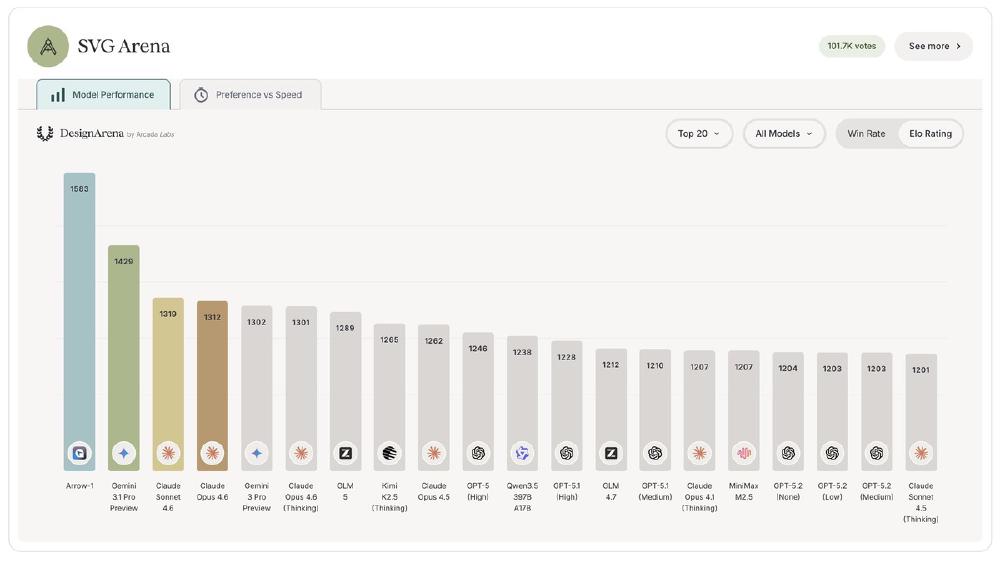
Arrow 1 by QuiverAI just claimed the #1 spot on SVG Arena with an Elo of 1583 - the first model to ever break 1500 on any Design Arena leaderboard. The previous leader, Gemini 3.1 Pro Preview, held the top rank at 1421. Arrow 1 shattered that by 162 points, one day after launch.
This isn't a general-purpose LLM that happens to produce SVGs on the side. Arrow 1 is a purpose-built, vector-native model specifically trained for SVG generation and editing. While Claude, GPT, and Gemini produce SVGs as a byproduct of their code generation abilities, Arrow treats vector graphics as its primary output format.
| Model | SVG Arena Elo | Type | Gap to #1 |
|---|---|---|---|
| Arrow 1 (QuiverAI) | 1583 | Purpose-built SVG model | - |
| Gemini 3.1 Pro Preview | 1421 | General-purpose LLM | -162 |
| Claude Opus 4.1 | ~1350 (est.) | General-purpose LLM | ~-233 |
| GPT-5 | ~1340 (est.) | General-purpose LLM | ~-243 |
The 162-point gap is extraordinary. When Gemini 3.1 Pro took #1 last week, Design Arena noted its 87-point lead was "the largest winning margin we've seen since arena launch." Arrow 1 nearly doubled that margin.
TL;DR
- Arrow 1 by QuiverAI hit #1 on SVG Arena with Elo 1583 - the first model to break 1500 on any Design Arena leaderboard
- It beat the previous leader (Gemini 3.1 Pro Preview, Elo 1421) by 162 points, nearly doubling the previous record margin
- Arrow 1 is a purpose-built SVG generation model, not a general-purpose LLM - backed by an $8.3M a16z-led seed round announced one day before
- Produces clean, layered SVGs from text or images with real-time streaming, at prices starting from free (20 SVGs/week)
What Arrow 1 Does
Architecture
Arrow 1 is the production model from QuiverAI, a San Francisco startup founded by Joan Rodriguez, whose PhD research at Mila (Quebec AI Institute) focused specifically on multimodal SVG generation. His prior work includes StarVector - a foundation model for SVG generation published at AAAI - and RLRF (Reinforcement Learning from Rendering Feedback), accepted at NeurIPS 2025, which trains models by rendering generated SVGs and comparing them visually to the originals.
The core insight: SVGs are code. They encode hierarchy, grouping, spatial relationships, gradients, and geometric structure. General-purpose LLMs treat SVG generation as a code completion task. Arrow treats it as a specialized visual generation task where the output happens to be code. The difference shows up in output quality - cleaner control points, fewer artifacts, properly structured layers, and precise geometry that general-purpose models struggle with.
Arrow 1 is closed-weight. It uses "a different technique to create these than all previous LLMs," according to early testers who saw the anonymous Arrow Preview model on Design Arena before the public launch.
Capabilities
- Text-to-SVG: Generate vector graphics from natural language
- Image-to-SVG: Convert raster images (PNG, JPEG, WebP) into editable SVG
- Conversational editing: Refine outputs through natural language iteration
- Real-time streaming: Watch the model sketch via Server-Sent Events (SSE) with reasoning, draft, and content stages
- Multi-reference input: Up to 4 reference images per request
- Icons, logos, illustrations, diagrams, typography, floorplans, fashion and industrial designs
The outputs are production-ready: well-structured layers, clean paths, minimal manual cleanup. This matters because the gap between "AI-generated image" and "asset a designer can actually use" is usually measured in hours of manual editing. Arrow aims to close that gap at the vector level.
Side-by-Side Comparisons
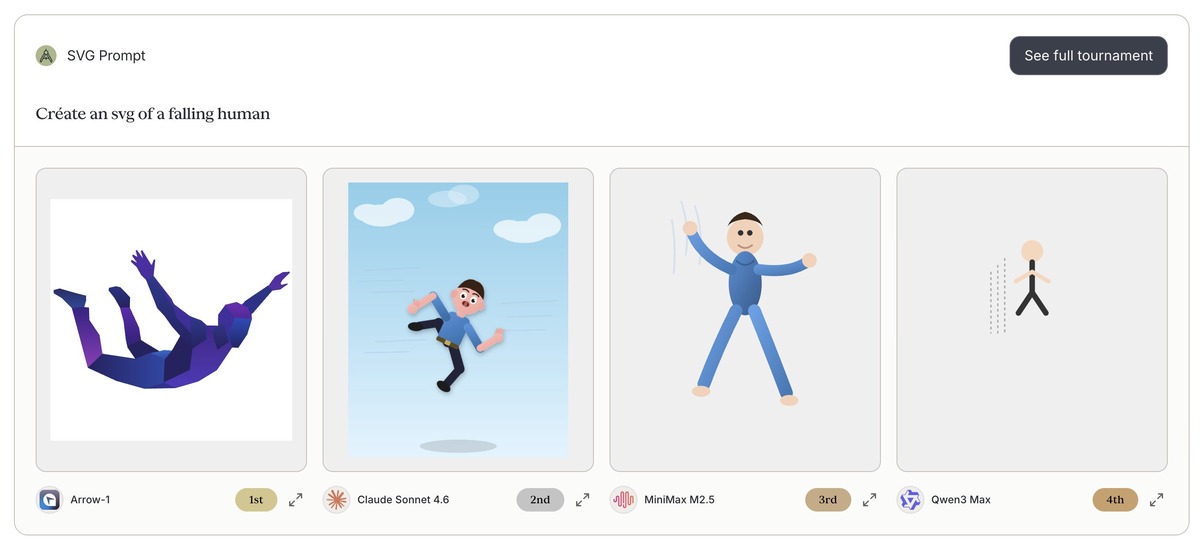
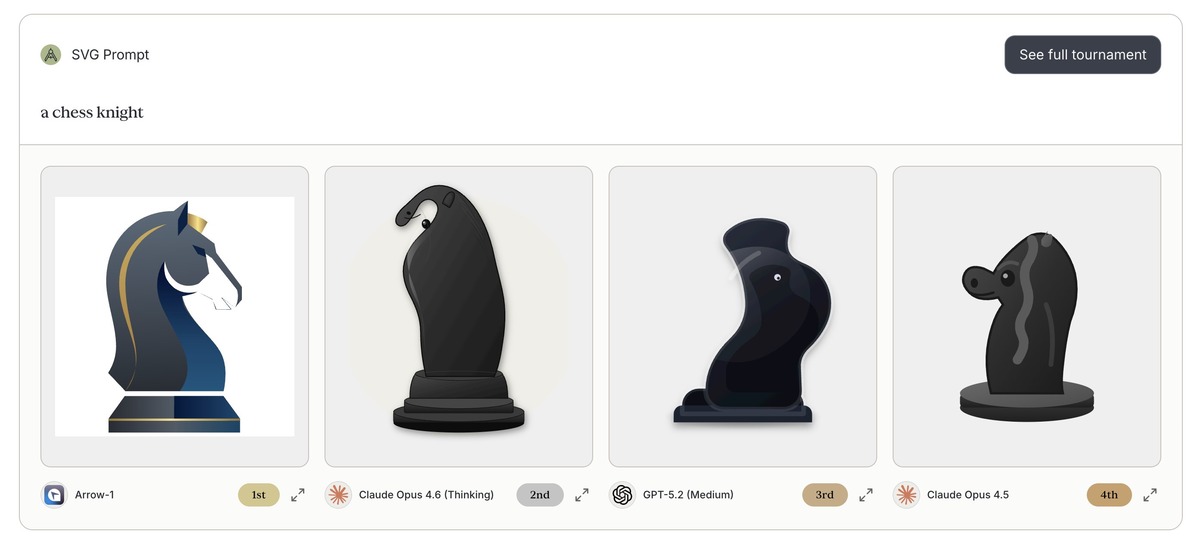
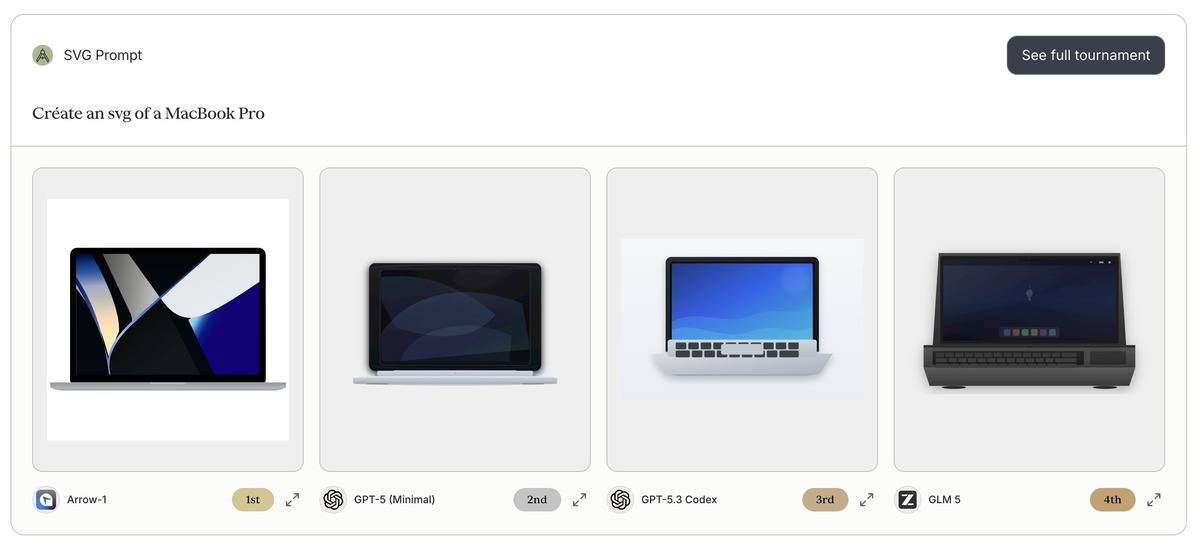
These comparison images from Design Arena show Arrow 1's outputs against other models on identical prompts:
The Benchmark
How SVG Arena Works
SVG Arena is part of Design Arena, a crowdsourced benchmark for AI-produced design backed by Y Combinator (Summer 2025). The methodology is straightforward: users see outputs from two anonymous models given the same prompt, vote on which they prefer, and votes feed into a Bradley-Terry rating system expressed as Elo scores. Models with fewer than 15 votes are excluded. Leaderboards refresh every two hours.
Design Arena has grown to 1.2 million monthly visitors and 150,000+ users across 145 countries. It covers multiple categories including SVG, websites, game development, 3D design, data visualization, and UI components. SVG Arena is consistently one of the most active.
Why 1583 Matters
The Elo system is calibrated so that meaningful gaps are smaller than they look. In chess, a 200-point difference translates to a roughly 76% expected win rate. Arrow 1's 162-point lead over Gemini 3.1 Pro suggests it'd win head-to-head matchups about 70-75% of the time according to the Bradley-Terry model.
But the significance is less about the exact number and more about the gap pattern. Before Arrow 1, the SVG Arena was a contest between general-purpose LLMs. Gemini, Claude, and GPT competed within a fairly narrow Elo band, each creating SVGs as one of many capabilities. Arrow 1 broke the ceiling because it only does one thing - and does it at a level the generalists can't match.
Pricing and Access
Arrow 1 is available at quiver.ai via both a web interface and API.
| Plan | Price | SVGs/Week | API Access |
|---|---|---|---|
| Free | $0 | 20 | Yes |
| Basic | $20/month | 100 | Yes |
| Pro | $40/month | 250 | Yes |
| Enterprise | Custom | Custom | Yes + on-premise |
The API (api.quiver.ai/v1/svgs/generations) supports text-to-SVG and image-to-SVG, with streaming, temperature control, and up to 131K max output tokens. Rate limit is 20 requests per 60 seconds. The Node.js SDK is available at @quiverai/sdk.
QuiverAI announced an $8.3 million seed round led by Andreessen Horowitz on February 25 - one day before Arrow 1 hit #1. Angel investors include the CEOs of Webflow (Linda Tong) and Replit (Amjad Masad), plus designers from Figma and GitHub.
"AI has made remarkable progress producing pixels. But structure is a different problem: SVGs encode hierarchy, grouping, and spatial relationships."
- a16z investment thesis
What It Does Not Tell You
Elo is a relative ranking, not an absolute quality metric. Arrow 1's 1583 means it wins most head-to-head matchups on Design Arena. It does not tell you whether the outputs are production-ready for your specific use case - icon design, technical diagrams, and brand illustrations have different quality bars.
The leaderboard is one day old. Arrow 1 launched on February 25. The #1 ranking was announced February 26. The Elo score will stabilize as more votes build up. Early scores tend to be volatile, especially when a model generates excitement and attracts favorable attention. Design Arena excludes models with fewer than 15 votes and flags those under 50 as "new."
SVGs aren't images. Arrow 1 competes in a different category than image generation models like Midjourney, DALL-E, or Nano Banana 2. Vector graphics are resolution-independent, editable, and lightweight - but they're not photorealistic. If you need a photograph, Arrow 1 is the wrong tool. If you need a logo, icon, or illustration that scales from a favicon to a billboard, it may be exactly the right one.
Closed-weight means no self-hosting. Arrow 1 is proprietary. You can't run it locally, fine-tune it, or audit the weights. For organizations with strict data governance requirements, this matters. The free tier's 20 SVGs per week is enough to assess, not enough to build a production pipeline.
General-purpose LLMs aren't standing still. Gemini 3.1 Pro was #1 just last week. Claude and GPT continue to improve their code generation capabilities, which directly affects SVG quality. A purpose-built model has an architectural advantage today - whether that advantage persists as generalist models scale is an open question.
A startup with 3 people and $8.3 million just built a model that beat every major AI lab on a public leaderboard in their specific domain. Arrow 1's 1583 Elo is the highest score ever recorded on any Design Arena leaderboard - and it achieved it one day after launch. The vibe coding era taught us that AI can write code. Arrow 1 suggests that specialized models writing specialized code - in this case, vector graphics - can beat generalists by margins that are difficult to close. Over 65% of websites use SVG. Every logo, icon, and illustration in a modern design system is a vector. QuiverAI just proved there's a frontier worth claiming in the space between pixels and code.
Sources:
Last updated

