
Qualcomm Bets $14B to Shatter Nvidia's AI Lock-In
Qualcomm confirmed a $3.9B acquisition of AI software startup Modular and is in advanced talks to buy RISC-V chip designer Tenstorrent for up to $10B, betting that open hardware and a portable compiler can dislodge Nvidia from the data center.
 7 min read
Qualcomm used its Investor Day on June 24 to confirm what the rumor circuit had been building toward for weeks: a $3.9 billion acquisition of AI software startup Modular, announced alongside reports that the company is in advanced talks to buy RISC-V chip designer Tenstorrent for between $8 billion and $10 billion.
If both deals close, Qualcomm will have committed roughly $14 billion to a single thesis - that Nvidia's hold on the data center comes not from raw hardware performance, but from CUDA, and that a company willing to build a credible software alternative alongside its own silicon can break the lock.
TL;DR
- Qualcomm confirmed a $3.9B all-stock acquisition of Modular on June 24, adding the Mojo language and MAX inference engine to its stack
- Modular's co-founders Chris Lattner (creator of LLVM and Swift) and Tim Davis join Qualcomm with roughly 150 employees
- Talks with Jim Keller's Tenstorrent value the RISC-V chip startup at $8-10B, about three times what it sought a year ago
- Combined, the two deals would commit approximately $14B to attacking Nvidia's CUDA moat from the software and hardware sides simultaneously
The Two-Deal Structure
Both acquisitions serve the same goal but attack it from opposite ends. Modular contributes the software layer: a runtime and compiler stack that lets developers write AI inference code once and deploy it across CPUs, GPUs, NPUs, and custom accelerators without rewriting per platform. Tenstorrent, if that deal closes, contributes the hardware - RISC-V AI accelerators that don't carry Arm licensing fees and are designed for inference workloads where power efficiency matters more than peak throughput.
| Deal | Status | Price | What Qualcomm Gets |
|---|---|---|---|
| Modular | Confirmed, closes H2 2026 | $3.9B all-stock | Mojo language, MAX engine, ~150 engineers |
| Tenstorrent | In advanced talks | $8-10B | Jim Keller, RISC-V AI chips, Grayskull and Wormhole |
| Combined exposure | ~$14B | Full hardware and software AI stack |
The $3.9 billion for Modular comes entirely in Qualcomm stock - 19.2 million shares at the volume-weighted average closing price ahead of close. The deal is expected to shut in the second half of 2026, subject to regulatory clearance. Tenstorrent terms haven't been confirmed; performance-linked milestones are likely in any final structure. Intel has also expressed acquisition interest in Tenstorrent, which helps explain why the valuation jumped so sharply.
The Software Bet: Modular
Chris Lattner built the infrastructure most of the software industry runs on without knowing his name. LLVM is the compiler toolchain underlying Clang, Rust, Swift, Julia, and scores of other languages. Swift itself is Apple's primary language for iOS development - Lattner created it. He later led compiler work at Google and did a stint at Tesla before co-founding Modular with Tim Davis.
Modular's two main products are the Mojo programming language and the MAX inference engine. Mojo is Python-compatible and compiles to hardware-specific machine code through Modular's own backend. MAX runs production AI inference across CPUs, GPUs, NPUs, and ASICs without separate ports per chip type. The platform currently supports Nvidia, AMD, Intel, and Arm hardware, meaning early adopters don't have to pick sides before committing.
Qualcomm CEO Cristiano Amon framed the acquisition plainly: "We believe the future belongs to developer-friendly, horizontal platforms that can run across diverse compute environments and give customers real choice."
That framing points directly at CUDA. Nvidia's grip on enterprise AI comes partly from real switching costs: running AI workloads on Nvidia hardware requires code written specifically for CUDA, and migrating to a competitor's chips means rewriting substantial portions of that code. Modular's write-once claim, if it holds at production scale, lowers that barrier much.
What Modular doesn't bring: hyperscaler contracts or established data center infrastructure. It gives Qualcomm a credible software story. Customer adoption is a separate problem.
The Hardware Bet: Tenstorrent
Jim Keller's chip design record is short and consistent. He architected AMD's K8 processor, which gave AMD a competitive product line again after years of falling behind Intel. He led chip design at P.A. Semi, the startup Apple acquired to build its first custom mobile silicon. He ran AMD's Zen architecture, which turned a near-bankruptcy into a truly competitive platform. He then led Tesla's Autopilot hardware development before a two-year stint at Intel. Every major program he's touched has delivered.
 Jim Keller, CEO of Tenstorrent. His resume includes AMD's Zen cores, Apple's custom mobile silicon, and Tesla's Autopilot chip.
Source: commons.wikimedia.org
Jim Keller, CEO of Tenstorrent. His resume includes AMD's Zen cores, Apple's custom mobile silicon, and Tesla's Autopilot chip.
Source: commons.wikimedia.org
Tenstorrent builds AI accelerators on RISC-V, the open instruction set that lets manufacturers design chips without licensing fees to Arm or Intel. Its Grayskull and Wormhole architectures focus on data locality and memory-bandwidth efficiency over raw compute density - a deliberate position that the inference market cares more about energy per token than tokens per second, which is where Nvidia is most entrenched.
One year ago, Tenstorrent was seeking $800 million in a funding round at a $3.2 billion valuation. The current acquisition talks value it at $8-10 billion - roughly a 3x jump with no major production deployment in the meantime. The move is driven by Keller's reputation and by the scarcity of credible non-Nvidia options for companies that want one. With Intel also circling, Qualcomm's urgency is doing part of the pricing work.
The deal isn't done. Neither company has confirmed the talks. Performance milestones in the reported structure mean the full $10 billion depends on Tenstorrent shipping hardware that works at scale.
Who Benefits
Qualcomm's existing customers get the most immediate practical benefit. Companies running Qualcomm silicon in AI PCs, automotive systems, and edge devices gain a plausible path to production AI workloads on Qualcomm hardware, without committing to Nvidia's ecosystem. The Modular stack makes the migration more tractable; Tenstorrent's chips offer a data center option free of Arm licensing overhead.
Tenstorrent's shareholders win cleanly if the deal closes near the high end of the range. A startup that tripled its valuation in 12 months without volume product shipments will take the exit. Keller's leverage comes from Intel's competing interest, and Qualcomm's urgency comes from the math: building a RISC-V AI hardware capability from scratch would take longer than buying the team already doing it.
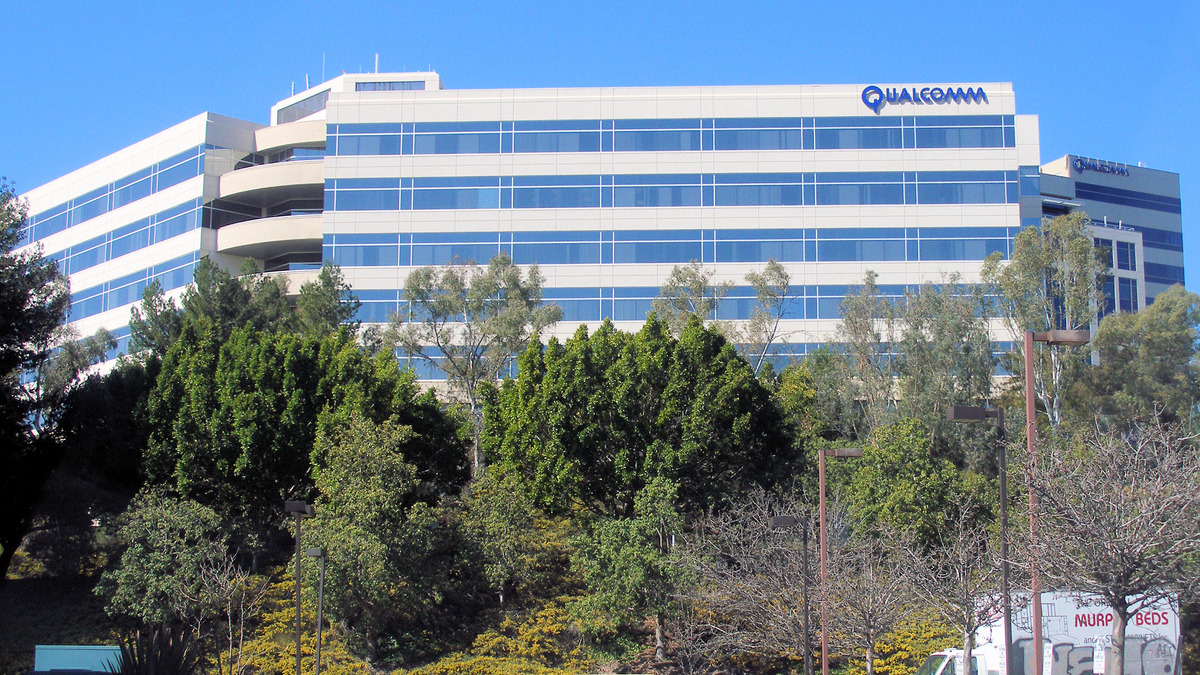 Qualcomm's San Diego campus. The company's Investor Day on June 24 announced its largest AI infrastructure bets to date.
Source: commons.wikimedia.org
Qualcomm's San Diego campus. The company's Investor Day on June 24 announced its largest AI infrastructure bets to date.
Source: commons.wikimedia.org
The broader RISC-V ecosystem also benefits from the credibility a $10 billion acquisition price brings to the architecture. RISC-V has been the preferred instruction set for companies trying to escape Arm licensing costs for several years, but it's lacked a commercial anchor in AI inference with realistic enterprise adoption prospects. A Qualcomm-backed Tenstorrent changes that picture.
Who Pays
Qualcomm shareholders absorb roughly $14 billion in combined exposure to enter a market Nvidia has spent 15 years building through compounding advantages: CUDA tooling, developer community gravity, NIM container support, and hardware roadmaps that keep shipping faster than competitors close the performance gap. The Modular deal immediately dilutes existing holders by 19.2 million shares; a Tenstorrent deal at $10 billion adds clearly more.
Enterprise AI teams considering Qualcomm alternatives face the same question they've asked about every wave of CUDA challengers: software portability claims look strong on paper and underdeliver at operator coverage depth and kernel performance in production. Qualcomm now owns a team with the technical credibility to close that gap. Whether it actually does is the central bet in both acquisitions.
Nvidia doesn't stand still either. Its inference tooling, NIM microservices, and the gravitational pull of its developer ecosystem are compounding assets. Qualcomm's thesis requires the inference market to evolve toward portability and energy efficiency faster than Nvidia can extend its own stack to cover those requirements - a defensible hypothesis, but not a certain one.
Qualcomm paid $3.9 billion on June 24 for Chris Lattner's compiler and Tim Davis's execution. The Tenstorrent talks will determine whether Jim Keller's track record is worth a further $10 billion bet that RISC-V takes meaningful inference share from Nvidia before the next GPU generation resets the competitive picture again.
Sources:
- Qualcomm Acquires Modular AI Software Startup, How2Shout
- Qualcomm Acquires Modular to Strengthen AI Software, Let's Data Science
- Qualcomm Acquires Modular - Head-On Attack on Nvidia's CUDA Moat, Basic Tutorials
- Qualcomm in Talks to Acquire Tenstorrent - Valuation Triples in One Year, AI Unfiltered
- Qualcomm Bets $14 Billion on Cracking Nvidia's AI Monopoly, TechTimes
- Qualcomm in Talks to Acquire Tenstorrent, Tom's Hardware
- Qualcomm-Tenstorrent $10 Billion RISC-V Deal, Let's Data Science

