
Pope Leo XIV Tells Priests to Stop Using AI to Write Sermons - Use Your Brain Instead
Pope Leo XIV urged Roman clergy to resist the temptation of AI-generated homilies, arguing that sharing faith is something artificial intelligence will never be able to do.
 Updated
7 min read
Updated
7 min read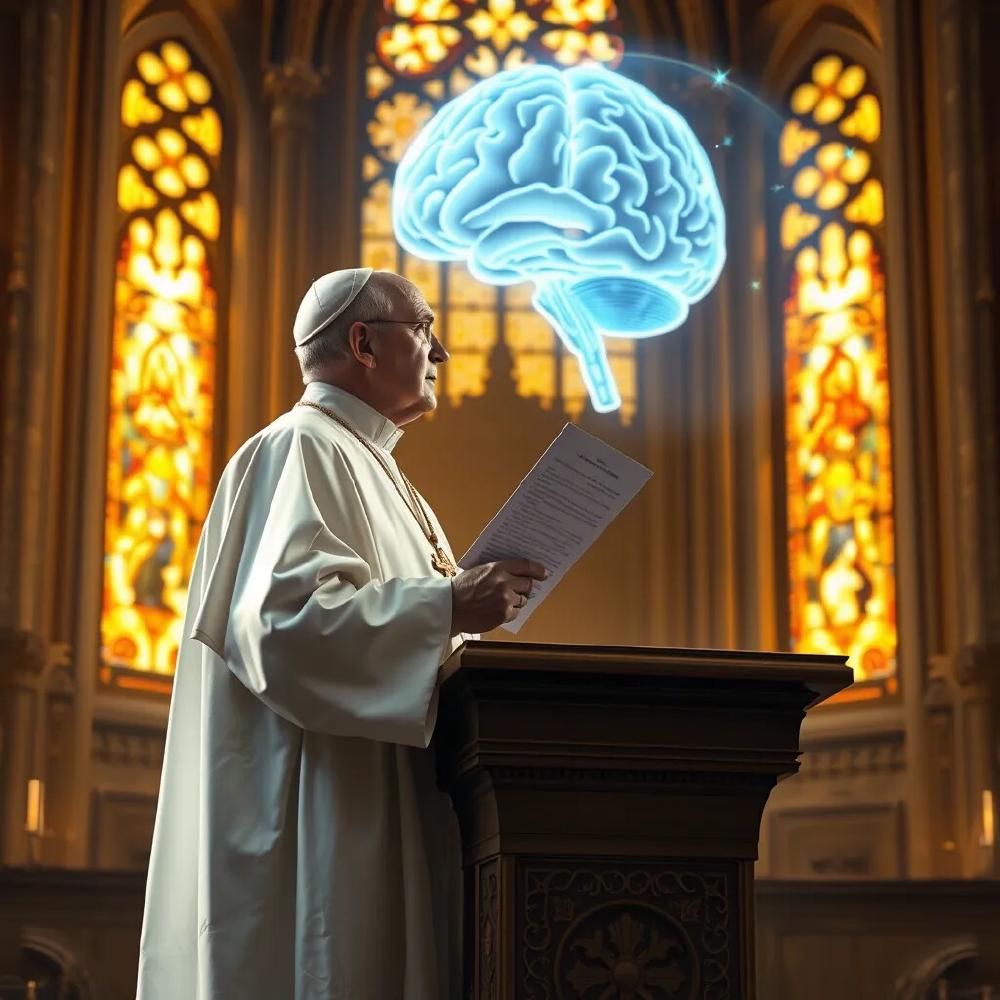
Pope Leo XIV has told priests to put down the chatbots and pick up their pens. In a closed-door meeting with clergy from the Diocese of Rome on February 19, the Pope urged priests to "use our brains more and not artificial intelligence to prepare homilies" - a direct acknowledgment that AI-written sermons have become common enough to warrant intervention from the top of the Catholic Church.
TL;DR
- Pope Leo XIV told Roman clergy to stop using AI to write homilies during a private Q&A session at the Vatican's Paul VI Hall
- He argued that the brain "needs to be used" like any muscle, and that AI "will never be able to share faith"
- The remarks are pastoral guidance, not a formal decree - but carry significant moral weight
- The Vatican simultaneously announced an AI translation system for Mass at St. Peter's Basilica, drawing irony from observers
- Surveys show 64% of preachers now use AI for sermon preparation in some form
What the Pope Said
The February 19 session lasted about 45 minutes. Cardinal Baldo Reina, Rome's vicar general, and four priests representing different age groups joined the Pope for a question-and-answer dialogue that covered prayer life, priestly fraternity, ministry to young people, and technology.
The AI remarks were pointed. Pope Leo framed the problem in two ways.
First, intellectual atrophy. "Like all the muscles in the body, if we do not use them, if we do not move them, they die," he said. "The brain needs to be used, so our intelligence must also be exercised a little so as not to lose this capacity."
Second, the nature of preaching itself. "To give a true homily is to share faith," he said, and artificial intelligence "will never be able to share faith." The distinction he drew was between information delivery - something algorithms handle well - and personal witness, which they cannot.
"If we can offer a service that is inculturated in the place, in the parish where we are working... People want to see your faith, your experience," he added.
The Pope also took aim at clergy chasing social media engagement, calling it "an illusion on the internet, on TikTok" to believe that gathering likes and followers constitutes authentic ministry. "It is not you: if we are not transmitting the message of Jesus Christ, perhaps we are mistaken."
Guidance, Not a Ban
This was not an encyclical, an apostolic exhortation, or a formal decree. It was pastoral counsel delivered in a private meeting, later published in full by Vatican News on February 20. Priests are not formally prohibited from using AI tools. The Pope is making a strong personal appeal about discernment in ministry - which, given who is making it, carries considerable weight.
The distinction matters. Prewritten homily services have existed for decades - FAITH Catholic has been selling sermon aids since 1969, and sites like ePriest.com offer similar resources. The Pope's objection targets AI's impersonal nature specifically, not the use of external resources in general. The difference between consulting a commentary and having ChatGPT write your entire sermon is, in his framing, the difference between preparation and abdication.
The Vatican's AI Contradiction
The timing created some awkward optics. On the same day as the Pope's meeting with clergy, the Vatican announced "Lara" - an AI translation system developed by Translated and Carnegie-AI LLC that will translate liturgical celebrations at St. Peter's Basilica into up to 60 languages in real time via QR code.
So the Vatican is deploying AI to translate the Mass while the Pope tells priests not to use AI to prepare it. The apparent contradiction dissolves under closer examination - translation is a mechanical task that preserves human-authored content, while homily writing is the creative and spiritual act the Pope wants to protect - but the juxtaposition gave headline writers an easy angle.
A Pope Who Chose His Name Because of AI
Pope Leo XIV has been threading this needle since day one. When he took the name Leo in May 2025, he told the College of Cardinals he did so because of Pope Leo XIII, whose 1891 encyclical Rerum Novarum addressed the social upheaval of the first industrial revolution. "In our own day, the church offers everyone the treasury of its social teaching in response to another industrial revolution and to developments in the field of artificial intelligence," he said.
Since then, he has maintained a consistent position: AI should serve human dignity, not replace human judgment. In a December 2025 address, he warned that "the ability to access vast amounts of data and information should not be confused with the ability to derive meaning and value from it." He told the Builders AI Forum that AI should support the Church's mission of evangelization - but as a tool, not a substitute.
Reports indicate the Vatican is preparing what may be Pope Leo's first encyclical, possibly titled Magnifica Humanitas, focused on AI from the perspective of Catholic social doctrine. Cardinal Victor Manuel Fernandez, prefect of the Dicastery for the Doctrine of the Faith, is coordinating the review.
The Numbers Say Priests Are Already Using AI
The Pope's remarks aren't hypothetical. According to a survey by Exponential, 64% of preachers now say they use AI for sermon preparation in some form - a nearly 20-point increase in one year. A Barna Group survey found 12% of senior Protestant clergy are comfortable using AI to write sermons outright, while 43% acknowledged its merits for preparation and research.
The practice extends beyond Christianity. Rabbi Josh Fixler of Congregation Emanu El in Houston had an AI chatbot trained on his old sermons generate and deliver one in a synthetic version of his voice. Rabbi Daniel Bogard of Central Reform Synagogue in St. Louis teaches other rabbis AI usage, comparing it to chavrutah - the Talmudic study practice of partners debating texts together.
Not everyone is on board. Brad East, a theology professor at Abilene Christian University, has argued that "AI has no place in the pulpit" and that "the drudgery is part of the point" of sermon preparation. Paul Hoffman of Evangelical Friends Church in Rhode Island asks the question that cuts closest to Pope Leo's argument: "Does AI know the stories of your people?"
What This Means
Pope Leo is making a philosophical argument, not a technical one. He is not saying AI is bad. He is saying that certain human activities - preaching, witnessing, sharing lived faith - lose their meaning when outsourced to machines. The brain-as-muscle metaphor is practical: stop thinking and you stop being able to think. The faith-sharing argument is theological: a congregation wants to hear their priest's understanding of the Gospel, not a statistical summary of what other priests have said about it.
Whether this slows adoption is another question. The 64% usage figure suggests the horse has already left the stable. And the Pope's guidance, however authoritative morally, lacks the force of canon law. Priests who find AI useful for research, structure, or overcoming writer's block are unlikely to stop because of a private Q&A session - even one with the Bishop of Rome.
But the signal matters. The leader of the world's 1.4 billion Catholics just told his clergy that the point of a sermon is the human being delivering it. In an industry racing to automate everything that can be automated, that is a rare and deliberate line in the sand.
Sources:
- Pope Leo XIV tells priests not to use AI to write homilies or seek likes on TikTok - Catholic Review
- Pope Leo XIV to priests: no to homilies with Artificial Intelligence - ZENIT
- Pope Implores Priests to Stop Writing Sermons Using ChatGPT - Futurism
- Pope Leo: Don't Use AI to Write Homilies, Use Your Brain - EWTN Vatican
- Pope Leo XIV tells priests not to use AI to write homilies - OSV News
- How Pope Leo's Name Carries a Warning About the Rise of AI - TIME
- Vatican will use AI to translate Mass in 60 languages at St. Peter's Basilica - Euronews
Last updated

