
Perplexity Hits $450M ARR After Agents Pivot
Perplexity's annual recurring revenue crossed $450M in March after a 50% single-month jump driven by its Computer agent platform - not search.
 6 min read
Perplexity finished March 2026 with annual recurring revenue above $450 million - up 50% in a single month. That number, first reported by the Financial Times, is the clearest signal yet that the company's bet on AI agents is paying off faster than most observers expected.
The driver isn't search. It's Computer, the orchestration platform Perplexity launched to Max subscribers in late February, which routes work across up to 19 AI models from OpenAI, Anthropic, and Google to complete multi-step workflows for users.
TL;DR
- Perplexity ARR crossed $450M in March 2026, up 50% in one month
- Computer, the $200/month agent platform, is the primary growth engine
- ARR grew from $100M in March 2025 to $450M in 12 months
- Internal target: $656M ARR by end of 2026
- Company still dwarfed by Cursor ($2B ARR) and Anthropic ($30B run rate)
The Numbers
The ARR trajectory tells the story more clearly than any product announcement.
| Period | ARR |
|---|---|
| Early 2024 | ~$10M |
| March 2025 | ~$100M |
| Mid-2025 | ~$148M |
| End 2025 | ~$232M |
| March 2026 | $450M+ |
A jump from $232M to $450M in roughly three months - most of it concentrated in March - is not the kind of growth that comes from a search business. Subscription search revenue is fairly stable. Agent usage, especially usage-based billing, spikes when enterprises actually deploy the product.
Perplexity's Max plan costs $200 per month. Users get a credits allowance and then pay near-direct model costs above that threshold, with no markup. That structure lets the company capture revenue proportional to actual usage rather than capping it at a flat fee.
"When you build a team, you don't build a homogenous group where everyone has the same skills. You build a team with diverse strengths. We're applying that same logic to AI workflows. The orchestration is the product."
- Aravind Srinivas, CEO of Perplexity
The orchestration framing matters. Perplexity doesn't compete with OpenAI or Anthropic on model quality. It positions itself as the layer above the models - the system that decides which model runs which part of a workflow, manages state across multi-step tasks, and handles the interface between those models and real business applications.
From Google Challenger to Operator
Perplexity spent its first three years being described as a Google rival. That framing was always more convenient for headlines than accurate for the business. Its core product was AI-powered search with citations - useful, but not a structural threat to Google's ad-supported search monopoly.
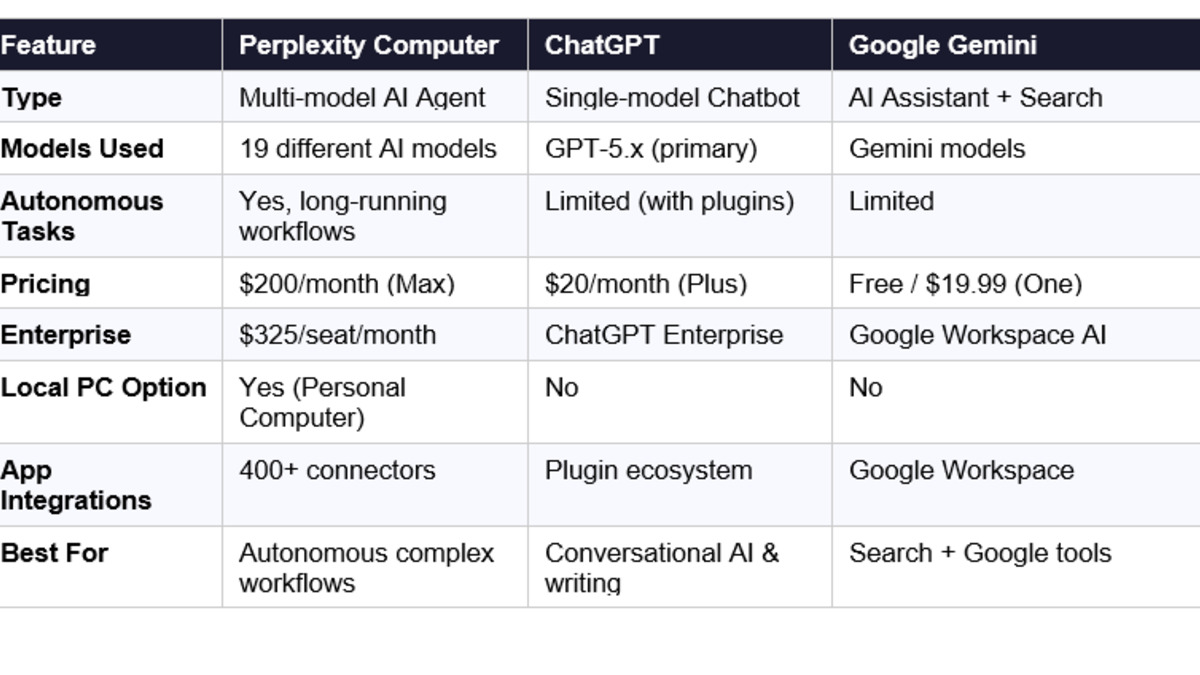 A comparison of Perplexity Computer against competing agent platforms, highlighting its multi-model orchestration approach.
Source: buildfastwithai.com
A comparison of Perplexity Computer against competing agent platforms, highlighting its multi-model orchestration approach.
Source: buildfastwithai.com
The Computer pivot changed the category entirely. Rather than competing for search queries, Perplexity now competes for enterprise workflow budgets. One internal test the company cited showed a single Computer deployment replacing a $225,000 annual marketing stack over a weekend.
That's not a search story. That's a labor substitution story, and the economics are completely different. A company that saves $225K on a tool it pays $2,400 per year for doesn't need to be convinced. The ROI calculation sells itself.
Perplexity now orchestrates 19 different AI models for different tasks within the same workflow: Anthropic's Opus for core reasoning, Gemini for deep research sub-agents, Grok for speed in lightweight tasks. The pivot to an agent-first model was announced in February. The revenue spike that followed in March suggests enterprise adoption moved faster than the market anticipated.
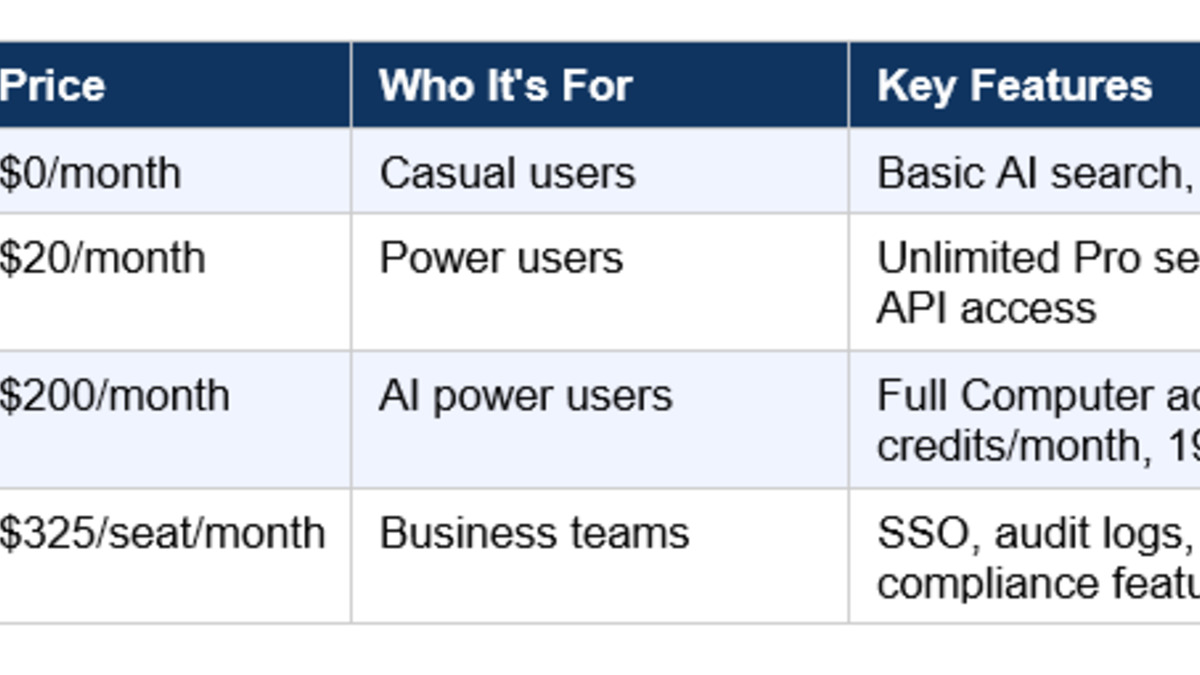 Perplexity's usage-based pricing tiers, with the Max plan at $200/month driving the bulk of new agent revenue.
Source: buildfastwithai.com
Perplexity's usage-based pricing tiers, with the Max plan at $200/month driving the bulk of new agent revenue.
Source: buildfastwithai.com
The company also launched a tax filing agent in March, which connects directly to current IRS materials rather than relying on training data cutoffs. Small deployments like that accumulate. Across 100 million monthly active users, even a fraction converting to high-value agent use cases adds up fast.
The Counter-Argument
A $450M run rate sounds strong. Measured against where AI revenue has gone in 2026, it's a modest number.
| Company | Revenue Run Rate |
|---|---|
| Perplexity | $450M ARR |
| Cursor | $2B ARR |
| Anthropic | $30B run rate |
| OpenAI | ~$24B annual revenue |
Cursor - a coding assistant with a narrower product footprint - is running at more than four times Perplexity's ARR. Anthropic, which Perplexity's Computer relies on for Opus, is at $30 billion. OpenAI, another provider in the Computer orchestration stack, reported roughly $24 billion in annualized revenue.
The dependency structure is also worth scrutiny. Perplexity's agent platform routes work to models it doesn't own, pays costs set by providers it doesn't control, and builds workflow logic on top of APIs that could be restricted, repriced, or rate-limited at any time. Anthropic's own managed agents platform launched recently with overlapping positioning. OpenAI has Responses API and Assistants. Microsoft has Copilot. Every foundation model lab is now moving into the orchestration layer.
Perplexity's answer is that these companies are bad at building products and good at building models. That may be true - but it's a bet on a permanent skill divide that doesn't stay permanent forever.
What the Market Is Missing
The search-versus-agents framing is useful for analysts but misses what's actually happening in Perplexity's revenue composition. The $450M figure includes both the old subscription search business and the new agent tiers. The search base is probably growing slowly; the agent layer is almost certainly what drove the March spike.
If Computer's revenue compounds at anything close to the rate that March suggests, the internal $656M ARR target for end of 2026 is achievable. Gartner projects 40% of enterprise applications will include task-specific agents by end of this year. Perplexity is already in that market with a working product, paying customers, and infrastructure that routes across every major model provider.
The risk isn't that the agents story is wrong. The risk is that orchestration becomes a commodity. If Google, Anthropic, and OpenAI each build orchestration layers that work as well as Perplexity's - and bundle them with their own models - the independent orchestrator position gets squeezed. Perplexity needs the product layer to compound its moat faster than the model providers can close the product gap.
March 2026 suggests the company has more runway than the headline search narrative implied. Whether that's enough depends on how fast the competition moves.
Sources:
- Perplexity's Shift to AI Agents Boosts Revenue 50% - PYMNTS
- Perplexity revenue surges 50% as AI startup shifts from search to autonomous AI agents - Tech Startups
- Perplexity Tops $450M ARR After Record-Breaking Month - TechStory
- Perplexity Revenue Jumps 50% to $450M as It Pivots to AI Agents - Techloy
- What Is Perplexity Computer? The 2026 AI Agent Explained - Build Fast With AI

